Anatomy of a Highly Rated Token
In this Spotlight, we examine Meteora’s MET token, which earned a AAA letter grade and an overall score of 60.2, placing it second in our database.
Forgd
MET
UNI
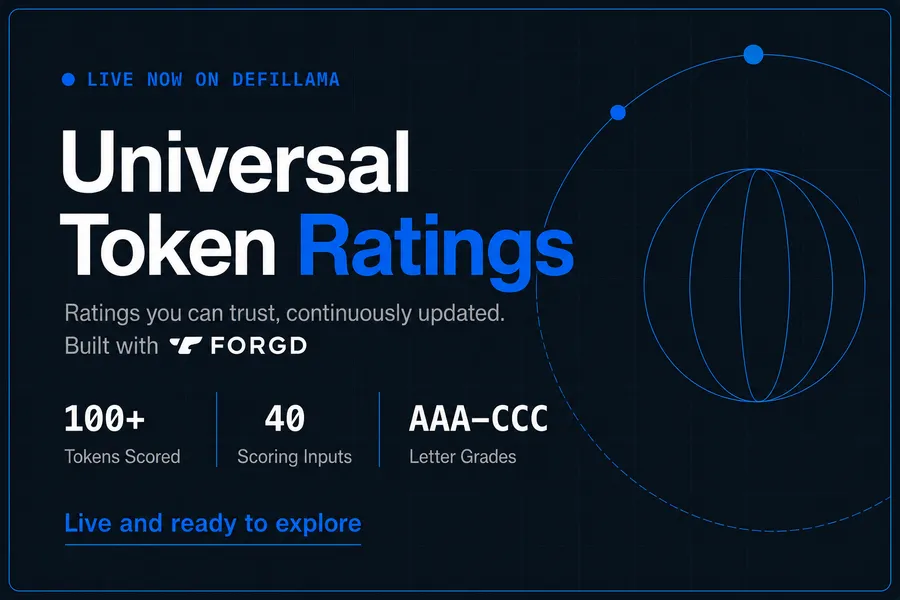
Three weeks have passed since we released Universal Token Ratings. The UTR, built in partnership with Forgd, is meant to give investors a simple way to evaluate tokens in real-time, with up-to-the-minute data.
So far, 168 tokens have been scored by the UTR. Scores range from an abysmal 5.6 out of 100 to 61.5. Tokens are also given a familiar, Moody’s-style letter grade. As of Tuesday, 26 tokens earned a CCC. Only two tokens earned a AAA.
But the UTR isn’t just for investors. It’s also for token issuers. Ideally, it will motivate them to do better, disclose more, and work harder to ensure that their tokens are deeply liquid.
That begs the question: how, exactly, do tokens earn top marks? And what can the issuers of middling tokens do to improve their score?
In this Spotlight, we examine Meteora’s MET token, which earned a AAA letter grade and an overall score of 60.2, placing it second in our database.
To see our earlier reports on the UTR, see here and here.
Meteora: a case study
Tokens are scored on two axes, Disclosure and Performance. Scores for each axis range from 0 to 10, and a token’s overall score is the product of their Disclosure and Performance scores — not an average, and not a percentage. In other words, if a token scores 7 out of 10 on both axes, its overall score is 49 out of 100, not 70.

Each axis is comprised of categories that are further divided into sub-categories. Tokens earn a score between 0 and 10 on 32 separate sub-categories, such as whether token issuers have disclosed the identities of insiders or published their vesting schedules. Performance-related sub-categories consider a token’s volume, bid/ask spreads, recent price performance, open interest, exchange coverage, market capitalization, and more.
Here’s the key: each sub-category is weighted. The Disclosure axis features 13, but they aren’t created equal. Identifying the people who control relevant multi-signature wallets is worth 10% of a token’s Disclosure score. Transparency regarding market maker engagement, deals with exchanges, and allocations to external parties each count for 9%.
Meteora earned the fourth-highest Disclosure score in the UTR, just edging Uniswap’s UNI token — the only other token to earn a AAA rating. Interestingly, if the overall Disclosure score was the sum of its sub-categories, UNI would have topped Meteora here. But that isn’t how the UTR works. The sub-categories are weighted, and Meteora earned top marks where it mattered.
Consider how each token scored on its disclosure of multi-signature wallets. Meteora scored an 8 out of 10, meaning it had provided the address of a primary treasury wallet, confirmed that it was controlled by a committee of signers, and detailed how many of those signers would need to agree in order to withdraw funds. Meteora had also disclosed partial information about secondary multisig wallets. It did not, however, disclose signers’ roles or identities.
Uniswap, meanwhile, scored a 6 out of 10. That means it had shared the address of a primary wallet and its signer threshold but did not disclose secondary wallets.
Meteora also scored a perfect 10 out of 10 on exchange agreement disclosures. It had disclosed which centralized and decentralized exchanges it was listed on and it disclosed whether any listing fees, token allocations, or incentive arrangements were part of the listing agreement.
Uniswap’s 5 out of 10 in this sub-category means that it had listed its major trading venues but offered no comment on its listing arrangements.
On the Performance axis, Meteora scored highly in four of the five most important sub-categories: top-tier exchange coverage, trade volume as a percentage of market capitalization, order book depth as a percentage of market capitalization, fully-diluted valuation, and the market cap to FDV ratio.
Exchange coverage is the most important, accounting for 15% of a token’s Performance score. Meteora trades on Binance, OKX, Coinbase, and Upbit, and earned a perfect 10 out of 10.
It also earned perfect marks on trade volume and order book depth. Meteora’s token saw $53 million in average daily trade volume over the past month, roughly a quarter of its market capitalization. That put it well above the threshold for a perfect score: trade volume as 10% of market cap.
But it lost points on fully-diluted valuation. The value of all Meteora tokens is just $204 million, earning it a 5 out of 10. Only projects with an FDV over $1 billion earned perfect marks.
How to improve
Our previous research found that Disclosure is the true bottleneck. For three out of every four rated tokens, the Disclosure score is lower than the Performance score. Rated tokens’ mean Disclosure score sits at 4.98 out of 10. Their mean Performance score sits at 6.07.
For most issuers, that means doubling down on transparency is the easiest thing they can do to improve their tokens’ scores.
Let’s take the example of two high-profile tokens with middle-of-the-pack scores: Ethena’s ENA and Lido’s LDO, which earned overall scores of 34 and 32.4, respectively. Both earned BBB ratings.
Their performance scores were exemplary, a testament to their large market capitalizations and interest among crypto traders. They are, after all, governance tokens that give holders a say in the management of multibillion-dollar protocols.
But Ethena is not, as it touts on its website, an example of “unparalleled transparency.” Specifically, it has disclosed little about its core contributors. It earned a 3 out of 10 on the “insider identities’” sub-category. That means that most of the people who built Ethena and who continue to exert outsize influence over it are pseudonymous. Its founder, Guy Young, is well-known in the industry. Beyond that, however, Ethena doesn’t appear to offer a detailed org chart identifying all founders, key developers, and executives.
Lido fares even worse despite its status as the world’s largest crypto protocol. Most of its insiders have been identified (it earned a 7 out of 10 in that sub-category) but its organizational structure is poorly defined (4 out of 10) and it has not divulged insiders’ wallet addresses (2 out of 10). It has shared little information on who controls its treasury wallet (2 out of 10) and it has not disclosed allocations to external parties such as investors, exchanges, or influencers, beyond vague references to the manner in which it raised capital (3 out of 10).
For tokens that want to boost their Performance scores, the task is more daunting: every single founder wants to manufacture investor interest and, in turn, high market capitalization and trade volume. Very few succeed.
Issuers would do best to focus on securing a listing on a top-tier exchange. It is the single most valuable thing an issuer can do to boost its Performance score. Unlike other metrics in the UTR’s Performance axis.