Card Compare dashboard tracks crypto cards’ cashback, fees, and more
The dashboard’s unexpected success suggested people weren’t just seeking information that could help them invest — they also wanted information that could help them choose between myriad crypto applications.
Satoshi Nakamoto subtitled the Bitcoin white paper “A Peer-to-Peer Electronic Cash System.” But most cryptocurrencies have functioned more like tech stocks than cold, hard cash.
Two products are quickly changing crypto from something you HODL into something you spend: stablecoins and crypto-based credit and debit cards.
Stablecoins have been around for years. But cards are just now seeing the kind of explosive growth that suggests crypto may yet embed itself in people’s daily lives, as Satoshi had envisioned.
“We’re seeing [that] stablecoin-linked cards are in hyper-growth-mode,” Cuy Sheffield, Visa’s head of crypto, said on CNBC last month. “There are new issuers coming into our network, launching stablecoin-linked cards every week.”
Since April 2024, money spent using stablecoin cards has grown every month, without fail. In September, people spent a record $1.2 billion in stablecoins using cards, according to paymentscan.xyz. That’s a 203% increase from the same period a year earlier, when people spent just $403 million.
Transactions and addresses both hit all-time highs last month as well. In fact, though addresses appeared to have plateaued in March, they began rising again in August. Each of the past five weeks saw record highs.

As more and more people flock to these cards, they’ll need a way to decide which ones fit their lifestyle and budget. They’re in luck.
DefiLlama’s latest tool, Card Compare, makes it easy to figure out which crypto cards are available in a given country and how those cards stack up.
Consolidating far-flung information
Card Compare has its origins in the MiCA dashboard that launched earlier this year, according to Patrick Scott, DefiLlama’s chief revenue officer. The dashboard’s unexpected success suggested people weren’t just seeking information that could help them invest — they also wanted information that could help them choose between myriad crypto applications.
That insight led to the development of Find my Exchange, released September 15, and Card Compare, which followed on September 30.
The availability, fees, rewards, and features of crypto cards vary widely between providers and countries. Worse yet, that information is scattered among providers’ websites. Transferring an entire stablecoin balance into fiat and using a standard credit or debit card is far easier than scouring dozens of websites to find and apply for the perfect crypto-based card.
Fees, perks, and more
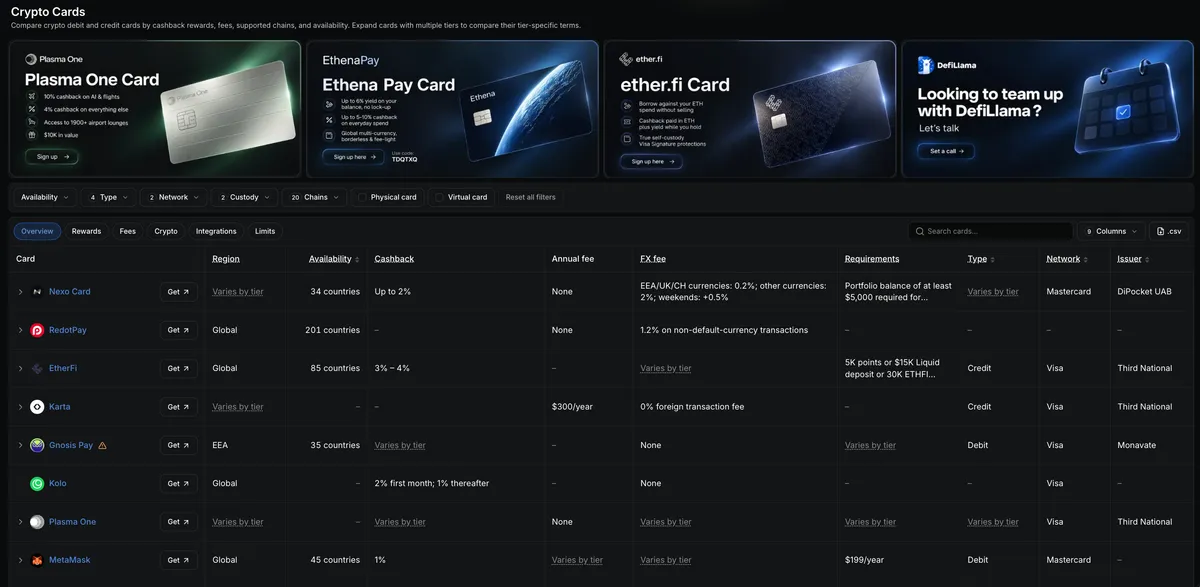
Card Compare lets users discover and compare crypto cards in one place.
The dashboard includes cards’ issuers, the regions in which they’re available, the cash back they offer, the annual fees they charge, their foreign exchange fees, and their requirements. It also tracks the perks that cards offer, such as airport lounge access; the ATM fees they charge; the cryptocurrencies they let users spend; their integrations with Apple and Google Pay; and spending limits.
Providers that want their card to stand out can become sponsors; their cards are featured above the dashboard, allowing providers to display the cards’ key features.
Take Plasma, one of our featured partners. Its spotlight at the top of the Card Compare page highlights their Platinum card’s 10% cashback on AI and flights and 4% cashback on all other purchases.
The Plasma Platinum card is, of course, in the Card Compare database itself. The tool notes the card belongs to the Visa network, is issued by Third National Bank, and comes in two versions: a US-available credit card and a globally available spend card. Both feature no foreign exchange markup from Plasma, though Visa foreign exchange fees may apply. Both require that users lock 100,000 XPL for a 12-month period.
Despite the growing popularity of crypto-based cards, DefiLlama developers found some red flags as they built the Card Compare. For example, they found some companies’ cashback claims misleading.
“Up to 12%” often hides tiny base rates, caps, token requirements, and FX fees that can erase rewards,” one said.
Another found the process frustrating — with a caveat.
“I couldn't sign up for anything, [a popular card] gave my data to a fake government authority, it was really tough to find accurate details, sometimes separate docs would conflict,” they said. “I will say for the right user, the setup is pretty seamless — someone in an allowed location can get fully signed up with a ready-to-go card in a few mins.”
To learn more about crypto cards, their regional availability, cashback, fees, requirements, and much more, visit Card Compare today. To become a featured partner, contact us at [email protected].