A Rating You Have to Keep Earning: Forgd and DefiLlama Introduce Universal Token Ratings
DefiLlama has teamed up with Forgd to launch the industry’s first continuously updated metric for scoring token disclosure and performance: Universal Token Ratings (UTR). We’ve intentionally designed the system so that a high rating is difficult to earn, and even harder to keep.
Forgd
Crypto has never had a shortage of badges. There are audit stamps, transparency checklists, self-reported scorecards, and way too many superlatives. The industry has produced plenty of ways for projects to signal credibility. But many of these signals are deeply flawed. The industry needs a trusted, go-to metric to measure credibility. One that's verifiable and hard to game.
That’s what we’re launching today.
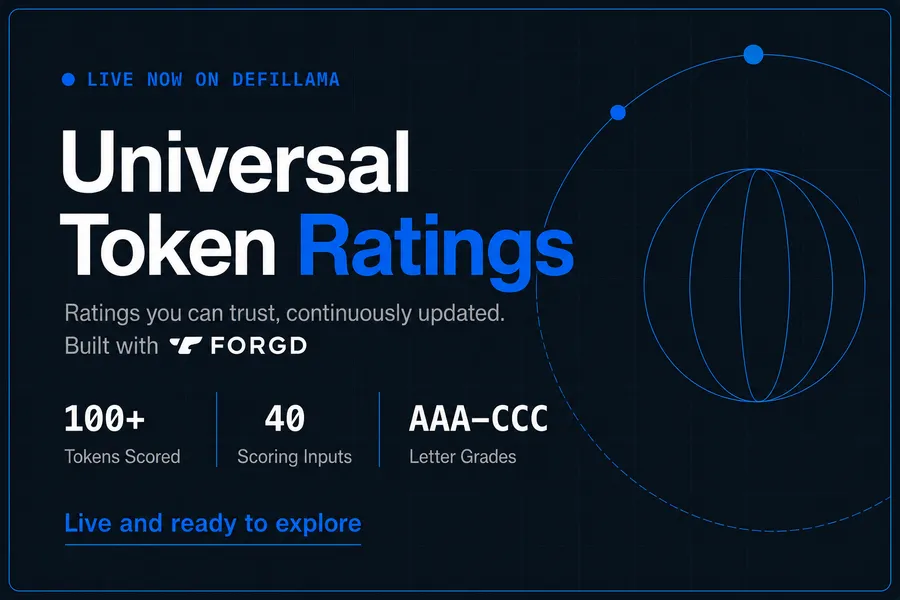
DefiLlama has teamed up with Forgd to launch the industry’s first continuously updated metric for scoring token disclosure and performance: Universal Token Ratings (UTR). We’ve intentionally designed the system so that a high rating is difficult to earn, and even harder to keep.
Every rated project gets a standardized 0–100 score and a familiar AAA–CCC letter grade. Both recalculate as the market moves. If liquidity dries up, a new batch of tokens unlock, or a market maker falters under stress, the score will update automatically, without any human oversight required.
Why UTR was built
DefiLlama exists to surface honest, unbiased data. For years, that has meant tracking what's verifiable: TVL, volumes, fees, unlocks, and other onchain analytics.
There is often a gap between what projects say and the realities of the market. A project can publish a beautiful tokenomics page and still trade with paper-thin liquidity. It can disclose a market maker engagement, but quickly let it lapse. Static transparency initiatives can't catch this, because they don’t continuously monitor the tokens they have rated.

Universal Token Ratings close that gap by design. The methodology is built on two independently scored axes, each graded 0–10:
The Disclosure Axis (D) measures what a project reports about itself — team, tokenomics and vesting, legal and treasury structure, and service provider engagements including market makers, auditors, and exchanges.
The Performance Axis (P) measures whether live market behavior actually supports these claims by tracking liquidity depth, bid-ask spreads, volume, exchange coverage, derivatives conditions, market maker adherence, and on-chain tokenomics delivery.
The final score is deliberately multiplicative: UTR = D × P.
A project with perfect disclosures and a broken market can't score well. Neither can a project with deep liquidity, but missing disclosure statements. Only projects strong on both dimensions can earn top grades. Verified on-chain events like token unlocks, new listings, and changed market maker mandates flow straight into the score with no refiling and no human in the loop.
The incentive shift
Here's the part we care about most: how this rating will influence behavior across the industry.
When a rating is a one-time exercise, the rational strategy for token projects is to optimize for that audit — pass the review, frame the badge, and never worry about it again. Nothing about that structure rewards staying transparent or keeping markets healthy.
A continuous rating flips the incentive. When a token’s grade can deteriorate in near-real-time, transparency stops being a launch-week deliverable and becomes an operating principle. Projects are rewarded for maintaining liquidity, honoring vesting schedules on-chain, keeping market maker engagements active, and refreshing disclosures as facts change. Otherwise their stellar AAA-rating will drift toward CCC, and investors will quickly abandon the project.
As Shane Molidor, Founder and CEO of Forgd, puts it: “Crypto has had transparency checklists, but never a continuously updated rating system. A UTR score is something you have to keep earning.”
That's the kind of accountability institutional capital and regulators have been asking digital assets to develop. The industry needs something that functions more like a bond rating than a badge.
Where the data comes from
The Performance Axis is powered by our data partnerships with Forgd, alongside Forgd's proprietary market maker monitoring infrastructure, which tracks live engagements across more than 500 token projects and 35 market-making firms. This builds on a partnership that started earlier this year with the integration of Forgd's market maker leaderboard on DefiLlama.
The full UTR methodology — every category weight, scoring rubric, and grading threshold — is published openly. If you want to know exactly why a project scored what it scored, you can trace it.
What you'll find at launch
Starting today, you can explore ratings for 100+ tokens directly on DefiLlama, with the ability to:
Track newly launched tokens from day one
Filter by valuation, sector, and exchange listing tier
And drill into full category-level breakdowns showing exactly where a project is strongest, and where the gaps are
The bigger picture
Ratings calculated from live market data are a natural extension of what DefiLlama has always done: give millions of users, researchers, and journalists a neutral, free, open source of truth. Universal Token Ratings take that a step further, drawing a line from a project’s disclosures and public statements to their measurable market performance.
We think the projects doing things right will welcome this. A market where credibility is continuously verified is a market where transparency confers a durable competitive advantage.
Explore Universal Token Ratings on DeFiLlama and learn how the scoring works.