Ethena's Expansion Playbook: Payments, Basis Trading, and Wall Street's ENA Bet
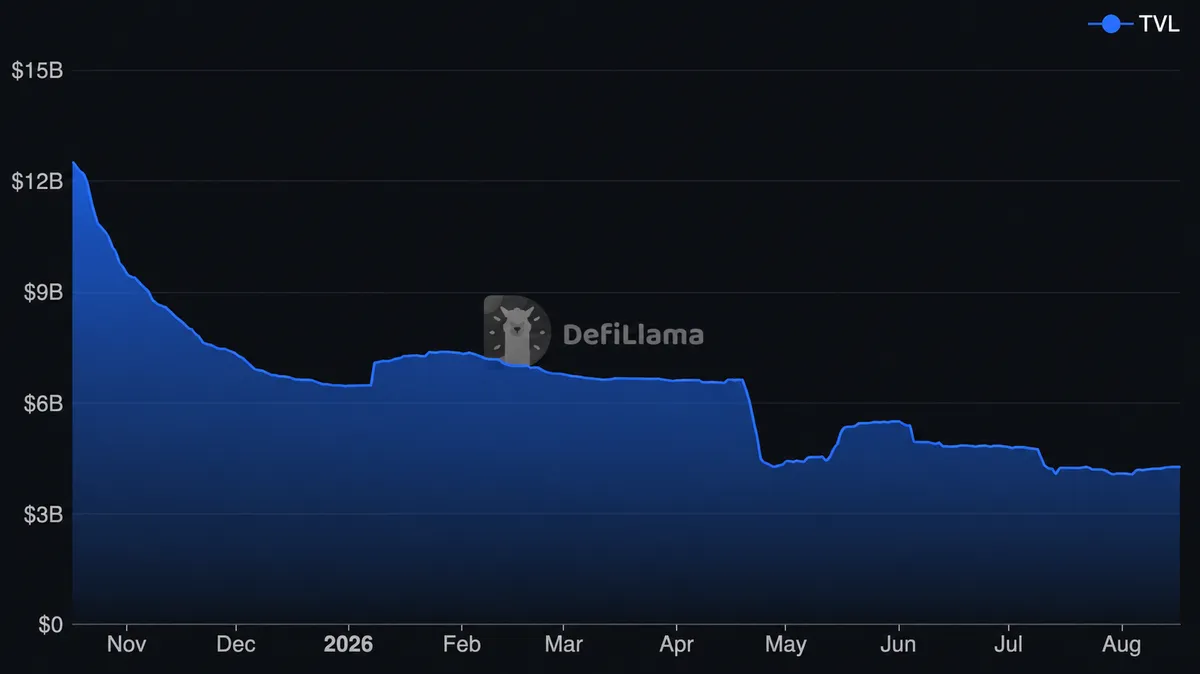
Ethena's total value locked stands at $5.33 billion today, up 18.2% over the past 30 days but down roughly 63% from the $14.5–15 billion it held a year ago. Over the full year, the picture is a sharp contraction followed by a partial recovery.
SUSDE
USDE
USDTB
Introduction
Ethena spent much of the past year proving that a synthetic dollar backed by a derivatives trade can scale. This year it has started proving something else: that the same delta-neutral playbook can be applied to almost any market with a funding rate to earn. That expansion has taken three forms. Ethena pushed USDe into consumer payments and everyday banking. Its Risk Committee approved, and then launched, a version of the core basis trade built on tokenized US stocks rather than crypto. And a public company, StablecoinX Inc., has become one of the largest holders of ENA, with close to a third of the token's total supply on its balance sheet.
That expansion is happening against a mixed backdrop. Ethena's total value locked stands at $5.33 billion today, up 18.2% over the past 30 days but down roughly 63% from the $14.5–15 billion it held a year ago. The 30-day gain is a rebound from an August low near $4.08 billion, not the start of a new growth trend. Over the full year, the picture is a sharp contraction followed by a partial recovery.
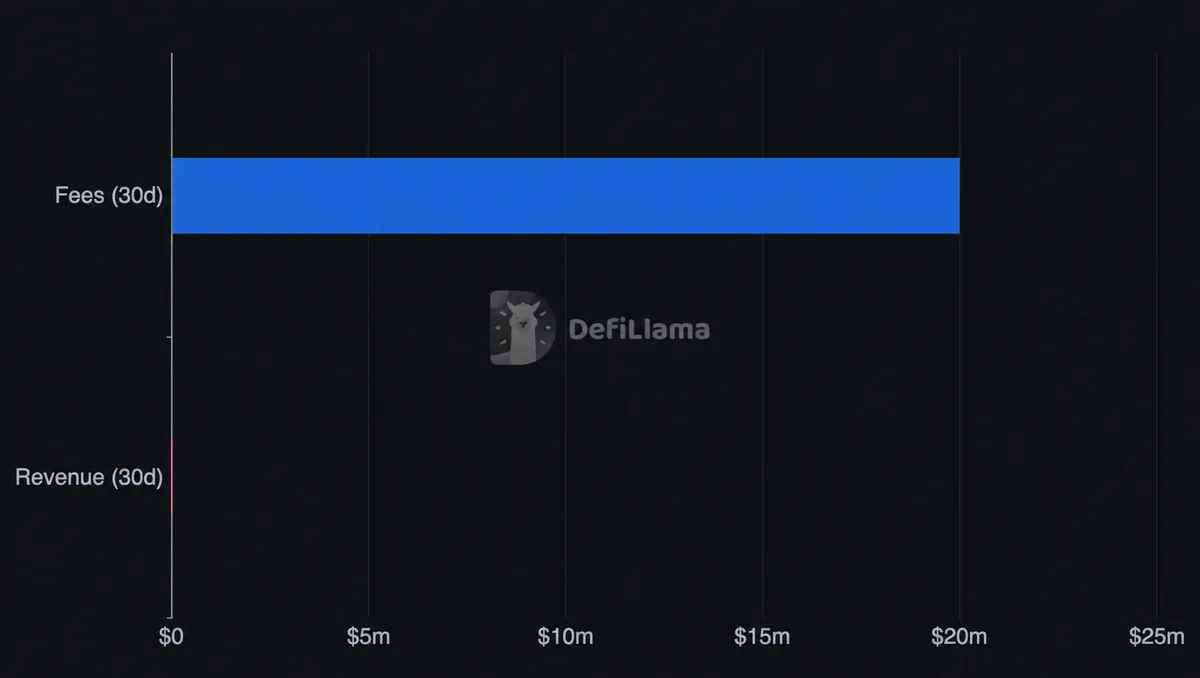
The more important number sits underneath that TVL. Over the past 30 days, Ethena's basis trade generated $20.1 million in fees, but only $16,141 of that was kept as protocol revenue. That's a split of roughly 1,250 to 1 in favor of USDe holders and stakers over the protocol itself.
That gap frames everything that follows. Ethena shrank sharply, is now recovering, and has so far chosen to pass almost all of its yield to holders rather than keep it, just as it extends the same trade into new markets. It's also the backdrop for Ethena's recent fee switch vote. This piece works through each part of that expansion in turn: how the core trade works, where it's being extended, the governance question over who captures the upside, and the public company that has turned ENA into a Wall Street position.

The Core Engine: USDe and Basis Trading
How it works
Ethena USDe is backed by a delta-neutral trade rather than cash reserves or crypto loans. Ethena holds crypto collateral such as BTC, ETH and SOL, and at the same time opens an equal short position in the matching perpetual futures market. The two positions cancel out price risk: if the collateral rises in price, the short loses money, but the gain on the collateral offsets it, and the reverse is also true. What's left is the funding rate, the regular payment that traders on one side of a perp market pay the other to keep the perp price close to the spot price. When markets are bullish or neutral, funding is usually positive, meaning shorts like Ethena get paid. That payment is what funds USDe's yield, and it's the same mechanism Ethena is now taking into new asset classes.
Where the TVL sits
Ethena's $5.33 billion in TVL is split across three products, each doing a different job.
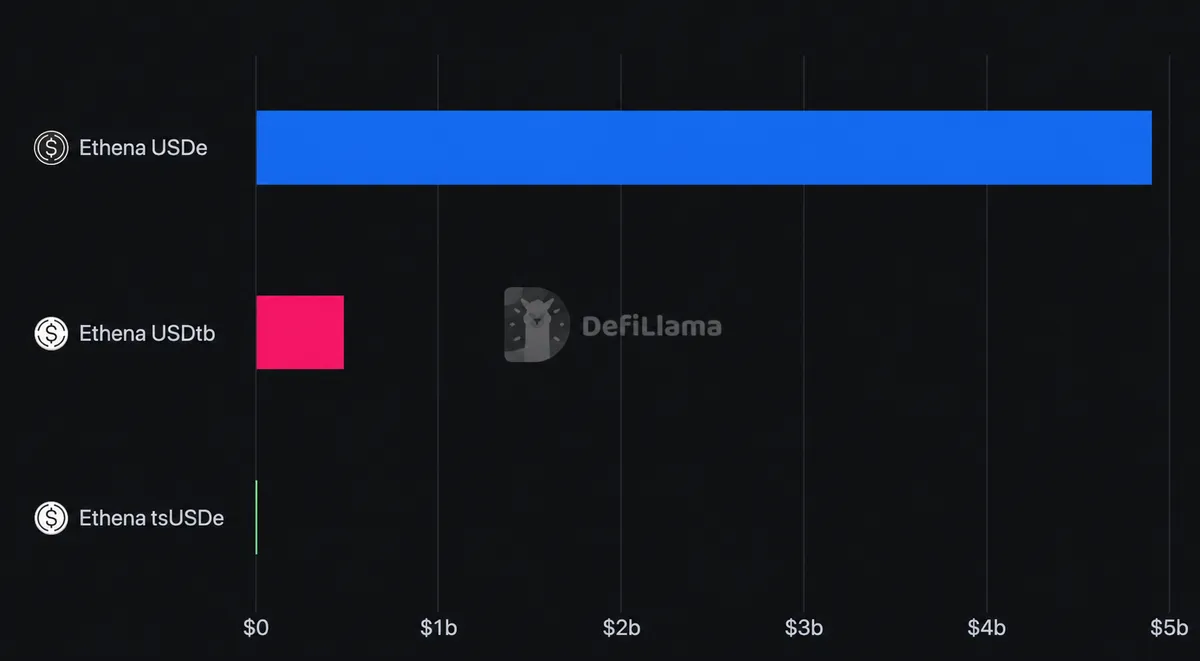
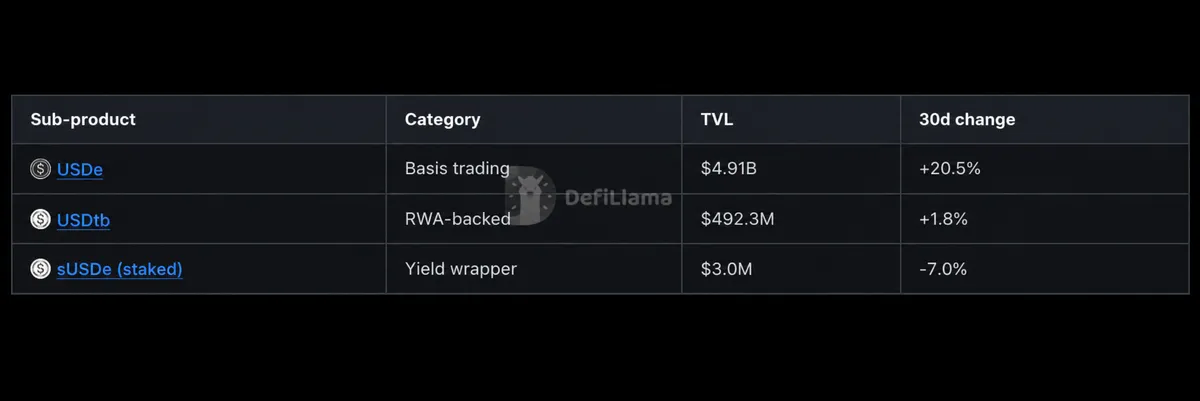
USDe, the core basis-trading product, makes up about 92% of total TVL and accounts for nearly all of the recent growth. Ethena USDtb, which is backed by tokenized real-world assets and offers lower yield for lower risk, is growing much more slowly. A smaller yield wrapper, tsUSDe, is tiny by comparison and shrinking. In other words, almost all of Ethena's growth is flowing through the same basis trade it's now extending into stocks. The TVL base isn't diversified; it's concentrated in the highest-yielding, highest-risk part of the product line.
Where the yield goes
Over the past 30 days, Ethena's tracked fees came to $20.1 million while protocol revenue was just $16,141. "Fees" here means the full yield the basis trade generates, almost all of which is passed straight to USDe holders and sUSDe stakers. "Revenue" is the small slice the protocol keeps after that. Put simply, Ethena today works more like a yield-distribution engine for its users than a business that earns fees for itself.
That split shows up clearly in valuation. Ethena's price-to-fees ratio is a reasonable 10.4x, but its price-to-revenue ratio is roughly 13,000x. That extreme figure reflects how little revenue the protocol keeps, not necessarily that the token is overvalued. It's also exactly the gap the ENA fee switch proposal, covered below, is meant to address.
New Bets and Latest Proposals
Ethena Pay
Ethena Pay is a self-custodial "neobank" app, a dedicated consumer product rather than a payments feature added onto USDe. It launched in beta on September 1, 2026, using Avalanche as its only settlement network, with an initial rollout across about 48 countries and 400 early-access users, expanding weekly through the month. The app combines savings of up to 6% APY on USDe balances, a card with cashback paid in AVAX (4% on the standard tier, up to 5% on higher tiers), free international transfers and fiat on-ramps in multiple currencies, all inside one self-custodial wallet. The US and EU are excluded from launch while regulatory approval is pending. Ethena Pay Ltd. is incorporated in Malta and says it doesn't hold customer funds; fiat payments run through licensed banking partners, and users keep control of their wallet keys. With the product still in beta, there's no public data yet on adoption or transaction volume, so for now it's a development to watch rather than one we can measure.
Equity basis
Ethena's Risk Committee approved a framework for running the core basis trade on tokenized US stocks: buy a tokenized stock, short the matching stock perpetual, and earn the funding between the two. The trade is live, not just proposed. Binance is the first venue, using its bStocks tokenized-stock product (reported at over $610 million in value, per Token Terminal data cited in coverage) as the long side, hedged with Binance's USDT-settled stock perpetuals.
According to figures Ethena has shared with the press, which we haven't independently verified, the equity basis has averaged about 3.56% annualized over the past six months, and open interest on Binance's stock perpetuals (around $2.9 billion) has grown at roughly 105% per month through 2026. Founder Guy Young called it the most significant expansion of USDe's funding mechanism since launch, pointing to the size of global equity markets as the real opportunity rather than the initial trade size.
Binance has also lowered the auto-deleveraging priority for eligible delta-neutral accounts, including Ethena's. That matters: if one side of a hedged position is forcibly closed during a volatile move while the other stays open, the trade is suddenly exposed to the price risk it was designed to remove. The equity basis gives USDe a second source of yield that should behave differently across market cycles, though for now it's a single trade on a single venue, running alongside the crypto basis trade rather than replacing it.
Converge: the bet that stalled
Not every Ethena initiative has shipped on schedule. Converge, announced in March 2025 as a joint settlement chain with tokenization firm Securitize, was designed as a settlement layer for traditional finance and real-world assets. It would use USDe and USDtb as gas tokens, rely on ENA-staked validators for security, and run on Arbitrum technology with Celestia for data availability. Mainnet was targeted for Q2 2025. It reportedly missed that timeline, and Ethereal, an Ethena-incubated perpetuals exchange that was meant to settle on Converge, reportedly cancelled its own launch by November 2025 as a result. It's a reminder that Ethena's announcements haven't always matched its delivery.
Governance
The main recent governance item is the ENA fee switch proposal, which ran on Snapshot from August 27 to September 2, 2026, with 88 voters. Its timing lines up directly with the fees-vs-revenue gap covered earlier, since a fee switch is the mechanism through which Ethena could start keeping more of the yield it generates. Beyond that, recent governance activity has mostly been routine, such as the Risk Committee's fifth-term election (August 3–9, 2026, with 71 voters).
The DAT: StablecoinX
Holdings and share of supply
StablecoinX Inc. (Nasdaq: USDE) is the main public-market vehicle for ENA exposure, and its position is one of the largest single-entity token holdings among digital asset treasury companies. It holds 3.03 billion ENA, worth $761.9 million, or about 30% of ENA's total supply. That's a striking concentration for a governance token: nearly a third of Ethena's token sits on one company's balance sheet, held as a long-term treasury position rather than for trading.
Trading below its own ENA, but the gap is closing
StablecoinX's realized mNAV, which compares the company's market value with the value of the crypto it holds, stood at 0.61x as of September 25, 2026. In plain terms, the market values StablecoinX at about 61 cents for every dollar of ENA it owns.
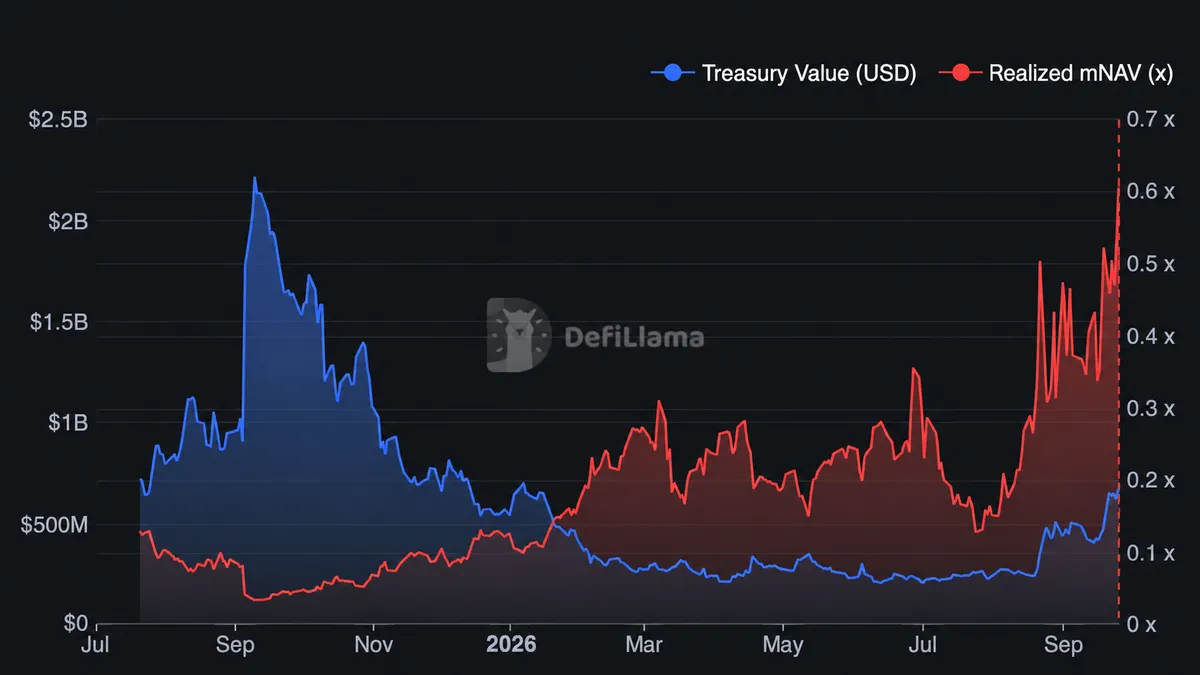
That 0.61x is actually the best level in its tracked history, going back to July 2025. The company's mNAV hit a low of 0.036x in September 2025, meaning it was valued at about 3.6% of its crypto holdings, and spent long stretches through late 2025 and into 2026 between 0.08x and 0.18x before recovering. So the more accurate picture isn't a company stuck at a discount, but one that spent more than a year deeply discounted and is now closing the gap without reaching parity. Even at its best point, the market still values StablecoinX below what its ENA is worth. That could reflect doubts about ENA's price, a discount for tokens that can't be freely traded, or broader skepticism about the treasury-company model itself. The data doesn't tell us which matters most.
Risks
The first risk is funding rates, which now matter on two fronts instead of one. Both the crypto and equity basis trades only earn yield when funding is positive. If funding falls or turns negative in crypto or stock perps, fee generation drops directly, and if both markets turn at the same time, the diversification from adding stocks weakens exactly when it's needed most.
The second is thin protocol revenue. At $16,141 over 30 days against $20.1 million in fees, the protocol keeps almost none of the yield it generates. That's a design choice rather than a temporary lag, and it's what the fee switch vote is about.
The third is a possible cut to token incentives. Ethena reportedly plans to reduce USDe-linked token incentives to zero by the end of September 2026. If confirmed, that would remove a source of demand for USDe just as the protocol is trying to grow through Ethena Pay and new basis-trade venues.
The fourth is concentration. With about 30% of ENA's supply held by StablecoinX alone, any forced selling, redemption pressure or change of strategy at that one company could move ENA's price far more than it would with a wider holder base.
The fifth is the valuation of StablecoinX itself. Its mNAV has recovered from 0.036x to 0.61x, but the market still values it below its own treasury. That's a signal about how investors view treasury companies as a category, and it makes raising more capital through the same vehicle harder.
Finally, there's delivery risk. Converge's stalled timeline shows that not every confidently announced Ethena project ships, which is worth remembering when judging newer bets like Ethena Pay and the equity basis.
Takeaway
Ethena's basis-trading engine is what makes everything else in this piece possible. Over the past year it has been through a sharp contraction, with TVL falling from roughly $14.5–15 billion to a low near $4.08 billion in August, followed by a partial recovery to $5.33 billion today. On top of that recovering base, Ethena is running three expansions at once: a consumer payments app on Avalanche to widen USDe's everyday use, an equity basis trade on Binance that diversifies where USDe's yield comes from, and a public company, StablecoinX, that has made ENA directly investable on Wall Street, even if the market still values that position at a discount.
What ties it all together is one tension that runs through every section: the trade generates real and growing yield, but the protocol keeps almost none of it, passing nearly everything to token holders while pushing into new markets. The fee switch vote is where that tension gets decided, and its outcome is arguably the most important open question in Ethena's current direction, more than the payments app, the equity basis trade or StablecoinX's discount. Converge, meanwhile, is a reminder that Ethena's ambition has at least once run ahead of its delivery, which is worth keeping in mind as its newer bets are judged.