Deep Enough to Trade: Gate’s Case For Tokens And Stocks
Gate has listed the most tokenized equity perpetuals, by far - standing at 385, beyond all the other exchanges. We want to go one layer deeper to diagnose whether a venue can actually support leveraged trading in these instruments at scale.
Gate
BTC
ETH
SOL
XRP
DOGE
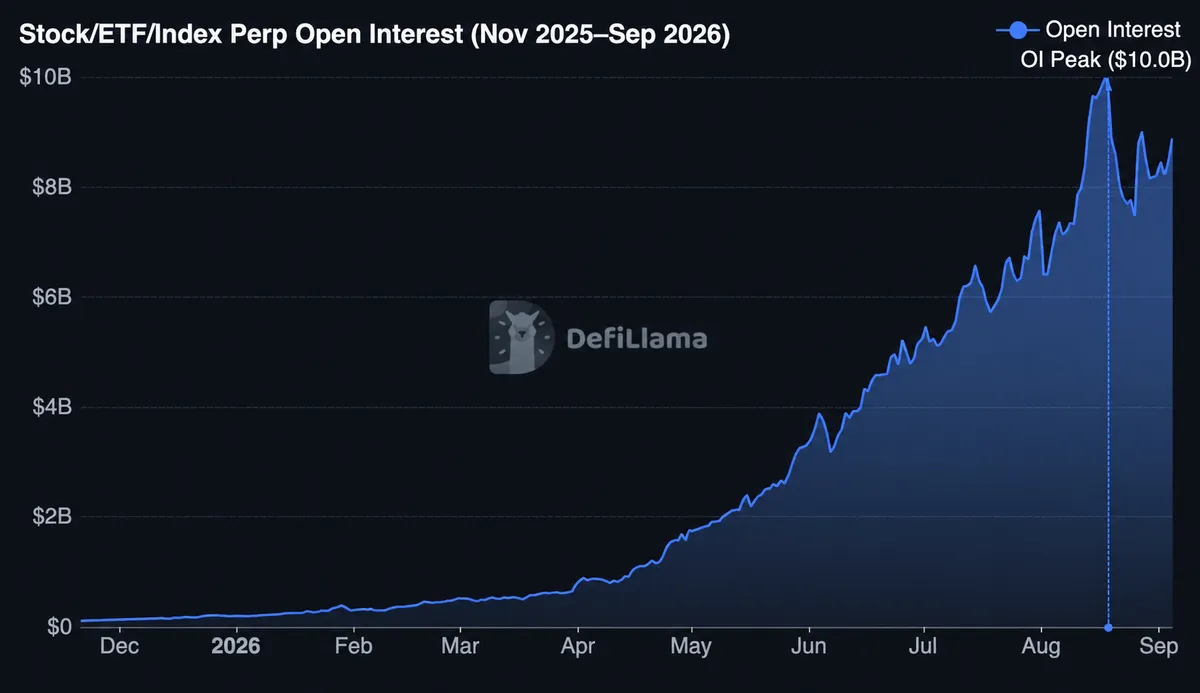
The tokenized-equity conversation over the past year has been one of magnificent growth. Stock, ETF, and equity-index perpetual open interest is up ~78x since DefiLlama first captured reliable tracking in November 2025, from $114M to a peak of $9.99B on August 18, 2026.
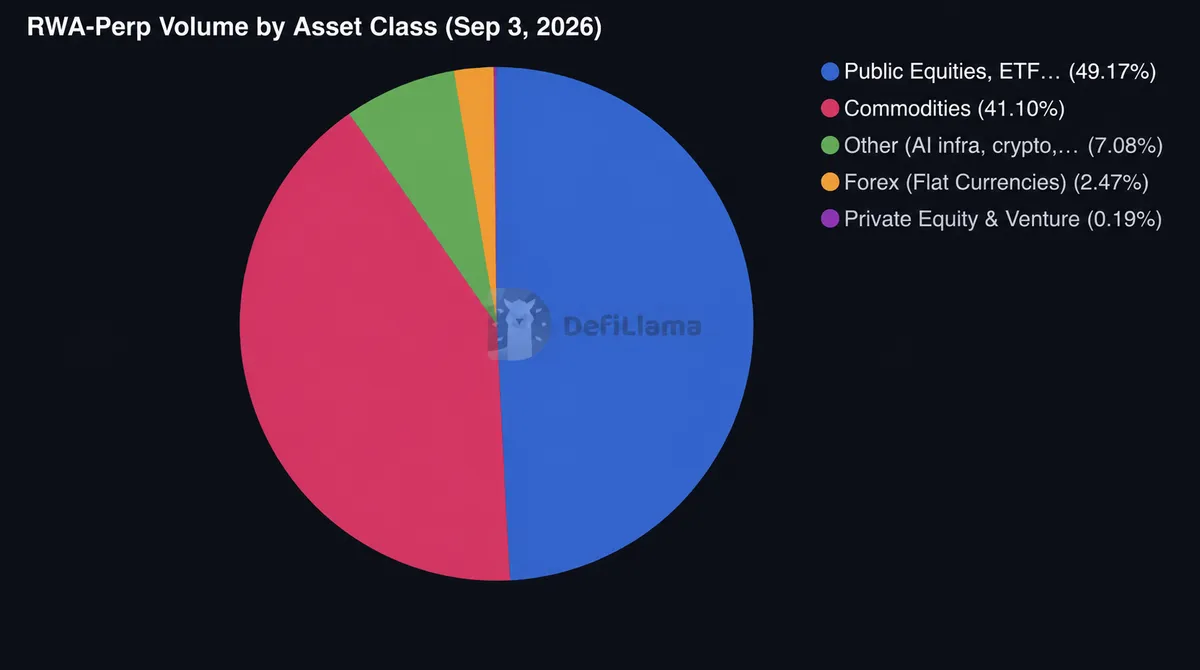
As of the most recently completed trading day, DefiLlama tracks $31.6B in 24h volume and $14.6B in open interest across 3,132 RWA-perp pairs on 32 venues. Stock, ETF, and equity-index perps specifically — the segment this piece focuses on — account for $15.6B of that volume (49.2%) and $8.5B of that open interest (57.9%) , making equities the single largest slice of the RWA-perp market, ahead of commodities, forex, and private-equity/venture perps combined.
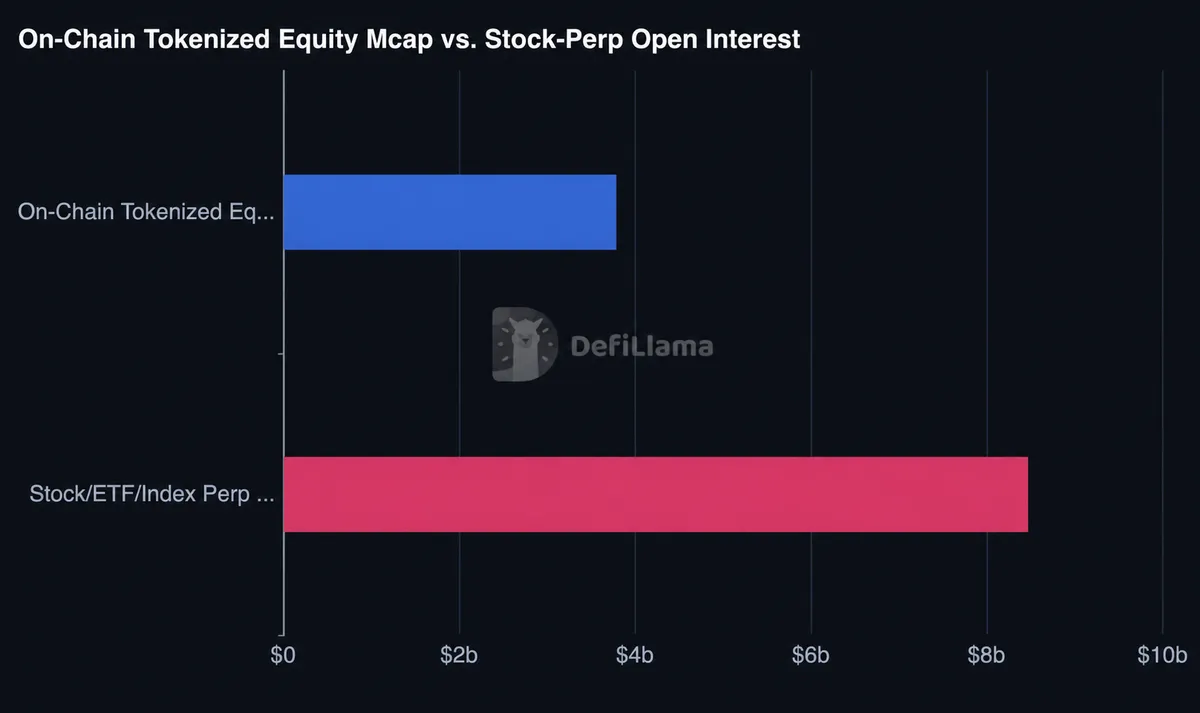
For context on the other side of the market: on-chain tokenized equities (the spot, custody-backed side — Ondo Global Markets, Backed/xStocks, bTech/bStocks, and others) currently carry $3.79B in active on-chain market cap across 1,639 tracked assets . Stock-perp open interest alone is now roughly 2.2x larger than the entire on-chain tokenized-equity market — a pattern we covered in our earlier piece, Stocks On The Blockchain - Do They Have Product-Market Fit?
Where Gate Fits In
Adoption of stock perps on the CEXes has mostly been a listings story: how many stocks does an issuer offer, how fast is on-chain market cap growing, which venue has the broadest catalogue.

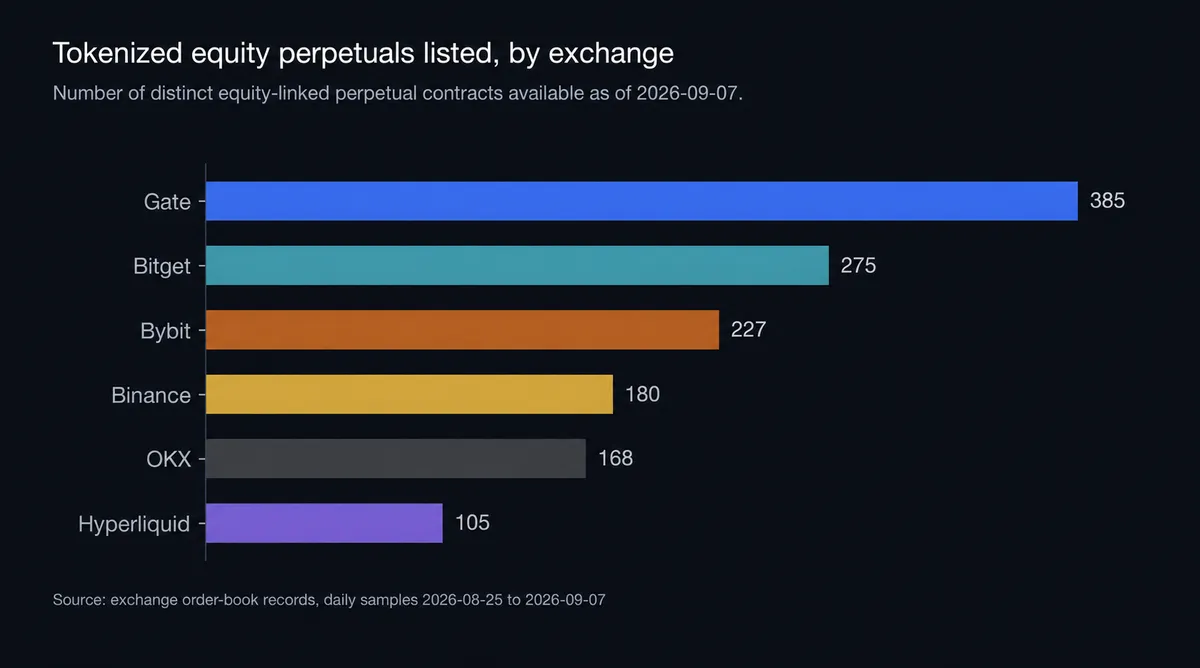
Gate has listed the most tokenized equity perpetuals, by far - standing at 385, beyond all the other exchanges. This is impressive, and we want to go one layer deeper to diagnose whether a venue can actually support leveraged trading in these instruments at scale, without the mechanical failure modes (bad fills, funding-rate whipsaws, cascading liquidations) that kill adoption in thin markets?
We're drawing on two independent data sources to do that:
Exchange order-book depth data supplied by Gate and independently re-verified against the complete Aug 25–Sep 7, 2026 window — covering crypto spot and perpetual pairs (BTC, ETH, SOL, XRP, DOGE) and equity-linked perpetuals across six venues (Gate, Binance, Bitget, Bybit, OKX, Hyperliquid), on an RPI basis. Binance spot has no RPI book, so its public order book is used instead. This is vendor-supplied; DefiLlama does not independently track order-book depth or bid/ask spreads for these instruments, so these figures are disclosed as exchange-reported.
DefiLlama's own RWA-perp tracking — volume, open interest, and funding-rate data for perpetual contracts referencing stocks, ETFs, and equity indices, current through today, across every venue we track.
As such, we will be going into the weeds to look at how Gate handles their flow, given they have the most number of perpetuals listed.
Gate — Mechanism, Core Lquidity, and RWA Footprint
While Gate isn't necessarily the largest stock-perp market by volume, it's the broadest equity-perp catalogue we found in this data — 385 listed contracts, more than any of the other five venues compared here — which makes it the highest-stakes test of the thesis above: a wide catalogue is exactly what "listings-story" adoption looks like, so if depth doesn't hold up behind it, that's where it would show.
Why Depth Matters More For Perps Than Spot
A thin spot market mostly costs you a bad fill. A thin perp market compounds that: shallow books widen the gap between mark price and where you can actually enter or exit, which pushes funding rates around more violently as small trades move the mark, which in turn increases the odds that a leveraged position gets liquidated on a move that a deeper book would have absorbed.
For a still-young product category like stock perps, that failure chain — bad fills, funding-rate whipsaws, cascading liquidations — is exactly what determines whether traders come back after their first large order.
Liquidity Evidence
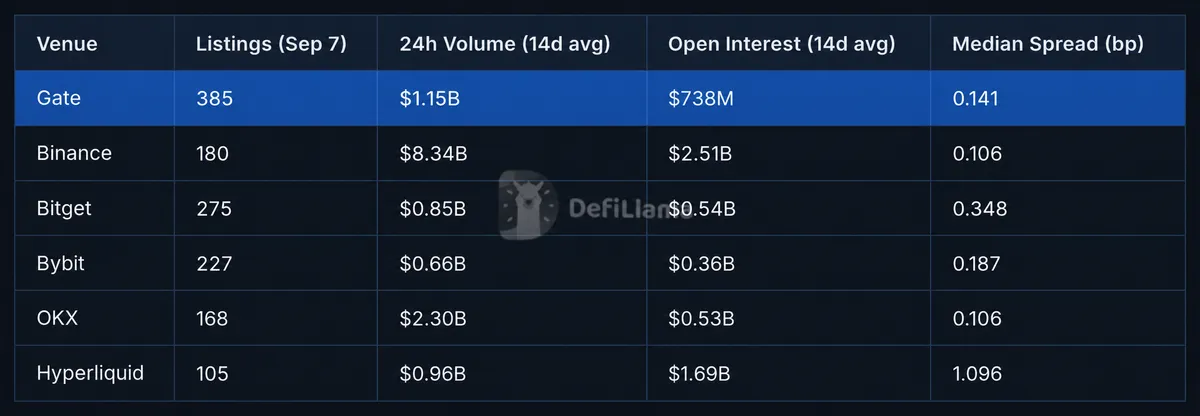
Gate lists 385 distinct equity-linked perpetual contracts as of September 7, 2026 — the most of the six venues in this comparison, ahead of Bitget (275), Bybit (227), Binance (180), OKX (168), and Hyperliquid (105) — and added the most new listings over the over the preceding 10 days (+12, vs +8 at Bybit and OKX),
Breadth alone proves availability, not tradability. So we checked the order book on the five most-traded names — SNDK, SKHYNIX, SPCX, SOXL, and MU, which together account for 60% of tracked equity-perp volume, averaged across the fourteen daily samples — at every depth band from top-of-book out to 2%.
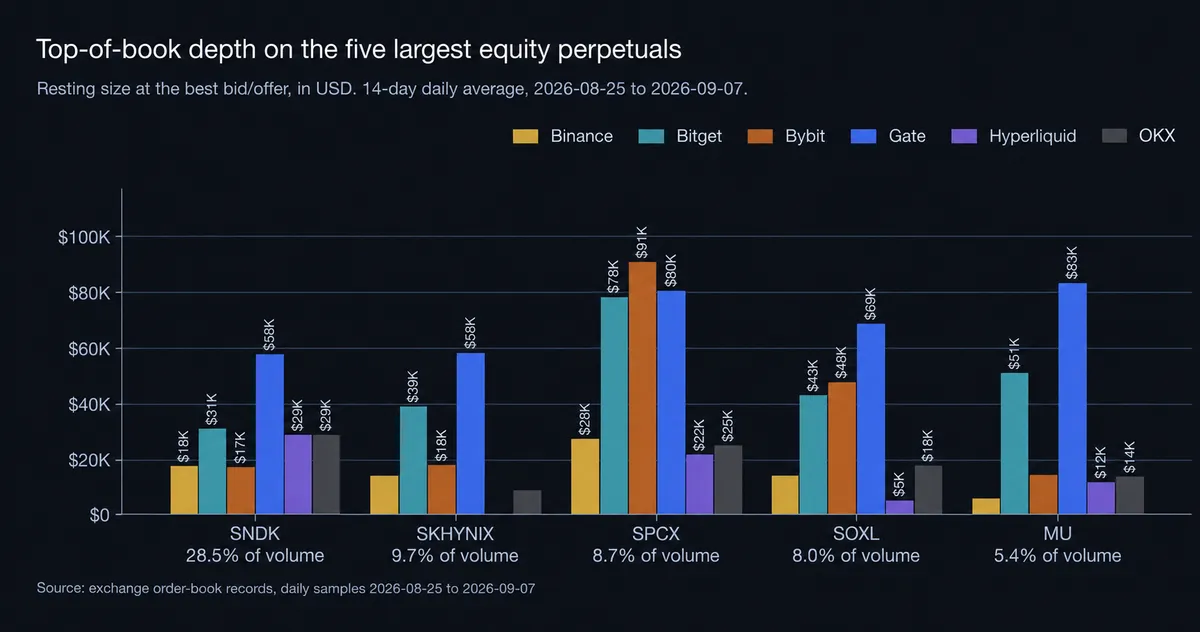
At the top of the book, it isn't close: Gate has the deepest resting size on four of the top five contracts by volume — SNDK, SKHYNIX, SOXL, and MU. The exception is SPCX, where Bybit's top-of-book ($90.6K) edges out Gate's ($80.3K).
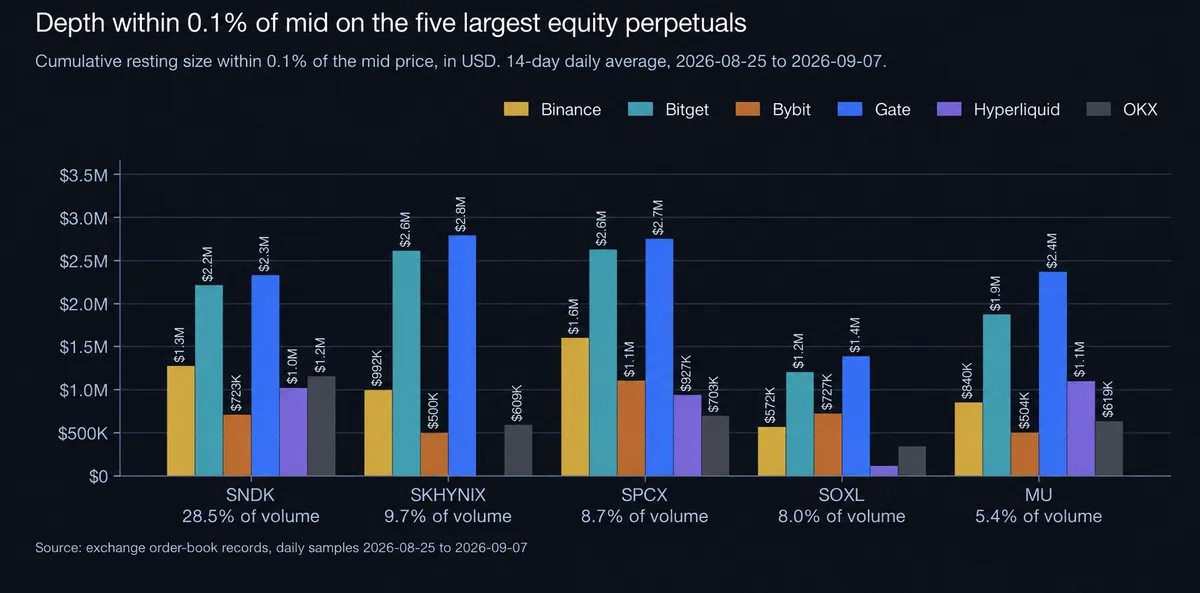
Moving one band out to the 0.1% level, Gate does sweep all five names, with margins ranging from 5% to 28%.
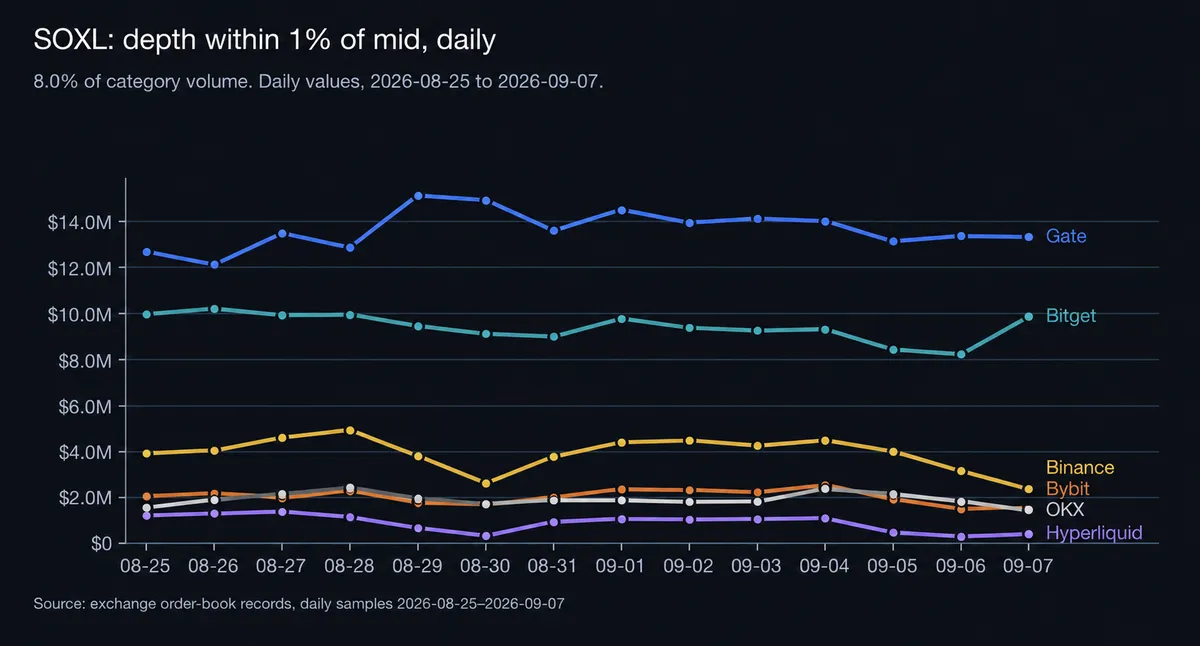
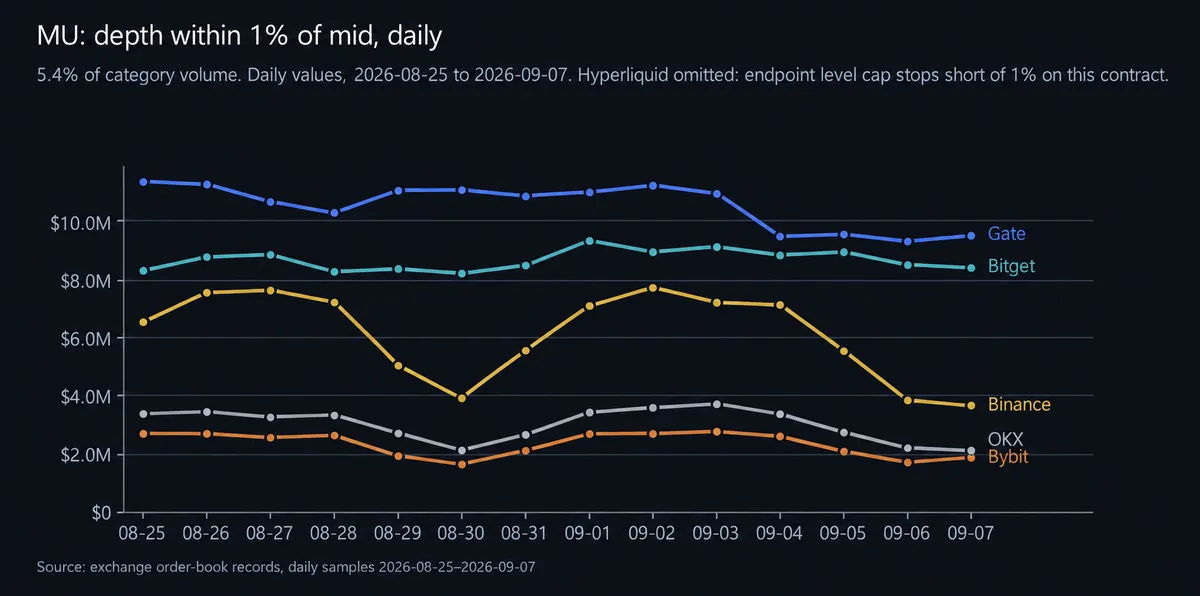
That lead isn't a single-day artifact. Tracking SOXL's and MU's 1%-depth daily over the full Aug 25–Sep 7 window, Gate held the top spot every single day on both names (14/14), with its lead never dropping below 19% on SOXL and 7% on MU. SNDK is more mixed by comparison — Gate led on only 10 of the 14 days, with its edge thinning noticeably in the back half of the window.
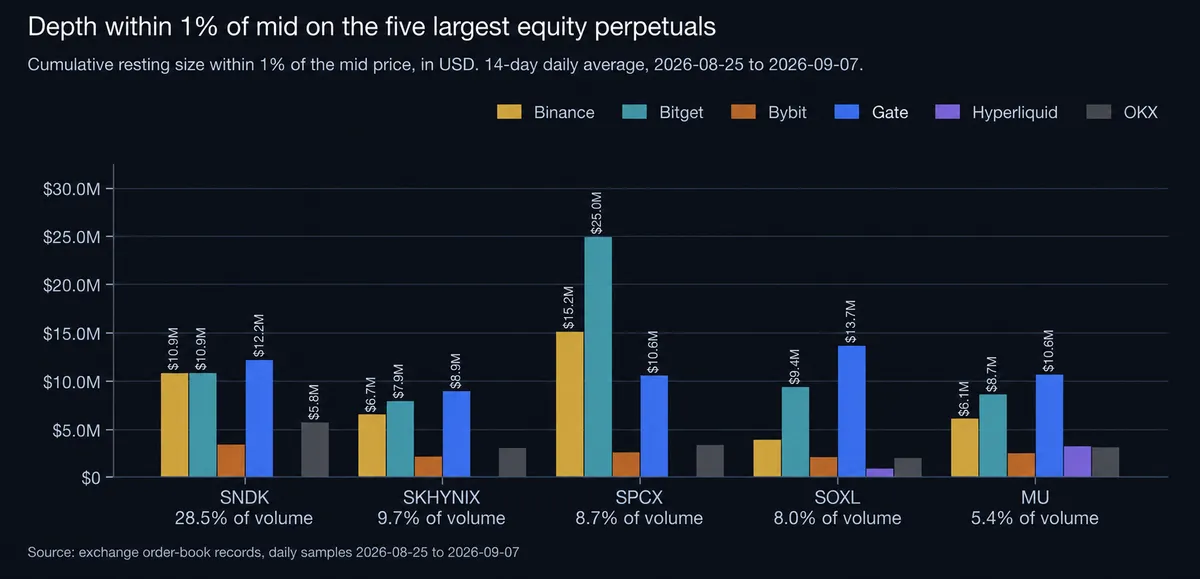
Moving out to 1% depth, the picture stays strong but gets more textured: Gate is deepest on four of the five names, losing only SPCX, where Bitget's 1% depth ($25.0M) runs roughly double Gate's ($10.6M).
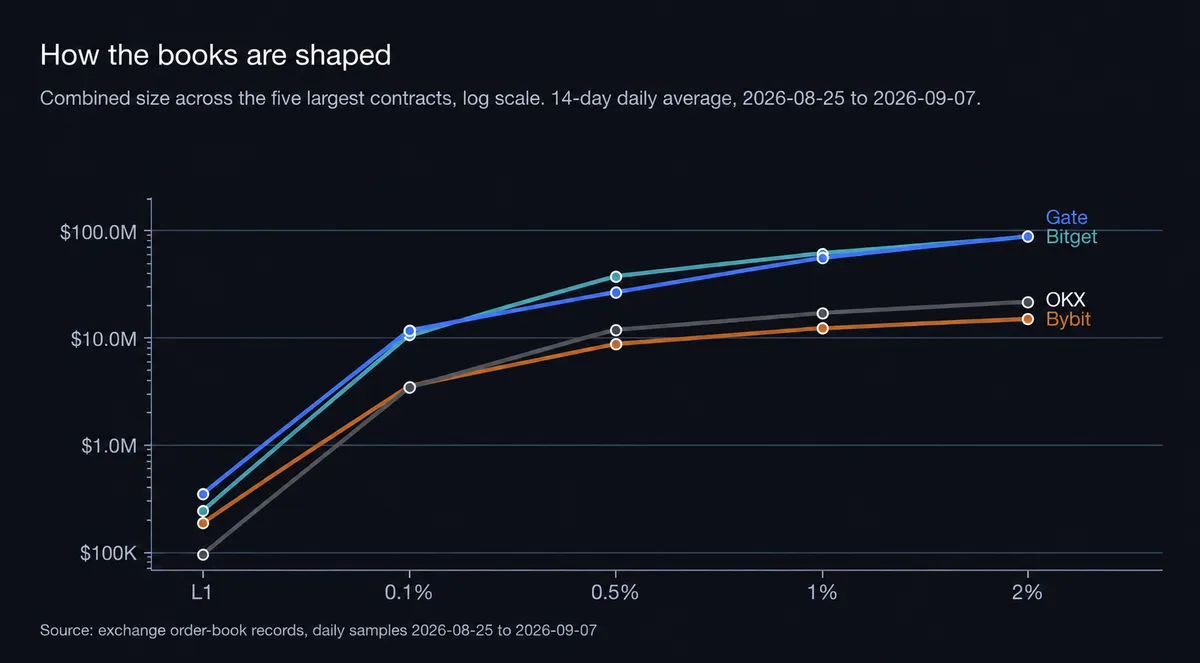
Looking at the combined top-5 book across every band tells the fuller story. Gate leads clearly at the extremes — top-of-book and the wide 2% band — but the middle of the book is level rather than Gate-led: at the 0.5% mark, Bitget is ahead on three of the five names, with the two of them tied within 1% of each other on the remaining two. That's a real, disclosed pattern, not a rounding error — Gate isn't uniformly deepest through the whole book, it's deepest at the extremes.
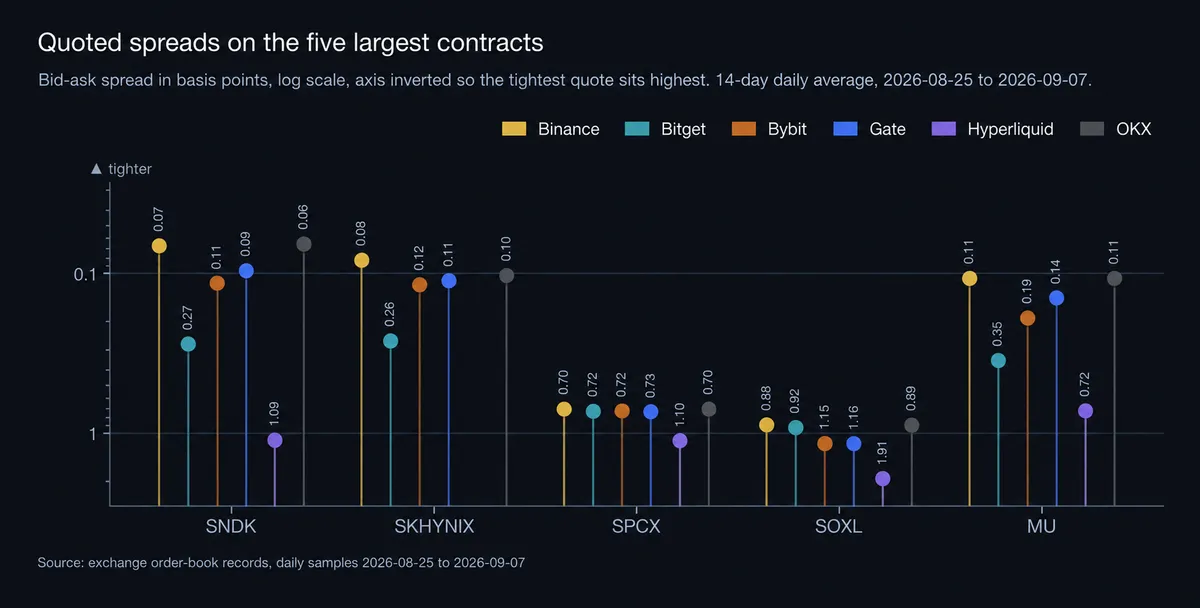
Spreads confirm the same "strong but not uniformly best" pattern: on median bid-ask spread across the five most actively-traded contracts, Gate sits at 0.141 basis points — tighter than Bybit (0.187), Bitget (0.348), and Hyperliquid (1.096), but looser than Binance (0.106) and OKX (0.106), which are effectively tied for tightest.
If this were the only evidence, it would be a solid but mixed story. It reads more convincingly once you check whether the same firm's other order books look the same way. They do:
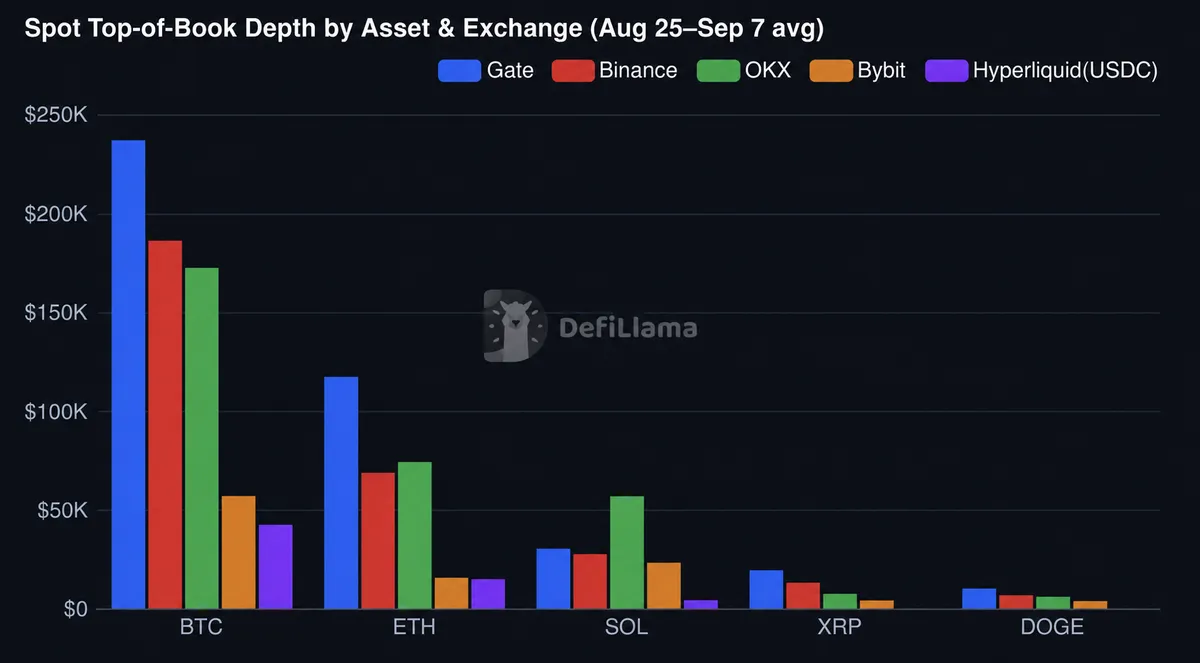
Across Gate's core crypto spot markets (Aug 25–Sep 7 average), Gate has the deepest top-of-book on four of the five major assets we checked — BTC ($237.0K), ETH ($117.4K), XRP ($19.5K), and DOGE ($10.0K) — ahead of Binance, Bybit, OKX, and Hyperliquid on each of those. SOL is now the exception: OKX holds the deepest top-of-book at $57.0K, ahead of Gate's $30.4K. The margin varies: comfortable on ETH (1.58x the next-best book, OKX) and DOGE (1.52x), thinner on BTC (1.27x); XRP sits at 1.51x.
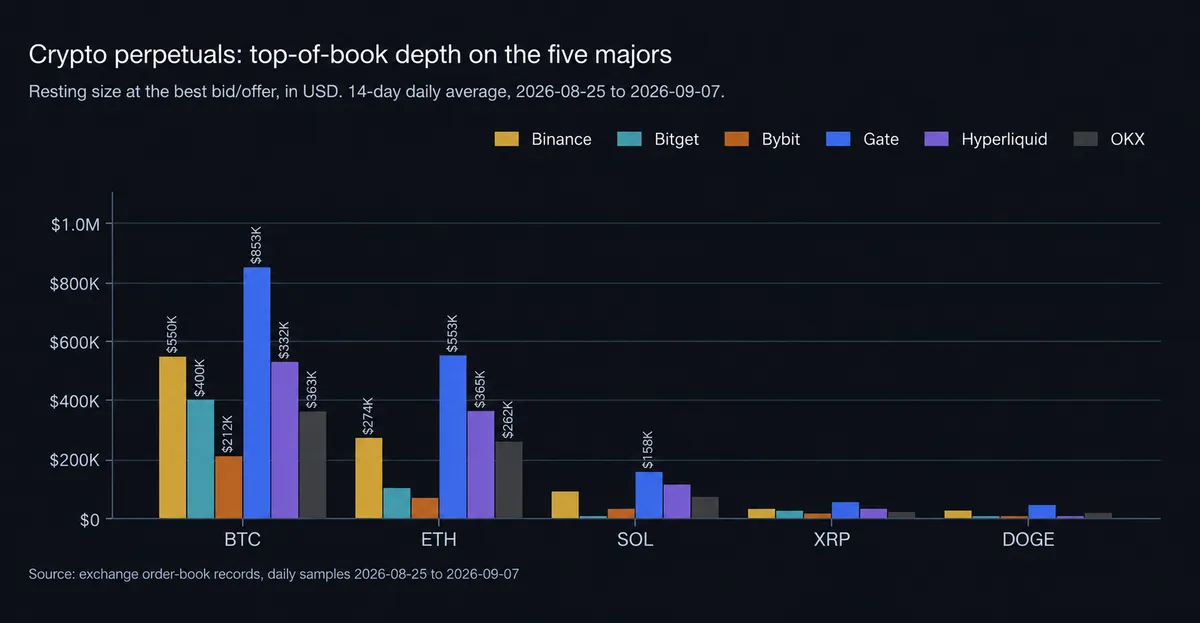
The same shows up on the perp side: with Bitget added to the comparison set, Gate has the deepest top-of-book on all five majors — BTC, ETH, SOL, XRP, and DOGE — ahead of Binance, Bitget, Bybit, OKX, and Hyperliquid on every one. At 1% depth the picture is more mixed: Gate holds the deepest book on BTC and SOL, while Bitget edges ahead on ETH, XRP and DOGE. This isn't offered as proof that Gate's equity books are deep — the equity data above already establishes that directly. It's evidence that the equity-book result is a general trait of how Gate runs its order books, showing up independently in a second, unrelated product line, rather than a one-off snapshot.
Rwa-Perp Footprint And Stability
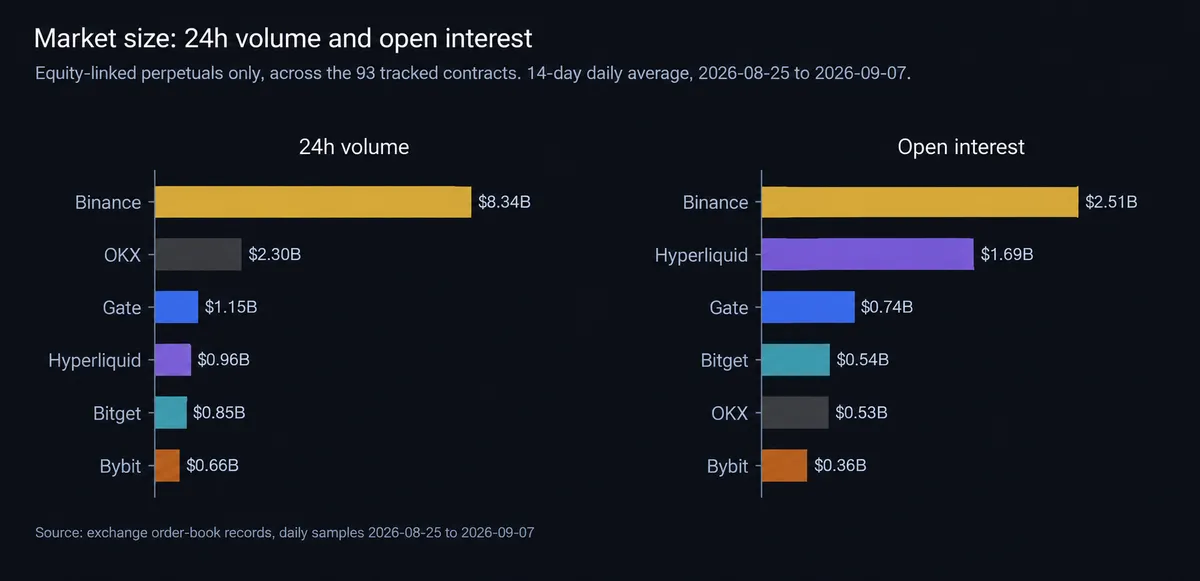
On the full equity-perp universe, across the 93 equity perpetuals tracked over the 14-day average, Gate ranks 3rd of 6 on 24h volume ($1.15B, against Binance's $8.34B) and 3rd on open interest ($738M, against Binance's $2.51B and Hyperliquid's $1.69B). Breadth and depth are not the same thing as scale — Gate isn't the biggest book here.
Narrowing to DefiLlama's own RWA-perp tracking, restricted to the stock/ETF/index scope specifically, Gate accounts for roughly $888.5M in daily volume and $778.1M in open interest on the most recent complete day.
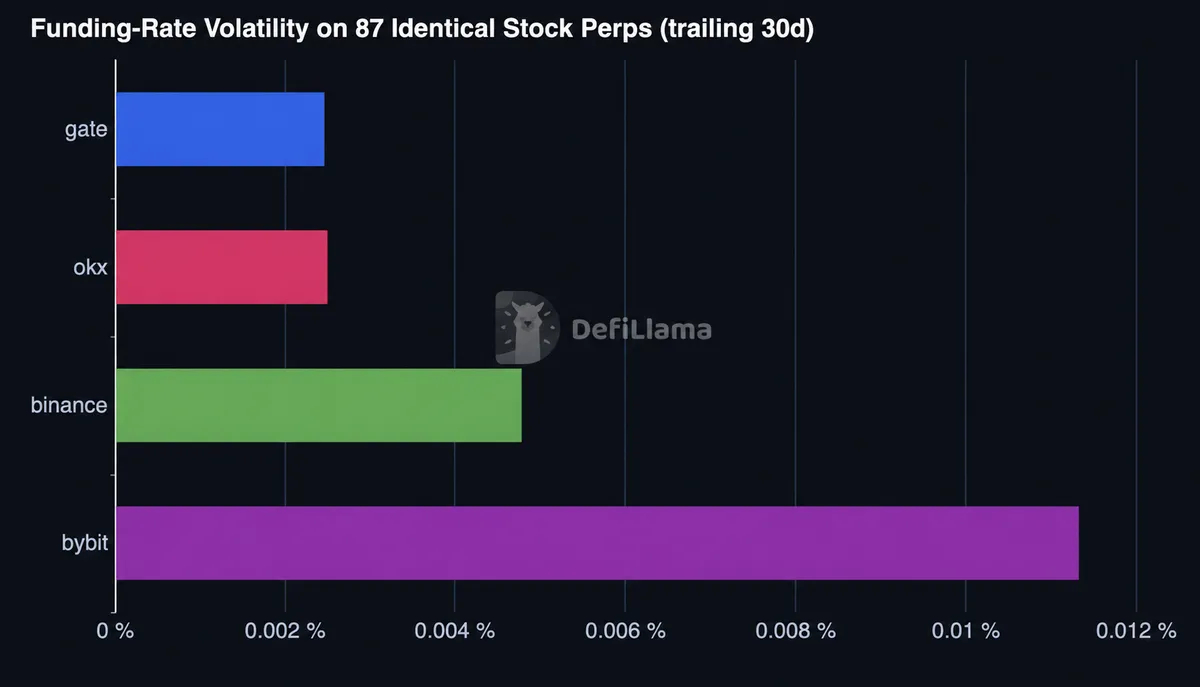
However, despite Gate losing out in market size, it makes up for in funding-rate volatility. Across 87 stock tickers listed identically on Gate, Binance, Bybit, and OKX, Gate's funding-rate volatility over the trailing 30 days (0.00245 percentage-point standard deviation) is a near-dead-heat with OKX (0.00248) — and meaningfully tighter than Binance (0.00478, ~1.95x Gate's) and Bybit (0.01132, ~4.6x Gate's). That gap holds despite Binance carrying roughly 2.9x Gate's average open interest on those same 87 names over the period — bigger books, less stable funding.
Put together, the picture that emerges isn't "Gate is the deepest book everywhere." It's more specific than that, and more useful: Gate leads the top of the book on four of its five most-traded equity contracts and sweeps all five once you move out to the 0.1% band, leads at the wide 2% end of the book too, and shows the identical pattern on its core crypto markets — but the middle of the book (0.5% depth) is level rather than Gate-led, and it sits mid-pack on raw spreads. Scale tells a third story again: Gate isn't the largest stock-perp venue by volume or open interest, trailing Binance by a wide margin on both.
What ties those three uneven results together is the one number that isn't a snapshot of order-book size at all: funding-rate volatility on identical instruments. There, Gate is essentially tied with OKX for the steadiest funding in the group, and meaningfully steadier than Binance and Bybit — despite running a fraction of Binance's open interest. Depth at the right points in the book, not raw size, is what keeps a leveraged market's funding from whipsawing. It also shows its not always about who lists the most, but also, who can actually hold a book together under size.
Comparisons & Gate’s Product Positioning
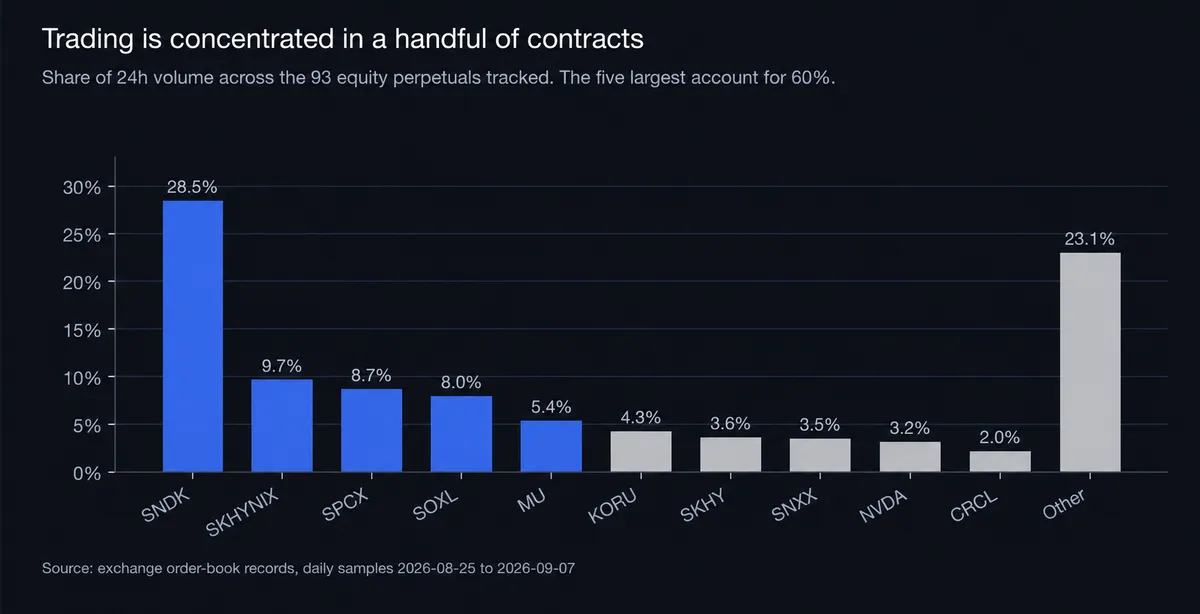
Before comparing venues head-to-head, it's worth being upfront about what's actually being compared. Trading in this segment is concentrated: across the 93 equity perpetuals tracked in the vendor data, the five largest contracts account for 60% of volume, with SNDK alone at 28.5%. That means most of what separates one venue's book from another's — in the depth comparisons above and the tables below — comes down to how each handles a small, identifiable set of names, not a broad average across the full catalogue.
Vendor equity-perp order-book comparison (Aug 25–Sep 7 average; listings as of Sep 7, 6 venues, full 385-instrument Gate catalogue):
Warehouse RWA-perp comparison (stock/ETF/index scope, latest complete day, DefiLlama's own tracking):
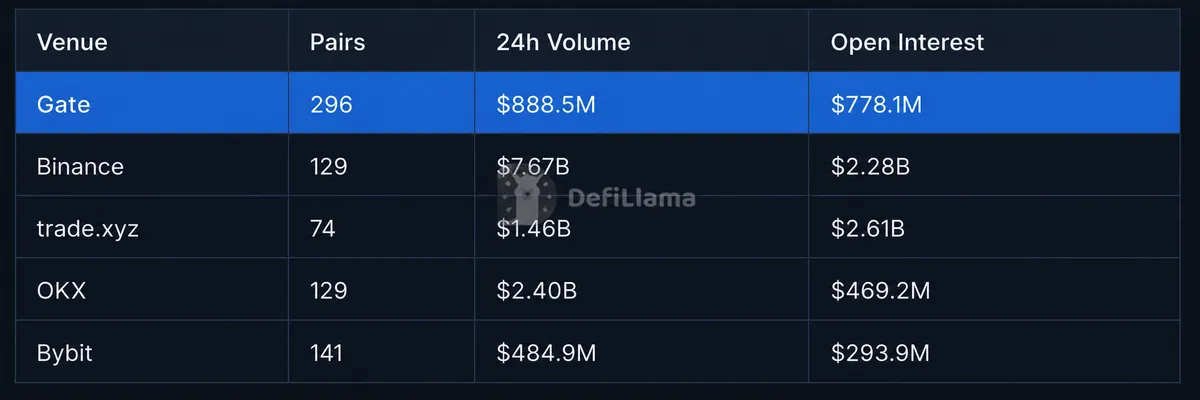
Read together, the two tables tell the same story from different angles: Gate has 2.3x Binance's pair count in the warehouse comparison, and 2.1x Binance's listings in the vendor comparison too — but Binance runs ~7x Gate's volume and 3.4x Gate's open interest. Breadth leader, not scale leader, in both.
The numbers point to one thing: deep, actively-managed order books. That capability shows up across two separate product lines (crypto and equity perps) and survives the one comparison: funding volatility, checked against identical instruments on other venues. None of that makes Gate the largest venue in either table above — it isn't, and the tables say so plainly. It's evidence for a specific, narrower claim: that Gate's liquidity is deep enough, and disciplined enough, to support the kind of leveraged trading this piece opened by asking about — not a claim to be the biggest market doing it.
Conclusion
Strip away the listings counts and the volume totals, and the question this piece opened with was never really "who has the most stocks" — it was whether any venue can actually hold a leveraged stock-perp book together at scale. That's an infrastructure and stability question, not a catalogue question, and it's the one the data above was built to answer.
Gate's answer is specific, not sweeping. It isn't the largest stock-perp venue by volume or open interest — Binance runs ~7x its volume and 3.4x its open interest in this data, and that gap is real and disclosed, not talked around. What it is: the broadest equity-perp catalogue of the venues compared here, the deepest top-of-book on four of its five most-traded names (and the deepest liquidity at the wide 2% band on four of the five, and the largest combined 2% book across them ($92.8M vs Bitget's $80.9M), the same depth pattern independently visible in its unrelated crypto markets, and — on the number hardest to manufacture — funding-rate volatility on identical stock contracts that's essentially tied with OKX for the steadiest in the group, despite carrying a fraction of Binance's open interest on those same names.
That last point is the one worth remembering after the tables are forgotten. A bigger book can still produce worse funding stability than a smaller, better-managed one, and for a trader deciding whether to keep leveraged exposure open overnight, stability is the number that determines whether they stay. Listing counts got tokenized equities onto exchanges. Whether traders actually stick around in size is going to be decided by exactly the kind of order-book discipline this piece measured — and on that measure, Gate's crypto liquidity and its stock-perp funding stability are two data points pointing at the same underlying capability, not two unrelated claims stitched together for a press release.