Variational Swaps
Swaps, a new instrument type that routes trader exposure directly to TradFi dealer liquidity instead of aggregated crypto-native depth. Funding on Swaps is largely flat, benchmarked to USD borrow rates rather than the long/short imbalance that drives a typical perp funding rate.
Variational
Order book DEXs, by design, can only do so much: they’re built to match buyers and sellers without ever taking a side themselves. That works well enough for crypto perpetuals, where a deep bench of market makers is comfortable managing risk on both sides of the book. But this fundamental structure hits a wall when you try to bring real-world assets or traditional finance (TradFi) instruments onchain. Dealers in those markets want to know who they’re trading with, and they prefer to manage risk on a know-your-counterparty basis, not anonymously.
This is a point Variational makes in its own documentation about its architecture: when order books are used in long-tail or off-chain markets, they break down because they try to create liquidity from scratch rather than drawing on the depth that already exists elsewhere.
Rather than building liquidity from scratch, Variational is designed to tap into the depth that already exists. Omni is Variational's cross-margined trading venue, spanning both crypto-native and RWA perpetuals, built on the Variational protocol. It runs on a request-for-quote system where a single liquidity provider, OLP, is the counterparty to every trade and hedges its own book off-chain, aggregating crypto liquidity from major exchanges alongside TradFi liquidity sourced directly from dealers.
That structure is why Variational can list something a CLOB exchange fundamentally cannot: Swaps, a new instrument type that routes trader exposure directly to TradFi dealer liquidity instead of aggregated crypto-native depth. Funding on Swaps is largely flat, benchmarked to USD borrow rates rather than the long/short imbalance that drives a typical perp funding rate. For example, on the gold and US100 markets when this article was written, longs pay 4-6% while shorts receive 2-3%.
A protocol precursor
Omni is the live proof of the OLP mechanism described above, not a separate product bolted on afterward. Every perp on Omni already routes through the same request-for-quote structure Swaps uses, just without the bilateral dealer hedge underneath. The real difference is where the liquidity comes from: Omni's perps source liquidity from crypto exchanges, while Swaps source liquidity directly from signed agreements with TradFi dealers. That makes Omni's trading history the closest thing to a track record Swaps had before launch.
That track record grew fast: Variational's RWA markets went from 6 listings and $188.4 million in open interest in May to well over 119 markets today and over $700M in TradFi OI. The listing count alone grew nearly 9x in a single month, from six to 53 in June. Growth since has been steadier, and open interest currently sits at its highest point.

Variational currently ranks third among tracked perpetual DEXs by open interest, at $1.77 billion, and 2nd in RWA open Interest. Every one of its 119 active RWA perp markets is still live, none delisted, carrying roughly $710 million in open interest.
Breaking open interest down by asset class reveals just how concentrated demand is: precious metals account for 42% of OI ($298.1 million) while covering only seven markets, while public equities, despite being spread across 83 tickers, make up just $116.5 million. Metals alone command nearly twice the open interest of all listed equities combined.
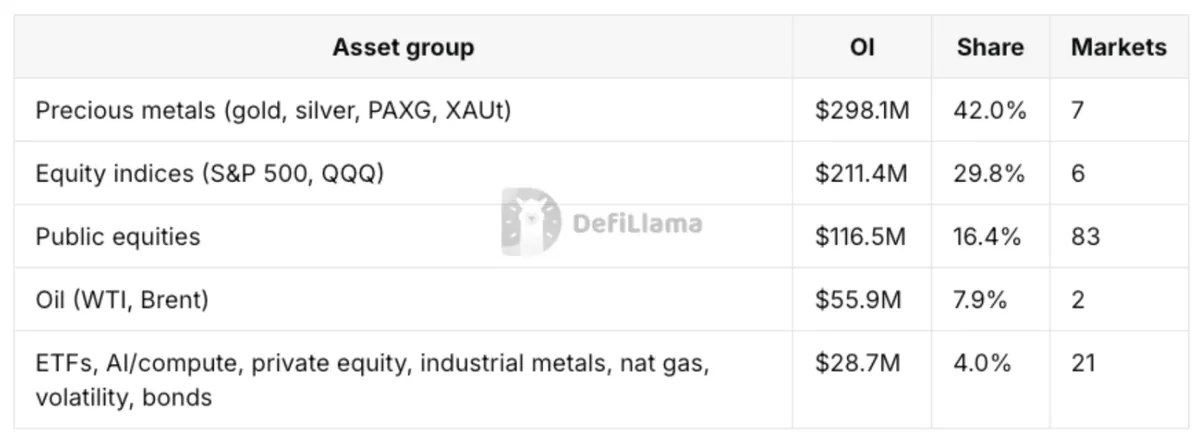
Seven gold and silver markets, carrying almost twice the open interest of 83 equity tickers combined, tell you where demand for on-chain TradFi exposure currently sits. It also tells you where swaps are likely to matter most first: metals and indices are the kind of deep, benchmark-priced underlyings where a dealer relationship beats an aggregated order book most visibly.
Top individual markets by OI:
Gold ($112.6 million)
Gold Swap (XAUS) ($71.8 million)
Tether Gold ($71.5 million)
Nasdaq-100 Index ($71.5 million)
S&P 500 Index ($57.6 million)
About Swaps
Variational co-founder Lucas Schuermann described the mechanics behind Swaps as “a bilateral contract where the trader faces a direct counterparty, in our case the Omni Liquidity Provider, rather than an exchange order book.”
Unlike perpetuals, which rely on variable funding rates, swaps have predictable carry costs. OLP hedges swaps directly on TradFi venues, so Variational can offer depth that isn’t capped by what crypto-native order books can support. Further, swaps often carry defined trading hours instead of trading 24/7 like perps, along with different index data, roll schedules, and hedging parameters underneath.
Put simply, the difference comes down to who's setting your costs.
A perpetual future is a synthetic position an exchange builds to track an asset's price without ever expiring, and the cost of holding it moves with the crowd, a funding rate that shifts depending on how many traders are long versus short at any given moment.
The kind of swap Variational is building works differently: it's a contract with one specific counterparty, a dealer, who prices your position off a reference rate instead of crowd behavior. The cost ends up looking less like a bet and more like a loan, a steady rate for the exposure, similar to what you'd pay to borrow money. Institutions favor that structure for this reason: the financing is a known, bookable number instead of one that can move against you unpredictably.
On Variational, swaps and perps will sit side by side rather than replace each other. For example, search “XAU” and both XAU-PERP and XAU-SWAP will surface. A trader who wants 24/7 access and is comfortable with variable funding stays on the perp. A trader who wants tighter, dealer-backed liquidity and predictable carry moves to the swap, at the cost of trading hours that initially mirror the underlying’s own market.
Choosing swaps over perps means accepting limited trading hours in exchange for more predictable costs and dealer-backed liquidity; the kinds of decisions that traders in traditional finance already make, depending on their priorities.
Swaps’ cost structure
Variational is launching Swaps with some big commitments behind it: the team has secured over $1 billion in open interest capacity through signed agreements and is offering stable financing usually benchmarked to USD borrow rates at about 4.5% all-in.
Swap financing is also typically anchored to a transparent benchmark: carry is priced off SOFR, the standard USD reference rate, plus a spread.
The launch market for gold (XAUS) is already showing this methodology in action, with funding rates derived directly from live market conventions and visible in real time. At launch, XAUS opened with a quote of 0.62 bps spread on $2.24 million of open interest - it has since grown to ~$72M within the first week. As of writing this article at launch, funding is asymmetric: 0.0157% for longs and 0.0068% for shorts on the standard daily interval.
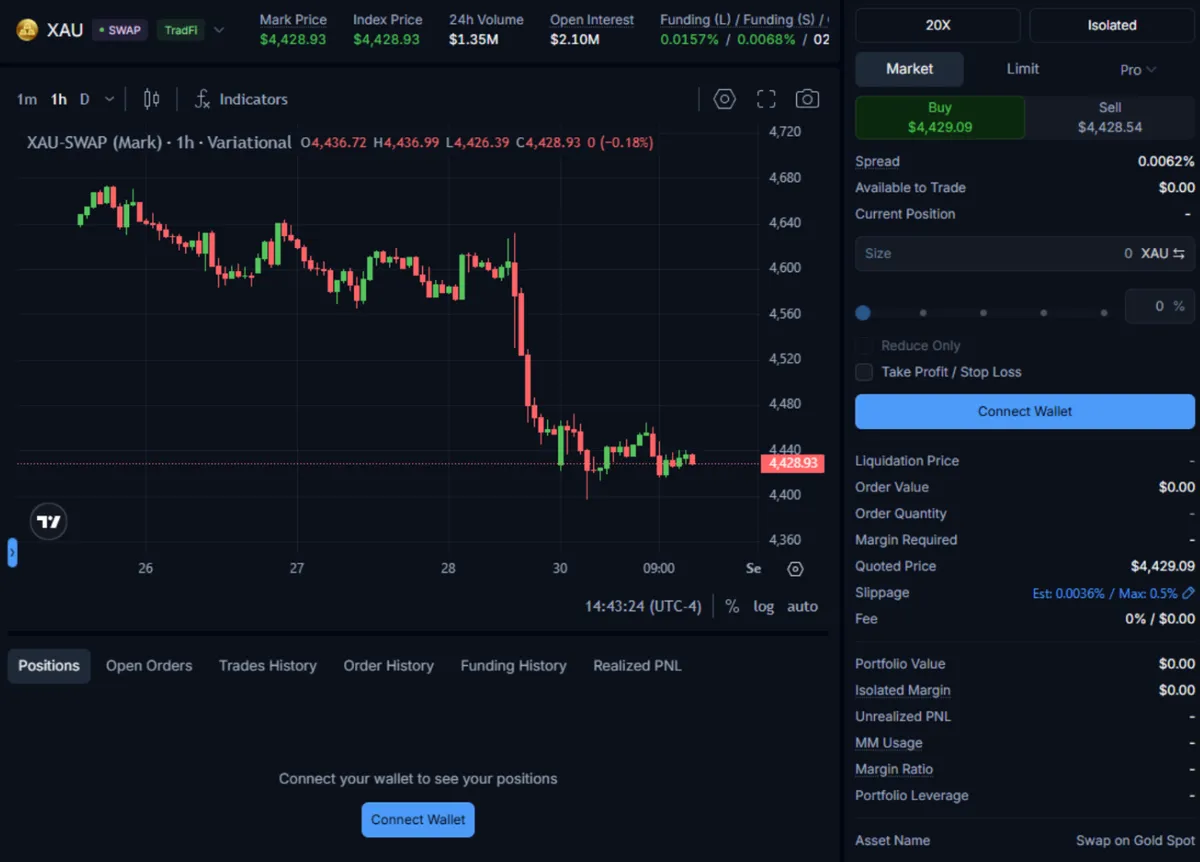
The protocol encodes a key tradition from TradFi FX and money markets: on most markets, the funding rate triples every Wednesday to account for the weekend carry, since most trades settle two business days later and the Friday-to-Monday stretch involves three calendar days. Rather than leave that gap unpriced, the market charges it all at once in a triple-sized instalment.
Note: not every market times it the same way; US100, for instance, charges triple on Fridays instead, but the underlying logic, pricing the extra weekend days upfront, is the same.
“Flat carry” refers to funding, the ongoing cost of holding a position, being predictable instead of variable. It says nothing about whether the entry spread itself stays flat as an order gets bigger. In fact, the data says the opposite: Swaps spreads widen as size increases — they just start from a much lower base than the competition. The largest single trade recorded so far illustrates this: a buy of 87 US100S contracts for $2.5 million in notional executed at just 1.08 bps of slippage.
Like-venue comparisons
Spread data from Swaps' launch markets, US100 (Nasdaq-100) and XAUS (gold), shows how the new model diverges from traditional perps.
Perp DEXs, including Variational's own Omni, publish flat fees. For Omni, that's 1.54 bps on Gold Perp. Swaps, in contrast, offer dealer-priced spreads that widen with order size, reflecting genuine market depth and size-based risk instead of applying a single rate to every trade.
For an outside benchmark, we're also comparing against Ostium, a dedicated onchain RWA perps venue built on Arbitrum. It's the deliberate choice here because it lists Gold and Nasdaq-100 directly, the same two underlyings Swaps is launching with, giving a same-asset comparison rather than a proxy. Ostium's live taker fee, the more complete figure to cite over its docs-quoted opening fee alone, runs flat at 5.73 bps on Gold and 5.29 bps on Nasdaq-100.
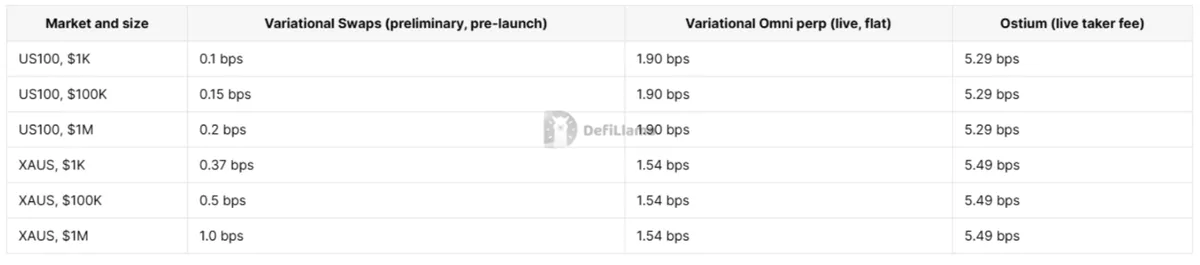
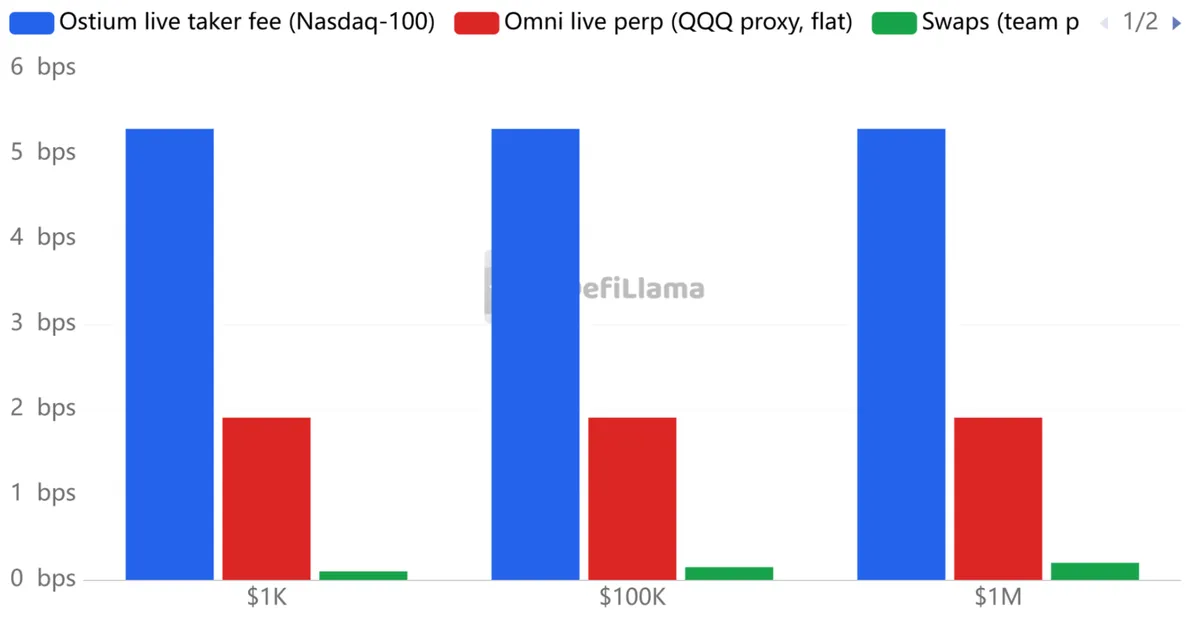
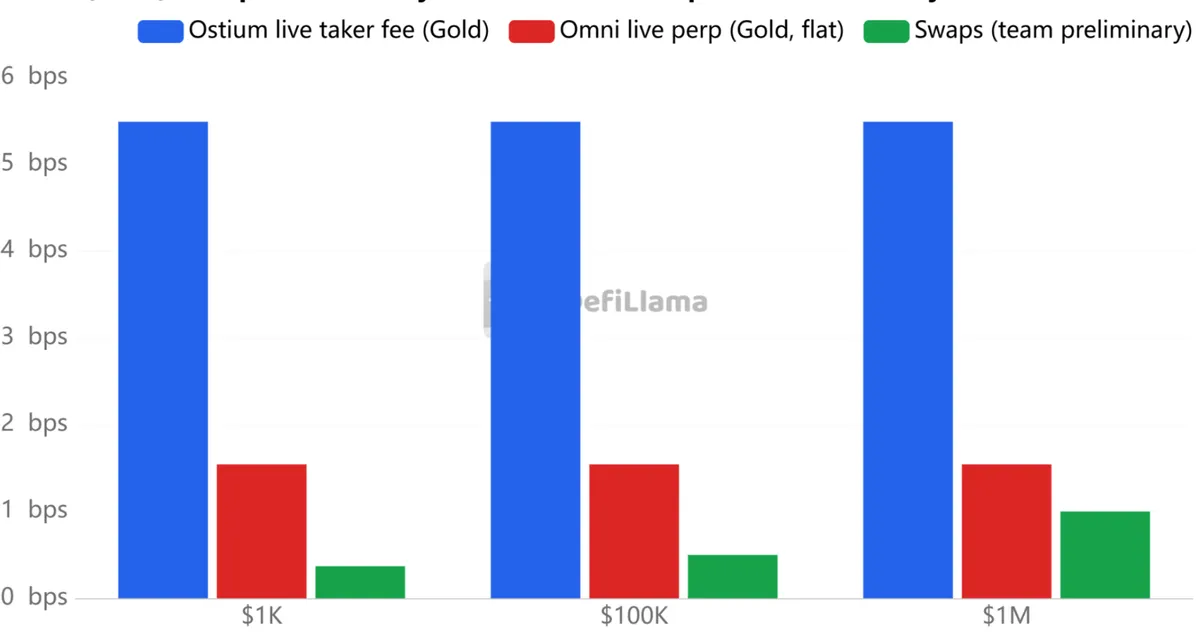
On US100, Swaps undercut Omni's own live perp fee by 19x at $1,000 and 9.5x at $1 million, wider margins against Ostium's live fee (52.9x and 26.4x). On XAUS the advantage is there, but narrower: 4.2x at $1,000 against Omni and 14.8x against Ostium, compressing to 1.5x and 5.5x respectively by $1 million. The advantage is largest where most trading actually happens, and on the one asset with the deepest existing perp market, it hasn't been shown to hold at the very top end the way it does lower down.
…vs TradeXYZ
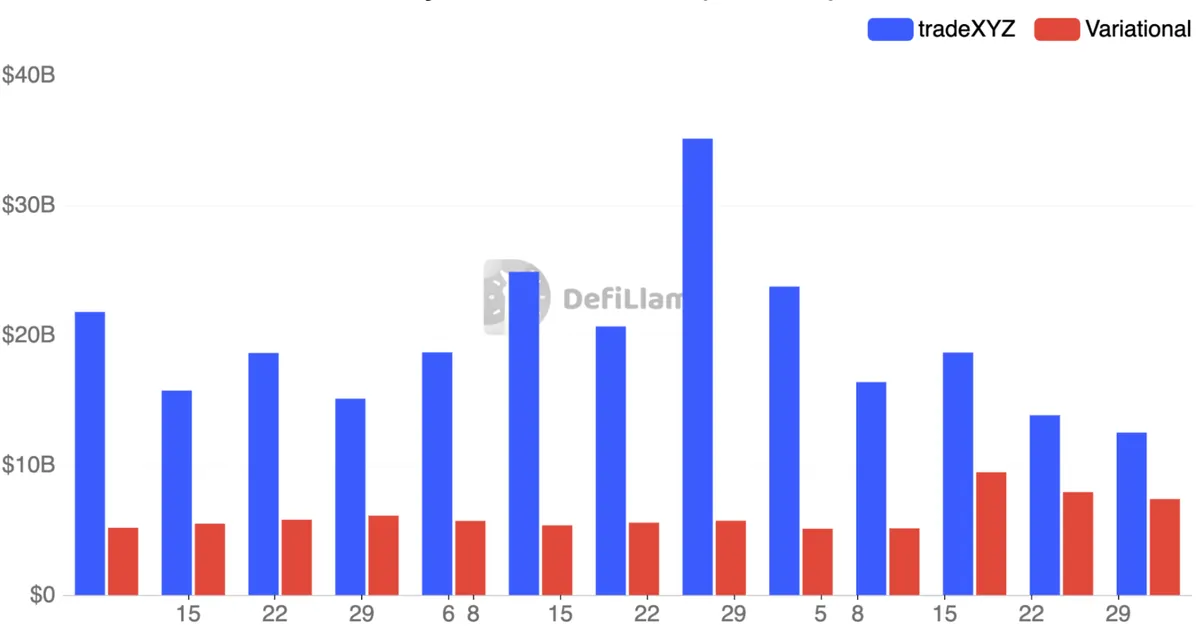
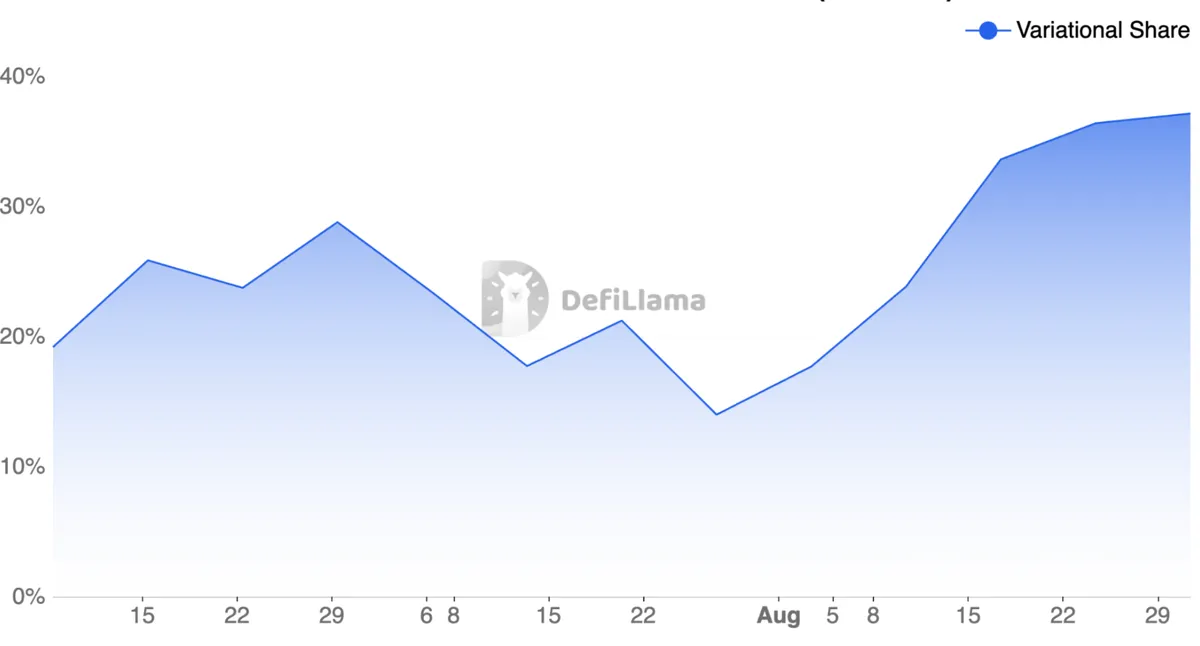
Over the trailing 13 weeks, the TradeXYZ picture has been mixed. TradeXYZ is still roughly 3x bigger by outright volume ($255 billion vs. Variational's $80 billion), but its own 30-day volume just fell 44.4%, its worst stretch in the tracked window, while Variational's share of the two venues' combined volume climbed from a low near 14% in late July to 36.4% most recently. The leader here is shrinking faster than the challenger is growing, and the gap, while still wide, has compressed rather than held steady.
Worth noting: TradeXYZ isn't an independently built venue, it's the first HIP-3 market on Hyperliquid's own infrastructure. Thus, its scale reflects someone else's liquidity stack, not a vertically integrated one like Variational's, which is why it's the most relevant benchmark in the category without being a true like-for-like competitor.
Down the road
Variational launched swaps on September 1, which timed nicely with an X Space co-hosted with DefiLlama Research. The initial rollout, US100 and XAUS only, was Phase 2 on Variational's own public roadmap. Phase 3, enabling 24/7 swap trading, is already the named next milestone. In the week since launch, Swaps have processed $2.8 billion in lifetime volume, with total open interest across the three live markets peaking at $245 million on September 8. US100S has emerged as the largest individual swap market, with open interest reaching $83 million on September 8. It also carries the highest trading activity of the three, with 24-hour volume hitting $416 million on the same day.
Further out, the roadmap includes the public launch for Omni (currently still in private beta), a planned token, and a separate institutional line called Variational Pro, due sometime in 2027. Lucas Schuermann has said most of the platform's listings over the next year will be swaps, with room to eventually list thousands of RWA markets. The nearer-term, more checkable version of that goal: cross 100 RWA markets with real TradFi liquidity and genuine trading activity behind them. Variational has hit a target like this before: In May, the team posted a public goal of 100 TradFi listings in 90 days, and hit it on the dot.
Some of that ambition is easier to take at face value once you know who's behind it. Schuermann and co-founder Edward Yu built and sold a quant trading firm, ran OTC crypto trading at Genesis, and helped raise $61.8M in funding for Variational (for more background history, check out Lucas’ and Edward’s personal websites).
This is not a group learning on the fly, and the sum of all that ambition has so far been an onchain growth masterclass.