Tranching in DeFi: Can the Junior Buffer actually survive an exploit?
The data shows that senior tranches are not fully insulated from hacks, and that their exposure can still be significant when losses are large enough to breach the junior buffer.
Over the past year, an increasing number of DeFi protocols have adopted tranche-based designs to attract users with different risk appetites. But how well does tranching actually work, and can it really protect capital against major losses, such as those caused by an exploit?
The data shows that senior tranches are not fully insulated from hacks, and that their exposure can still be significant when losses are large enough to breach the junior buffer.
To understand this, we examine some of the most well-known tranching protocols and compare their junior and senior tranches against potential exploit scenarios to assess how much protection they actually provide.
What Are Senior and Junior Tranches?

Tranching is not a new concept. It has long been used in traditional finance, particularly in structured credit products, securitisations, and collateralised debt obligations. The basic idea is to divide a pool of assets or risk into separate layers, known as tranches, so that different investors can assume varying levels of risk.
The senior tranche sits at the top of the capital structure. It has first claim on repayments and is designed to absorb losses only after the junior tranche has been fully depleted. In return for this added protection, senior depositors usually receive a lower yield.
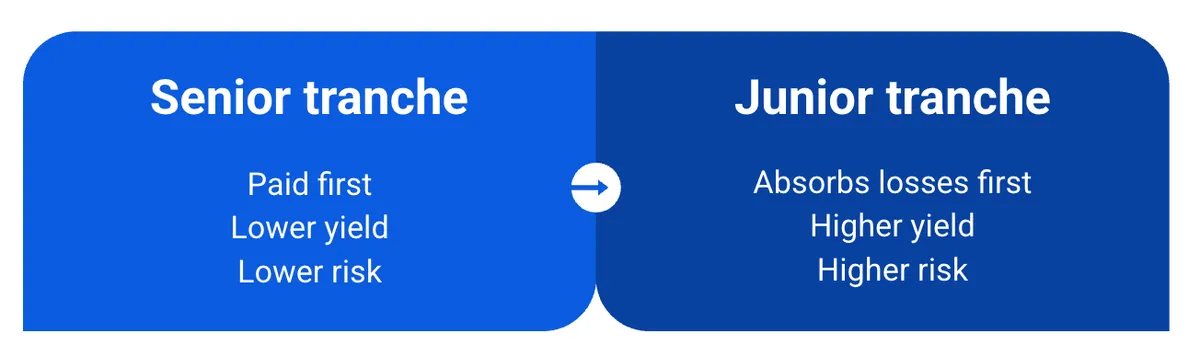
The junior tranche sits below it and acts as the first-loss buffer. Junior depositors take losses before the senior tranche is affected, but they are compensated for taking that risk through a higher potential yield.
For example, a protocol could have an 80% senior tranche and a 20% junior tranche. If the protocol suffers a 15% loss, the junior tranche absorbs the full loss and senior depositors remain protected. If the loss rises to 30%, the junior tranche is wiped out and the remaining 10% loss starts affecting the senior tranche.
Who are the major players and what are their buffers?
To understand how much protection tranching can provide in practice, we examined six major DeFi protocols that use senior and junior tranche structures. We compared the size of each protocol’s junior tranche with its senior tranche to assess how much capital is protected before senior depositors begin to take losses.
In our analysis, we use two metrics. The buffer ratio compares junior capital to senior capital, while the loss-absorption threshold measures junior capital as a share of the full pool.
The loss-absorption threshold is lower because it uses a larger denominator. Instead of comparing junior capital only to senior capital, it compares junior capital to senior and junior capital combined. As a result, the same junior tranche represents a smaller percentage of the full pool.
Project | Product | Senior tranche TVL | Junior Tranche TVL | Buffer | Loss-Absorption Threshold |
|---|---|---|---|---|---|
Avant Protocol | avUSD | 16.90% | 14.46% | ||
Strata | Ethena USDe | 21.15% | 17.46% | ||
Yuzu Money | YzUSD | $4.327M (Junior tranche + reserve fund) | 9.70% | 8.84% | |
Royco | Staked Avant USD | 29.54% | 22.80% | ||
3jane | USD3 | 14.26% | 12.48% | ||
infinifi | iUSD | 62.97% | 38.64% |
Credit: DefiLlama Research · © DefiLlama
Except for infiniFi, the protocols fall within a similar protection range across both measures. Avant, Strata, Yuzu Money, and 3Jane all maintain junior or reserve buffers of roughly 10% to 17%, with slightly lower loss-absorption thresholds. Royco sits somewhat higher, with a 29.54% buffer and a 22.80% loss-absorption threshold.
infiniFi stands out clearly, with a 62.97% buffer. Its loss-absorption threshold is more modest at 38.64%, but it is still the highest in our sample.
Does the buffer protect against an exploit?
The buffer comparison in the previous section tells us how much of each protocol's capital structure is protected against a partial loss. It does not tell us how often losses are actually partial.
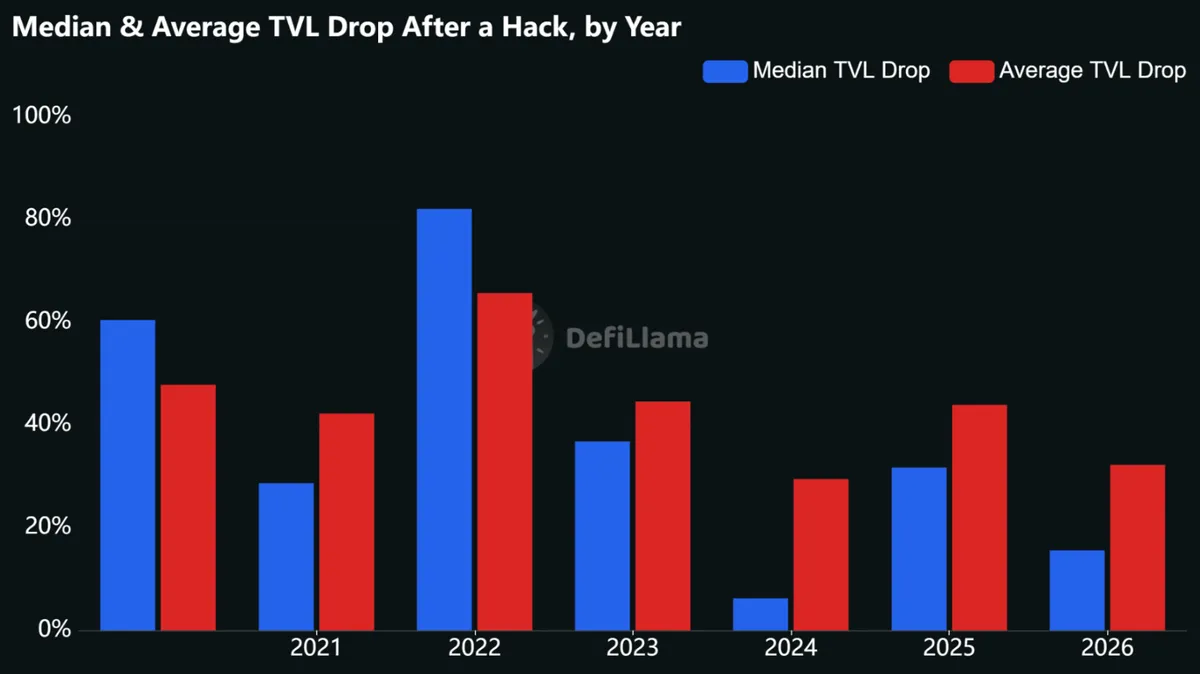
To answer that, we looked at 151 confirmed historical exploits where a protocol’s TVL could be measured both immediately before and immediately after the incident, and calculated the median and average share of TVL lost per event.
Across those 151 exploits, the median TVL loss was 34.05%, and the average was 43.58%. Within that same sample, 40 exploits, or 26.49% of the total, erased 80% or more of TVL in a single event, and 30 of those, or 19.87% of the total, left the protocol with less than 5% of its capital.
Ranked from most exposed to most resilient, the picture looks considerably worse than the buffer ratios alone suggest. Yuzu Money has the lowest loss-absorption threshold of the group at 8.84%, which was breached by 108 of the 151 confirmed exploits in our sample, or 71.52%.
3Jane follows close behind at 12.48%, breached by 102 exploits, or 67.55%.
Avant Protocol sits next at 14.46%, breached by 100 exploits, or 66.23%, just ahead of Strata’s 17.46% threshold, which was breached by 92 exploits, or 60.93%.
Royco sits a step above this cluster at 22.80%, but even at this higher threshold, 85 exploits, or 56.29%, still went straight through its buffer.
infiniFi is the clear outlier. Its 38.64% threshold is nearly double Royco’s and more than four times Yuzu Money’s, yet 70 exploits, or 46.36% of the sample, were still large enough to breach it.
It is also worth looking at the severe end of the sample specifically. 40 of the 151 exploits, or 26.49%, wiped out 80% or more of the protocol’s TVL in a single event. At that severity, buffer size stops being important, since even infiniFi’s 38.64% threshold would have been exceeded by a wide margin in each of those cases.