Report: Argentines’ financial reality and the impossible dollar access
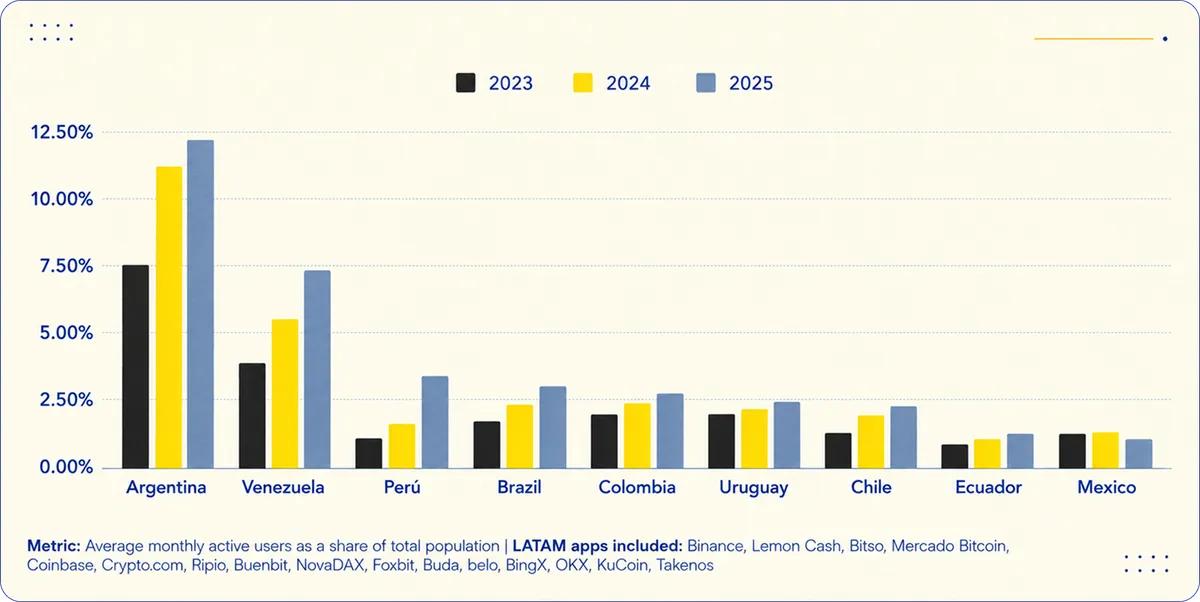
Argentina had roughly 8.6 million crypto users as of 2024, representing around 20% of the population. Of those, 12.5% are active on a monthly basis, significantly higher than any other country in Latin America. Volumes speak for themselves: more than $91 billion in value moved.


A conversation with Santiago Cristobal
- Crecimiento was born in May 2024, almost simultaneously with the first CNV regulatory resolutions. Looking back, were you building alongside the framework or did you find yourself building ahead of it, and does that distinction matter for what came next?
From the start, Crecimiento was built on two pillars: one is policy and regulation, and the other is the ecosystem itself. Crecimiento exists as a response to the Argentine opportunity, and that opportunity has three parts: a country with an enormous level of crypto adoption, a country with a huge amount of talent, and a country with a regulatory environment that's open to innovation. That last part isn't just background to what we do. The willingness to build a regulatory ecosystem that allows innovation, instead of shutting it down, is one of the reasons Crecimiento exists in the first place. It's part of what makes the Argentine opportunity real. So I wouldn't say we were building ahead of the framework.
However, from the very beginning, we did dreamed of a sandbox, and of creating these kinds of spaces. We took part in the public consultation process on several occasions.And from the start we ran events that worked as bridges between the private and public sides, where startups, companies and the wider entrepreneurial ecosystem could sit down with the regulators. Our first big edition is the clearest example of that: we had senior officials and representatives from the CNV, the IGJ and the Central Bank, together with the whole crypto ecosystem, in the same room.
I think the biggest merit of Crecimiento is to have identified an opportunity, and to build towards and existing trend, helping accelerate it, sometimes more directly some times more indirectly.
- This report identifies talent retention as one of the rarest and most decisive factors in Argentina's crypto success. Across four Aleph editions and 250+ startups supported, are you seeing Argentine builders genuinely choosing Buenos Aires over San Francisco, Zug, or Dubai, and what is actually keeping them here?
A couple of things. First, the Argentine ecosystem has always been closer to the United States. We don't really have strong links with Dubai or Switzerland. Where we do have links is San Francisco, when it comes to raising capital or scaling a startup, and Delaware, when it comes to incorporating.
So the comparison isn't really Buenos Aires against those hubs.
Argentina has been a very interesting place to build for years now. Because of the exchange rate, because of the amount of talent, it's been a good place to build a team, to work and to live. And I think that has more to do with a global trend: it's increasingly easy to raise capital without necessarily being in San Francisco. Over the last few years we've seen very successful companies and teams building from here, traveling from time to time to connect with other ecosystems, but without that pressing need to move the company, the person or the team to the US or anywhere else.
What we see at Crecimiento is that Argentina is one of the best places in the world to build in crypto specifically. If you're building in AI, or biotech, or robotics, maybe San Francisco still gives you real advantages beyond capital and network. But if you're building in crypto, and I'd say the same about fintech, Argentina is a great place to do it: the state of the economy, the level of adoption, how much people here understand about finance, and the opportunities that exist to build financial innovation.
And it's not just that Argentines stay. That's been happening for a while. On cost of living alone, Argentina was already a good place to build a startup. What we're seeing first-hand is entrepreneurs from other countries coming to Argentina to build: stablecoin solutions, wallets, new financial applications, things in DeFi. There's Bondi, two guys who came from Turkey. The Bufi team, from Ecuador. Peanut, which has a Spaniard, a German, a pretty international team. For us that's part of the Argentine opportunity, and part of the reason Crecimiento exists.
The local ecosystem is also getting stronger every year. A few years ago there were fewer founders, fewer mentors, fewer investors. It's still true that if you want to raise a round you have to connect with global investors, and going to San Francisco or other cities helps a lot. But now you can also do it from Argentina, and that wasn't really the case before.
- Venezuela, Nigeria, and Turkey all faced the same monetary conditions as Argentina, currency collapse, blocked dollar access, populations turning to stablecoins by necessity. None produced a comparable ecosystem. What makes Argentina's case different? And is this model something other countries can actually replicate, or is it specific to this context?
The way I see it, Argentina is the only country in the world that has both a huge level of crypto adoption and a regulatory environment that's open to crypto. Usually you get one or the other. You have countries like Nigeria or Turkey, where people use crypto and genuinely need it, but the governments dislike it or ban it outright.
And then you have countries like Singapore or the United States, where the regulators are in favor of innovation and want to bring in crypto solutions, but the citizens don't really need them. Argentina has both at the same time, which means the adoption here is happening bottom-up and top-down at once. That's exactly the opportunity Crecimiento was created for. It's the only country with those two conditions together.
On top of that you have a population with a very good level of English, a lot of talent, a lot of technical talent, a strong understanding of financial matters, and an economy that forces people to keep thinking about and adopting new financial solutions. It's a very powerful combination. If you look at the numbers, Argentina adjusted for the size of its economy is very strong, strong compared to the rest of Latin America and even to Europe, and the same goes for technical talent, whether you adjust per GDP or per capita. All of that creates a density, a kind of breeding ground that most places just don't have.
And there's a cultural side to it. Argentines are used to figuring things out. Years of an irregular, unstable economy have taught people to be creative and find solutions out of necessity, and that's what turns all that density into real innovation, into serious teams and real companies, and not just high usage numbers. That combination is very specific to Argentina, and it's hard to reproduce somewhere else, precisely because it's a combination and not a single ingredient.
- We are at a point where millions of Argentines are using crypto daily without thinking of it as crypto, paying taxes in Buenos Aires, receiving salaries in USDC, spending via QR codes. Where does this go next? How do you see the average Argentine interacting with these technologies in five years, and what does the infrastructure need to look like to support that?
It's a great question, and the honest answer is I don't know. It will depend on the entrepreneurs and what they build over the next few years. It will depend on thousands of factors that affect the Argentine economy, and on what happens at the macro level across a lot of dimensions — from the development of AI to crypto evolving into a more institutional industry. I can't predict that.
What I do see is that more and more Argentines will use crypto — whether directly, or through products that hide the crypto entirely. Today I'd put us at roughly 20 to 25%. In five years, I'd imagine at least more than a third, and maybe as much as half of Argentines using crypto on a weekly basis — again, many of them without knowing that what they're using is crypto at all.
I also imagine that in Argentina the integration between the crypto world and the traditional financial industry will happen faster than in other countries. I picture banks incorporating crypto substantively and for real into their value chain.And I picture the next generation of fintech not necessarily being crypto startups, but companies that find in crypto technology genuine solutions to the problems the Argentine economy and Argentine citizens actually face.Above all, I imagine a population that stays highly literate — in financial terms and in crypto adoption.
Beyond that, there's a piece that's much harder to foresee, to estimate, or even to understand. But if we do enter an agentic economy — as many now presuppose — where the bulk of transactions happen through agents, it's very possible that crypto takes on a preponderant role. And I believe Argentina has the conditions to adapt very quickly to that new economy and that new global system. The concrete result is impossible for me to predict: what that economy looks like, what commercial relationships look like, what the companies of the future look like, whether the Copernican shift some people talk about actually happens. What I do see is that Argentina is in a very good position to adapt to that change.
Two hundred years ago the Industrial Revolution drastically changed the rules of the game. The Internet did the same. If AI really takes us into a completely different era where the rules change again, some countries will benefit enormously and others much less. The great powers of the world will naturally find ways to profit from it — but I think Argentina can take it as an opportunity to do what's called a leapfrog: get ahead, skip a stage, and position itself far better for the next economy, the new economy powered by AI.Inflation, the starting point
To understand why crypto has found success in Argentina, you first need to understand how inflation made it nearly impossible for Argentines to preserve the value of their savings over time.
Since 1944, the country's average annual inflation rate has been 105%. The mechanism behind that number is simple and has repeated across eight decades: when the state runs a fiscal deficit it can't finance through borrowing, the central bank prints pesos to cover it. More pesos chasing the same goods means higher prices, which erodes confidence in the currency, which pushes the economy further into dollars, which further weakens the central bank's ability to manage its own currency. Different governments and different reforms, including a decade-long fixed exchange rate regime have interrupted the cycle temporarily but never broken it.
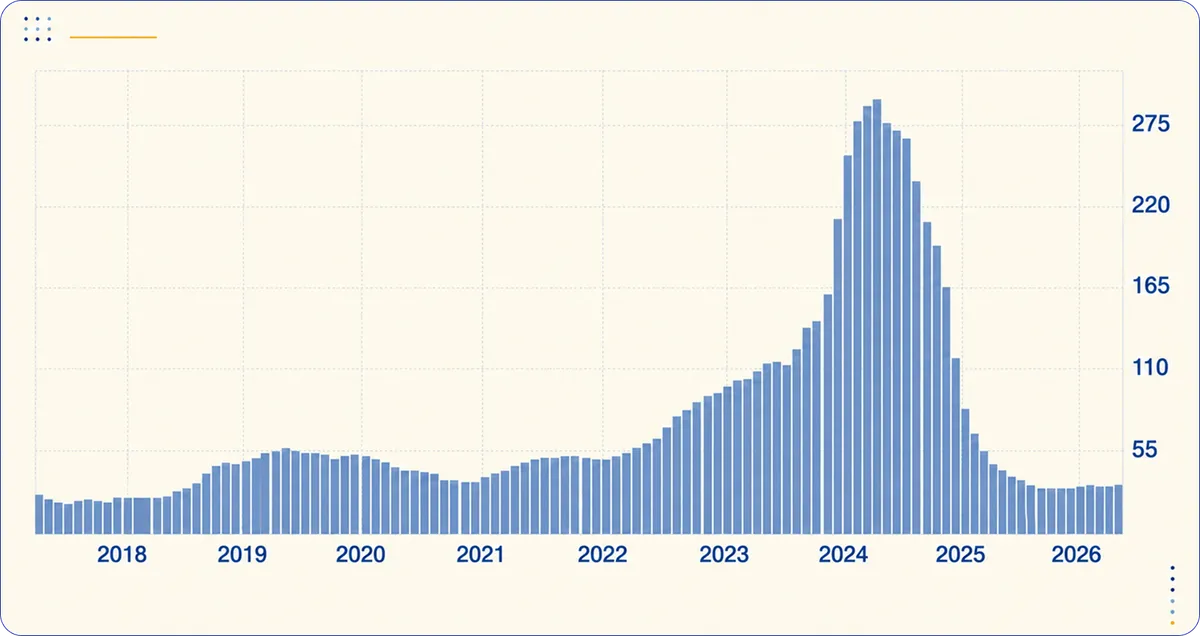
The recent economic cycle sits at the extreme end of that history. Inflation began accelerating in 2019, rising from 25% to an annual rate of 54%. After a brief slowdown to 35% in 2020, year-over-year inflation surged over the following three years, reaching 100% in 2023 and peaking at 292% in April 2024, shortly after Javier Milei took office. In the following months inflation finally began to decline, falling back to more familiar levels of around 35% in 2025, though this remains exceptionally high by international standards.ARGENTINA ANNUAL INFLATION since 2017 (YoY %)Credit: DefiLlama Research© INDEC

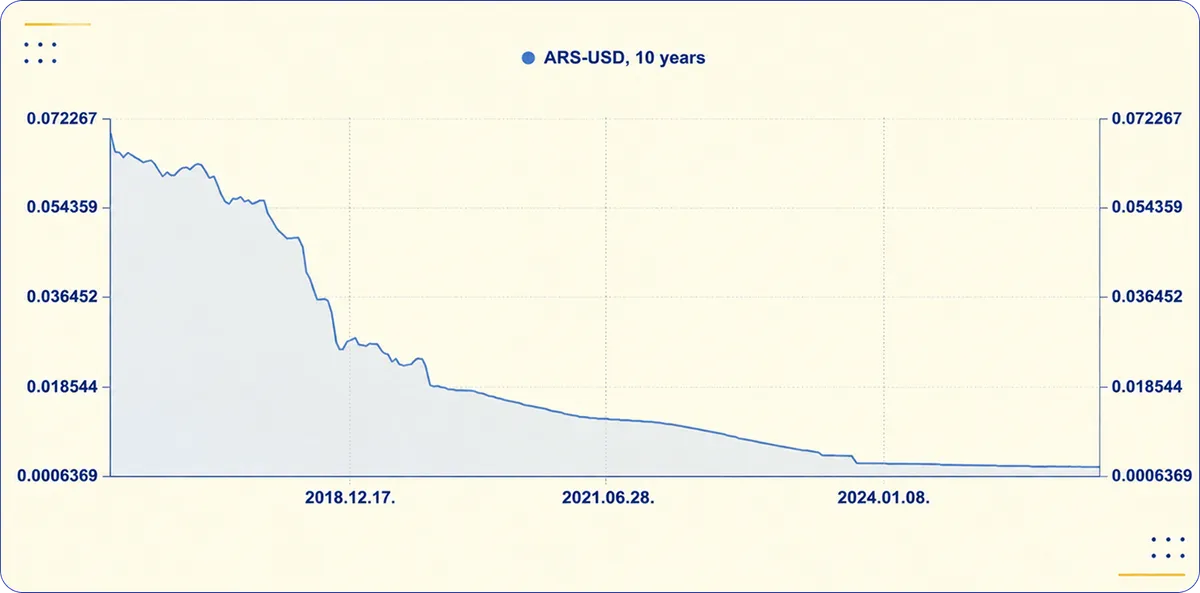
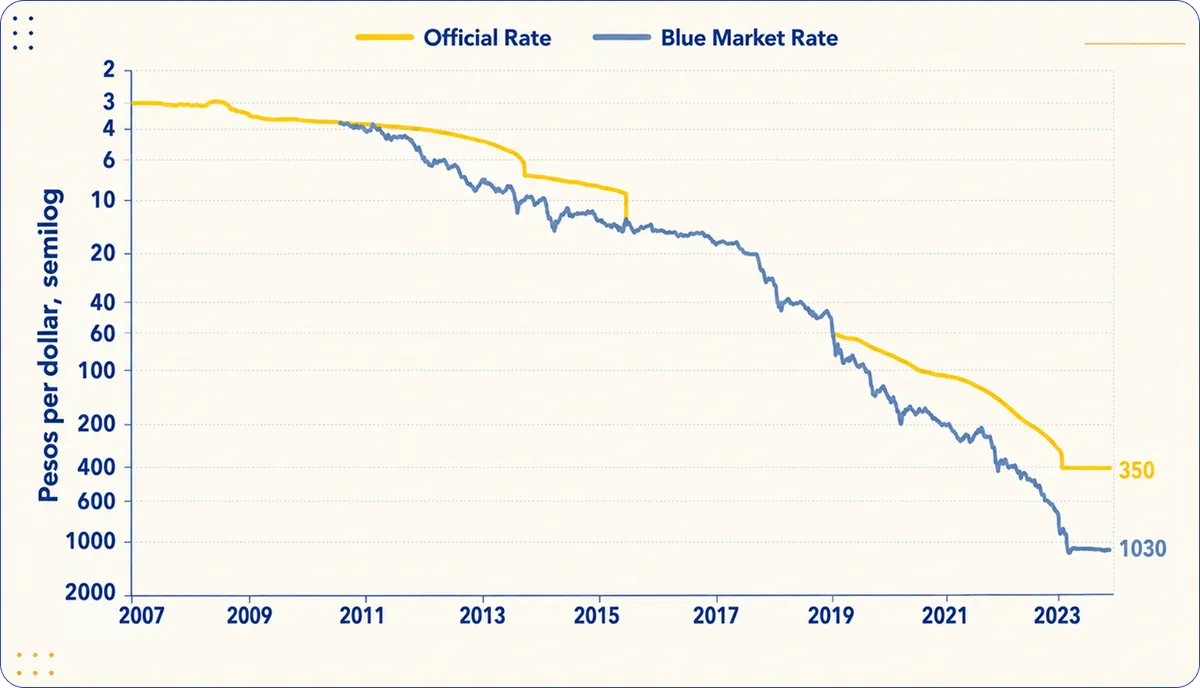
To illustrate what an extreme inflation rate of 292% means in practice, imagine a certain amount of cash could buy 1kg of pasta today. One month later, it would buy only around 890g. After six months, roughly 530g. After one year, just 255g. In other words, more than three-quarters of the purchasing power would disappear within a single year. And that's exactly what the Peso/USD chart reflects.
In such an environment, it is no surprise that Argentines seek alternatives to preserve their purchasing power. While gold can serve as a long-term store of value, people need something liquid enough to pay for everyday expenses. Over time, U.S. dollars became the preferred solution. The challenge, however, is that accessing dollars has often been difficult.
Access to the dollar was the problem
In most countries, buying U.S. dollars is relatively straightforward. In Argentina, however, access to dollars was heavily restricted and taxed, making it extremely difficult for citizens to move their savings out of the peso.
For years, the country operated under the cepo cambiario, a system of capital controls that limited individuals to purchasing a maximum of $200 per month at the official exchange rate through the so-called dólar ahorro. Not only was this amount relatively small for any meaningful savings protection, but purchases were also subject to a 30% tax advance on income and wealth taxes, collected at the point of purchase.
Anyone needing more than $200 per month, or unwilling to surrender 30% upfront to the state, had only one alternative: the dólar blue. This informal cash market operated in the gray areas of Argentine economic life, offering access to dollars at a significant premium to the official exchange rate and often requiring the right connections.
For Argentines, this came at a considerable cost. Since 2019, the dólar blue has frequently traded at premiums approaching 2x the official rate, as shown in the chart below. This premium largely reflected expectations of future peso devaluations. In other words, many preferred accepting a 2x exchange-rate penalty today rather than risking an even greater loss of purchasing power just a few months later.
The informal economy and the subscription gap
A second structural problem ran in parallel, affecting a different part of the population entirely. Argentina's informality rate reached 43.2% of the workforce in the second quarter of 2025, meaning four in ten workers hold jobs outside labor, tax, or social security regulation. Paid largely in cash, this segment of the population had no formal access to savings instruments, credit, or basic banking infrastructure at all. The dollar wall described above wasn't even a relevant constraint for them. They were outside the system before the question of dollars came up.
A third problem affected a much broader group, including Argentines who were fully banked. Foreign currency card transactions, including subscriptions to Netflix, Spotify, Adobe, and AWS, were treated by the financial system the same way as buying dollars: subject to the same tax surcharges under the cepo, and at various points restricted or blocked outright by banks. A $10 monthly subscription could end up costing 30% more than its sticker price, or fail at checkout entirely, regardless of whether the cardholder had a formal job or a healthy bank balance.
Stablecoins as a parallel channel
It's in this context that crypto became an evident solution, particularly through stablecoins as they sat outside the system entirely. Buying USDT through a local exchange wasn't a foreign exchange transaction subject to the $200 cap or the 30% withholding, it was a peso to crypto conversion on a private platform: no monthly limit, no tax at the point of purchase, no cash, no premium negotiation with a cueva.
For a population that had spent years either accepting the 30% haircut or navigating informal exchange houses with premiums, stablecoins offered the same outcome, dollar denominated value, through a channel the state hadn't built controls for or defined a framework around.
This is why Argentina's crypto adoption, outstanding as the following sections will show, isn't primarily a story about speculation, DeFi, or remittances. It is the result of a population that needed to protect its purchasing power and couldn't do it through official channels.
A use case emerging from the population itself, at this scale, tends to produce one of two government responses: restrictive, treating crypto as a threat to be contained, or accommodating, treating it as infrastructure to build on. Argentina took the second path, and it did so from 2024.
Milei as inflection point
By November 2023, when Javier Milei won the election, Argentina's crypto market was already well established, built informally by a population responding to the conditions described above. What the new government did was build a legal framework around it.
The core shift was currency competition: contracts can now be legally denominated in Bitcoin, USDT, or any cryptocurrency. The philosophy is straightforward: the market, not the central bank, should decide which currency people use, and that includes ruling out a central bank digital currency as a tool for regaining control.
A conversation with Simón Puebla
- Special Economic Zones have existed for decades, Shenzhen, Dubai's DMCC, E-Estonia. But they were designed for physical trade and manufacturing. You're betting that the same model works for the digital economy. Why is a SEZ the right structure for this, rather than a regulatory sandbox, a licensing regime, or simply better national legislation?
Because we didn't need to build anything new. The benefits already existed in Argentina under the Zonas Francas law and the Knowledge Economy law. They were just extremely hard to reach. We made them reachable. That means zero political cost and zero fiscal cost to the state, which is why this moved in months instead of years.
Compare that to the alternatives. A sandbox is temporary and narrow by design, so nobody builds a 10 year company inside one. A licensing regime regulates a single activity, it doesn't give you a perimeter. New national legislation costs political capital, takes years, and can be reversed by the next government. These two laws we leverage have been in place for over 20 years.
The other reason is that zones have already proven they work for regional development, but only when they are more than a legal framework.They have to be connected to the financial ecosystem, have a real tech ecosystem around them, and be run like a tech hub rather than a set of rules. That's the failure mode we're designing against.
To be precise, we're not a SEZ in the classical sense. We digitalize an existing free trade zone to expand what it can do. Same legal container, new operating system.
- This report documents why Argentina has a unique combination of conditions: a population that adopted crypto out of necessity, a world-class developer community that stayed and built locally, and a government that chose to formalize rather than fight what emerged.
From Andén's perspective, what specifically makes Argentina the right place to build the first Digital Economic Zone in Latin America, and what would disqualify another country from doing the same? Argentina already has every input. 10,000+ startups. 283,000 people employed in the knowledge economy, with a public target of 440,000 by 2030. 10B a year in knowledge based service exports, growing 20.8% year over year. One of the highest developer densities in the world.
Top regional universities, serious energy potential, and a government that is open to innovation instead of defensive about it.
And critically, the legal instrument already exists. Ley 24.331 article 6 enables services inside free trade zones. Ley 27.506 article 21 allows free trade zone benefits and Knowledge Economy benefits to accumulate in the same company at the same time.
The whole model operates by regulation: internal resolutions, controlled pilots, agreements between agencies. No new law required.
There's also a problem worth solving. Most high growth Argentine startups incorporate abroad. The talent stays here, the entity leaves. We're closing that gap.
What would disqualify another country: no stackable legal framework already on the books, so you'd need new legislation and the political cost that comes with it. No talent density, because a zone with no companies is just a document. And no institutional willingness to let a private operator run the digital layer. Take away any one of those three and the six month path disappears.
- Andén says a Digital Zone can be operational in six months and that the legal instrument already exists. If that's true, what's the hold-up? What are the one or two things that are still missing, whether regulatory, institutional, political, or cultural, before this becomes fully real?
It isn't a hold-up anymore. Zone 1 is approved and live, and digital incorporation is already open at incorporate.anden.tech. Companies are onboarding now.
What's still missing is on two fronts. First, capital. The province needs a stronger VC network and more access to funding so the companies that are already here and already growing can scale locally instead of leaving to raise.
Second, agility on the state side. Tax and compliance processes still need to be more digital and more streamlined for tech companies. We're automating a lot of that ourselves, but the underlying agencies moving faster makes the whole thing compound. We’ve found a government in Mendoza truly willing to make it happen - all that’s needed now is building and adopting the right tools to enable a more digitalized government. They have done a great job already with Mendoza por mi and other developments.
Neither of those blocks the zone. They determine how fast it grows.
- Concretely, what does a world with functioning Digital SEZs look like for an Argentine developer or a LATAM startup founder in their day-to-day life?
Concretely: they register the company digitally, in days, without a lawyer walking paperwork between offices. They get the tax benefits applied faster instead of hiring someone to chase them. They get commercial benefits from the partner network on day one, which for an early company is real money.
And their ongoing compliance, filings, and reporting run in the background instead of eating a week every month.
The end state is that a founder in Mendoza or Córdoba has the same operational baseline as a founder in Delaware or Singapore, without leaving the country. They spend their time building the business, not maintaining the entity.
- What does success look like five years from now if Andén works?
Mendoza is recognized as a regional tech hub in Latam, not as a promise but because the companies are there and visible. Also, we build an infrastructure that allows for traceability and auditability of transactions in the zone.
We've opened one or two more zones in other countries running on our stack, and they're driving real regional development in those jurisdictions.
We have one or two unicorns incorporated in the zone. We would have enhanced our value proposition beyond small and medium companies as we did today.
And we've pushed the benefits further at every level, national, provincial, and private, so that Argentina has the conditions to become the heart of the knowledge economy globally. Talent stays, entities stay, capital comes in.
What the Population Built
The behavior described in the previous section produced an interesting result: monthly active crypto users in Argentina in 2025 are roughly four times higher than at the peak of the 2021 bull cycle, yet crypto comes up less in everyday conversation than it did back then. That contradiction is the thread running through this section. Adoption became so deep it stopped being a topic and started being a habit.
In terms of scale, Argentina had roughly 8.6 million crypto users as of 2024, representing around 20% of the population. Of those, 12.5% are active on a monthly basis, significantly higher than any other country in Latin America. Volumes speak for themselves: more than $91 billion in value moved through Argentina over the twelve months to mid-2024, while the broader LATAM region generated $730 billion over 2025.
This penetration is reflected in global rankings. In the Bybit Global Crypto Adoption Index, made in collaboration with DefiLlama Research, Argentina ranks 30th overall but sits in the top 15 to 20 when it comes to transactional use and institutional readiness, with outstanding scores in stablecoin usage, centralized exchange volumes, VASP licensing, and fiat onramp and offramp infrastructure.
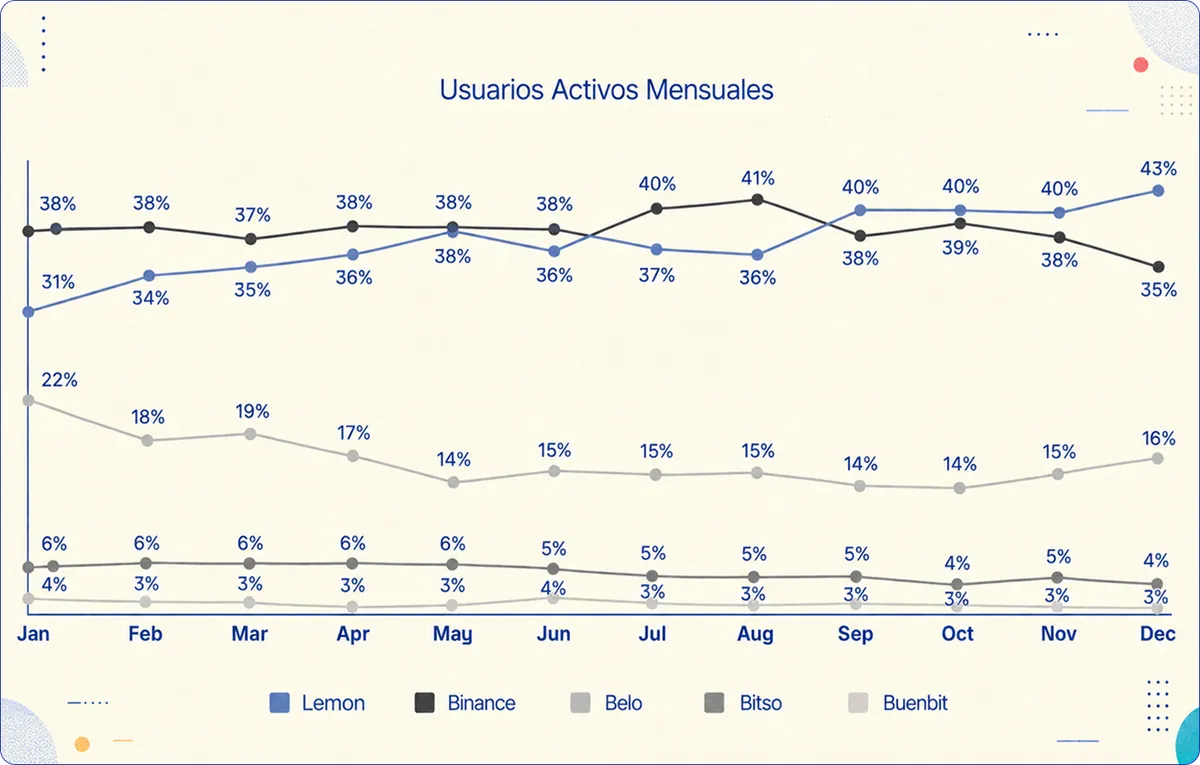
As for where this activity happens, 68.7% of total LATAM volume runs through centralized entities. In Argentina, Binance and Lemon together account for 70% of active sessions, followed by Belo at 13.9%. These platforms all offer frictionless fiat and payment solutions, which reflects the primary use case: people here are using crypto to manage money, not to speculate or trade, which also explains why DeFi remains marginal across the region.
Saving in dollars, at scale
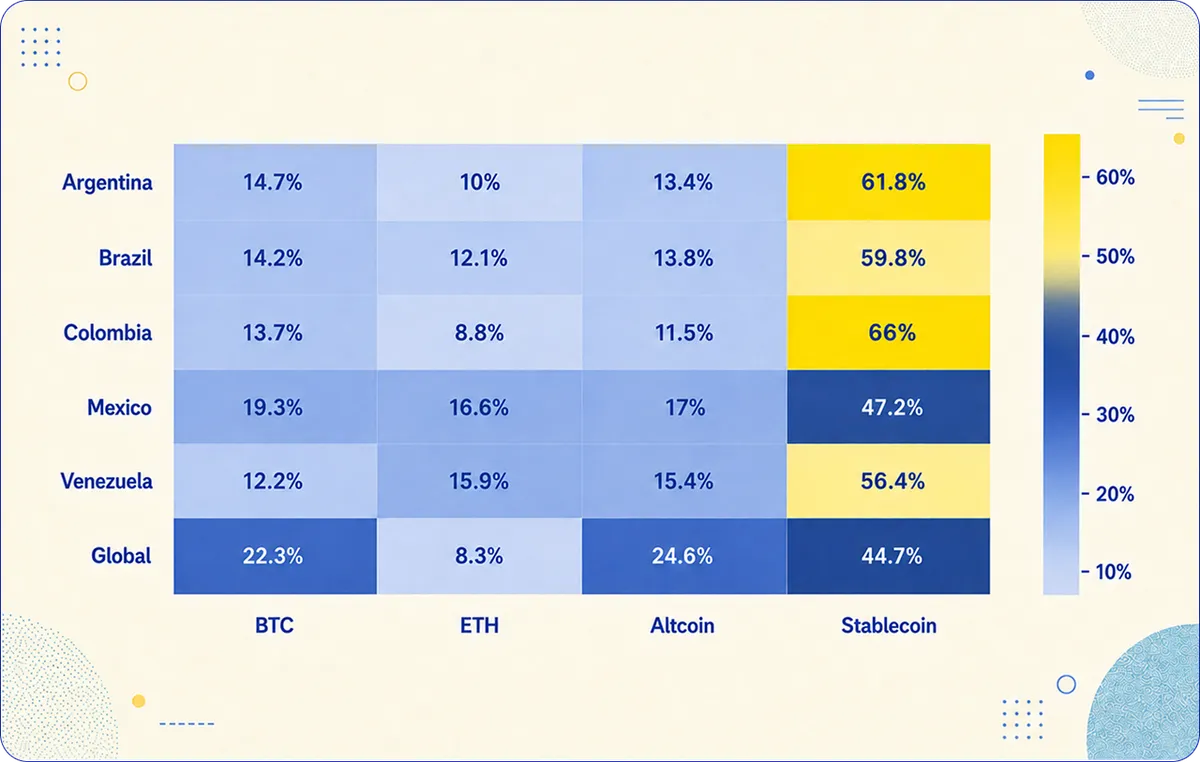
When checking deeper in the data, it’s with no surprise that we see converting pesos into digital dollars to preserve value is clearly visible being the main interest for Argentines.
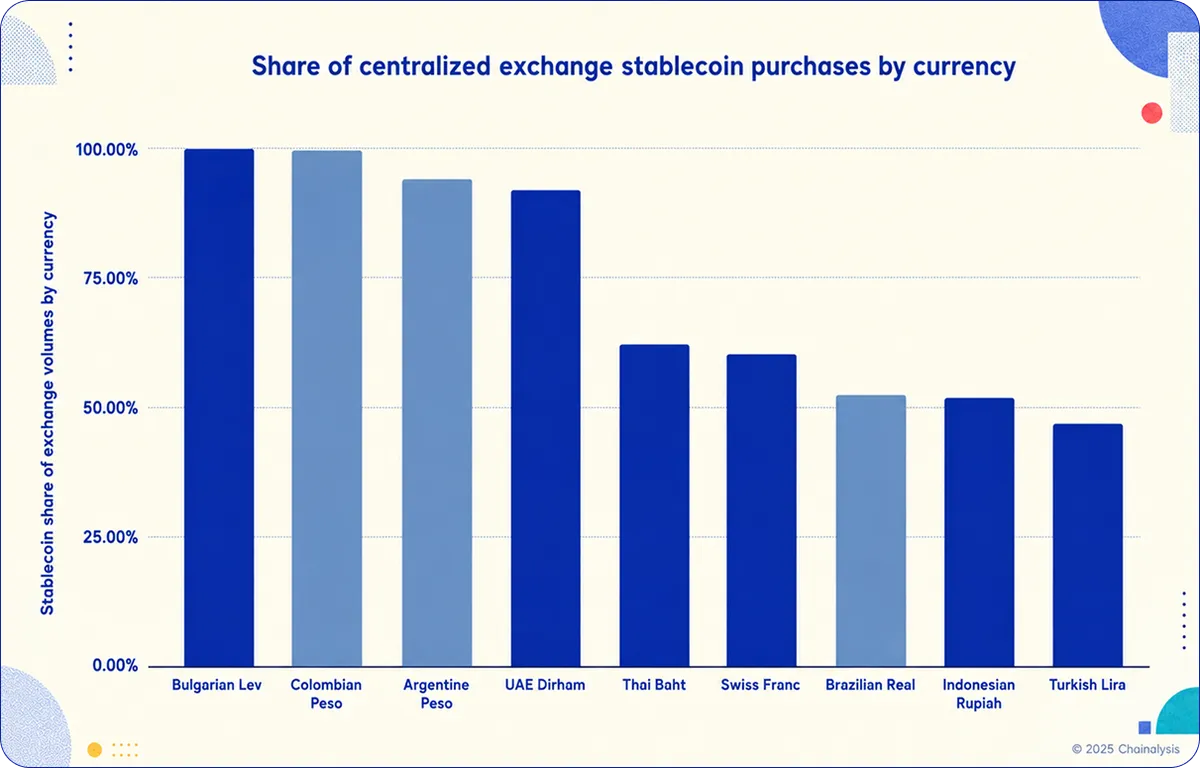
Between 2023 and 2024, stablecoins account for 61.8% of Argentine crypto transactions against a global average of 44.7% with USDT and USDC alone making up 72% of all exchange purchases. Between 2024 and 2025, more than 85% of the assets bought on exchange denominated in Argentine pesos were stablecoins. Additionally, stablecoin holdings grew 220% in 2025 signaling a growing appetite from Argentines to stack dollar denominated assets.
Bitso's 2024 transaction data shows a recurring pattern: volume spikes reliably around salary payment dates, as workers convert pesos into digital dollars before the month's inflation erodes the value. The same dynamic is visible in how people get paid.
According to Bitwage, only 2% of Argentine tech workers receive their salary in pesos while the remaining get it in USD or crypto. Among those paid in crypto, 75% choose stablecoins over volatile assets. But are Argentines actively using their stablecoins for payments?
From saving to spending
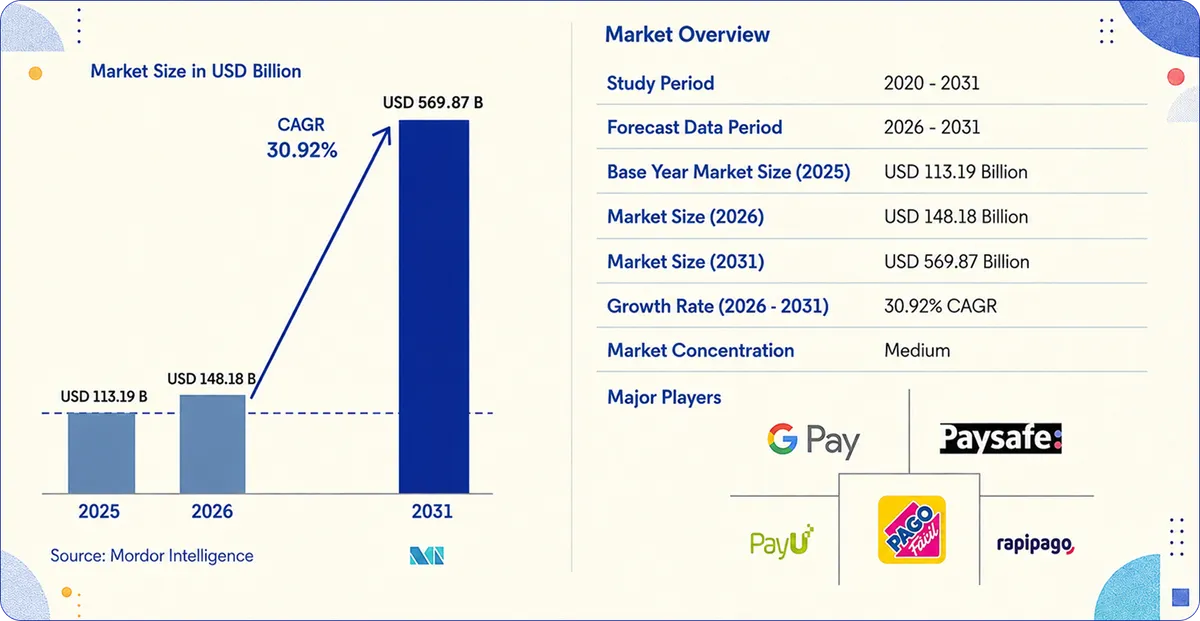
Argentina's payments market is undergoing a structural transformation that goes well beyond crypto. The market is expected to grow from $113 billion in 2025 to $570 billion by 2031, a compound annual growth rate of nearly 31%.
Digital wallets already command 46% of online transaction value and are forecast to reach 59% by 2027. Four in five Argentines pay via mobile, smartphone penetration sits at 97%, and electronic payment volume grew 68% year-on-year by late 2023, accelerated by the BCRA's Transferencias 3.0 programme, which made every QR code interoperable across all licensed wallets and settled transactions in real time.
In this environment, stablecoins are a natural fit. Argentina has seen a 16x increase in crypto mobile wallet usage over three years, according to a16z's State of Crypto 2025 report. And while Argentine consumers keep pesos only long enough to make immediate purchases, they increasingly spend the stablecoins they accumulated as protection against inflation.
Lemon is a prime example: users deposit pesos into the app, use them for daily purchases via the app or the card, and earn Bitcoin cashback on every transaction. Lemon has issued over one million Visa cards in Argentina and Peru, distributed $29 million in Bitcoin cashback since 2021, and counts 1.2 million monthly active users.
The momentum is broadening. In January 2026, Lemon launched Argentina's first Bitcoin-backed Visa credit card, allowing users to access peso credit lines using BTC as collateral without liquidating their holdings. Buenos Aires began accepting municipal tax payments in crypto via QR in August 2025. Belo, the country's third-largest platform by active sessions, raised $14 million in April 2026 in a round led by Tether, signalling that the world's largest stablecoin issuer is betting on Argentina's payment rails as a regional expansion vector. Binance extended its payment services to LATAM in October 2025, introducing QR code payments in Argentina and across the region, generating over $40 million in volume in its first year of operation.
When crypto disappears into the rails
The picture that emerges isn't of a crypto economy built on trading. It's a payments economy where stablecoins have become the settlement layer for daily life, running on infrastructure that is slowly becoming invisible. Argentines are increasingly using crypto without noticing it.
That's the result of more than a decade of builders taking risks and building without a framework. One that is only now coming into form. Who those builders are, and what that says about Argentina beyond its own borders, is where the next section picks up.
Argentina's Builders: From Crisis to Global Infrastructure
Argentina's crypto adoption was driven by its own population, seeking to protect their purchasing power. But none of that would have been possible without a generation of builders and innovators who, long before regulation became favorable, laid down the infrastructure that would meet that need. Here is how that evolution unfolded.
The first wave
The first wave is a category of early innovators: people who saw what most others didn't and built on conviction rather than permission. They didn't wait for a regulatory framework or a favorable government stance. For them, the problem was real, the tools were available, and that was enough to act.
Wences Casares is the clearest example. He grew up on a sheep ranch in Patagonia, and his parents lost their savings to inflation more than once, the same mechanism described at the start of this report, just a generation earlier. In 1994 he founded Argentina's first internet service provider. In 1997 he founded Patagon, an online brokerage that expanded across Latin America, the US, Spain and Germany before Santander acquired it for $750 million in 2000.
In 2011, Casares discovered Bitcoin. He has described the realization in direct terms: a currency the state couldn't devalue would have solved his parents' problem, and his own. He founded Xapo to build that solution, one of the first Bitcoin custody platforms in the world. Xapo went on to bring Bitcoin to a broader audience in Silicon Valley, and Casares joined the boards of PayPal and Diem.
A house in Palermo
In 2014, a group of young programmers turned a house in the Palermo neighbourhood of Buenos Aires into a crypto coworking space called Casa Voltaire. It was founded by Manuel Araoz, with Demian Brener, Esteban Ordano, Ariel Meilich and Santiago Palladino among its regulars. The shared premise was straightforward: use cryptography to build alternatives to systems that had repeatedly failed.
What came out of that house is infrastructure that the entire industry depends on: OpenZeppelin founded in 2015. After the DAO hack in 2016, OpenZeppelin published audited, reusable smart contract libraries that became the security standard for the industry, used by most major DeFi protocols. In 2017, Argentine developer nanexcool helped MakerDAO build its first decentralized oracles and deployed SAI, the first decentralized stablecoin backed by ETH. In 2018, Argentine developers Santiago Palladino, Esteban Ordano and Francisco Spagnuolo contributed to the implementation and adoption of ERC-721, the NFT standard. In 2019, Patricio Worthalter created POAP at ETHDenver, now used across the Ethereum ecosystem. In 2020, Franco Zeoli and Patricio Palladino co-founded Hardhat, now one of the most widely used Ethereum development environments in the world.
None of these are Argentina-specific products. They're global standards, written by Argentines, several of them explicitly motivated by the experience of living through monetary collapse and wanting to build something that didn't depend on third parties and governments that could fail. What is striking is that all of it was built with no VASP licensing, no banking support, and during a period where banks were actively prohibited from touching crypto.
Building for home
While some Argentine builders exported their solutions to the world, others directed the same energy inward. The local market had the same problem: Argentines needed tools to protect their savings, receive income, and transact in something more stable than the peso. A parallel cohort of founders set out to build exactly that, and the result is the platform layer that millions of Argentines use today.
Ripio, originally BitPagos, started in 2013 helping merchants trade pesos for Bitcoin, one of the earliest functioning exchanges in the country. Buenbit launched in 2018 with a stablecoin-first focus, marketing DAI savings products during the 2020-21 inflation spike with support from the Maker Foundation. Lemon launched in 2019 as a wallet and card platform, now central to the cashback and payments behavior described in the previous section. Belo launched in 2020 for freelancers and remote workers, building one of the first direct ACH-to-wallet transfer products for cross-border payments. In 2024, Borja Martel Seward, a Lemon co-founder, launched Roxom, an exchange where stocks, commodities and derivatives are denominated and settled in Bitcoin.
Interestingly, none of these companies were built for a crypto-native audience. They were built for Argentines who needed a better way to manage money in a broken monetary environment, by founders who understood that need because they had lived it. And like everything else in this section, they were built without a framework.
Where the ecosystem stands and who is arriving
Over time, and as regulation gradually moved in favorof crypto, the number of founders, startups and innovators kept growing, giving rise to strong local communities. The Cámara Argentina de Fintech counted 158 member fintechs in 2019. By 2024 that number had grown to 432. Crecimiento, launched in 2024, runs pop-up events in Buenos Aires aimed at positioning the city as a regional crypto hub, drawing thousands of attendees from across the region and beyond.
But the stronger signal comes from outside Argentina, where capital is now flowing into infrastructure built by Argentine entrepreneurs with little institutional support. In October 2025, F-Prime and ParaFi led Lemon's $20 million Series B. Draper Associates backed Roxom's Series A, and in April 2026, Tether led Belo's $14 million funding round. These are investments in an ecosystem that already exists, already serves millions of users, and already processes billions of dollars in volume. The goal is simple: accelerate growth as the regulatory framework finally begins to catch up with the reality of the market.
And that is where one of Argentina's core strengths lies. While most countries building a crypto regulatory framework have to simultaneously build the market and attract builders, Argentina doesn't. When the CNV (Comisión Nacional de Valores) produced four major resolutions between 2024 and 2026, it was formalizing a system that had been running for over a decade, built by engineers who responded to monetary failure with code rather than waiting for permission.
That regulatory framework, which can be read as a formal recognition of what builders spent years constructing, is the subject of the next section.
The Architecture of Formalization
Argentina's regulatory evolution stands out globally. In the space of two years, the country moved from an outright ban designed to protect the peso to one of the most complete VASP frameworks in the world, a shift that most comparable markets have not come close to replicating.
BCRA flipping its stance over night
In May 2022, after obtaining verbal approval from the BCRA (Banco Central de la República Argentina), Banco Galicia and Brubank introduced crypto trading for their customers. The products were operational, users were onboarding, and for a brief moment Argentina looked like it might integrate crypto into its formal banking system ahead of most of the world.
Two days later, Communication A7506 put an end to it. The BCRA prohibited all financial entities from offering or facilitating crypto services to their clients, effective immediately.
The decision was widely read as hostility, but the BCRA's official reasoning was precise: every crypto operation, in its view, was a foreign exchange operation. With the cepo cambiario still active, the peso under severe pressure, and dollar demand already difficult to manage, opening a crypto channel through the banking system risked creating an uncontrollable FX demand vector at exactly the wrong moment. The ban was a sequencing call made under specific macro conditions, not an ideological rejection of crypto.
From prohibition to architecture
What changed between 2022 and 2026 isn't the BCRA's view of crypto but the political and macroeconomic conditions that made the ban necessary. When Javier Milei took office in December 2023, many reforms were undertaken. The most important one for our topic is the liberalization of money, meaning a free market for currencies where the peso would compete against other currencies such as the US Dollar or even Bitcoin.
Consequently, the cepo cambiario was progressively dismantled, restoring free dollar access for the first time in years. Following the reforms, monthly inflation fell from 25% at the start of his term to under 3% by early 2026.
This created the conditions for the Comisión Nacional de Valores, operating under a government now philosophically aligned with crypto, to build a regulatory architecture that gave the BCRA something it didn't have in 2022: a framework to operate within.
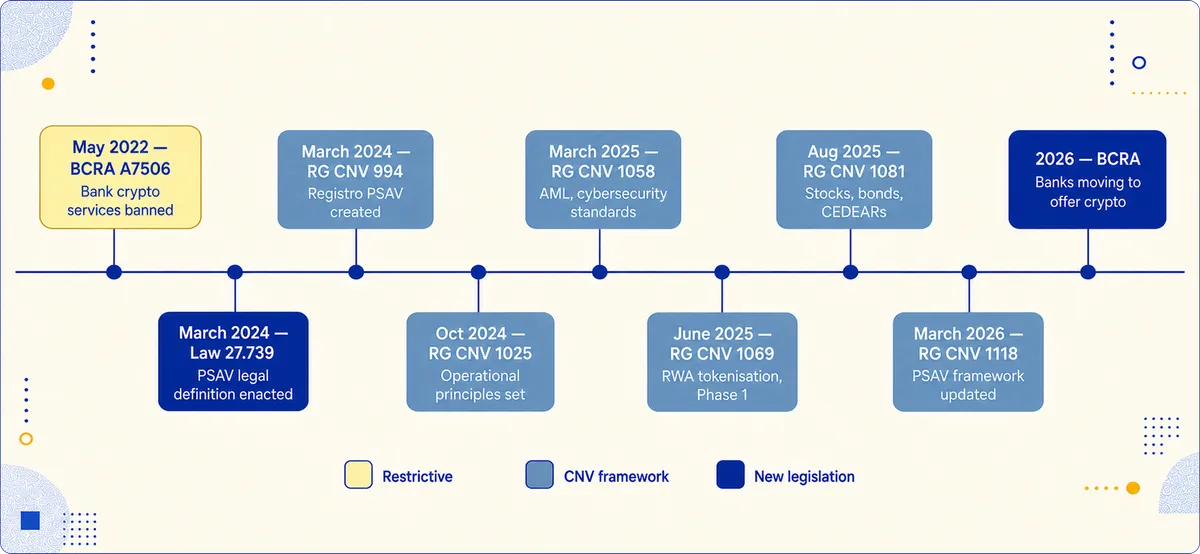
Actually that framework was built remarkably fast. Between March 2024 and March 2026, the CNV produced seven major regulatory instruments that changed the crypto landscape in Argentina:
Law 27.739, published in the Boletín Oficial on 15 March 2024, introduced the legal definition of Proveedor de Servicios de Activos Virtuales (PSAV) into Argentine law, making Argentina the first country in Latin America to reach this level of statutory clarity. The law mandated AML and KYC compliance aligned with FATF standards for any entity providing virtual asset services.
In March 2024, resolution CNV 994/2024 created the Registro PSAV, requiring all individuals and entities providing virtual asset services to register with the CNV before operating. The obligation applied to local and foreign firms alike, establishing a clear perimeter for who is in scope and who must comply.
In October 2024, resolution 1025/2024 set the operational principles governing registered PSAVs, covering governance structures, reporting obligations, and conduct standards expected of licensed operators. It translated the registration requirement into a functioning compliance framework.
In March 2025, resolution 1058/2025 expanded the requirements to cover cybersecurity obligations, transaction monitoring, and enhanced AML/CTF controls, bringing Argentina's framework into closer alignment with FATF standards and international best practice.
In June 2025, resolution 1069/2025 opened the first regulatory framework for the tokenization of real world assets via DLT, covering unlisted securities. It made Argentina the first country in Latin America to create a specific legal basis for RWA tokenization, with PSAVs able to participate as depositants.
In August 2025, resolution 1081/2025 extended the tokenization framework to stocks, negotiable bonds and CEDEARs, broadening the scope significantly. A regulatory sandbox runs to August 2026, allowing experimentation within defined limits before full rules apply.
In March 2026, resolution 1118/2026 updated the structural title of the PSAV regulatory framework, reflecting the consolidation and maturity of the architecture built over the preceding 18 months.
Six major resolutions in 24 months, on top of a foundational law. The CNV president Roberto Silva described the pace explicitly: "we are at the vanguard, regionally and of many countries in the world." The data supports that.
Argentina's 24-month regulatory build stands out by any comparative standard. Switzerland, widely recognized as one of the world's most crypto-friendly financial centers, has been integrating digital assets into its existing legal framework since FINMA's first ICO guidelines in 2018, a seven-year incremental process with no standalone crypto statute and its first DLT trading facility only licensed in March 2025. Singapore's Payment Services Act, enacted in 2019, reached full enforcement only in June 2025, a six-year build that now covers 33 licensed firms. The European Union's MiCA took four years from proposal to entry into force in December 2024, and has been widely criticized for its restrictive approach and chilling effect on innovation. El Salvador moved faster than anyone, making Bitcoin legal tender in 2021 and introducing a Bitcoin-linked residency visa, but the framework has barely evolved since. Brazil passed a solid VASP framework in 2022-2023 but is simultaneously building a CBDC, pointing in a different philosophical direction. The United States is perhaps the closest parallel in terms of recent momentum, with significant regulatory activity since the Trump administration took office, though fragmentation across agencies and competing jurisdictions continues to slow progress.
Hence, it is without surprise that Argentina ranks among the leaders in most global indexes for infrastructure and regulatory clarity. And that performance reflects something structurally unique: regulation is easier to build when you already know what you are regulating. In simpler words: Argentina didn't have to imagine what a functional crypto market looks like as its population was already using one and its builders had already laid the tools and rails underneath it.
The no-CBDC choice
One institutional decision worth noting explicitly is the deliberate rejection of a central bank digital currency, consistent with the currency competition philosophy that runs through Argentina's broader economic strategy. The argument is straightforward: why build a state-issued digital currency when private stablecoins already serve millions of users at scale, with deeper penetration than any CBDC has achieved anywhere?
This puts Argentina in deliberate contrast with Brazil, which is actively developing Drex, and with the broader global trend toward state-controlled digital currencies. It is a position that the adoption data, so far, continues to validate as adoption grows.
What remains open
The architecture has gaps, and they are worth stating directly.
Tax treatment for crypto gains remains ambiguous under Ganancias and Bienes Personales. This is the primary friction point for formalizing retail holders and the most commonly cited barrier by compliance-focused institutional investors considering the Argentine market.
Crypto deposit protection has not been formalized: users holding assets on exchanges have no equivalent of the deposit insurance that applies to bank balances.
Also, stablecoins do not yet have a specific legal category distinct from other virtual assets, creating interpretive uncertainty that the CNV has acknowledged but not yet resolved.
Still, the progress made over the past two years is outstanding: the rails are in place, the regulatory perimeter is defined and millions of people are already using the infrastructure. What is now missing is the institutional layer: the banks, the capital markets and the asset managers that will considerably boost adoption. And they are coming.
A conversation with Andrés Ondarra
- Argentina moved $93.9 billion in crypto volume over three years and generates the highest per-capita crypto volume in Latin America. Out of every market Nexo could have picked for a LATAM hub, what made Argentina the obvious choice, and how much did the Buenbit acquisition shape the timeline versus the underlying market itself?
We chose Argentina because of how its users behave. According to Chainalysis's Global Crypto Adoption Index, Argentina leads Latin America in per-capita adoption, with close to 19.8% of the population using cryptocurrencies in some form, placing it within the global top 20 for adoption. That profile — retail, non-institutional, looking to protect against inflation and dollarize savings — is exactly the profile our value proposition is designed to serve: daily-interest savings, crypto-backed credit, and now the Nexo Card.
There's an additional point that doesn't always show up in volume statistics but was decisive for us: Buenbit already offered its more than one million users the ability to invest from very low amounts in U.S. stocks. For years, the average Argentine investor could only access fractional U.S. assets through CEDEARs, which trade in pesos and are exposed to the exchange-rate gap. Buenbit solved that friction with an account denominated directly in dollars. Finding that product already built, tested, and with real traction was a very clear signal that Argentina not only had the market best suited for us, but also the talent and infrastructure to scale it with Nexo's global platform.
On top of that, since 2024 Argentina's National Securities Commission (CNV) made registration as a Virtual Asset Service Provider (VASP/PSAV) mandatory to operate legally in the country. Buying a platform that was already registered and licensed — with a clean track record and an established user base — allowed us to enter much faster than if we had started the licensing process from scratch. In short: the market explains why Argentina; the acquisition explains why we were able to move at the speed we did.
- Nexo entered Argentina by acquiring Buenbit rather than registering as a PSAV from scratch. Was that regulatory shortcut the deciding factor in choosing Argentina over other LATAM markets, or did the $93.9 billion in three-year volume and the $2,041 per-capita figure (highest in the region) matter more?
One thing is why we chose Argentina, and another is why we chose to enter by acquiring rather than registering ourselves.
We were going to bet on Argentina regardless: the size of the market and, above all, the intensity of use — the enormous local habit of using stablecoins as a savings tool rather than for speculation — already justified it on their own. What determined the form of entry was purely regulatory. Registering a VASP from scratch involves meeting minimum net-worth requirements, custody policies, compliance and cybersecurity standards, and going through the CNV's approval timelines. Acquiring Buenbit, which was already registered and had a clean operating track record, saved us that time and that risk, and allowed us to start operating with the regulatory confidence already built in. But it wasn't just a licensing matter: the appeal we saw in Buenbit's platform, with a solid track record and a value proposition that resonated strongly with Argentine users, was equally decisive. That already-built product, together with the regulatory registration already obtained, helped us accelerate our expansion into a market that is so strategic and such a priority for Nexo.
- Argentina has one of the most stablecoin-native user bases in the world, with the vast majority of exchange activity happening in dollar-pegged assets. How has building for Argentine users shaped the way Nexo thinks about its products globally? Is this a market that's pulling Nexo's roadmap forward rather than the other way around?
The influence runs in both directions, and that's actually the interesting part. Daily-interest digital-dollar savings and crypto-backed credit already existed on Nexo's global platform before we arrived in Argentina. What changed here was how we communicated it and what local rails we built so a user could move in and out of those products from a local bank account without friction: for example, in addition to being able to fund the account with pesos, we recently launched local dollar rails, which allow moving dollars between a local bank account and the platform instantly — something designed specifically for the logic of the Argentine saver.
But it's also true that Argentina is serving us as a testing ground. Our intention is, building on this experience, to expand into other markets with similar dynamics — high inflation, capital controls, the need for dollarization — and that includes both products and narrative. Argentina isn't rewriting our global roadmap, but it is accelerating and validating it under real conditions, with a level of usage that few markets in the world have. That learning is part of what we now want to bring to Peru and Mexico.
- The digital dollar savings product is being positioned as an upgrade on the traditional plazo fijo. What was the reaction from Argentine users when Nexo introduced it, and what does that tell Nexo about how ready this market is for crypto-native savings tools compared to other countries it operates in?
We officially launched the product in March 2026, presenting it, without overstating it, as an alternative to the traditional fixed-term deposit: stablecoin savings with daily interest credited automatically and no minimum terms, with immediate availability of funds, and a yield that at the time stood around 13% annual in dollars — above the average for local fixed-term deposits and mutual funds, which were around 8% annual at the time. As part of the launch, we lowered the entry threshold for our loyalty program's welcome benefit (Platinum tier) to a deposit of US$1,000 within the first seven days, so that more users could access a benefit originally aimed at higher-capital users.
The reception was very positive and faster than in other markets where we operate: Argentine users don't need us to explain what a stablecoin is or why it makes sense to save in digital dollars — they already arrive with that habit. That makes Argentina, compared with other countries in the region, a particularly mature market for this type of product.
- Nexo became the AFA's regional digital asset partner for what turned out to be a massive year for Argentine football. Looking back at the World Cup now that it's behind us, what did that partnership deliver for Nexo, and how did the AFA relationship change the way Argentines think about the brand?
In April 2026 we became the Official Regional Digital Assets Partner of the Argentine national football team for South America, a one-year agreement that included ticket giveaways for Argentina's World Cup matches, signed jerseys, and content with national-team players. We chose to partner with the Argentine national team because we share the same values: discipline, ambition, and the idea that you can always go further are the same principles we built Nexo on. Beyond the sporting result — Argentina reached the World Cup final, which remains a source of pride for the whole country — for us the value of this partnership never depended on a single result, but on something deeper: it allowed us to humanize and localize the brand, to show that Nexo understands and shares what matters to Argentine people, to show that behind the platform there's a local team, of Argentines, working every day so that other Argentines have better financial tools, and to associate ourselves with a symbol that brings together millions of people regardless of whether they already use crypto or not.
The partnership with the AFA was consistent with our local strategy: it wasn't generic advertising, but about building a long-term relationship with a country that has already chosen digital assets as part of its everyday financial life. That's why our campaign was built around that idea of continuity and progress — "always moving forward" — and the constant pursuit of the next generation of champions, both on the field and in the way we think about the future of digital finance in Argentina. We feel inspired by those who always go further.
- Banks are expected to start offering crypto services in Argentina once the BCRA lifts its restriction. Does Nexo see that as validation of the market it's already built in, and what does it want its role to look like once that happens?
It would be great news for the whole ecosystem, and yes, we would read it as validation. If the Central Bank decides to lift the restrictions that currently prevent banks and payment service providers (PSPs) from offering crypto, it's because the market that platforms like ours built over years of restrictions has already shown demand solid enough for traditional banking to want to get involved. And that, ultimately, is good for the user: more access, more competition, and more opportunities for more people to benefit from what digital assets offer.
We don't see it as a threat to what we've built, but as the next stage in this market's maturation.
- Buenos Aires is now Nexo's hub for expanding into Peru and Mexico. What is it about what's been built in Argentina that Nexo is most excited to bring to the rest of the region?
What excites us most is having proven, with real numbers rather than just hypotheses, that a digital-dollar savings product with a strong local narrative — positioned against traditional savings instruments people already know, like the fixed-term deposit — can drive mass adoption in a market under currency stress. That learning, together with the experience of building local rails in domestic currency to reduce onboarding friction, and a brand strategy with cultural grounding like the one we had with the AFA, is exactly the combination we want to replicate in Peru and Mexico.
These are markets with their own dynamics: Mexico, according to Chainalysis, is the region's third-largest market by volume, and Peru, though smaller, is growing strongly. In both cases the pitch is similar to Argentina's: access to better dollar rates, wealth diversification, and, over time, the ability to move money between countries in the region more simply. Buenos Aires functions as the center from which we coordinate that expansion, drawing on the team and the knowledge we've already built here.
- If everything goes right for Nexo in Argentina, what does the company look like here in five years, and what role does Nexo want to have played in Argentina's crypto story by then?
I think we're already seeing it, and that gives us a lot of confidence about where we're headed. In five years, we picture Buenos Aires consolidated not only as the hub toward Peru and Mexico, but as a relevant decision-making center for all of South America. We also picture much deeper integration between crypto and the traditional financial system, and Nexo as one of the reference players in the convergence of financial solutions that let users manage their assets through comprehensive offerings and access to more efficient products.
The challenge ahead of us is staying differentiated from other local and international exchanges competing for the same dollarized audience, and the way to achieve that is by keeping doing what got us here: listening to what the Argentine saver needs before anyone else, building products from that, and then bringing them to the rest of the region. If in five years people associate Nexo with having helped millions of Argentines preserve the value of their savings in a simpler and more transparent way, we will have fulfilled the role we set out to play.
Institutions are entering the arena

So far this report has shown that Argentina's crypto economy was built from the bottom up: a population in need of an alternative monetary system created the demand, a generation of engineers built the infrastructure, and a government built the framework around it. All the ingredients are now in place for institutions to enter the market.
Banks at the door
The most structurally significant institutional development is the one closest to completion. The BCRA is now preparing to lift Communication A7506, the same ban it imposed in 2022, and allow banks to offer crypto services through legally separate entities. The initial asset list under discussion covers BTC, ETH, USDC, USDT and XRP.
The scale implication is straightforward. Argentina's formal banking system reaches demographics that crypto exchanges still don't. Banks will allow existing account holders to access digital assets through institutions they already trust without the challenges of using a wallet or a new crypto app. The potential is huge with millions of users entering a market that already has 8.6 million active participants and all of this without rebuilding the infrastructure.
One tension deserves honest treatment. Lemon and the Cámara Argentina de Fintech have formally requested that banking authorization and the PSAV framework advance in parallel, not sequentially.
Their concern is competitive asymmetry: if banks enter the market under different or more permissive conditions than the exchanges that built the ecosystem, the regulatory balance tips against the very players who created the infrastructure.
This is a legitimate concern, and how the BCRA resolves it will be one of the clearest signals of whether Argentina's regulatory posture is genuinely ecosystem-friendly or simply open to incumbents.
Argentina's capital markets go onchain
The second institutional frontier is the tokenization of Argentina's capital markets. Globally, tokenized real world assets currently represent around $30 billion onchain and $350 billion in represented underlying value, a figure that has tripled year on year. For any country that moves early with a clear regulatory framework, the opportunity is significant. Argentina is doing exactly that, with the CNV building its tokenization framework in two deliberate phases and describing the overall effort as its "Big Bang" of regulatory reform.
Resolution 1069/2025 established the first regulatory framework specifically for real world asset tokenization in Argentina, covering financial trusts and closed mutual funds backed by physical assets, making Argentina the first country in Latin America to create a specific legal basis for RWA tokenization. Two months later, Resolution 1081/2025 extended that framework to marketable securities: shares including dual-listed stocks, negotiable bonds, and CEDEARs. Tokenization is no longer limited to alternative assets, it is now a legally recognized mechanism applicable to the full range of publicly offered financial instruments. Importantly, token holders receive the economic rights, interest, dividends, amortization, while governance and voting rights remain with the registered owner. Investors can convert tokenized positions back to traditional form at any time.
What comes next is already being designed. In May 2026, the CNV proposed Draft Resolution 1137, which removes the restriction on specific financial instruments, allowing any closed-end mutual fund with automatic public offering authorization to migrate to digital asset format. The proposal also extends the sandbox to December 31, 2027, a signal that the CNV isn't winding the experiment down, it's widening it.
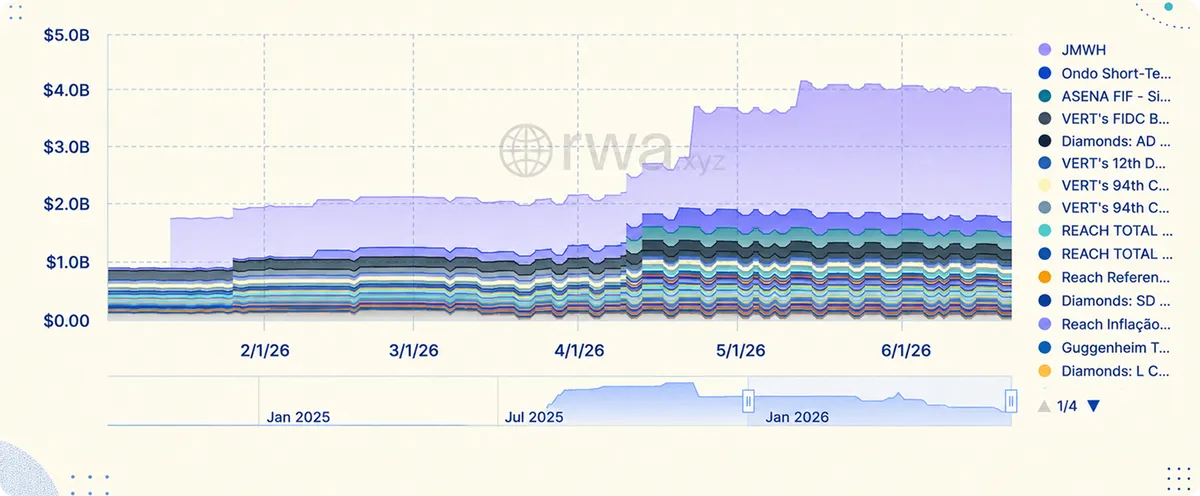
This regulatory clarity is what institutions had been waiting for, and the first examples are already emerging. In early 2026, Argentina's state-backed energy company YPF Luz launched Enertoken, a platform that tokenizes and manages electricity contracts on XRPL, developed in partnership with Justoken. The underlying token, JMWH, has since become the largest represented asset on XRPL by total value, reaching $2.2 billion in underlying value.
On the startup layer, BoulderTech, founded by a former MercadoLibre executive, is working with major Argentine real estate owners to bring property assets onchain. Berry gives Argentines access to the US stock market through tokenization. Betrusty is working to tokenize rental access.These are early examples, but they reflect a broader dynamic: Argentina's innovation is homegrown, and this attracts capital through investments.
Private capital responding
Thanks to its regulatory clarity and the innovation happening, Argentina is attracting another audience beyond the classic institutions: the investors. And what they are doing is the clearest available signal of whether Argentina's positioning is being taken seriously.
In October 2025, F-Prime Capital and ParaFi Capital led Lemon's $20 million Series B, the first major crypto funding round in Latin America in three years. The investment was explicitly framed as a bet on Argentina as a regional expansion hub, not just a domestic platform. Draper Associates backed Roxom's Series A the same year. In April 2026, Tether led Belo's $14 million raise which should be seen as a direct signal from the world's largest stablecoin issuer that it views Argentina's payment rails as a regional expansion vector. Zonda Bitcoin Capital launched Argentina's first public Bitcoin treasury model, targeting 1,810 BTC through BlackRock's IBIT ETF.
Overall the direction is clear for institutions: everything they need is there, from infrastructure to users to regulation. They are entering through various channels and this momentum is expected to grow in the coming months. But to understand why this outcome is unique, it helps to look at what happened in the countries that faced the same conditions but made different choices and at the countries that are culturally closer and succeeded via another path.
A unique path in a crowded field
The story behind the emergence of Argentina's crypto economy is not unique. Other countries have faced inflation, currency devaluation, and restricted access to harder assets but they didn’t take the path Argentina did. At the same time, in LATAM, Argentina's level of adoption places it alongside Brazil, the region's other crypto leader, which got there through an entirely different model. In this section, we compare both to understand why Argentina's path stands as a case of its own.
Argentina and Brazil: two leaders, two philosophies
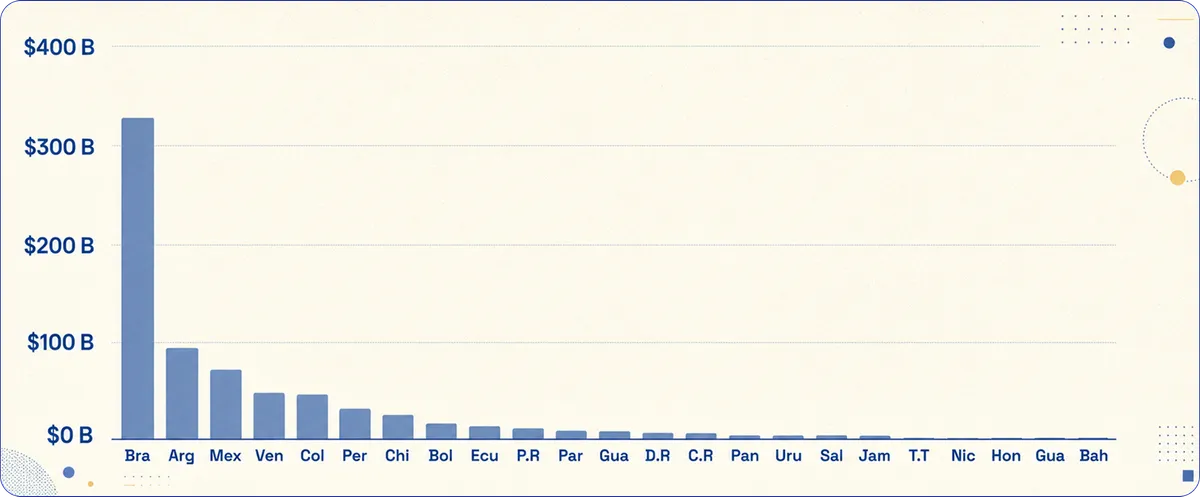
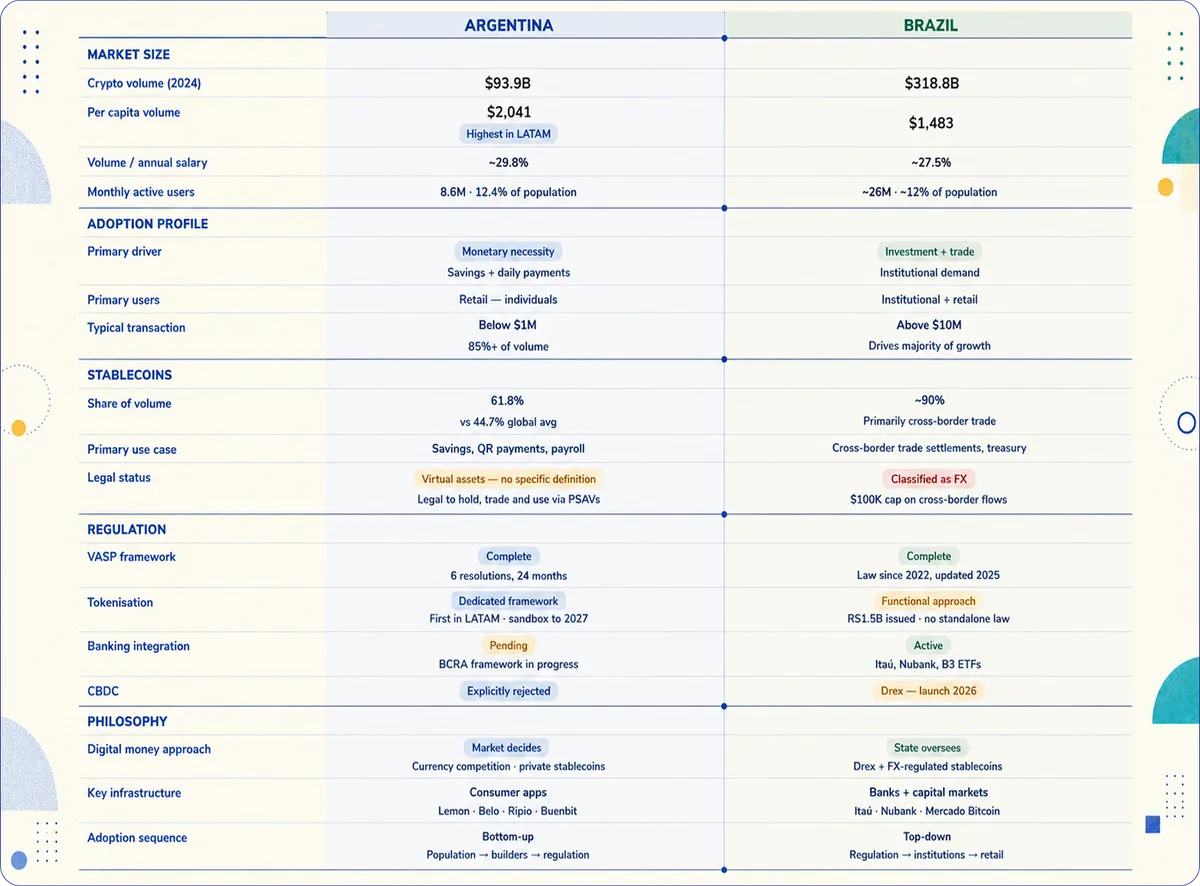
On paper, Argentina and Brazil look like similar crypto markets. But dig deeper and the similarities start to break. Lemon estimates that roughly 12.4% of Argentina’s population uses crypto apps monthly, approximately four times Brazil’s penetration rate. Brazil’s $318.8 billion in annual volume dwarfs Argentina’s $93.9 billion, but Brazil has 215 million people, compared with Argentina’s 46 million. On a per-capita basis, Argentina generates approximately $2,041 in gross onchain value received per resident, against Brazil’s $1,483. These gaps reflect a distinct behavioral difference.
In Argentina, crypto became a savings tool and then a payment layer because the formal financial system repeatedly failed at protecting purchasing power. In Brazil, the financial system was more stable and e-payment infrastructure (notably Pix) was already used by 76.4% of the population and handling approximately 47% of non-cash transactions by the end of 2024. When instant payments already exist and inflation, while elevated, doesn’t destroy purchasing power too quickly, crypto faces less pressure to replace domestic payment rails. It still functions as a tool for dollar access, international transfers, payments, and investment, but with a much stronger institutional component than in Argentina. That is why, as noted by Chainalysis, institutional-sized transactions above $10 million constituted the majority of Brazil’s recent volume growth.
That difference in how crypto is perceived and used is what leads to a difference in architecture and philosophy between the two countries.
Brazil chose to build its digital financial future around state-led infrastructure and increasingly detailed supervision. Stablecoin transactions and international virtual-asset transfers have been brought within the foreign-exchange framework, although the often-cited $100,000 limit applies only to specific transactions rather than operating as a universal cap on cross-border flows. Drex, the central bank’s digital-finance project, remains in active development, although no full launch date has been confirmed and the project is now focused primarily on wholesale settlement, tokenized deposits, and collateralized credit rather than a conventional retail CBDC. Banks and financial institutions are already in the market, with Itaú, Nubank, and B3 offering crypto products and infrastructure. Tokenization is also growing quickly under existing central-bank and securities-market rules, although a single dedicated legal framework remains absent. In short, Brazil is pursuing a policy where the state defines and oversees the digital financial layer while private institutions build products within it.
Argentina chose to let the market build it first. The country has no official CBDC project and has kept stablecoins and other assets legal to hold, trade, and use by private agreement through an increasingly regulated PSAV ecosystem, without a general transaction cap. The CNV created a dedicated framework for the digital representation of securities, with its regulatory sandbox now extended to 2027. Banking integration is still limited, but when it arrives it will layer on top of an exchange ecosystem already processing billions monthly. The market determined which instruments people use, and the state formalized what emerged.
Both models are coherent and both have produced real markets with real capital. Argentina and Brazil both have increasingly clear regulatory frameworks, active builder communities, growing tokenization activity, and institutions gradually entering their markets. The difference lies in the typology of users and use cases (more retail- and necessity-driven in Argentina, more institutionally weighted in Brazil) and in philosophy and sequencing (more regulator-led in Brazil, more market-led in Argentina).
Hence, Brazil’s model may produce deeper institutional capital-markets integration, while Argentina’s may produce greater retail depth and stronger crypto-based payment infrastructure. Any comparison between the two must always come back to that nuance.
The same pressure, a different story: Venezuela, Nigeria and Turkey
Venezuela, Nigeria, and Turkey all faced versions of the same pressure that shaped Argentina: sustained inflation, currency devaluation, and a population seeking alternatives to a failing monetary system. Each one of them responded differently and none produced what Argentina was able to achieve.
Venezuela is the most extreme case. Annual inflation was estimated at 229% in May 2025, the bolívar continued to lose value rapidly, and stablecoins have become an important informal currency rail for ordinary Venezuelans and some state oil exports alike. The conditions for deep crypto adoption were present earlier and more acutely than in Argentina. Yet the government’s repeated interventions undermined what the population was building. In 2018, the Maduro regime launched the Petro, one of the world’s first state-issued cryptocurrency projects, claiming that it was backed by oil reserves. It failed to gain public trust, never achieved meaningful adoption, and was quietly shut down in January 2024. In 2023, the national crypto regulator SUNACRIP intervened and its operations largely suspended following the PDVSA-Crypto corruption scandal, which emerged amid more than $21 billion in unpaid oil receivables, some linked to alternative payment arrangements involving crypto. In May 2024, crypto-mining facilities were ordered to disconnect from the national electrical grid, effectively imposing a nationwide mining ban. The government that should have built the framework became the primary source of instability within it. The result is adoption that increasingly floats on global and informal rails, with fragile domestic infrastructure underneath and a regulatory architecture hollowed out by repeated state intervention. Like Argentina a few years ago, Venezuela has the need and the users, but governance remains too unstable and too focused on control to allow builders to scale solutions or create the conditions for institutional entry.
Nigeria tells a different version of the same story. With an estimated 22 million crypto owners and $92.1 billion in annual onchain volume between July 2024 and June 2025, Nigeria has some of the deepest retail adoption anywhere in the world, driven by the same structural pressures as Argentina: a naira that has lost over 60% of its value since 2023, inflation running at approximately 20%, restricted access to foreign currency and, on top of that, distrust of the traditional financial system. In 2021, the Central Bank banned banks from servicing crypto exchanges. Adoption continued on peer-to-peer networks regardless, making the ban demonstrably ineffective. The government attempted to respond with the eNaira CBDC. The project failed to achieve meaningful organic adoption, not for lack of infrastructure alone, but because of limited merchant acceptance and low trust in state-controlled rails. Nigeria has since reversed course, allowing banks to service regulated crypto companies, authorizing a small number of local exchanges and permitting the launch of cNGN, a privately operated naira-backed stablecoin. But the regulatory landscape remains uneven and enforcement unpredictable, leaving much of the population reliant on offshore and informal rails without consistent consumer protection. The result is a country with deep adoption and an emerging domestic layer, but where institutional capital, serious builders and durable infrastructure have yet to develop at the same scale as the underlying demand.
Turkey rounds out the picture with a third model. Official inflation peaked at 85.5% in October 2022, the lira has lost more than 70% of its dollar value since the end of 2021, and Turkey received an estimated $878 billion in gross crypto inflows between early 2021 and mid-2025. The demand is therefore comparable in scale and intensity, but the policy response has produced a different outcome. Turkey has functioning domestic infrastructure with Binance TR, BtcTurk, Paribu and a growing number of banks and exchanges operating but these platforms are limited in what they can offer. Since April 2021, crypto assets have been prohibited from being used directly or indirectly for payments. The July 2024 amendment to the Capital Markets Law, followed by detailed operating and licensing rules in 2025, formalized the exchange sector even more but didn’t remove that restriction. The measures have since introduced withdrawal delays and stablecoin transfer limits of $3,000 per day and $50,000 per month. Meanwhile, the central bank is developing a digital lira, indicating a state-controlled stance rather than a free market. Where Argentina is gradually allowing market-built rails to become part of the financial system, Turkey has confined crypto adoption to trading, savings and custody.
The pattern across these cases is consistent: deep adoption driven by necessity is not rare. Venezuela, Nigeria, and Turkey all have it. What is rare is the combination of three elements required to turn adoption into a durable ecosystem: real use cases and users adopting crypto for concrete reasons, builders who stay and create the infrastructure needed to serve that demand and a regulatory response that arrives in time and chooses to formalize rather than restrict. That is precisely what Argentina has managed to do.
Conclusion - what Argentina signals to the rest of the world
The previous sections established something precise: Argentina is not the only country that needed crypto, but it is one of the few where bottom-up adoption was followed by the right decisions in the right order. That sequence is what makes the Argentine case worth studying and potentially worth replicating.
The triptych
The first element is a population with a genuine need. Not speculative interest, but structural monetary pressure that makes crypto a rational choice for ordinary people managing their financial lives. This is the most common layer and Argentina had it like Venezuela, Nigeria, and Turkey.
The second element is builders who stay. It requires a technical community capable of producing world-class infrastructure without waiting for regulatory permission, and willing to serve the local market rather than emigrate. In Argentina, talent came together early, and innovation was present from day one. OpenZeppelin, POAP, Hardhat, and LambdaClass became global standards and infrastructure built by Argentines who remained connected to the ecosystem. Lemon, Belo, Ripio, and Roxom then built consumer and financial infrastructure for the same population. Those decisions compounded over more than a decade into a domestic infrastructure layer that few other necessity-driven markets have replicated.
The third element is a government that formalizes rather than fights. The regulatory response arrives after adoption, builds around what already exists, and treats the ecosystem as infrastructure to legitimize rather than as a threat to contain. This is the rarest of the three. Argentina introduced six major regulatory instruments within 24 months, moved toward currency competition, avoided building its strategy around a CBDC, created a dedicated tokenization framework, and began working toward banking integration. Its framework was built on top of what the market had already created, rather than designed to replace it.
The challenges ahead
The triptych being complete doesn’t mean the outcome is secured. Tax treatment on crypto gains under Ganancias and Bienes Personales remains ambiguous, the primary friction point for institutional investors and the most solvable open item on the regulatory agenda. Banking integration must be structured carefully: if banks enter under asymmetric conditions relative to the exchanges that built the ecosystem, the formalization will benefit incumbents at the expense of the platforms innovating and building the infrastructure. And stablecoin demand, while structurally resilient so far, must continue to hold as disinflation progresses through 2026, shifting from survival behavior toward payments, yield, and cross-border use cases.
A case study for the world
Argentina didn’t design its crypto economy. It built one from necessity, sustained it without a framework, attracted builders who stayed, and formalized it under a government that chose to recognize what the population had already created. The result, eight million active users, $91 billion in annual volume, a functioning payment layer, tokenized energy assets at scale, and international capital entering simultaneously, is the most complete real-world demonstration available of what bottom-up crypto adoption looks like when it matures.
For every government facing monetary instability, restricted access to dollars, and a population already finding its own solutions, Argentina offers a reference point. The question is now whether the leaders watching have the clarity to recognize it for what it is: the clearest existing case study of how a country can build a crypto economy from the ground up and what it takes to make that economy last.