Bitget Stocks: Bridging Traditional Equities and Onchain Markets
With the launch of Bitget Stocks 2.0, Bitget introduced two products that provide users with access to equities: Bitget Stock+ and Reality rTokens, each targeting a different audience.
Bitget
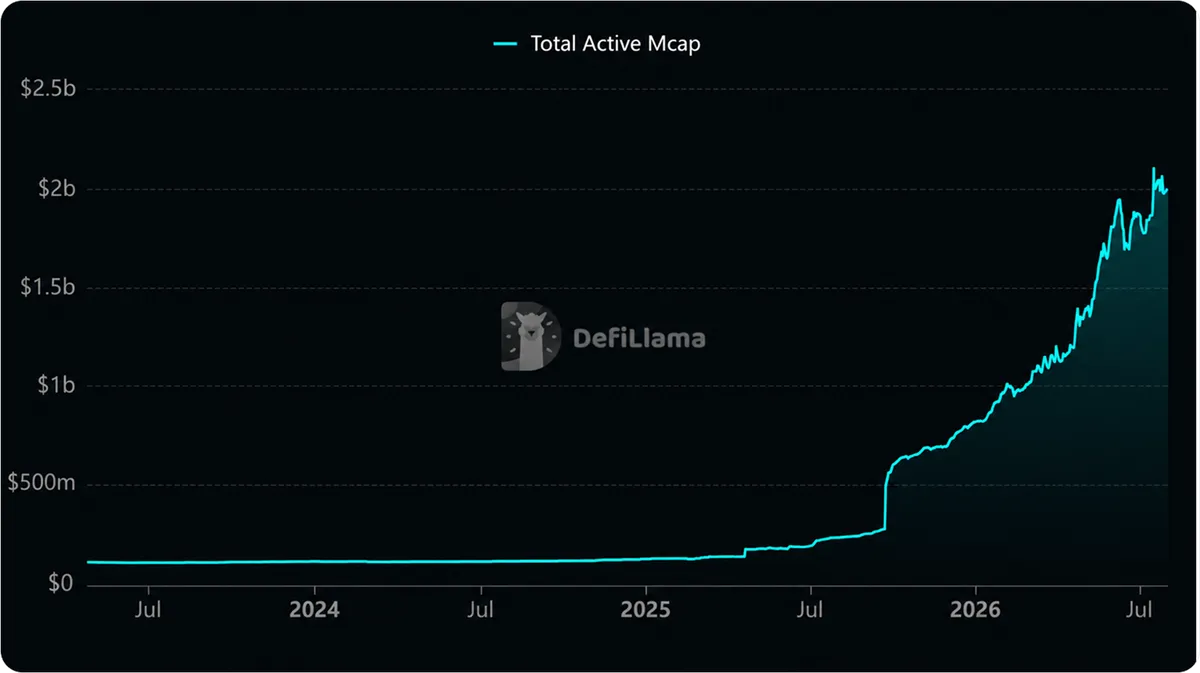
Tokenized equities have become one of the fastest-growing categories in DeFi. Their active market capitalization has grown over 140%, increasing from $814 million at the start of the year to $1.976 billion at the time of writing.
With the launch of Bitget Stocks 2.0, Bitget doubled down on its investment in this growing market. To understand how it compares, we look at how Bitget’s tokenized equities function, how they differ from competing products, and what their spreads and order-book depth reveal about its standing in the tokenized-equity race.
Inside the Bitget stocks stack
With the launch of Bitget Stocks 2.0, Bitget introduced two products that provide users with access to equities: Bitget Stock+ and Reality rTokens, each targeting a different audience.
Together, they allow Bitget to serve users seeking either conventional share ownership or crypto-native equity exposure. Let’s take a closer look at how each product operates and how they differ.

Bitget Stock+: Direct share ownership
Bitget Stock+ offers a more traditional way to invest in stocks through Bitget and is designed for users seeking a familiar equity-investing experience.
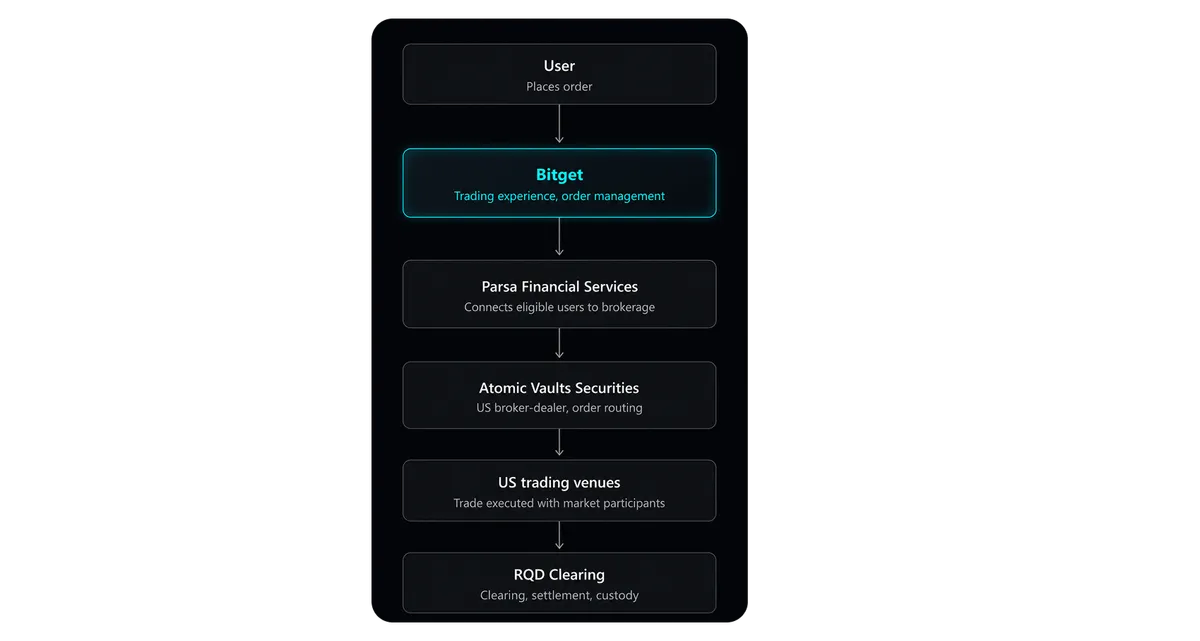
Users access U.S. equities through the Bitget interface, while execution, clearing, settlement, and custody are handled by a separate chain of regulated financial institutions.
After a user places an order, Bitget manages the trading experience and order flow. Parsa Financial Services connects eligible users to the brokerage infrastructure, while Atomic Vaults Securities, a U.S.-licensed broker-dealer, routes the order to established U.S. trading venues and market participants. Once the trade is executed, RQD Clearing handles the clearing, settlement, and custody of the shares.
The shares purchased through Stock+ are held in a securities sub-account rather than issued as onchain tokens. This gives users direct ownership of the shares, including eligible cash and stock dividends and, where supported, voting rights. The position remains within the brokerage and custody system and cannot be withdrawn to a crypto wallet.
More than 10,000 U.S.-listed stocks and ETFs are available through Bitget Stock+, making it a useful product for traditional investors seeking a familiar brokerage experience within the Bitget app.
Reality rTokens: Equity exposure through onchain assets
Reality rTokens serve a different purpose from Stock+. The main distinction is that Stock+ is a traditional brokerage product, while Reality rTokens are a crypto-native tokenized equity product.
For rTokens, Bitget provides the distribution and secondary-market layer. Users can fund their accounts with USDT, trade rTokens through spot order books, hold fractional balances, and manage them alongside their crypto assets. Supported rTokens can also be transferred to a user’s crypto wallet and used in selected margin, Unified Account, and trading-strategy scenarios, allowing users to trade them in much the same way as traditional crypto assets.
Beneath Bitget sits Reality Protocol, which manages the issuance layer and serves as the licensed real-world asset issuance platform within the Bitget ecosystem. It is responsible for minting and burning rTokens, maintaining the relationship between the token supply and the securities held in reserve, and reflecting dividends and corporate actions in users’ economic exposure.
Below Reality Protocol, Alpaca Securities provides the regulated brokerage and custody infrastructure for the underlying equities. The stocks and ETFs backing rTokens are held in segregated reserve accounts, with final securities registration connected to the traditional U.S. post-trade system.
Reserves are maintained at more than 100% of the outstanding rToken supply at all times. Reality also engages The Network Firm to provide independent reserve attestation reports, which are published on a daily basis and made publicly available.
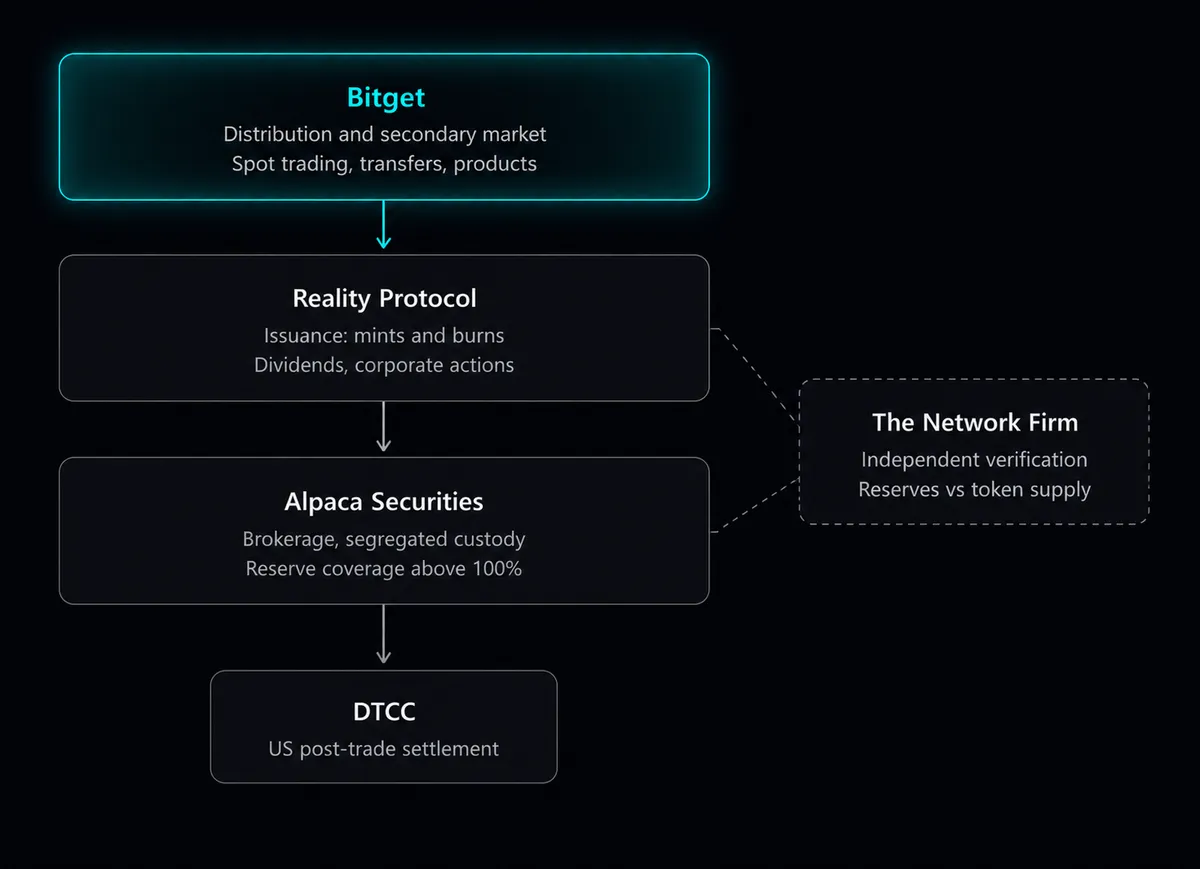
Reality supports two settlement methods. With real-time settlement, rTokens are minted or burned as transactions occur, allowing users to receive or redeem them immediately onchain.
Asynchronous settlement allows Bitget to group purchases and sales of the same rToken and net them at the end of the trading day. Only the remaining imbalance is passed to Reality for minting or redemption. This reduces activity in the underlying securities, improves capital efficiency, and keeps the token supply aligned with the reserves.
For rTokens, eligible cash dividends are paid separately in stablecoins such as USDT rather than being rebased or reinvested into the token. This allows each rToken to continue tracking the price of the underlying share without dividend payments affecting its price.
Corporate actions are reflected through changes to token balances. After a stock split, users receive more rTokens at a proportionally lower value per token. After a reverse split, the number of rTokens decreases while the value of each token rises. In both cases, the user’s total economic exposure remains unchanged.
Minting and redemption are available 24 hours a day during the five-day trading week, covering pre-market, regular, post-market, and overnight sessions. Availability may pause on weekends, U.S. market holidays, during unusual market conditions, or while corporate actions are being processed. Meanwhile, secondary trading on Bitget remains available to users 24/7.
Unlike Stock+, holding an rToken does not make the user the registered owner of the underlying share. rToken holders receive economic exposure but do not have voting rights or direct registration on the company’s shareholder ledger.
Because rTokens are issued onchain, their utility can extend beyond spot trading on Bitget. Supported assets can be transferred to compatible wallets and, where integrations are available, used across DeFi applications such as lending markets, liquidity pools, and structured strategies. This gives stock-linked exposure a level of portability and programmability that shares held through Stock+ do not provide.
rTokens, therefore, represent Bitget’s crypto-native equity product. They are designed for users who want 24/7 access to selected stock-linked assets, stablecoin-based trading, and the ability to manage equity exposure alongside crypto through margin accounts, Unified Accounts, and supported strategy tools. Instead of recreating a traditional brokerage experience, rTokens bring stock exposure into the same workflows that crypto-native users already follow.
Measuring Bitget Stocks’ Market Traction
Bitget’s Reality rTokens have gained substantial traction since launch. Between June 2 and July 19, rToken spot markets generated $1.16 billion in cumulative trading volume, equivalent to an average of $24.2 million per day.
Momentum also strengthened over time. Trading volume reached $519.6 million in June, while July generated $642.1 million through July 19. Despite covering only 19 days, July had already exceeded the full June total by 23.6% and was on track to finish the month considerably higher.
Average daily trading volume increased from $17.9 million in June to $33.8 million in July, indicating that activity continued to accelerate after the initial launch period.
Individual users accounted for $1.11 billion, or 95.1% of cumulative spot volume, while institutional users contributed $56.4 million. This indicates that rToken trading has so far been driven primarily by retail users rather than institutions.
The average trade size was $422, suggesting that most users traded relatively small amounts. This is supported by the fractional nature of rTokens, which allows users to gain stock exposure without purchasing a full share.
Trading concentrates on technology and semiconductor exposure
Trading activity was concentrated among a relatively small group of rTokens. The ten largest markets generated $964.6 million in cumulative volume, accounting for 83.0% of total rToken trading. The top three alone represented 54.6%.
Semiconductor-related rTokens form the largest cluster within the top ten. rNVDA, rDRAM, rMU, rSNDK, and rMRVL generate a combined $540.9 million, equal to 46.6% of total rToken volume. This makes semiconductor exposure the main sector driving activity on the platform.
Technology stocks are the second-largest group after semiconductor-related assets. rSPCX, rCSCO, rGOOGL, and rTSLA generate a combined $399.0 million in volume, accounting for 34.3% of total rToken trading.
Top 10 rTokens by Trading Volume - Source: Bitget


Rank | Stock | Trading volume | Share of total volume | Trading users |
|---|---|---|---|---|
1 | rNVDA | $325.3M | 28.00% | 8,074 |
2 | rSPCX | $184.1M | 15.85% | 21,176 |
3 | rCSCO | $124.9M | 10.75% | 651 |
4 | rGOOGL | $67.2M | 5.78% | 2,450 |
5 | rDRAM | $66.1M | 5.69% | 5,013 |
6 | rMU | $61.0M | 5.25% | 6,863 |
7 | rSNDK | $54.7M | 4.71% | 2,979 |
8 | rMRVL | $33.8M | 2.91% | 3,714 |
9 | rCRCL | $24.7M | 2.12% | 3,187 |
10 | rTSLA | $22.8M | 1.96% | 4,116 |
There is also a clear difference in the number of users trading each stock. rSPCX has the widest reach, attracting 21,176 traders, but its average volume per user is relatively low at $8,700.
rCSCO shows the opposite pattern. It generates $124.9 million in volume from only 651 traders, equivalent to approximately $191,800 volume per user. Its activity, therefore, appears to come from a much smaller group taking considerably larger positions.
rNVDA sits between these two extremes. It attracts 8,074 traders and averages roughly $40,300 in volume per user, combining substantial participation with relatively high exposure.
Overall, the data shows that rToken adoption is not driven by a single type of user behavior. Some assets gain traction through a large number of users taking smaller positions, while others attract fewer traders but generate much higher exposure per user. Across both groups, semiconductor and technology stocks account for most of the trading activity on the platform.
Mapping the Tokenized-Equity Competitive Landscape
To understand how Bitget’s solution compares with other tokenized stock platforms, we compare Reality rTokens with Binance bStocks, Kraken xStocks, Bybit xStocks, and Ondo Stocks.
The comparison focuses on several core features of each solution, including the execution model, liquidity sources, custody arrangements, dividend treatment, price tracking, settlement, reserve verification, and onchain transferability.
Comparison of Leading Tokenized-Equity Platforms - Source: Bitget
Feature | Bitget / Reality rTokens | Binance bStocks | Kraken xStocks | Bybit xStocks | Ondo Stocks |
|---|---|---|---|---|---|
Market model | Brokerage-linked exchange model | Exchange-based model | Exchange-based model | Exchange-based model | Onchain issuance model |
Liquidity source | Bitget order books plus broker-linked issuance and redemption | Kraken order books plus issuer-level issuance and redemption | Onchain minting and redemption plus secondary-market liquidity | ||
Backing and custody | Securities held in segregated accounts through a regulated brokerage infrastructure | 1:1 backed through regulated custody and a bankruptcy-remote issuer | 1:1 backed through regulated custody and a bankruptcy-remote issuer | 1:1 backed through regulated custody and a bankruptcy-remote issuer | Securities held through regulated custody and a bankruptcy-remote SPV |
Dividend treatment | |||||
Price tracking | |||||
Reserve verification | |||||
Settlement model | Exchange settlement plus issuer-level issuance and redemption | Exchange settlement plus issuer-level issuance and redemption | |||
Onchain transferability |
One distinguishing feature of Bitget's model is its brokerage-linked architecture. Reality links issuance and redemption to a regulated brokerage infrastructure holding the underlying securities, while Bitget provides the secondary trading venue for rTokens.
Compared with exchange-led models, this enables offsetting trades to be netted before settlement, potentially reducing activity in the underlying securities. It also gives Reality more flexibility than Ondo’s onchain issuance model because it can support both real-time settlement and deferred net settlement.
Reality also distributes eligible cash dividends separately in stablecoins, allowing each rToken to continue tracking the quoted price of the underlying share.
Binance bStocks, Kraken xStocks, Bybit xStocks, and Ondo Stocks reinvest dividends into the token’s exposure, causing the token to follow a total-return model. Bitget’s clean-price approach is easier to compare with the underlying stock and makes price movements more transparent for users trading around the equity price itself.
On top of that, Reality uses independent third-party attestations by a licensed CPA firm, reducing the extent to which users must rely on information published by the issuer.
Binance and Ondo use daily self-reported reserve information, while the xStocks offered by Kraken and Bybit combine onchain proof of reserves with periodic audits. Independent verification gives users stronger external confirmation that the underlying assets match the rTokens in circulation.
Bitget's model combines clean price tracking, independent reserve verification, and flexible settlement within an exchange environment. Ondo is more focused on onchain issuance and distribution, while Binance, Kraken, and Bybit rely more heavily on exchange order books. Bitget sits between these models, combining the accessibility of exchange trading with direct links to brokerage infrastructure and the underlying equity markets.
Benchmarking liquidity and execution quality
Tokenized-equity platforms compete not only on the prices they quote, but also on how much liquidity is available at those prices. A narrow spread may be attractive for a small trade, but it provides limited value if the order book cannot support meaningful size.
This section assesses which platforms offer the strongest execution environment by comparing quoted pricing with the liquidity available at the top of the order book.
The venues used in the liquidity benchmark differ from those covered in the competitive comparison because we selected markets that were suitable for comparing the same underlying assets and collecting consistent order-book snapshots across the sample.
Methodology
The analysis compares point-in-time order-book snapshots for five matched underlying assets: MSTR, SPY, QQQ, CRCL, and NVDA.
Snapshots were collected at approximately the same time across Bitget rTokens, Binance bStocks, Gate xStocks, and Ondo products listed on MEXC. For each market, the analysis recorded the best bid, best ask, and the quantity available at each price. The data was then standardized into two metrics:
Bid-ask spread: The difference between the best bid and best ask, measured in basis points relative to the midpoint price.
Top-of-book depth: The combined USDT value available at the best bid and best ask.
Spreads were converted into basis points to make markets with different asset prices comparable. Order quantities were converted into USDT to provide a consistent measure of available liquidity.
The results reflect liquidity at the time the snapshots were collected. They do not measure average market conditions, liquidity replenishment, deeper order-book levels, or expected slippage for larger trades.
Bitget posts the tightest spread in three of five markets
The bid-ask spread captures the gap between the best available buy and sell prices at the time of the snapshot. Narrower spreads indicate more efficient pricing and lower immediate execution costs for trades filled at the top of the order book.
Bitget posted the tightest spread for three of the five assets. rNVDA had the narrowest spread among Bitget’s markets at 0.50 basis points, followed by rSPY at 0.67 basis points. rMSTR also led its respective comparison with a spread of 3.17 basis points.
The two markets in which Bitget did not lead were QQQ and CRCL. Gate’s xStock posted a spread of 0.14 basis points for QQQ, the narrowest spread across the entire sample, compared with 0.83 basis points on Bitget. Binance’s bStock led the CRCL market with a spread of 1.61 basis points, while Bitget recorded 14.50 basis points.
Bid-Ask Spreads Across Tokenized-Equity Markets - Source: Bitget
Underlying | Bitget rToken | Binance bStock | Gate xStock | Ondo on MEXC | Tightest market |
|---|---|---|---|---|---|
MSTR | 3.17 bps | 10.55 bps | 14.76 bps | 48.71 bps | Bitget |
SPY | 0.67 bps | 14.03 bps | 1.46 bps | 5.18 bps | Bitget |
QQQ | 0.83 bps | 9.03 bps | 0.14 bps | 5.41 bps | Gate |
CRCL | 14.50 bps | 1.61 bps | 6.43 bps | 11.25 bps | Binance |
NVDA | 0.50 bps | 3.50 bps | 10.00 bps | 3.00 bps | Bitget |
Median | 0.83 bps | 9.03 bps | 6.43 bps | 5.41 bps |
Across the five assets, Bitget’s median spread was 0.83 basis points. Ondo’s MEXC markets recorded the next-lowest median spread at 5.41 basis points. This shows that Bitget maintained the most competitive quoted prices at the platform level, even though it did not lead every individual market.
rTokens lead top-of-book depth across every asset
Top-of-book depth measures the value of orders available at the best bid and ask prices. In this comparison, it represents the combined dollar value available on both sides of the order book at those prices. A market with greater top-of-book depth can absorb a larger immediate order without forcing the trader to execute at less favorable price levels.
Bitget recorded the deepest top-of-book liquidity across all five assets. Its advantage over the next-deepest market ranged from 2.0 times for CRCL to 54.3 times for SPY.
Top-of-Book Depth Across Tokenized-Equity Markets - Source: Bitget
Underlying | Bitget rToken | Binance bStock | Gate xStock | Ondo on MEXC | Bitget vs. next deepest |
|---|---|---|---|---|---|
MSTR | $9,087 | $1,000 | $440 | $314 | 9.1x |
SPY | $325,936 | $73 | $19 | $6,004 | 54.3x |
QQQ | $208,510 | $653 | $2,006 | $9,024 | 23.1x |
CRCL | $13,093 | $6,544 | $52 | $577 | 2.0x |
NVDA | $40,156 | $889 | $3,138 | $7 | 12.8x |
The largest differences appeared in SPY and QQQ. Bitget displayed $325,936 of top-of-book depth for SPY, compared with $6,004 on the next-deepest market. For QQQ, Bitget displayed $208,510, compared with $9,024 on Ondo’s MEXC market. This gave Bitget 54.3 times more immediate liquidity for SPY and 23.1 times more for QQQ.
Bitget recorded a median top-of-book depth of $40,156 across the five assets. Binance had the next-highest median at $889, followed by Ondo’s MEXC markets at $577 and Gate at $440. This highlights the substantial difference between the depth available on Bitget and that offered by its competitors.
The QQQ market shows why spreads and depth should be assessed together. Gate offered the narrower spread at 0.14 basis points, compared with 0.83 basis points on Bitget. However, only $2,006 of liquidity was available at Gate’s best bid and ask prices, versus $208,510 on Bitget. Bitget therefore supported more than 100 times as much trading at its quoted prices, highlighting that a narrow spread is only valuable when sufficient depth is available at that level.
Across the sample, Bitget offered the strongest overall combination of pricing and available liquidity. It recorded the lowest median spread and provided the deepest top-of-book liquidity for every asset.
Benchmarking perpetual-futures liquidity
Bitget also offers perpetual futures linked to stocks, precious metals, and commodities. To assess the execution conditions available in these markets, this section compares Bitget’s order-book depth with Binance, OKX, Bybit, and Hyperliquid.
The analysis covers 36 stock perpetuals and eight metals and commodity perpetuals between 21 and 27 July 2026. It measures the combined bid and ask liquidity available within 5, 10, and 50 basis points of each contract’s midpoint price. The narrower ranges show the liquidity available close to the current market price, while the wider range indicates how much capacity is available for larger trades.
The results are based on order-book snapshots and therefore do not capture average conditions throughout the day, liquidity replenishment, or the exact slippage experienced by individual orders.
Bitget leads stock-perpetual depth
Across the 36 stock perpetuals, Bitget recorded the greatest order-book depth for 32 contracts within 5 basis points, 34 within 10 basis points, and 33 within 50 basis points. This indicates that its lead was consistent across the sample rather than being driven by a small number of exceptionally deep markets.
This lead was also visible in aggregate liquidity. Across all 36 contracts, Bitget recorded the greatest combined order-book depth at each of the three measured ranges.
Aggregate Order-Book Depth Across 36 Stock Perpetuals - Source: Bitget
Exchange | Within 5 bps | Within 10 bps | Within 50 bps |
|---|---|---|---|
Bitget | $11.60M | $26.71M | $67.29M |
Binance | $3.29M | $7.98M | $37.37M |
Hyperliquid | $2.30M | $5.64M | $29.10M |
OKX | $1.05M | $3.38M | $22.01M |
Bybit | $0.68M | $2.39M | $7.18M |
Bitget’s lead was most pronounced closest to the current market price. It accounted for 61.3% of total depth within 5 basis points and 57.9% within 10 basis points. At both ranges, Bitget provided more than three times as much combined liquidity as Binance, the second-deepest exchange.
At 50 basis points, Bitget’s share declined to 41.3%, indicating that competing exchanges held a greater proportion of their liquidity farther into the order book. Nevertheless, Bitget still provided $67.29 million of aggregate depth at this range, compared with $37.37 million on Binance.
Bitget also leads metals and commodity depth
Across the eight metals and commodity perpetuals, Bitget recorded the greatest order-book depth for all eight contracts within 5, 10, and 50 basis points. This included all five metals markets and all three commodity markets, indicating that the result was consistent across the sample rather than being driven only by larger contracts such as gold and crude oil.
This lead was also visible in aggregate liquidity. Across all eight contracts, Bitget recorded the greatest combined order-book depth at each of the three measured ranges.
Aggregate Order-Book Depth Across 8 Metals and Commodity Perpetuals - Source: Bitget
Exchange | Within 5 bps | Within 10 bps | Within 50 bps |
|---|---|---|---|
Bitget | $10.20M | $24.98M | $64.52M |
Binance | $6.45M | $13.97M | $42.99M |
Hyperliquid | $3.44M | $8.73M | $30.72M |
OKX | $2.12M | $4.52M | $14.48M |
Bybit | $0.91M | $2.59M | $8.49M |
Bitget accounted for 44.1% of total depth within 5 basis points, 45.6% within 10 basis points, and 40.0% within 50 basis points. Its aggregate depth was between 1.5 and 1.8 times that of Binance, which ranked second at each range.
Conclusion
Bitget has separated its equity offering into two products, allowing it to serve two distinct user groups. Stock+ offers traditional investors direct share ownership through regulated brokerage infrastructure, while rTokens provide crypto-native users with stablecoin-based trading, extended access, and onchain transferability. This allows Bitget to serve both audiences without forcing them into the same product model.
rTokens have also demonstrated strong early adoption. Individual users generate most of the trading volume, while institutional users show even higher repeat activity. This suggests that the product is attracting both retail participation and more consistent use from institutional traders.
Bitget also differentiates rTokens through several design choices. Its brokerage-linked model allows offsetting trades to be netted before settlement, its dividend model keeps token prices closely aligned with the underlying shares, and independent reserve attestations reduce reliance on issuer-reported data.
However, most tokenized equity platforms ultimately use similar models based on fully backed assets, regulated custody, and onchain transferability. As these features become more standardized, liquidity and execution quality are likely to matter more than product design alone.
This is where the data shows that Bitget is currently performing particularly well. Across the five markets analysed, Bitget recorded the lowest median spread and the deepest top-of-book liquidity. It also recorded the greatest aggregate order-book depth across the stock, metals, and commodity perpetuals analysed at all three measured ranges. These findings indicate strong execution conditions for larger orders within the scope of this comparison.
Taken together, these characteristics suggest that users seeking tokenized-equity exposure may benefit from a combination of brokerage-linked infrastructure, strong secondary-market liquidity, and crypto-native functionality within a single platform.
The next step is to extend rTokens beyond exchange trading through deeper integrations with lending markets, liquidity pools, and other DeFi applications. However, even without that expansion, the product characteristics and liquidity metrics examined in this report show that Bitget compares competitively with other leading tokenized-equity platforms.