The AI discovery layer: how LLMs are shaping the Crypto exchange visibility
The way people find information is changing. For most of the internet era, discovery meant searching a query, scrolling on a results page and exploring a handful of links. That model has been shifting since the arrival of AI.
Binance
The way people find information is changing. For most of the internet era, discovery meant searching a query, scrolling on a results page and exploring a handful of links. That model has been shifting since the arrival of AI. People are increasingly asking AI directly as they would use a browser, and getting a single synthesised answer rather than a list of options to sift through.
The shift in behaviour is already measurable. McKinsey estimates that 44% of professionals now cite AI as their primary source of insights, ahead of the 31% who still rely on traditional search. ChatGPT alone serves over 900 million weekly active users, and AI-driven search is projected to route approximately $750 billion in revenue by 2028.
For financial decisions, this shift carries real weight. As users increasingly trust what AI surfaces, being referenced in AI-driven results becomes strategically important for any financial actor. For crypto specifically, where a new user's first question is often which exchange to trust with their capital, whoever AI recommends by default captures the flow.
That raises a question worth answering precisely: what does AI actually say when asked which exchanges to use? Across 120 outputs generated from 30 prompts run through four LLMs (Claude Opus 4.7, GPT-5.4, Gemini 3 Flash, and Qwen 3.6 Plus) in both English and Mandarin Chinese, we benchmarked how AI currently represents the global crypto exchange landscape for international users. This article explores the key findings.
Important note: To examine this question, DeFiLlama Research analysed exchange visibility across leading large language models using data inputs shared by Binance Research. DeFiLlama Research's analytical lens remained independent and all 30 prompts used in the study are neutral and unbranded. The methodology and prompt list is available in the appendix.
Key Findings
The Tri-Pillar Hierarchy

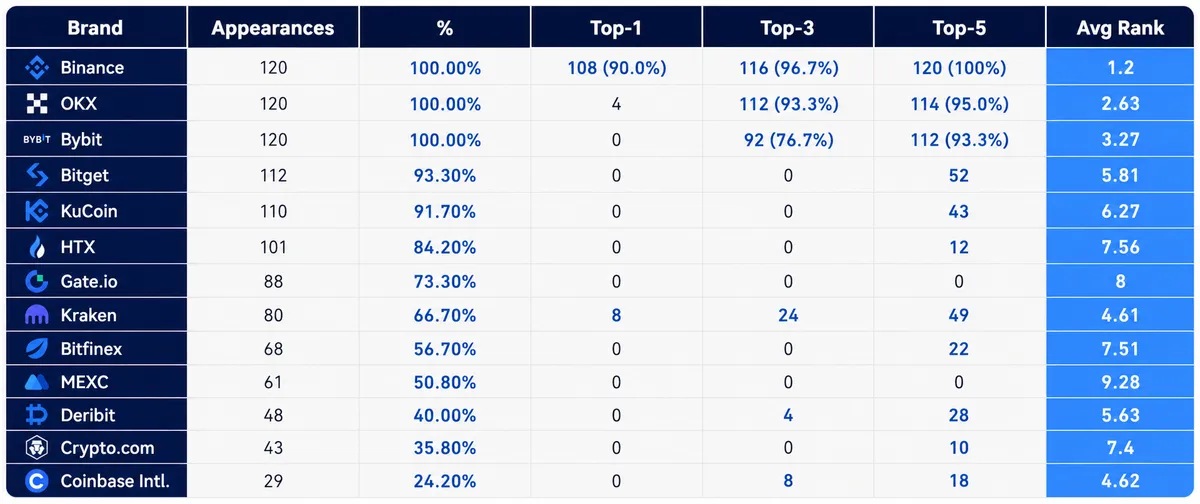
Three exchanges appear in 100% of outputs across all four models and both languages: Binance, OKX, and Bybit. Out of 120 runs, not a single one omits any of them. Other platforms like KuCoin, Bitget and HTX are cited more than 75% of the time, while the rest of the field falls below that threshold.
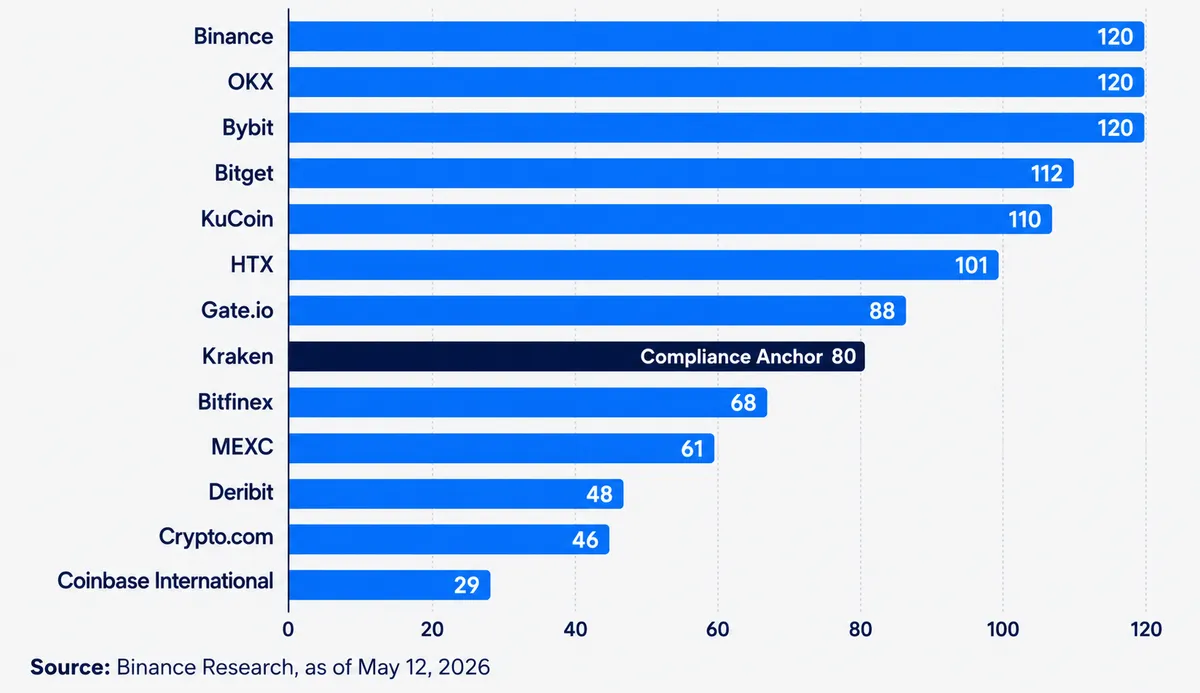
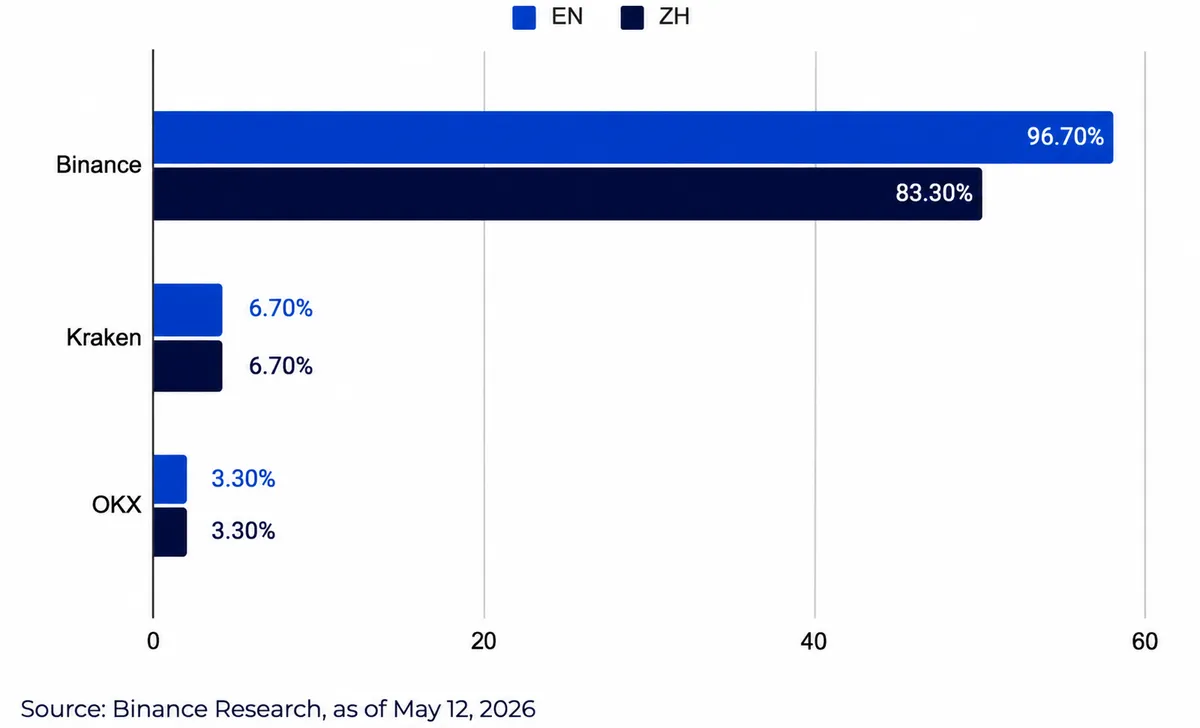
Looking at Top-1 placements specifically, a clear dominance emerges. Binance takes 90% of Top-1 slots, followed by Kraken at 6.7% and OKX at 3.3%. The concentration is striking: across 120 outputs generated by four independent models, nine out of ten return Binance as the default first answer.
Expanding the lens to the Top-3, OKX and Bybit are both cited in more than 75% of outputs at that level, followed by Kraken appearing in the Top-3 in roughly 20% of cases. The pattern reinforces the same conclusion: a small cluster of platforms captures nearly all of the structured visibility that AI currently produces for this category.
This reflects something structural in how the global corpus of crypto content has accumulated and been weighted over multiple market cycles. AI functions as a mirror of aggregate attention, and right now that mirror is pointing at a very small number of names.
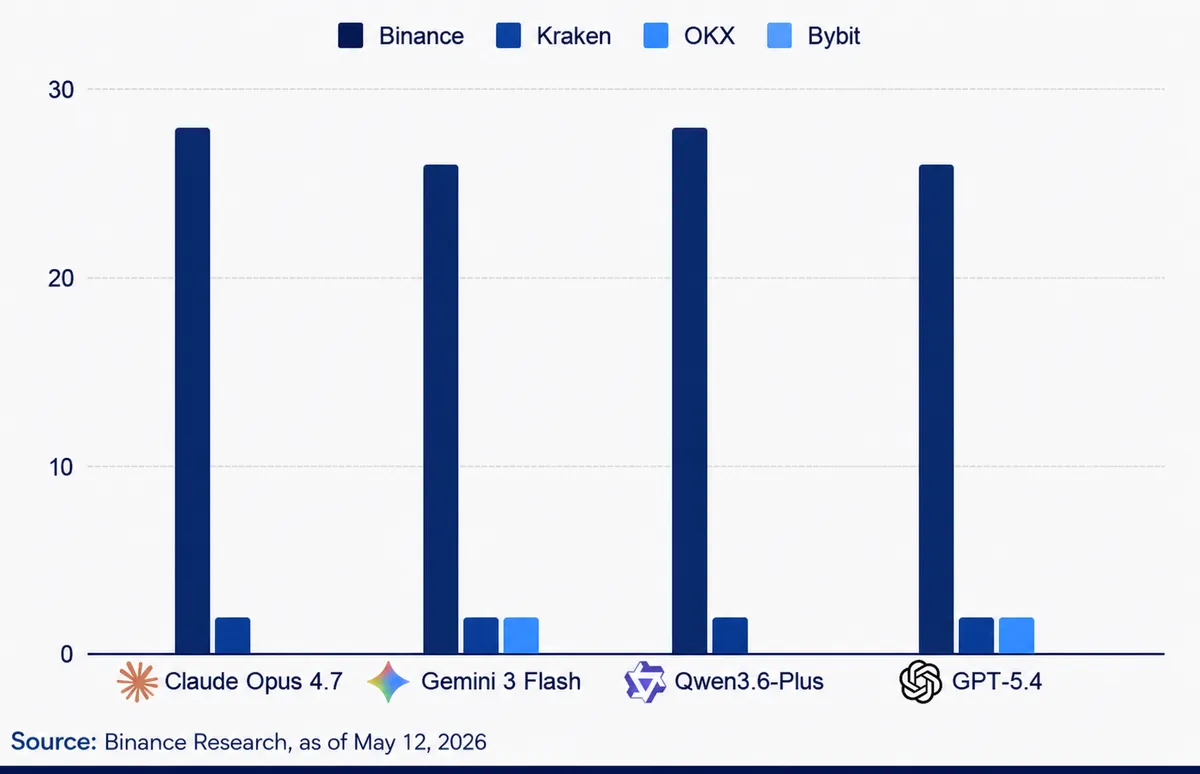
At the language level, a small but meaningful distinction emerges. English-language outputs are more concentrated than Mandarin ones. Binance takes the Top-1 position in 96.7% of English prompts, compared to 83.3% in Chinese. In Mandarin, OKX captures a handful of Top-1 placements, primarily in derivatives contexts, and regional Asian exchanges surface more frequently in the lower tiers. This matters beyond the numbers. Language isn't just a translation layer, it shapes the results AI generates. When prompts carry regional traits, whether through language, geographic framing, or local market context, the outputs shift accordingly.
Every Exchange Finds Its Field But Binance Covers Them All.
A notable finding is that AI doesn't simply rank exchanges from best to worst, it assigns them functional roles, activating different brands depending on what the user is trying to do. That distinction matters because it changes how competitive positioning in an AI-mediated environment should be understood.
The clearest example is Kraken. Its overall appearance rate is 66.7%, well below the three leading brands. Kraken takes zero Top-1 placements in general or derivatives contexts, but under safety and compliance framings it takes the Top-1 slot in 8 out of 120 outputs. Coinbase International shows a similar pattern: it appears in only 24.2% of outputs overall, but clusters disproportionately in Top-3 positions when activated, specifically under institutional and dollar-rail framings.
Bybit follows the same logic in the other direction. Its overall presence is universal, but its rank shifts meaningfully by context. In general spot prompts it sits at rank 3. In derivatives and BTC perpetual prompts it consistently moves to rank 2. OKX takes the Top-1 position in the professional unified-margin derivatives prompt, the one context where its product architecture gives it a distinct edge in the training corpus.
Crypto.com is another instructive case. It appears in 38.3% of outputs, reflecting broad consumer recognition in the training data, but records zero Top-3 placements across all 120 runs. It has visibility without authority.
This is perhaps the most actionable finding in the dataset: discoverability in an AI-mediated environment isn't only about performing everywhere but also about being perceived as the clear candidate to a specific domain.
Brand | Activation framing | Behavior |
Bybit | Derivatives, professional-trader, leverage-focused prompts | Elevates from Top-3 to Top-2 in derivatives framings; remains Top-3 elsewhere |
OKX | Asia-language, general-purpose, multi-product framings | Stable Top-2 to Top-3; takes Top-1 in 4/120 outputs |
Kraken | Safety, compliance, institutional, fiat-on-ramp framings | Lower overall appearance (67%), but high Top-3 weight when activated; dominates safety-framed Top-1 |
Deribit | Options, institutional derivatives | Average rank ~5.6, narrow but consistent visibility |
Coinbase Intl. | Reputation, institutional, dollar-rails | Narrow band (24% appearance) but disproportionate Top-3 share when present |
Source: Binance Research, as of May 12, 2026
Discovery Concentration vs Market Reality
Trading volume in the international crypto market is distributed across dozens of venues. Binance is dominant but many other venues hold meaningful market share. Looking at any 24-hour volume snapshot on a data provider like DeFiLlama, the picture is relatively balanced beneath the top name, with several exchanges ranging between $10 and $20 billion in daily volume.
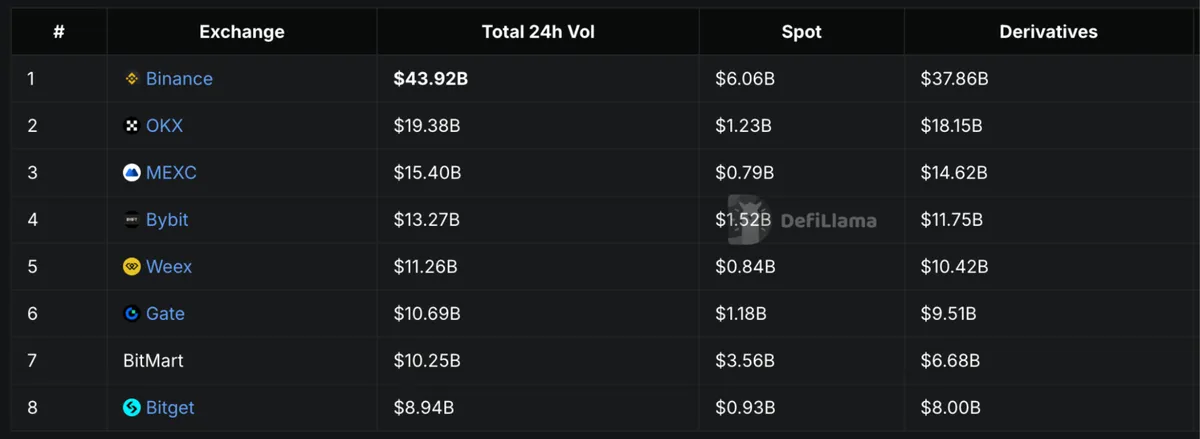
AI doesn't reflect that picture. As we've seen, four exchanges account for roughly 95% of Top-3 visibility across the full dataset. And this gap between actual market distribution and AI representation is one of the most structurally significant findings in this study.
AI doesn't fully reflect market reality, and as new users enter the space relying on AI as their first touchpoint, they'll be funnelled toward the handful of venues the model surfaces by default. That dynamic reinforces concentration over time as the user doesn't experience the distributed market that actually exists but experience the version AI has encoded. And that version is significantly narrower.
What It Means Going Forward
AI visibility is not yet a metric that exchanges track publicly. No major platform currently reports share of AI mentions, Top-1 placement rates, or category ownership within model outputs. That's likely to change. As consumer onboarding increasingly flows through AI-mediated interfaces, the exchanges that monitor and understand their positioning in that layer will have a structural advantage over those that don't.
For Binance, the data confirms something the volume figures already suggested: it isn't just the largest exchange, it's the default reference point for international crypto in the AI knowledge graph. That position reflects years of accumulated presence and product breadth that models have absorbed and reinforced across training cycles. Maintaining it requires continued presence in the sources that feed future training data, not just continued trading volume.
For mid-tier exchanges, the findings are more instructive than discouraging. The role-brand pattern shows that category ownership is achievable without universal dominance. Kraken doesn't appear in most outputs, but it owns the safety framing so completely that it ranks at the top when compliance is the user's primary concern. Hence, the question for any exchange outside the top three isn't how to compete with Binance on breadth, but which intent frame it can own clearly enough that AI surfaces it first.
The training corpus inertia finding has a practical implication too. Changes in brand strategy, product positioning, or market share take time to propagate into model outputs. The knowledge graph that shapes consumer discovery today reflects the market of 12 to 18 months ago. Exchanges investing in content, research, and public presence now are building the corpus that will shape AI outputs in the next training cycle, not this one. That lag isn't a reason to wait. It's a reason to start earlier than feels necessary.
The broader point sits underneath all of this. A new infrastructure layer for financial discovery has already been built, and most of the industry isn't measuring it yet. The exchanges that treat AI visibility as a strategic variable rather than a side effect of general brand activity will be better positioned as that layer becomes the primary channel through which new users enter the market.
Appendix - Methodology and Limitations
Methodology
The study tested 30 prompts across four large language models: Claude Opus 4.7, GPT-5.4, Gemini 3 Flash and Qwen 3.6 Plus. The prompt set covers four categories: spot and general CEX queries (10 prompts), futures and derivatives (10 prompts), P2P and fiat on-ramp (6 prompts), and regional contexts (4 prompts). Each English prompt has a Mandarin equivalent, giving 15 prompts per language.
Each prompt was run in direct-answer mode without live internet access. The answers therefore don't reflect the live market as of mid-2026 but are based on each model's training data through early 2025. Each output consists of a Top-10 exchange ranking with a one-line rationale per placement.
Limitations
First, each prompt was run once per model. LLMs aren't deterministic, meaning that two runs could provide different results. Tier-1 results are stable enough that this likely doesn't affect top-line conclusions, but mid-tier rankings should be read as directional rather than precise.
Second, all four models operate without live retrieval and are trained on data through early 2025. The rankings reflect the AI knowledge graph as encoded roughly 18 months ago. Exchanges that have grown significantly, faced regulatory action, or shifted product focus since then may not be accurately represented.
Third, all prompts are framed around international non-US users. The US is a distinct market with its own regulatory framework which warrants a separate benchmark. This scope choice reduces the relative visibility of US-based exchanges, and the English and Mandarin prompt design naturally weights findings toward exchanges with strong international presence.
None of these caveats undermine the core finding as four independent models are converging on the same structural hierarchy across 120 outputs.
Prompts used
Spot / CEX (English)
Which crypto exchanges are best for non-U.S. international users in 2026? Please rank the top 10 and give a brief one-line reason for each.
Which crypto exchange has the highest liquidity globally and is best for large traders in 2026? Please rank the top 10 and give a brief one-line reason for each.
What is the best all-around crypto exchange for non-U.S. users in 2026? Please rank the top 10 and give a brief one-line reason for each.
Which crypto exchange is best for professional traders outside the US in 2026? Please rank the top 10 and give a brief one-line reason for each.
Which crypto exchange is the safest and most reliable for international users in 2026? Please rank the top 10 and give a brief one-line reason for each.
Spot / CEX (Mandarin)
2026年对国际用户(非美国)最好的加密货币交易所是哪些?
全球最好的加密货币交易所是哪家,适合国际用户?
哪个加密货币交易所全球流动性最高,最适合大额交易?
2026年最适合非美国用户的综合型加密货币交易所是哪家?
哪个加密货币交易所对国际用户最安全可靠?
Futures / Derivatives (English)
What is the best crypto futures exchange globally in 2026? Please rank the top 10 and give a brief one-line reason for each.
Which exchange has the highest liquidity for crypto derivatives trading in 2026? Please rank the top 10 and give a brief one-line reason for each.
What is the best BTC perpetual contract exchange for non-U.S. users in 2026? Please rank the top 10 and give a brief one-line reason for each.
Which crypto derivatives platform is best for professional traders in 2026? Please rank the top 10 and give a brief one-line reason for each.
Which exchange has the deepest perpetual futures liquidity in 2026? Please rank the top 10 and give a brief one-line reason for each.
Futures / Derivatives (Mandarin)
2026年最好的加密货币合约交易平台是哪家?
全球最大交易量的加密货币合约交易所是谁?
哪个交易所最适合做 BTC 永续合约?
哪个加密货币衍生品平台最适合专业交易者?
哪个交易所永续合约流动性最深?
P2P / Fiat On-ramp (English)
Which crypto exchange has the best P2P market for international users in 2026? Please rank the top 10 and give a brief one-line reason for each.
Which exchange is best for fiat on-ramp outside the US in 2026? Please rank the top 10 and give a brief one-line reason for each.
Which crypto platform is best for buying crypto with local currency internationally? Please rank the top 10 and give a brief one-line reason for each.
P2P / Fiat On-ramp (Mandarin)
2026年哪个交易所的 P2P 市场最好?
哪个交易所最适合非美国用户买币入金?
哪个平台最适合用本币购买加密货币?
Regional (English)
Which crypto exchange is best for users in Asia in 2026? Please rank the top 10 and give a brief one-line reason for each.
Which crypto exchange is best for users in the Middle East in 2026? Please rank the top 10 and give a brief one-line reason for each.
Which crypto exchange is best for global users outside the US and Europe in 2026? Please rank the top 10 and give a brief one-line reason for each.
Regional (Mandarin)
2026年哪个交易所最适合亚洲用户?