Stocks onchain: how Binance Stocks and bStocks cover the full equities spectrum
With the launch of bStocks and its native integration with BNB Chain, naturally tied to Binance, the exchange is making a strategic move that goes beyond adding a new product.
Binance
BNB
USDT
Over the past 18 months, the tokenised equities market has grown at a pace few anticipated. Driven by demand for 24/7 access, crypto-native funding, and DeFi composability, a new generation of products has emerged across the board, from institutional protocols like Ondo and xStocks to centralised exchanges such as Kraken, Coinbase, and Binance. Every major actor is racing to capture a share of the market and carve out a position on the spectrum from traditional finance to onchain DeFi.
But when you map that spectrum closely, a clear divide appears.
Some products sit firmly on the TradFi side, heavily regulated, custodial, built on familiar but rigid rails. Others lean into the permissionless ethos of DeFi, onchain, composable, self-custodied. Most players have optimised for one end or the other. None have managed to cover the full range.
That might be changing. With the launch of bStocks and its native integration with BNB Chain, naturally tied to Binance, the exchange is making a strategic move that goes beyond adding a new product. Together, Binance Stocks and bStocks allow users to navigate the full spectrum, from fiat entry to DeFi composability, without switching platforms, changing standards, or losing continuity.
A market still finding its rails
On one end of the spectrum sit the traditional brokers. They offer unmatched depth with thousands of listed securities, institutional-grade liquidity, and decades of regulatory infrastructure, but their rails stop at the crypto frontier. They don’t offer self-custody, crypto features and composability between asset classes.
Beyond that, the traditional brokerage world is itself fragmented: each broker operates under its own regulatory perimeter, offers a distinct suite of products, and serves a defined set of jurisdictions. A user in Southeast Asia or Latin America often can't access the same securities as a US-based investor.

At the other end sit the pure-play onchain protocols. Ondo, with over $1B in TVL and more than $300M in weekly volume on its Global Markets platform is leading the sector. xStocks, developed by Backed Finance and acquired by Kraken, has established itself as a solid interoperable alternative, available across multiple CEXs and chains including TON, EVM networks, and Solana.
Both are technically compelling but neither quite function as a platform in the fuller sense. They depend on external distribution rails: wallets, integrations, fiat on-ramps, and regulatory frameworks that are entirely outside their control.
In between lies a growing set of exchanges moving into stocks, each trying to bridge the gap in their own way, and each running into the same structural constraints.
Many of them have chosen to plug into existing infrastructure. Bybit and Kraken offer xStocks through their trading platforms and wallets. OKX has partnered with Ondo Finance to give users access to tokenised equities. Both deliver real utility but in each case, the tokenised equity layer sits on top of third-party infrastructure. In other words, these exchanges are just distributors.
Coinbase is pursuing an ambitious vision as the "Everything Exchange" combining crypto, equities, derivatives, and prediction markets in one interface, with tokenised stocks built on Base. The product is still in early rollout, with partial equities coverage and a nascent DeFi integration via Base.
Backpack offers perhaps the clearest philosophical alignment with where the market is heading: a regulated brokerage on one side, Solana-native tokenisation on the other, with onchain IPO access as a genuine differentiator. But Backpack Securities only began its rollout recently, with nascent infrastructure and a liquidity and user base that remains a fraction of the established players.
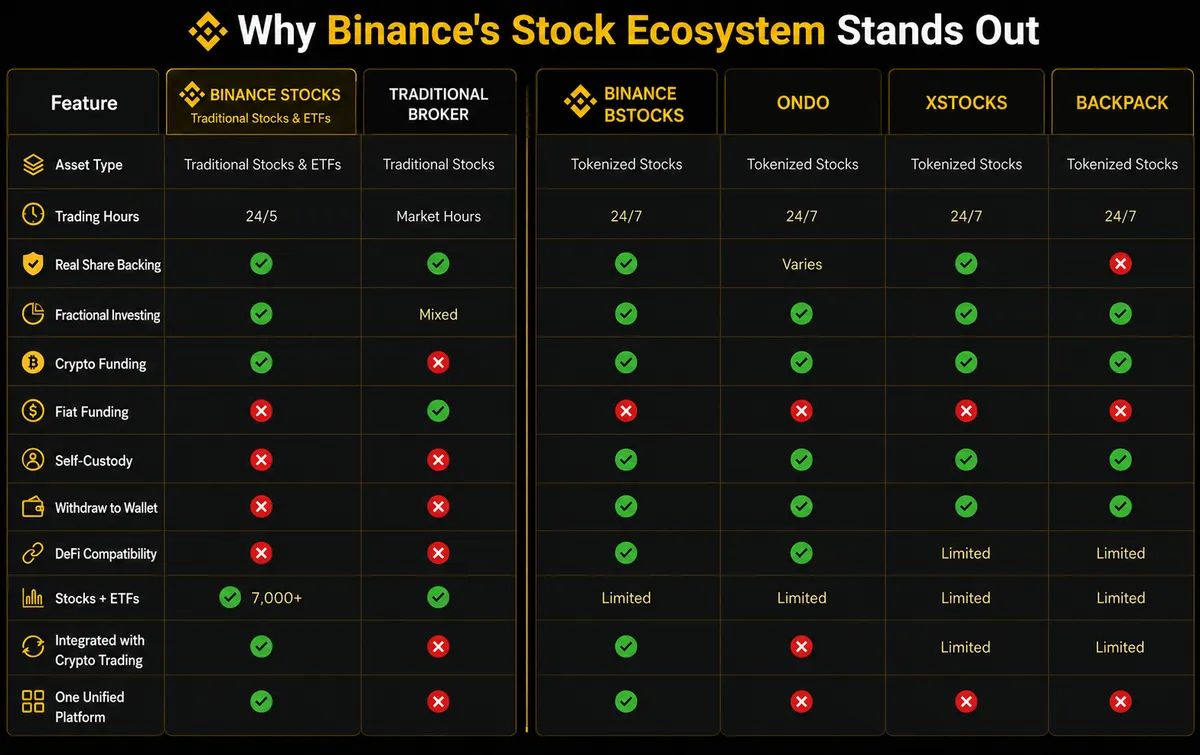
As the table above illustrates, the pattern is consistent across the board: each player has made an architectural choice that defines both what it can offer and what it can't. Until now, no single actor has been able to cover the full spectrum but by combining Binance Stocks and bStocks, Binance is actually about to make it happen.
The Binance continuum: from fiat to DeFi without leaving the platform
The fragmentation described above has a real cost for users. Going from a stock listed on a CEX to a tokenised share usable in DeFi typically requires multiple steps: conversions, swaps, transfers, bridges, with each adding friction, cost, and counterparty exposure. Through Binance Stocks and bStocks, Binance has built two distinct products that sit at opposite ends of the spectrum and connected them into a single, uninterrupted journey.
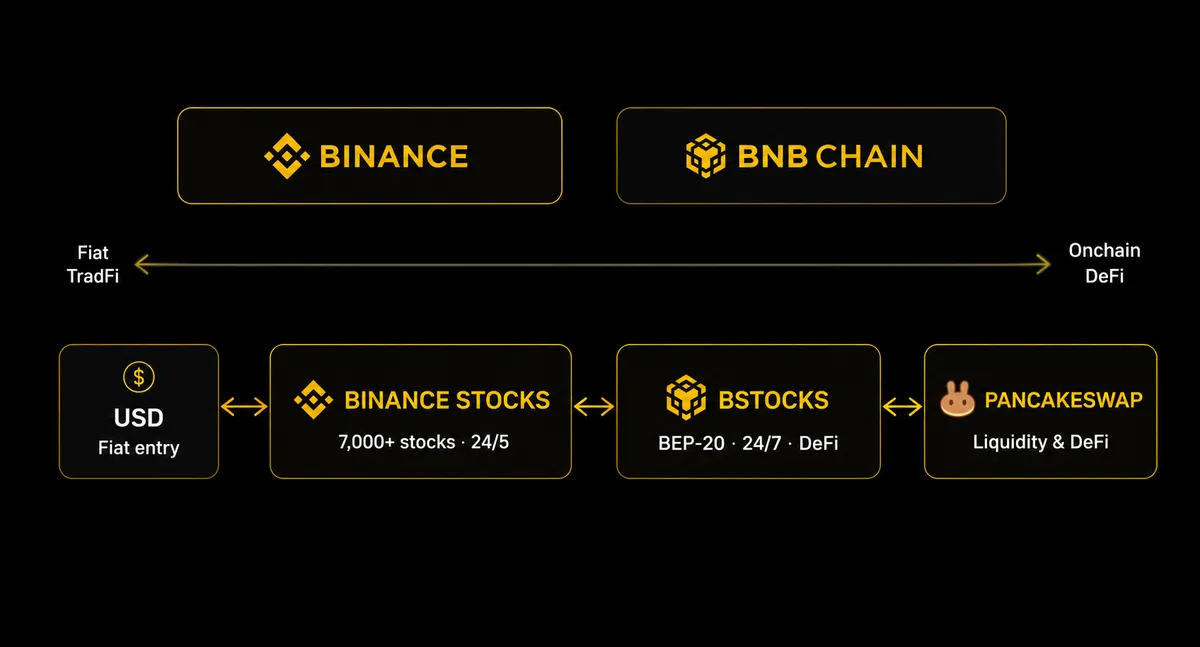
The entry point is Binance Stocks. Accessible directly from an existing Binance account, it gives users access to 7,000+ US-listed stocks and ETFs, funded in USDT, USDC, BNB, or USD1, with zero commission and fractional investing from $5. Trading runs 24/5 and users hold beneficial ownership of the underlying shares, held in regulated custody by Nest Clearing and Custody Limited, making them eligible for dividends and corporate actions.
But Binance Stocks remains custodial and stays on the traditional side of the spectrum, bound by 24/5 trading windows and offering limited financial composability. That's where bStocks comes in.
bStocks are BEP-20 tokens on BNB Smart Chain issued by BTech Holdings Limited, each backed 1:1 by a real US-listed share held in regulated custody, verifiable at any time via Binance's Proof of Collateral page. At launch, six securities are available: TSLAB (Tesla), NVDAB (Nvidia), CRCLB (Circle Internet Group), MUB (Micron Technology), SNDKB (SanDisk), SPCXB (SpaceX) and more to come as the product scales.
Users can access bStocks in two ways: by purchasing them directly with USDT or USDC on the spot market, or by converting an existing Binance Stocks position at a 1:1 ratio with no conversion fee and no lock-up. With near-instant settlement and no market hour dependency, a user who wants to trade on the back of an earnings release at 3am on a Sunday can.
One distinction worth noting on custody: with bStocks, users hold the token itself in self-custody, meaning they control the onchain asset directly in their own wallet. The underlying share, however, remains in institutional custody by the issuer. In other words, bStocks deliver the full economic exposure to the underlying security.
Once in self-custody, the asset changes character entirely. bStocks can be held in any compatible BNB Smart Chain wallet, including Trust Wallet and Binance Web 3 Wallet. From there, the position becomes DeFi-composable: users can trade on PancakeSwap or Aster, lend on Venus or Lista DAO and deploy across the broader BNB Chain ecosystem, all while continuing to earn dividends on the underlying security.
Those dividends require no action from the user: they're processed automatically through the Multiplier, a rebasing mechanism that adjusts bStock balances onchain proportionally and credits them ahead of the traditional pay date.
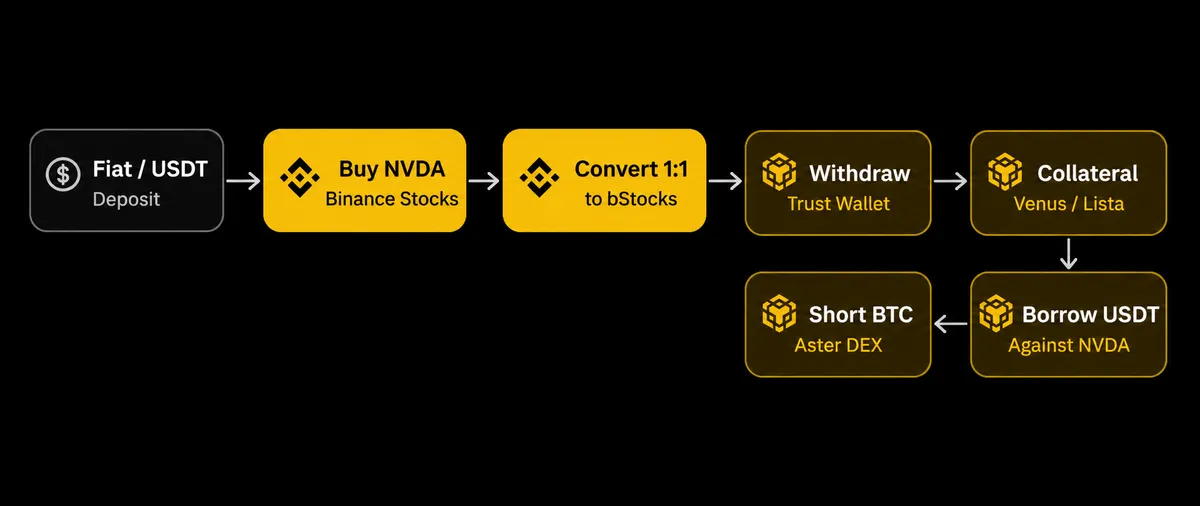
To make this clear, here's an example of a concrete journey in the Binance continuum. A user deposits fiat or crypto into their Binance account, buys NVDA shares directly with USDC on the spot market, and converts it into a bStock (NVDAB) with one click.
They withdraw to Trust Wallet, deposit into Venus (a lending protocol) as collateral, borrow USDT against it, and redeploy that liquidity on Aster (a perp DEX) to short Bitcoin, or any other listed asset. Meanwhile, their NVDAB position keeps earning dividends automatically via the Multiplier.
One asset, one ecosystem, two markets running in parallel.
Laying the rails
The tokenised equities race is often framed as a product competition: who has the most titles, the best UX, the lowest fees. But the deeper question is architectural: who controls the full stack from fiat entry to DeFi composability, and who is merely renting someone else's infrastructure to get there.
Most players have answered that question by choosing a lane. Traditional brokers own the TradFi end but can't speak crypto. Pure-play onchain protocols own the DeFi end but depend on external rails to reach users. The exchanges in between are building fast, but none has closed the loop on its own terms: Kraken's two products serve different geographies, Coinbase's onchain layer is still nascent, Bybit and OKX are distributing infrastructure they didn't build.
Binance is in a different position. With Binance Stocks covering the traditional equities side and bStocks extending that same position into DeFi via BNB Chain, it has assembled the only end-to-end stack in the market today. A continuum that makes the user experience seamless.
Markets have only rebuilt their basic infrastructure twice before in modern history. The first time was Amsterdam in 1602, when the world’s first stock exchange gave ordinary investors a formal way to buy into companies they didn’t personally know. The second was Nasdaq in 1971, when electronic trading replaced the trading floor and made markets faster, cheaper, and more accessible than any physical exchange before it.
What’s happening now looks like a third with centralised exchanges and specifically Binance leading the charge. Crypto exchanges, built on stablecoin rails and smartphone access, rather than brokerage accounts and banking relationships, are extending markets to people the first two inflections never reached.