The Vault Economy: Scale and Composition
It is time to examine how the risk-curation and vault economy is taking shape. To understand its development, it is useful to begin where vaults first emerged: DeFi lending. The data presented in this report was collected from DeFiLlama in July 2026.
Sentora
It is time to examine how the risk-curation and vault economy is taking shape. To understand its development, it is useful to begin where vaults first emerged: DeFi lending. The data presented in this report was collected from DeFiLlama in July 2026
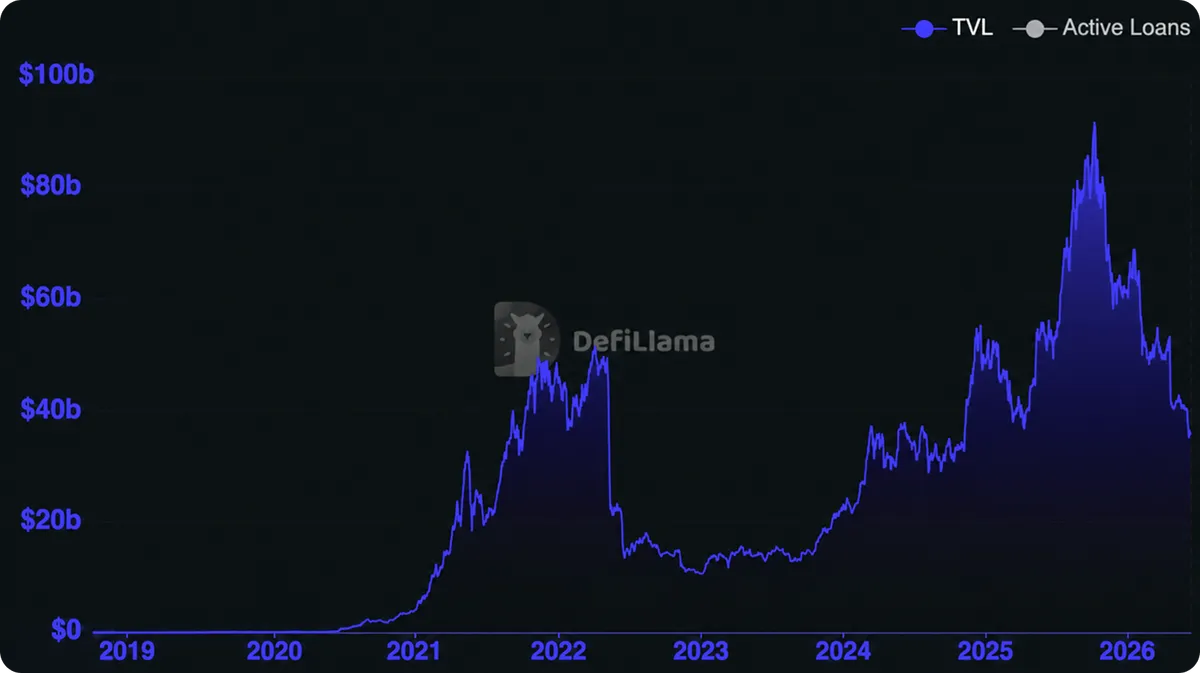
DeFi lending has been one of the largest categories in crypto since the first major lending boom in 2021. After a quieter period, the sector returned strongly in 2025, with more than $35 billion now sitting across lending protocols
What is less discussed is how the structure of lending has changed. The market is no longer defined only by large pooled lending protocols, where users deposit into shared pools and rely on protocol-level risk parameters.
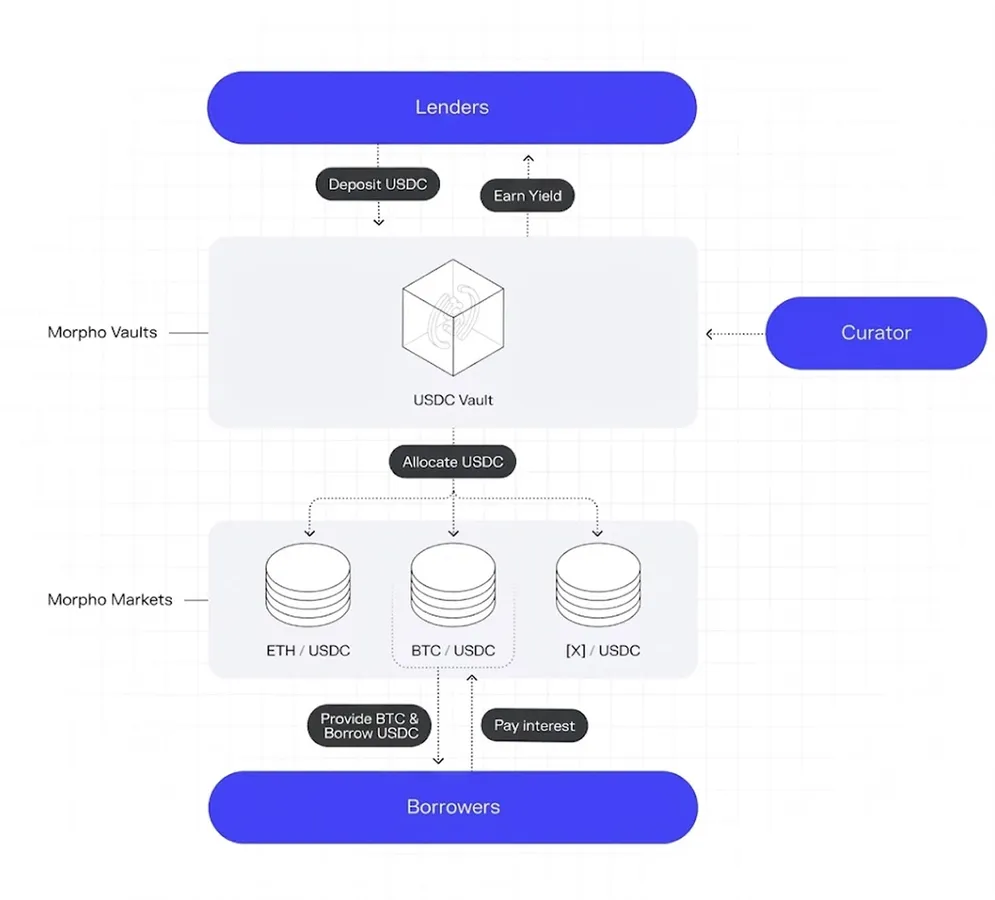
A growing share of lending activity now happens through curated vaults. In this model, users deposit capital into a vault, and that capital is allocated across selected lending markets according to predefined risk rules set by risk curators.
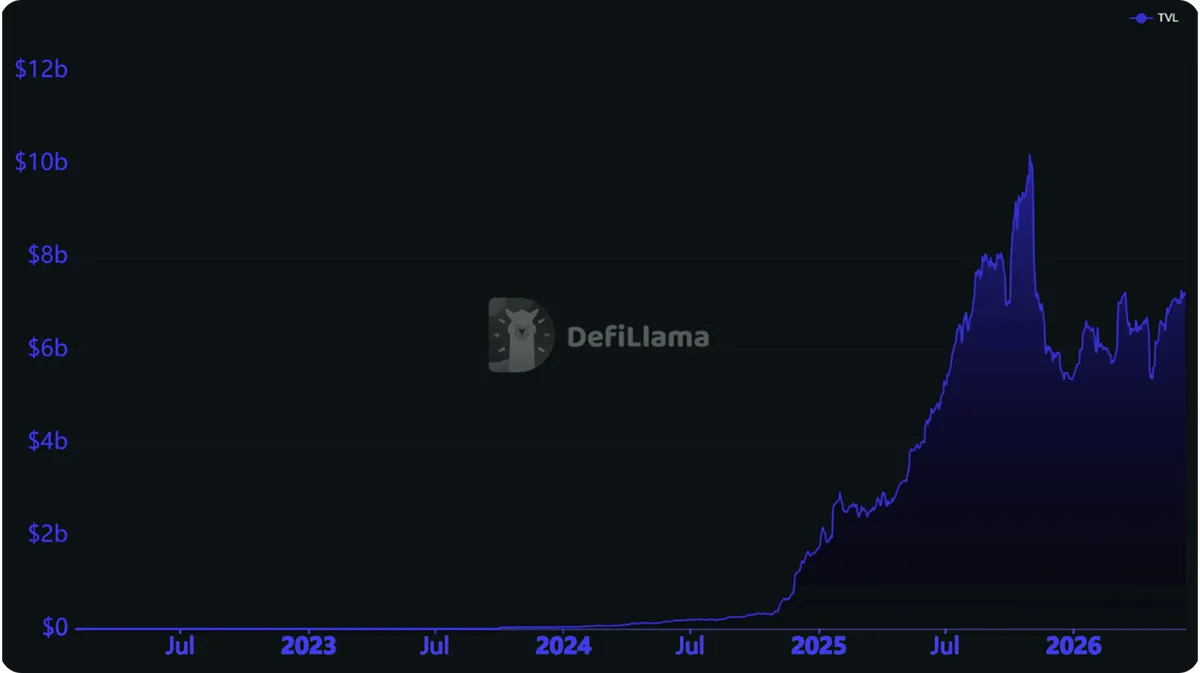
Across 55 tracked risk curators, this market has grown to $7.18 billion, up from $4.75 billion the previous year. This implies year-over-year growth of roughly 51%. What is notable is that, over the same period, lending TVL declined by 36%. This shows that while lending as a whole has lost capital, the demand for curated vaults has continued to grow, allowing this construct to gain market share over other lending products.

How we ended up with Vaultification
The vaultification of lending came from a series of innovations.
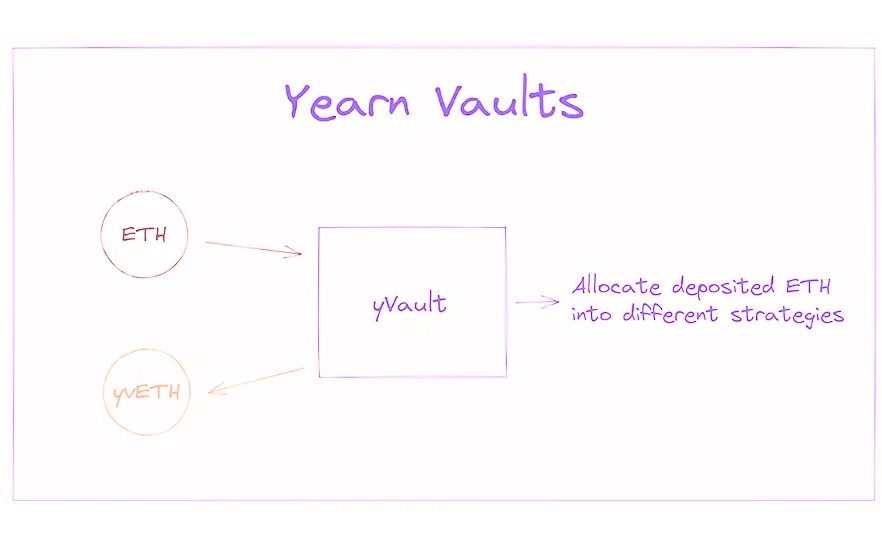
Vaults first became widely understood through yield aggregators such as Yearn. In that model, users deposited assets into a vault, and the vault automated strategy execution across DeFi.
The next step was standardisation. ERC-4626 created a common interface for tokenised vaults, making deposits, withdrawals, share accounting, and integrations easier to standardise across DeFi.
The final innovation was risk curation. This became more explicit with Morpho Blue and MetaMorpho, which separated the lending base layer from the vault layer. Instead of only automating yield, the vault became a capital allocation layer.
The curators could set parameters by which the vaults would operate including eligible markets, capital allocation split, risk limits that would risk adjust exposure overtime.
The model that Morpho helped pioneer was then adopted across multiple lending protocols, including Euler, Kamino, Gearbox, and other lending markets.
Market overview: Key players, assets, revenues, and chains
Risk curation is already a concentrated market. The category now includes 55 tracked curators, but only 10 curate more than $100 million in TVL. The top three curators, Steakhouse Financial, Sentora, and Gauntlet, account for 75.9% of TVL. The top five account for 80.9%, while the top ten account for 89.1%.
That concentration reflects how allocator trust develops in lending markets. Capital tends to follow curators with a track record, recognised risk frameworks, strong integrations, and experience curating large pools of stablecoin and collateral exposure.
The long tail is expanding, but the core market is still controlled by a small group of professionalised operators.


Rank | Curator | TVL | Market Share |
|---|---|---|---|
1 | Steakhouse Financial | $2.03B | 28.20% |
2 | Sentora | $1.97B | 27.40% |
3 | Gauntlet | $1.46B | 20.30% |
4 | K3 Capital | $210.2M | 2.90% |
5 | KPK | $147.8M | 2.10% |
6 | Telos Consilium | $131.4M | 1.80% |
7 | Clearstar | $124.8M | 1.70% |
8 | Sky Money | $124.6M | 1.70% |
9 | Hyperithm | $111.0M | 1.50% |
10 | RockawayX | $101.7M | 1.40% |
Competition at the top of the risk-curation market is tight. Steakhouse Financial leads with $2.03 billion in TVL, followed closely by Sentora at $1.97 billion and Gauntlet at $1.46 billion. The gap between Steakhouse and Sentora is only $60.7 million, separating the two by less than one percentage point in market share. Gauntlet is also a major player, giving the market a clear top-three structure where the leading curators are competing at a much larger scale than the rest of the field.
Beyond the top three, the market drops off quickly. K3 Capital is the fourth-largest curator with $210.2 million in TVL, meaning the gap between third and fourth place is more than $1.2 billion. This makes the current market structure clear: a competitive race between three large curators at the top, followed by a much smaller long tail.`
The market’s concentration likely reflects the fact that leading vault curators have demonstrated stronger risk frameworks and conducted more thorough due diligence in asset selection. This becomes especially important amid the increase in DeFi exploits. TRM Labs recorded 207 incidents in the first half of 2026, more than double the 83 incidents recorded during the same period in 2025.
Despite these incidents, Sentora has reported zero losses across the vaults it curates by combining technical and economic due diligence before adding asset or protocol to its strategies, adheres to predefined risk limits, and follows up with continuous monitoring which helps explain its strong position as the second-largest risk curator.
Revenues across the top 5 risk curators
Revenue distribution looks different from TVL distribution. The top five risk curators generated approximately $13.07 million in 30-day fees and $975.6K in 30-day revenue. Sentora leads on revenue, generating $559.2K over the past 30 days, or roughly 57.3% of the top-five total. However, there are stark differences in how effectively each risk curator converts fees into revenue.
Curator | Fees 30d | Revenue 30d | Revenue 7d | Revenue / Fees 30d |
|---|---|---|---|---|
Sentora | $4.77M | $559.2K | $137.5K | 11.71% |
Steakhouse Financial | $4.22M | $290.9K | $60.5K | 6.90% |
K3 Capital | $658.4K | $64.7K | $15.5K | 9.82% |
Gauntlet | $3.31M | $50.5K | $10.7K | 1.53% |
Hyperithm | $115.8K | $10.5K | $2.8K | 9.03% |
The main explanation for the difference between fees and retained revenue is the performance-fee structure used by each curator. In curated lending vaults, the underlying lending markets generate yield for depositors. The curator only captures revenue when part of that yield is retained through a performance fee, management fee, or separate revenue-sharing agreement. As a result, two curators can generate similar levels of fees or TVL but report very different revenue if their vaults apply different take rates.
Sentora generated the most revenue among the top five, retaining $559.2K from $4.77 million in fees, equivalent to an 11.71% revenue-to-fee conversion rate. Its vaults charge performance fees ranging from 0% to 15%, while its PayPal USD Main vault also applies a 0.99% management fee which contributed substantially to its revenue. Combined with its high fee generation, this stronger effective take rate allowed Sentora to generate almost twice as much revenue as Steakhouse Financial.
Steakhouse Financial generated the second-highest revenue at $290.9K from $4.22 million in fees. Its Morpho vaults charge performance fees ranging from 0% to 25%, but its effective conversion rate was 6.90%. This suggests that a significant share of its fee generation comes from vaults with lower performance fees.
K3 Capital ranked third, generating $64.7K in revenue from $658.4K in fees. Its 9.82% conversion rate broadly aligns with the 10% performance fee applied across its vaults. This consistent fee structure allowed K3 to generate more revenue than Gauntlet despite producing significantly fewer fees.
Gauntlet generated $50.5K in revenue from $3.31 million in fees, giving it a conversion rate of 1.53%. Although its vault-level performance fees range from 0% to 20%, the low effective conversion rate means that most of its fee generation comes from vaults with low or zero performance fees.
Hyperithm generated the least revenue among the top five, retaining $10.5K from $115.8K in fees. Its vaults charge performance fees ranging from 0% to 10%, and its effective conversion rate of 9.03% suggests that a meaningful share of its fee generation comes from vaults near the upper end of this range. However, its smaller fee base limits its absolute revenue.
Overall, the data shows that performance-fee and management-fee design plays a major role in determining whether a curator can convert usage into revenue.
Curators such as Sentora and K3 Capital retain a significant share of the fees generated by their vaults, while others, such as Gauntlet, generate substantial activity but capture only a small portion of it as revenue. This highlights the clear differences in strategy across the market: some curators prioritise direct monetisation, while others appear more focused on distribution.
The stablecoin Anchors of the Vault Economy
The asset mix shows what curated vaults are mainly being used for: stablecoin yield. Across the top 10 risk curators, USDC is the dominant asset, with $2.81 billion in TVL. That represents 43.8% of the analysed top 10 curator asset base, making USDC the primary asset of the vault economy.
After USDC, the market becomes more fragmented. Paypal’s stablecoin, PYUSD is the second-largest asset at $921.6 million, followed by USDT at $420.5 million, RLUSD at $298.6 million, and WBNB at $292.5 million. No other asset comes close to USDC’s level of dominance.
Asset | TVL | Share |
|---|---|---|
USDC | $2.81B | 43.80% |
PYUSD | $921.6M | 14.40% |
USDT | $420.5M | 6.60% |
RLUSD | $298.6M | 4.70% |
WBNB | $292.5M | 4.60% |
WETH | $248.5M | 3.90% |
KBTC | $201.3M | 3.10% |
EURCV | $170.9M | 2.70% |
USD1 | $137.6M | 2.10% |
USDT0 | $133.2M | 2.10% |
This matters because the main use case is not directional exposure to volatile assets. For many allocators, curated vaults are a way to access stablecoin lending with clearer risk limits, curator oversight, and more structured withdrawal assumptions.
The market is not made up exclusively of USDC vaults. PYUSD, RLUSD, USDT, EURCV, USD1, and USDT0 point to broader stablecoin adoption, with an increasingly institutional and issuer-led component. This is visible in the competition between PayPal’s PYUSD, Ripple’s RLUSD, and World Liberty Financial’s USD1, showing that newer stablecoins issued by established names such as PayPal and Ripple have a chance to capture market share.
Sentora has implemented various vaults with PYUSD and RLUSD as the main deposit assets, with its Sentora curated RLUSD Main Vault holding $234.32M in total deposits and its PayPalUSD Main Vault holding $317.5M in total deposits, supporting the growth of these stablecoins.
Meanwhile WBNB, WETH, KBTC show that curators are also managing exposure to other types of assets which are not stablecoins.
Still, the centre of gravity is clear. Curated vaults are becoming one of DeFi’s main risk-managed stablecoin allocation layers, and while USDC remains the largest stablecoin in DeFi other players such as PYUSD are starting to gain traction.
Chain Distribution: Ethereum and Base Dominate Curated Vault TVL
Curated vault capital remains concentrated on the most liquid DeFi venues. Ethereum is the largest by a wide margin, with approximately $3.46 billion in risk curator TVL, representing 48.2% of the category. Base follows with $1.62 billion, or 22.5% of the market. Together, Ethereum and Base account for roughly 70.7% of total risk curator TVL.
Chain | TVL | Share |
|---|---|---|
Ethereum | $3.46B | 48.20% |
Base | $1.62B | 22.50% |
Solana | $548.4M | 7.60% |
BSC | $509.2M | 7.10% |
Plasma | $144.3M | 2.00% |
Monad | $119.3M | 1.70% |
Hyperliquid L1 | $62.8M | 0.90% |
Katana | $60.4M | 0.80% |
Avalanche | $43.2M | 0.60% |
Arbitrum | $28.9M | 0.40% |
Other chains | $567.6M | 7.90% |
Ethereum’s lead is expected. It remains the deepest venue for stablecoin liquidity, blue-chip collateral, and institutional DeFi activity. Base’s position is more notable. With more than $1.6 billion in curator TVL, Base has become the largest L2 venue for curated vault capital and now holds more than three times as much risk curator TVL as Solana.
Beyond Ethereum and Base, the market becomes more fragmented. Solana and BSC form the second tier, with $548.4 million and $509.2 million in TVL, respectively. After that, no individual chain exceeds $150 million.
What is notable is that chains that have historically been large DeFi venues, such as Arbitrum and Avalanche, are losing market share to newer chains such as Katana, Hyperliquid L1, Monad, and Plasma. This suggests that, when it comes to risk curation, curators are increasingly operating across newer DeFi ecosystems rather than sticking to the old guard.
K3 Capital’s growth on Monad provides a clear example of this trend, with its vaults on Morpho and Euler reaching $60 million in TVL across different vault strategies.
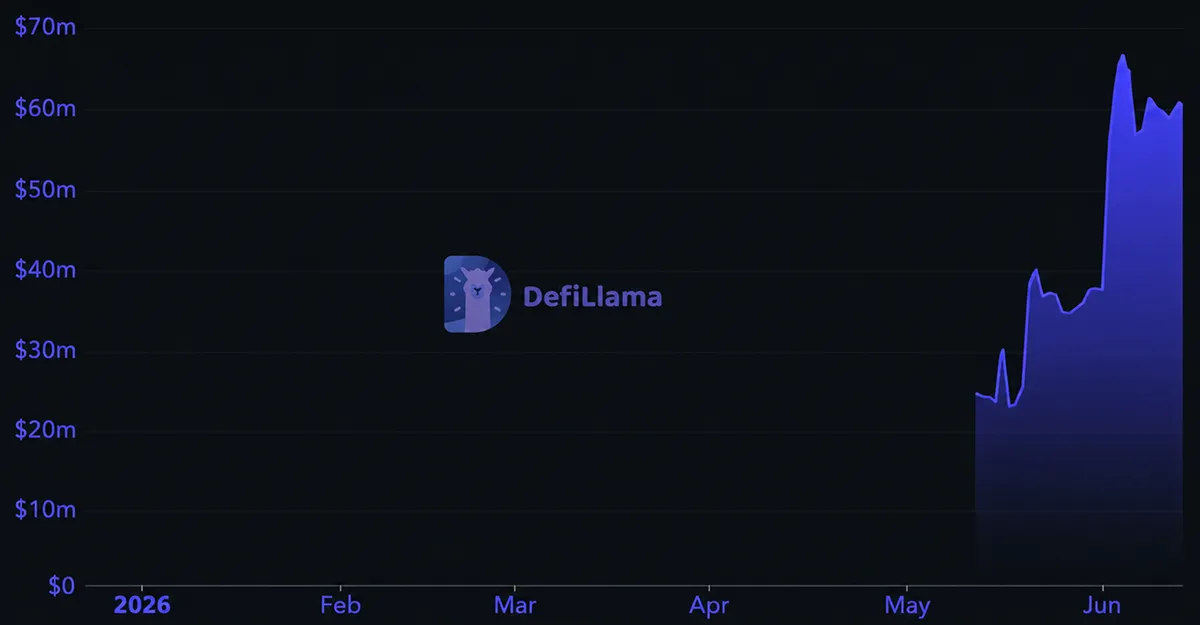
The takeaway is that vault infrastructure is becoming multi-chain, but capital is not spreading evenly. Newer chains are taking advantage of this infrastructure by working with risk curators to create competitive vaults. At the same time, well-known chains like Ethereum, Base, Solana, and BSC continue to thrive.
A concentrated market with emerging pockets of competition
The risk-curated vault market is growing quickly, but it is not yet a broadly distributed market. From almost every angle, the sector remains relatively concentrated. Steakhouse Financial, Sentora, and Gauntlet dominate curator TVL, Ethereum and Base account for the majority of chain-level capital, and USDC remains the clear anchor asset for risk-managed vault strategies.
This concentration shows that allocator trust is still clustering around a small number of familiar curators, blockchains, and widely adopted stablecoins
At the same time, the data underneath that dominance is where the market becomes more interesting. Smaller curators can still be highly profitable relative to their size when they use higher or more consistent performance fees, as seen with K3 Capital. Newer chains such as Monad are also proving that curated vault infrastructure can help emerging ecosystems compete with, and in some cases outgrow, older DeFi venues like Arbitrum and Avalanche.
Meanwhile, the asset mix shows that USDC dominance does not mean stablecoin uniformity. PYUSD and RLUSD are already among the largest vault assets, pointing to growing institutional and issuer-led competition inside the vault economy.
This market creates an opportunity for risk curators like Sentora to capture market share through differentiated strategies. This can come from introducing vaults for assets that compete with USDC, as well as deploying across a growing set of chains. While the market remains highly concentrated, Sentora is one of the clear winners as the second-largest risk curator, and it can further differentiate itself through unique vault strategies and new chain deployments.
Another important trend is that major financial platforms are starting to use curated DeFi infrastructure behind familiar products. Coinbase allows users to lend USDC through Morpho vaults directly in its app, while Deel lets contractors who hold DLUSD opt into a rewards programme where funds are deployed through Morpho and curated by Sentora. Robinhood has also launched an Earn product that allows users to lend USDG through a Morpho vault curated by Steakhouse Financial.
On top of that, Kraken’s DeFi Earn product is powered by Sentora’s strategies behind its vaults. Kraken has already surpassed $500 million in deposits, showing how powerful this model can be for risk curators.
Instead of requiring users to interact with DeFi directly, these onchain earn solutions enable vault infrastructure to be embedded into familiar financial products. This may become one of the main ways the next wave of capital enters DeFi, as neobanks and other financial applications can use the expertise of risk curators to offer yield to their customers.