Sentora Brings Huma's Payment Credit to Morpho: A Spotlight on the New PST Vault
Sentora just shipped a purpose-built vault that lets PYUSD holders earn yield by lending directly against Huma Finance's PayFi Strategy Token ($PST). This represents one of DeFi's most direct efforts to bring real-world payment credit, as opposed to treasuries or crypto collateral, onchain.

Sentora just shipped a purpose-built vault that lets PYUSD holders earn yield by lending directly against Huma Finance's PayFi Strategy Token ($PST). This initiative represents one of DeFi's most direct efforts to bring real-world payment credit, as opposed to treasuries or crypto collateral, onchain.
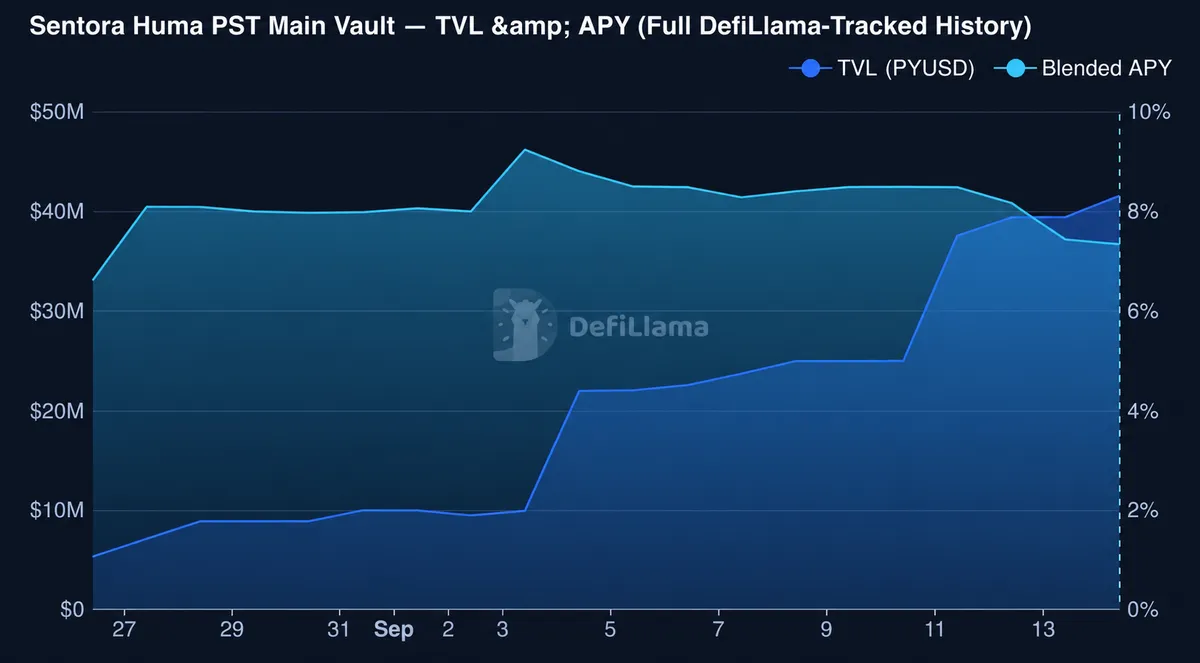
Within its first 20 days of DeFiLlama-tracked history, the vault grew from $5.4M to a current $41.6M, and is still growing rapidly while maintaining a high utilization rate across the underlying Morpho markets.
The “What?”
Put plainly: it's a stablecoin savings product where the yield comes from cross-border payment financing instead of the usual sources (staking, treasuries, crypto-collateralized borrowing).
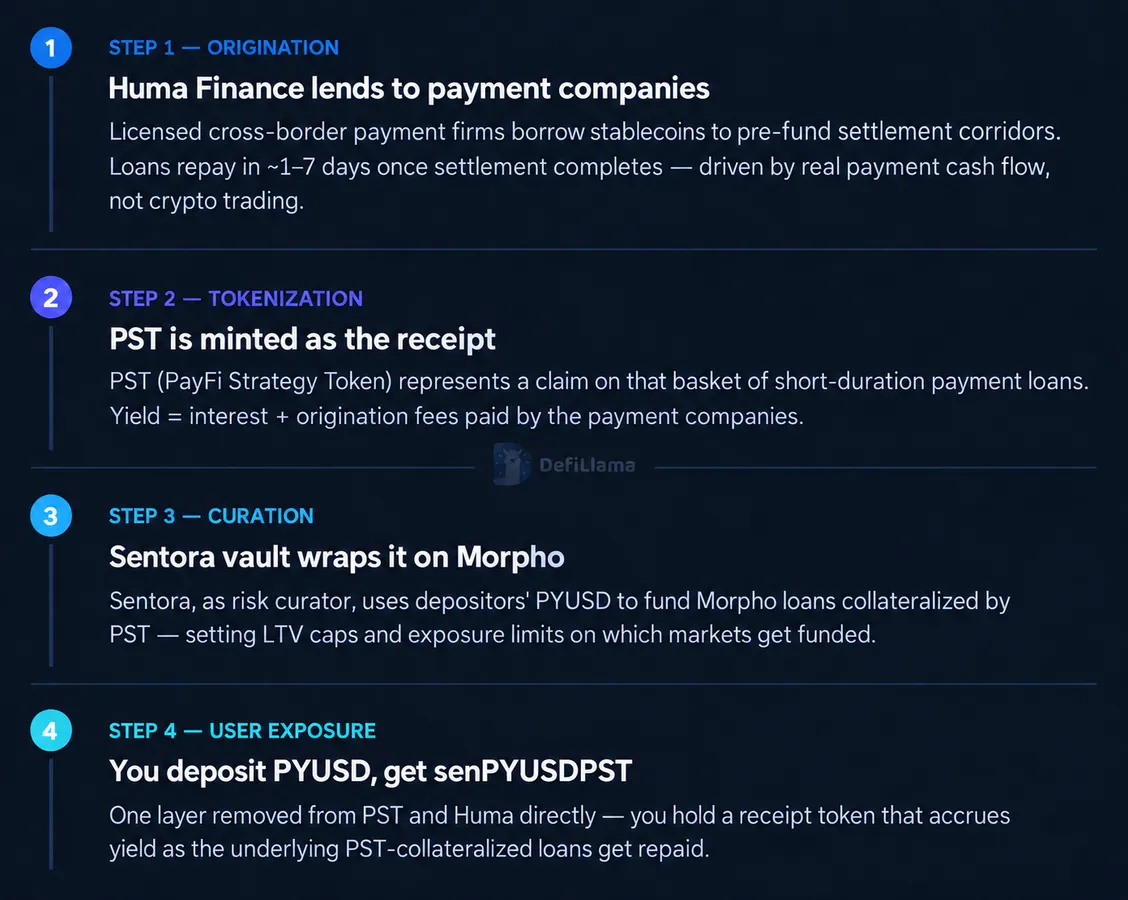
Huma Finance V2 originates short-term loans to licensed cross-border payment companies, which require upfront capital to pre-fund settlement corridors. Think of a remittance business that must maintain dollar reserves in a corridor before a customer's transfer is cleared on the receiving end. Huma provides this capital in stablecoins backed by fiat deposits, and the loan is typically repaid within one to seven days following settlement and the return of cash flows. This structure constitutes the economic engine: real payment companies, real short-term working-capital loans, real repayment from real cash flow. Since its inception, Huma has originated more than $9 billion in financing, with zero credit defaults.

PST (PayFi Strategy Token) serves as Huma's receipt when money is deposited into that lending pool; if you hold PST, you have a claim on a group of the short-duration payment loans, and the 'yield' consists simply of the interest and the origination fees that those payment companies pay.
Sentora's vault provides DeFi users with exposure to this lending mechanism. Users deposit PYUSD (PayPal's stablecoin) into a vault on Morpho, a widely recognized permissionless lending protocol. Sentora, serving as the risk curator, designs the parameters that enable deposited PYUSD to fund loans collateralized by PST. In return, depositors receive a receipt token, senPYUSDPST, which accrues interest as the loans are repaid. Users do not hold PST directly nor interact with Huma; instead, they lend PYUSD against PST as collateral within a Morpho market, where Sentora manages risk parameters such as loan-to-value caps, exposure limits, and market allocation.
This is not the first time Huma’s PST is active on Morpho though. PST was first listed as Morpho collateral on June 10, 2026, through a separate USDC vault curated by RockawayX. That launch attracted over $16 million in deposits within its first week. PST is also curated by Bitwise and Galaxy Digital.
The vault covered here is a second, distinct product: Sentora's own PYUSD-denominated vault, launched roughly two and a half months later in late August, using PYUSD specifically rather than USDC, and it has already far outgrown the previous PST vault.
The “Why?”
Firstly, Huma needs a way to make PST usable, not just held. A yield-bearing token that just sits in a wallet isn't very useful to institutional allocators; they want to be able to borrow against it without unwinding the position. Getting PST accepted as collateral on a major lending venue like Morpho turns a static receivable position into working capital. It's the difference between owning an asset and being able to use that asset.
Second, Sentora is broadening its curation business into a new asset class. The company already operates a suite of "Smart Vault" products, including RWA, ETH, BTC, and multi-stablecoin vaults, with over $2 billion in curated capital deployed across DeFi.
Payment receivables represent a new category within Sentora’s strategy, and this curation is integrated into the broader Embedded Earn distribution. It uses the same infrastructure to power Kraken's DeFi Earn program, which has grown to over 100,000 depositors and $800 million across existing vaults.
Consequently, the new PSTvault is not the final product; rather, it functions as a testing ground for a strategy that will later be introduced to larger, retail-focused exchange and fintech platforms. Depositor interest has accelerated due to attractive borrow rates in the underlying PST markets (approximately 7%, with further details provided below) and the opportunity for a highly appealing looping trade: deposit PST, borrow PYUSD against it, redeploy the PYUSD, and repeat the process.
The Performance
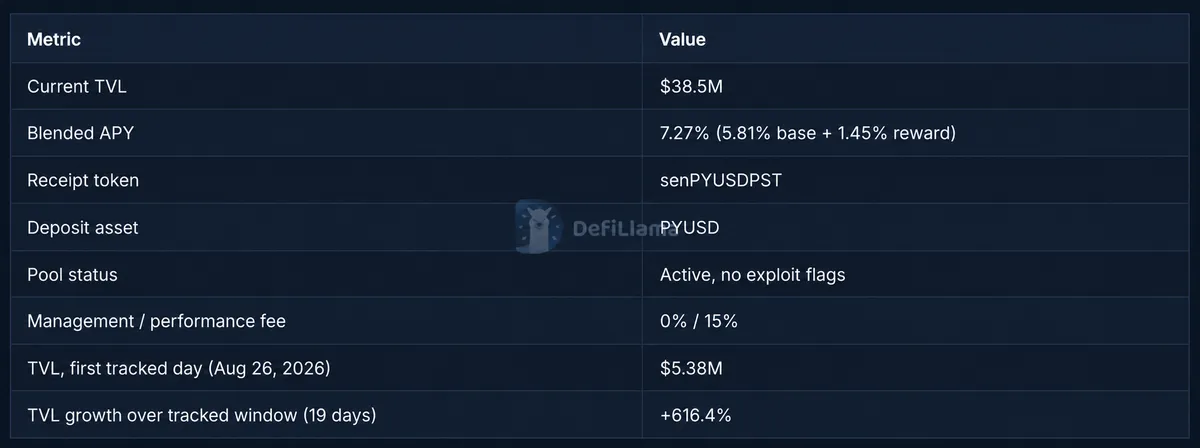
DefiLlama already tracks this specific pool: Sentora Huma PST Main, on Ethereum and wrapped using Morpho Blue.
Total value locked (TVL) has grown roughly 7.7x since DefiLlama-tracked history began on August 26, from $5.4M to $41.6M. Over the same 20-day period, APY remained relatively stable at 6.6%–9.2%, generally around 7%–8.5%. That stability is the stronger evidence for the underlying borrow-rate thesis: if reward emissions were fixed while TVL climbed this much, yield dilution would have shown up clearly, and it didn’t, even as TVL grew nearly 8x.
The Underlying Collateral Markets
The vault's PYUSD is actively deployed into two Morpho Blue markets where PST serves as collateral. Both markets are tracked by DefiLlama independently:
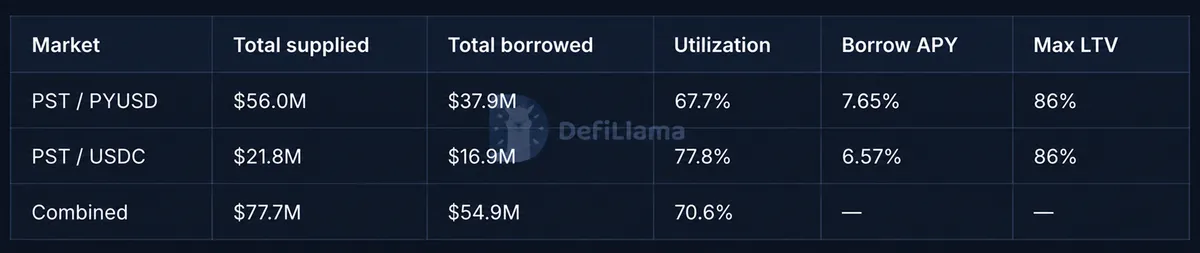
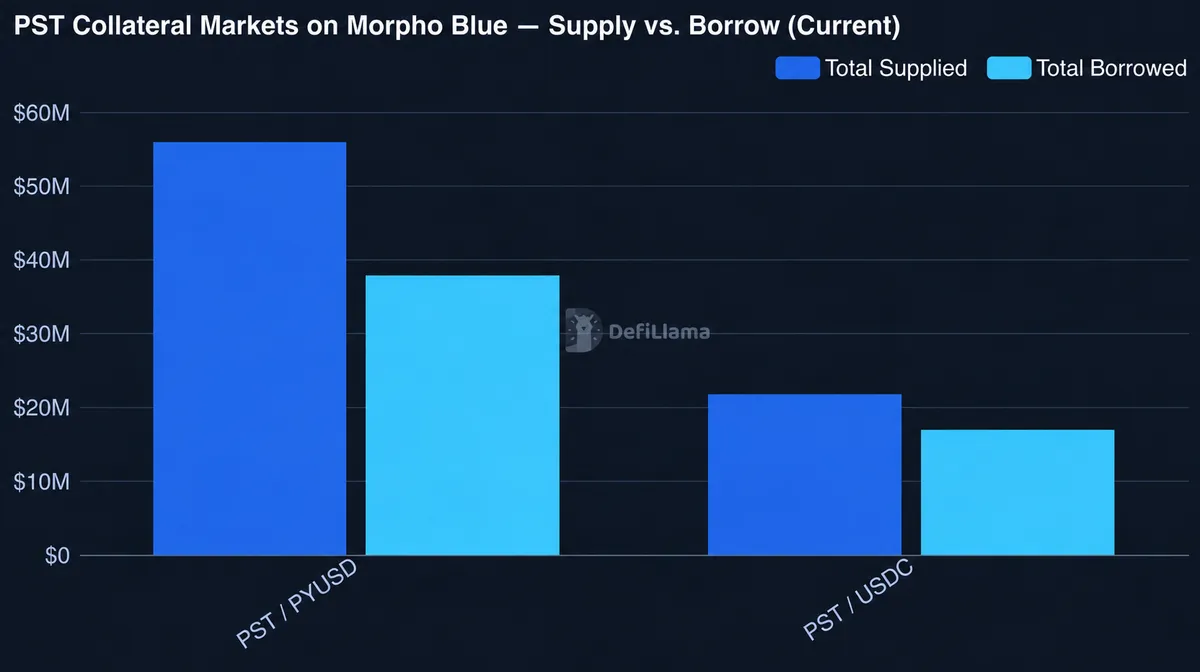
Utilization remains high but has eased slightly as supply has outpaced new borrowing: combined utilization across both PST markets now sits at about 70.6% ($54.9M borrowed against $77.7M supplied) — still well above typical idle-liquidity levels for a market this young, even if a touch below the ~75% figure at an earlier snapshot.
Additionally, an 86% maximum loan-to-value (LTV) ratio against a receivables-backed, predominantly off-chain asset is considered aggressive by DeFi standards. In comparison, blue-chip crypto-collateral lending markets (such as ETH or BTC against stablecoins) typically maintain significantly lower LTVs due to the potential for sudden price declines in crypto collateral. PST's value, however, is considerably more stable than that of crypto assets, owing to its short-duration, cash flow-backed structure. This characteristic distinguishes both the DeFi sector and this vault specifically.
How Big Is This?
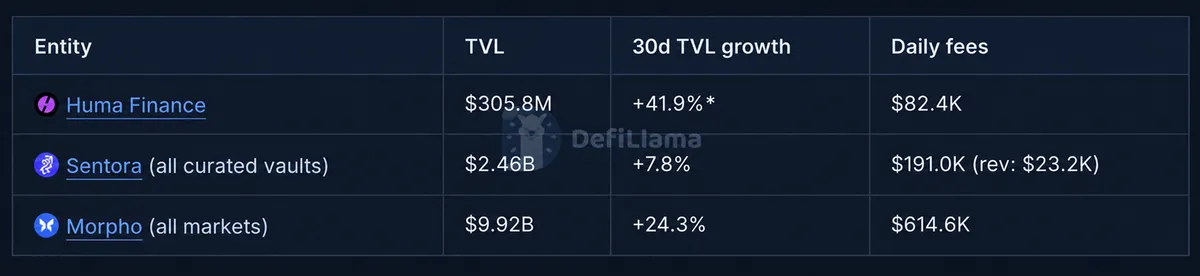
At a current $41.6M, this single vault is well under 1% of Morpho's $9.92B in total TVL (about 0.42%). It's a much bigger share of the other two names in the stack, though: roughly 1.7% of Sentora's $2.46B curated book, and about 13.6% of Huma Finance's own $305.8M in DefiLlama-tracked TVL. This one vault is now a meaningful fraction of Huma's entire tracked footprint, which is arguably the more interesting framing given Huma is the origination engine behind the yield.
The Takeaway
For those unfamiliar with the product, the vault offers several potential advantages:
The vault provides a distinct source of yield. Most "real-world asset (RWA) yield" in DeFi has historically referred to tokenized Treasury bills, which generate returns linked to interest rates and behave similarly to other treasury products. In contrast, PST's yield is determined by the repayment behavior of licensed payment companies, introducing a fundamentally different risk factor. This yield is not correlated with Federal Reserve policy or crypto market sentiment. If this decorrelation persists, the vault could serve as a valuable diversification tool for on-chain portfolios, rather than functioning as another treasury wrapper with a different branding.
Demand is materializing rapidly from genuine usage. Approximately 70.6% combined utilization in the PST markets, following a brief ramp-up period, indicates that deposited liquidity is actively being borrowed and deployed.
Sentora's Huma PST Main vault exemplifies a small yet rapidly expanding DeFi primitive. Payment-receivables credit is being operationalized through a familiar and well-understood structure, namely a curated Morpho vault. Deposits are both genuine and increasing, while the underlying collateral markets demonstrate substantial borrowing demand rather than idle liquidity intended solely for TVL metrics. This level of substantive activity surpasses what many "RWA" launches achieve in their initial week.