Morpho Trades Above Aave on Zero Revenue. A Rational Bet on Growth?
Morpho's fully diluted value sits 27% above Aave's. It holds less than half the deposits, generates half the fees, and pays out nothing, because the fee switch written into its contract has never been flipped. That gap is a bet on growth.

Morpho's fully diluted value sits 27% above
Aave's. It holds less than half the deposits, generates half the fees, and pays out nothing, because the fee switch written into its contract has never been flipped.
That gap is a bet on growth and we are testing this bet against the three things that would have to show up in the data: liquidity, fees, and revenue.
Our findings? Only the first one holds.
The scoreboard
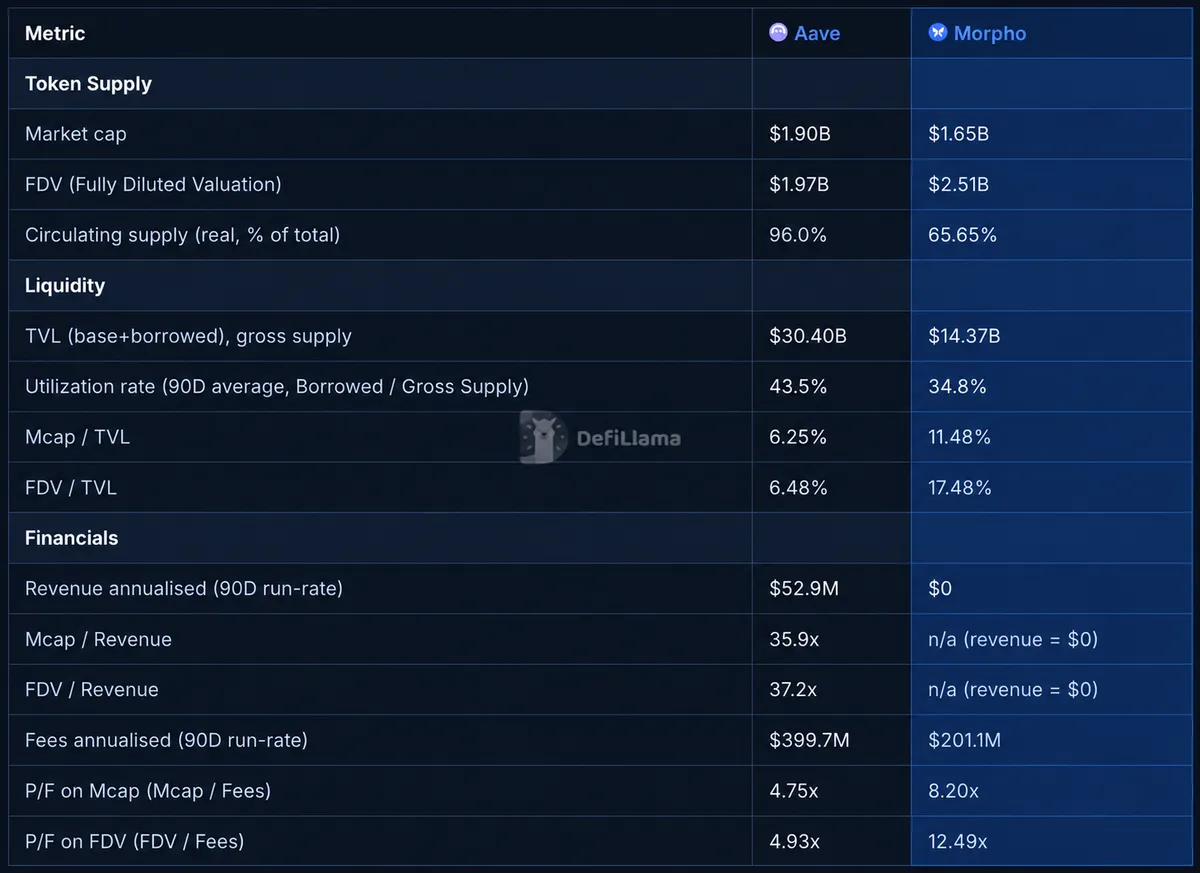
Comparing both projects on key metrics gives us a straightforward picture.
On valuation, Aave is larger by 5% on circulating market cap, but the situation completely reverses once you account for the tokens still to be unlocked. Morpho has only 65% of its supply circulating, meaning the protocol is 40% larger than Aave on FDV.
On liquidity, Aave holds more than twice the deposits and shows a higher utilization ratio, 43.5% against 34.8% for Morpho. Yet the market prices Morpho nearly 3x higher per dollar of deposits on FDV, 17.5% against 6.5%.

On financials, Morpho earns half of Aave's fees on 47% of the liquidity, so Morpho’s book monetizes well. But those fees never become revenue: Morpho doesn't take a share (fee switch not activated as of today), while Aave collects 13.2%.
All of this brings us to the ratios that matter. Market cap to revenue can't be compared today, since Morpho has no revenue, though we'll project it later in this piece. On price to fees, where both can be measured, Morpho trades at 1.7x Aave on market cap and 2.5x on FDV. That's a clear premium, and it's a bet on growth. But is that growth actually materializing this year?
Fact 1- Deposits back the bet
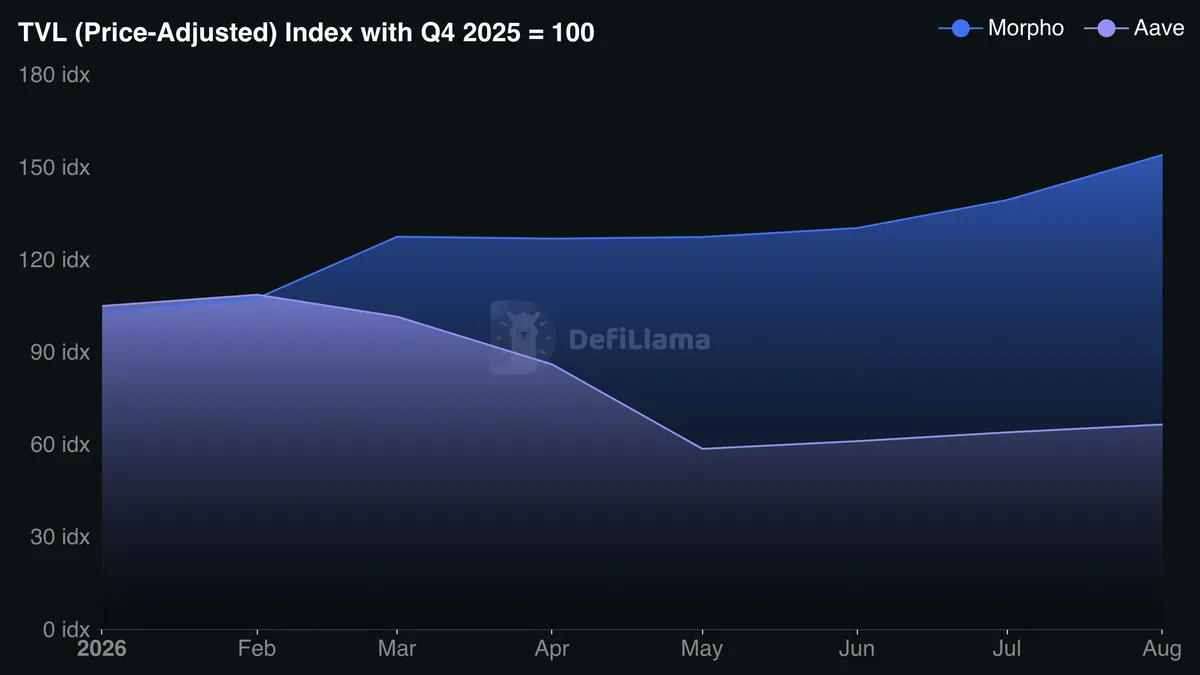
The two books have moved in opposite directions since Q4 2025. Morpho sits at 154 and Aave at 67, meaning Morpho's real deposit base has grown 54% while Aave's has shrunk by a third.
Morpho's growth is also accelerating. Month over month since May: +0.4%, +2.3%, +7.0%, then +10.5% in August, the strongest month of the year.
Aave held above its Q4 base through February, peaking at 109, then fell for three straight months: 102 in March, 86 in April, and 59 in May, pulled down by the April 18 KelpDAO rsETH exploit and the withdrawals that followed. What matters here is that Aave hasn't recovered: it's 13% off the May low and still a third below where it started.
So the first leg of the bet holds. Morpho is taking real deposits at an increasing rate, while its largest competitor is smaller than it was nine months ago.
Fact 2 - Fees don’t follow
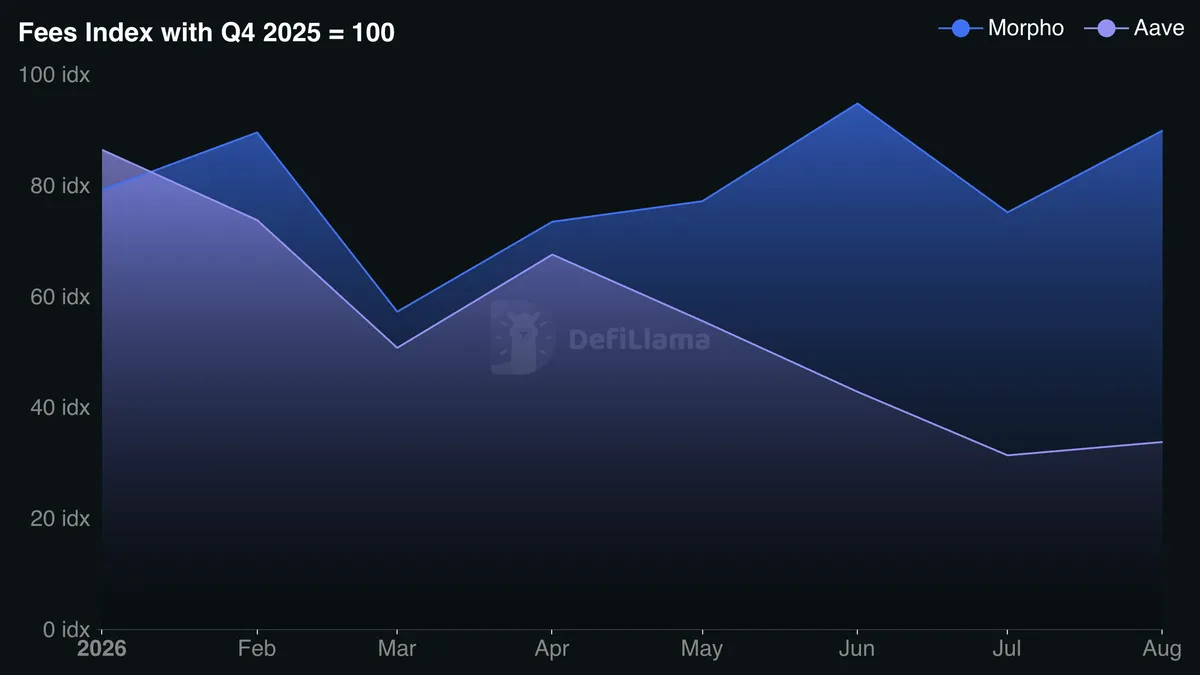
Morpho's fees sit below their Q4 2025 level and have been choppy all year, ranging from 57 to 95 and averaging 80. Nothing there qualifies as growth.
Morpho does hold up well relative to Aave, whose fee base has collapsed from 86 in January to 34 in August, most of that fall coming after the April hack. That gap could look like a reason for the premium but it would be based on competition underperforming rather than growth.
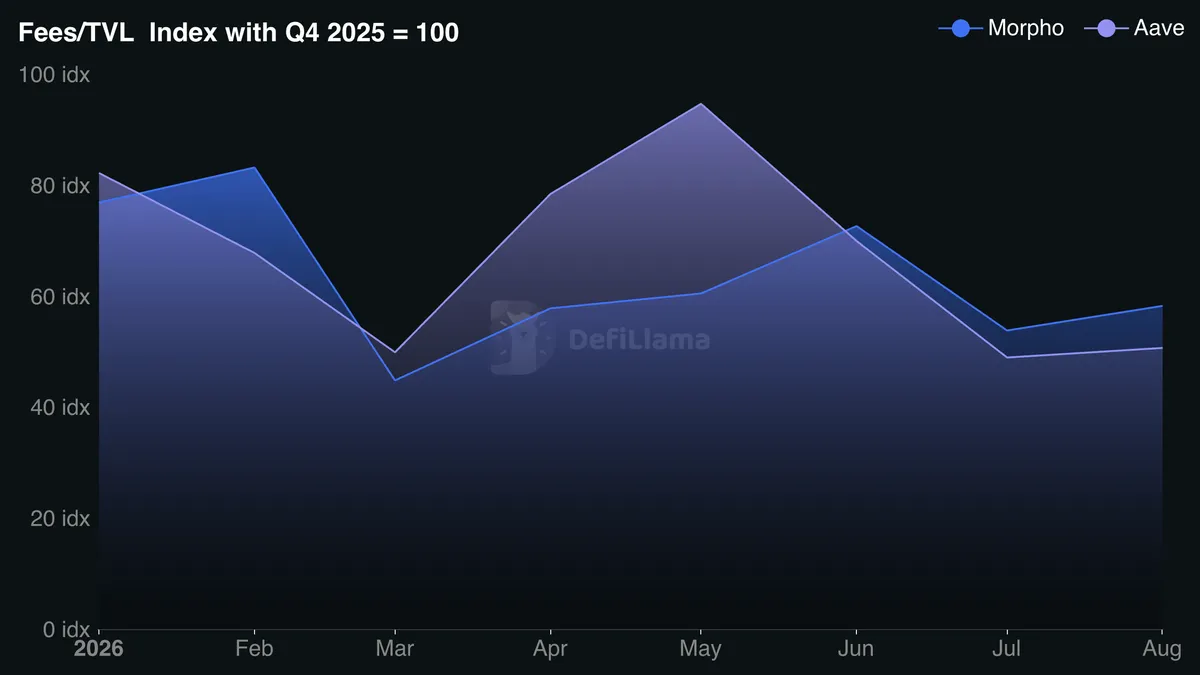
Another way to measure relative growth is how much in fees each dollar of deposits produces. Here the result is striking: the two protocols are broadly the same, 58 for Morpho and 51 for Aave, and both sit near half their Q4 2025 level.
Morpho gathered deposits and held its fees, Aave lost both, and yet each deposited dollar earns the same on either side. That reflects the structure of lending markets, where rates are driven largely by system-wide borrowing demand rather than by the protocol itself. So if the premium is meant to reflect growth in productivity per dollar deposited, the bet doesn’t hold: Morpho has gone backwards on that measure, and only marginally above Aave.
Fact 3 - Even the maximum switch falls short
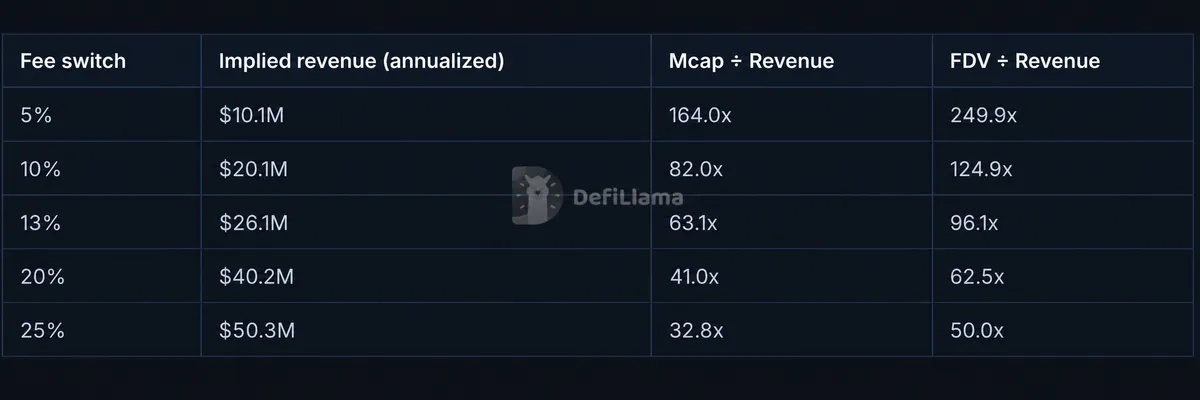
Morpho currently returns all borrower interest to lenders, but the Morpho Blue contract allows governance to retain up to 25%. That creates a useful way to test the valuation: what would Morpho’s revenue multiple look like if it monetized at Aave’s current take rate, or pushed the fee switch to its maximum?
At Aave’s 13.2% take rate, Morpho would trade at 63x revenue on market cap and 96x on FDV, 1.8x and 2.6x Aave’s respective multiples of 35.9x and 37.2x. In other words the valuation gap would still be there.
At the 25% maximum, the gap narrows sharply. Morpho would trade at 32.8x on market cap, slightly below Aave’s 35.9x. On FDV, however, it would still trade at 50.0x versus Aave’s 37.2x, a premium of roughly one-third.
But this remains a theoretical exercise. Morpho’s circulating market cap will rise as tokens unlock, and neither its fee base nor TVL will necessarily be the same when a fee switch is activated. More importantly, monetization itself could affect the economics of the protocol. Morpho currently passes 100% of borrower interest to lenders; retaining up to 25% would reduce lender returns and could, in turn, affect deposits.
A premium already narrowing?
Across the three metrics, the picture is mixed. On liquidity, the bet has worked: Morpho grew while Aave contracted. On fees, the case is weaker: Morpho monetizes deposits slightly better, but fee growth has stalled and productivity per dollar remains close to Aave’s. On revenue, the maximum fee switch is needed to close the gap on market cap only, and not FDV.
For now, Morpho’s premium is therefore clearly supported by deposit growth, but much less so by the economics that sit on top of it.
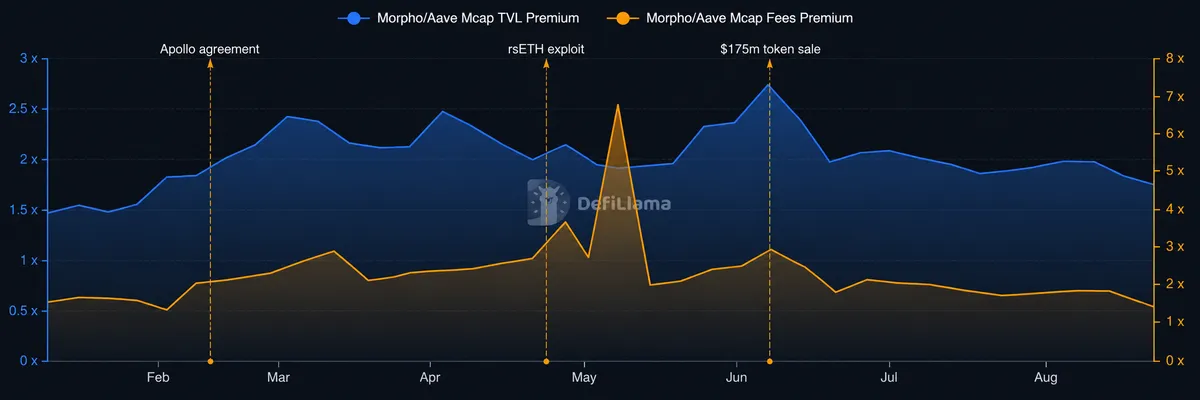
And the market may already be adjusting. Morpho continues to trade at a premium, particularly following the Apollo announcement, but that premium has narrowed materially. On market cap, the fee premium fell from 2.9x to 1.3x, while the deposit premium declined from 2.8x to 1.8x.
The key takeaway is that Morpho has earned its growth premium on deposits. Keeping that premium requires those deposits to translate into fees, and eventually into revenue. Until then, the valuation remains a speculative bet on future monetization and the market may already be starting to reprice that bet.