LlamaPay: Payroll for the onchain economy
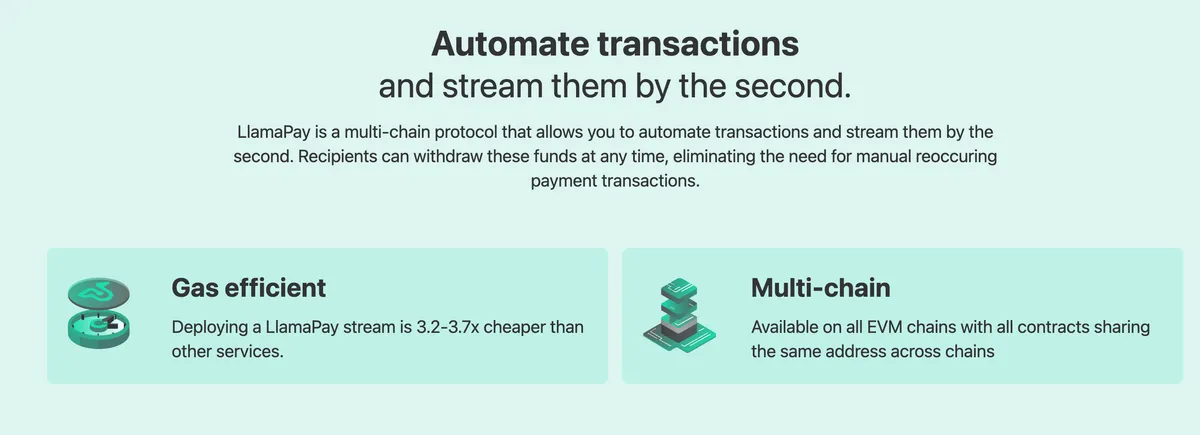
LlamaPay is a protocol that automates the process of sending and receiving crypto. Employers can stream salaries, so their workers can get paid in real-time.
DefiLlama’s pseudonymous chief, 0xngmi, wasn’t great at “keeping track of payments and all these things.” He sought software that could automate the chore, but he didn’t like what he found.
“So I decided I would just build my own,” he said. “I put it up, and then other people started using it.”
LlamaPay is a protocol that automates the process of sending and receiving crypto. Employers can stream salaries, so their workers can get paid in real-time. Customers get a simpler (and safer) way to pay businesses for their services. Token issuers get a tried-and-true tool for setting up token vesting. And it’s all immutable — the gold standard for crypto-based software.
The protocol is now used by crypto industry stalwarts, including Arbitrum, Curve, CoW Swap, and, of course, DefiLlama.
Over the past month, 56 organizations have paid more than 200 employees via LlamaPay, according to DefiLlama data. The employees claimed just under $950,000 in that span, with an average claim of $154.
The protocol works across multiple blockchains. Arbitrum leads in the number of claimants, while Ethereum edges Arbitrum in terms of organizations paying claimants.
As of Friday, streaming contracts held about $1.3 million in crypto. But token vesting contracts held more than $10 million, with Arbitrum once again leading the way.
Immutable, un-ruggable
It was four years ago when 0xngmi decided to automate the company’s payments system. He found a solution, but it was terribly slow.
“I was like, ‘I can build something better,’” he said.
He did. And then he added more features. And a couple more. He still improves it regularly, polishing the protocol in his free time.
“LlamaPay has mostly been about scratching my own itch, and then allowing others to use it as well,” he said. “I haven’t even done a launch tweet.”
Like some of the most celebrated protocols in decentralized finance, LlamaPay is immutable — 0xngmi cannot alter the smart contracts that power the service. That eliminates the trust assumptions that undergird the traditional financial system and, regrettably, much of the crypto economy.
“There’s no owner of the [smart] contracts, so I cannot rug them,” 0xngmi said. “It’s just there. It keeps working.”
Streaming salaries
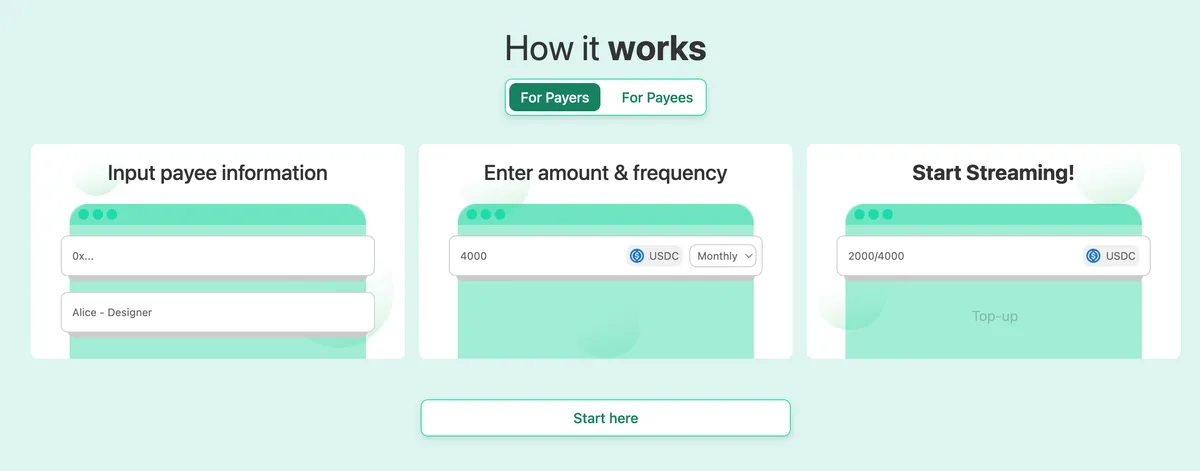
LlamaPay’s key feature is the ability to stream salaries. Rather than manually sending an employee their pay in biweekly or monthly lump sums, LlamaPay allows workers to claim the money they’ve earned within moments of earning it.
Here’s how it works: the employer places money in a smart contract. The employee can then withdraw from that contract whenever they want. The contract will calculate how much they can pull based on their salary and the amount of time that has elapsed since their last withdrawal.
“You are continuously paid,” 0xngmi said, “which is something that is only possible on the blockchain.”
He’s even noticed some users setting up bots that can withdraw at an hourly cadence — an extreme example, perhaps, but one that would allow people to dollar cost average into other crypto assets, if that’s how they want to store their wealth.
Securing payments
Everyone knows crypto has a UX problem. Wallet addresses are a headache-inducing string of numbers and letters. Complex transactions can require multiple approvals. Users need to have their guard up, lest they approve a malicious transaction slipped in by a scammer or hacker.
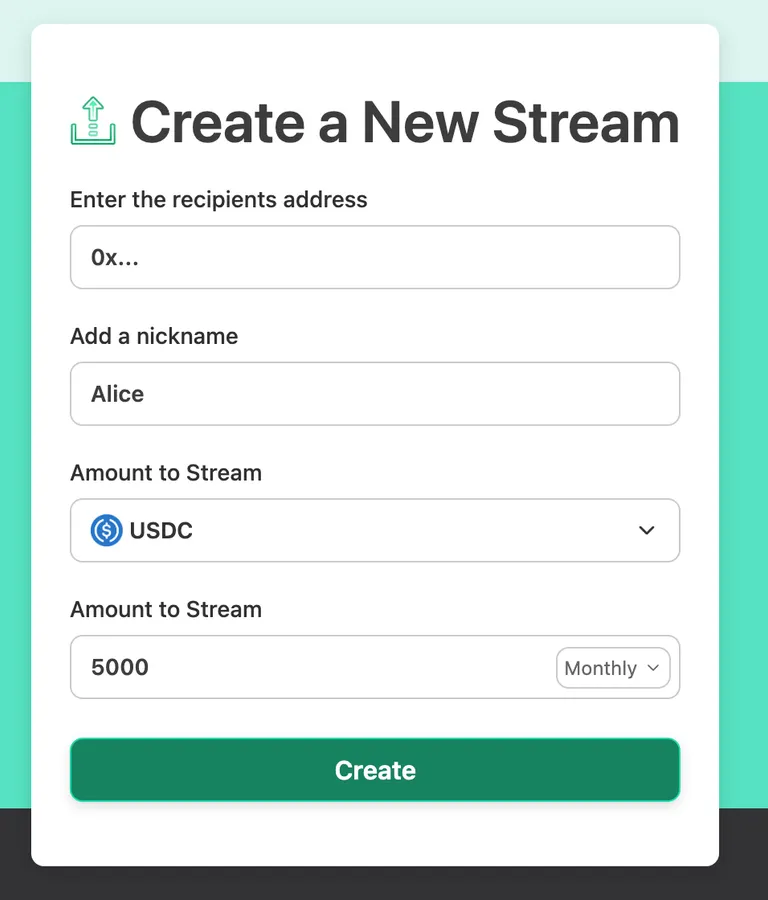
LlamaPay’s payments gateway lets businesses receive crypto payments and charge for recurring subscriptions — all while turning what would otherwise be a complicated series of steps for the customer into a simple, secure token transfer.
“When you make a payment with stable coins, it should be really easy to verify,” he said. “The verification message on your wallet should just be, ‘Send 1,000 USDC’ and that’s it.”
‘No need to reinvent the wheel’
When a team launches a new token, they need to establish a vesting schedule. But how that schedule is enforced varies substantially. Some rely on legal contracts, others on a simple custodial wallet. Both rely on trust, albeit to different degrees.
Immutable smart contracts have long been in use as well. One of the oldest came from Yearn, and issuers that sought to copy Yearn’s approach often copied the code from its vesting contract while creating a new user interface from scratch.
With Yearn’s permission, 0xngmi did the same, copying its battle-tested code — with a UI that anyone could use.
“There's no need to reinvent the wheel for that,” he said. “These contracts have had billions in TVL, and they haven't been hacked. At the end of the day, what you want with a vesting contract is, you want something safe.”
The cherry on top: Yearn is now a LlamaPay user, 0xngmi said.