Inside Gate’s Reserve Position: Diversified & Comfortably Over-Collateralized
Gate's derivatives-heavy trading book sits on top of a reserve base that's both verifiably substantial onchain and, by the exchange's own broader accounting, comfortably over-collateralized. Here's how the two pictures fit together.
Gate
Gate's derivatives-heavy trading book sits on top of a reserve base that's both verifiably substantial onchain and, by the exchange's own broader accounting, comfortably over-collateralized. Here's how the two pictures fit together.
DefiLlama tracks 87 centralized exchanges, with a combined $31 billion in 24-hour spot volume and $128.5 billion in 24-hour derivatives volume — a total market of roughly $159.5 billion per day. On the reserve side, the same 87 exchanges collectively hold $212.9 billion in tracked "clean" reserves (balances excluding an exchange's own native token).
Trading activity is heavily concentrated at the top. Binance alone processes $50 billion in daily volume, about 30% of the entire tracked market. OKX does $17.7 billion, and Gate follows with a combined 24-hour volume at $9.5 billion.
Gate As a CEX — How It Stacks Up
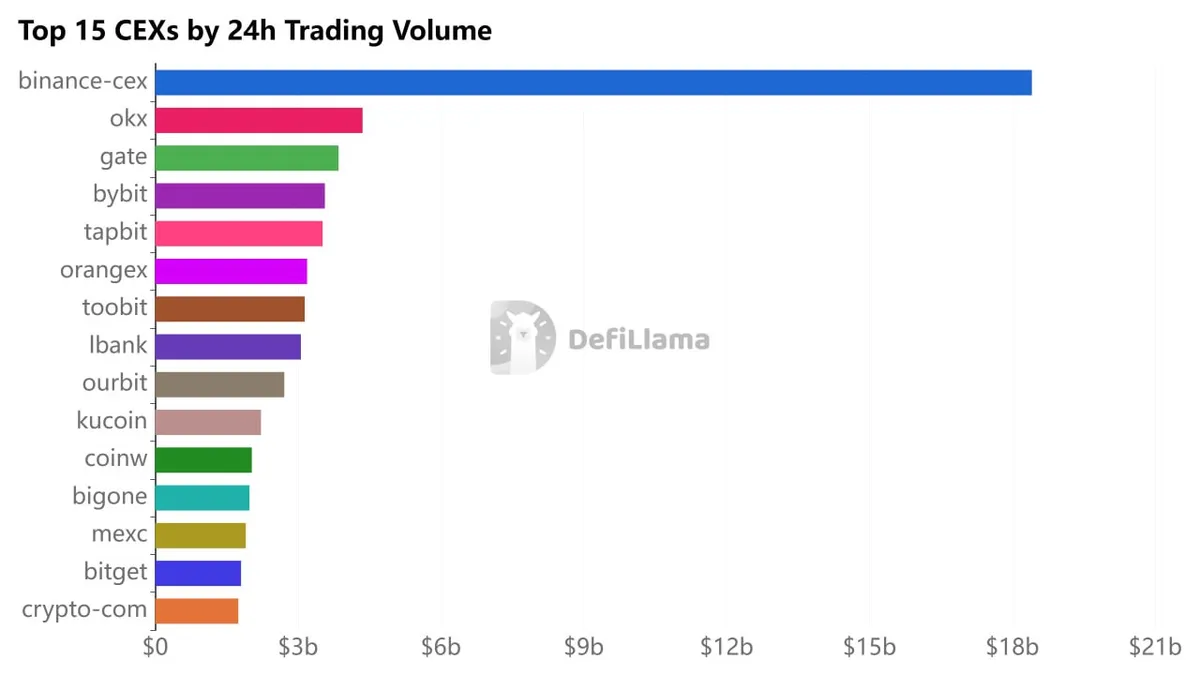
As shown above, Gate ranks third among the top 15 tracked exchanges by 24-hour spot volume, sitting just behind OKX and ahead of Bybit:
Spot volume: 3.85 billion per day, 113% larger than Bitget(1.80B), and about 8% ahead of Bybit ($3.57B)
Spot share of the top-15 cohort: ~6.7% of the combined 24h spot volume across these 15 exchanges
Gate's position among the top three exchanges by spot volume reflects strong spot-market activity in its own right.
Gate's spot ranking above tells only part of the story. That same day, Gate's derivatives volume was $21.7 billion, roughly 5.6x its spot volume, bringing its combined spot + derivatives volume to 25.6 billion.On a combined basis,Gate trails Bybit (34.6B combined, ~26% larger) but still runs about 20% ahead of Bitget's combined volume ($21.3B). This confirms Gate's overall trading activity leans derivatives-heavy.

Exchange | 30d Net Inflow |
|---|---|
OKX | +$1.35B |
Gate | +$308.1M |
MEXC | +$24.5M |
Bybit | -$91.0M |
Bitget | -$116.0M |
Binance | -$142.4M |
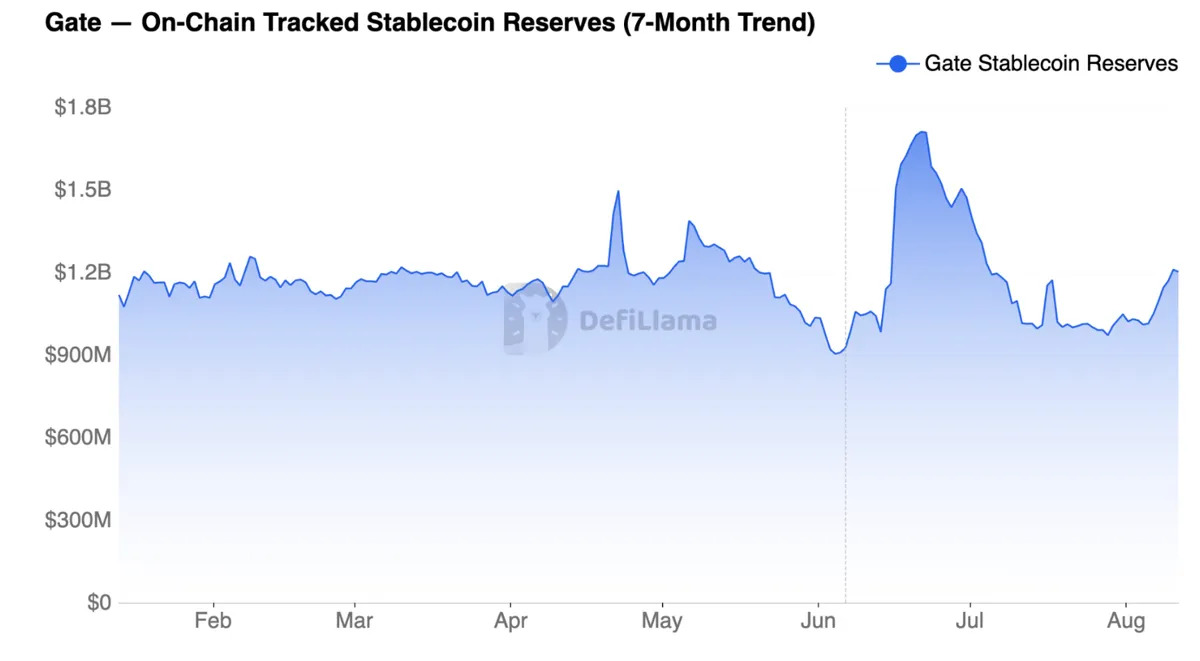
On top of that, Gate's on-chain tracked reserves have seen sustained net accumulation over the past month: DefiLlama data shows Gate pulled in $308.1M in cumulative net inflows over the trailing 30 days, with positive inflow days outnumbering outflow days across that window. That places Gate 2nd of 6 major exchanges we tracked side-by-side (behind only OKX's $1.35B) — and notably ahead of Binance (-$142.4M), Bitget (-$116.0M), and Bybit (-$91.0M), all of which saw net outflows over the same period.
Gate’s Reserve & Coverage Ratio
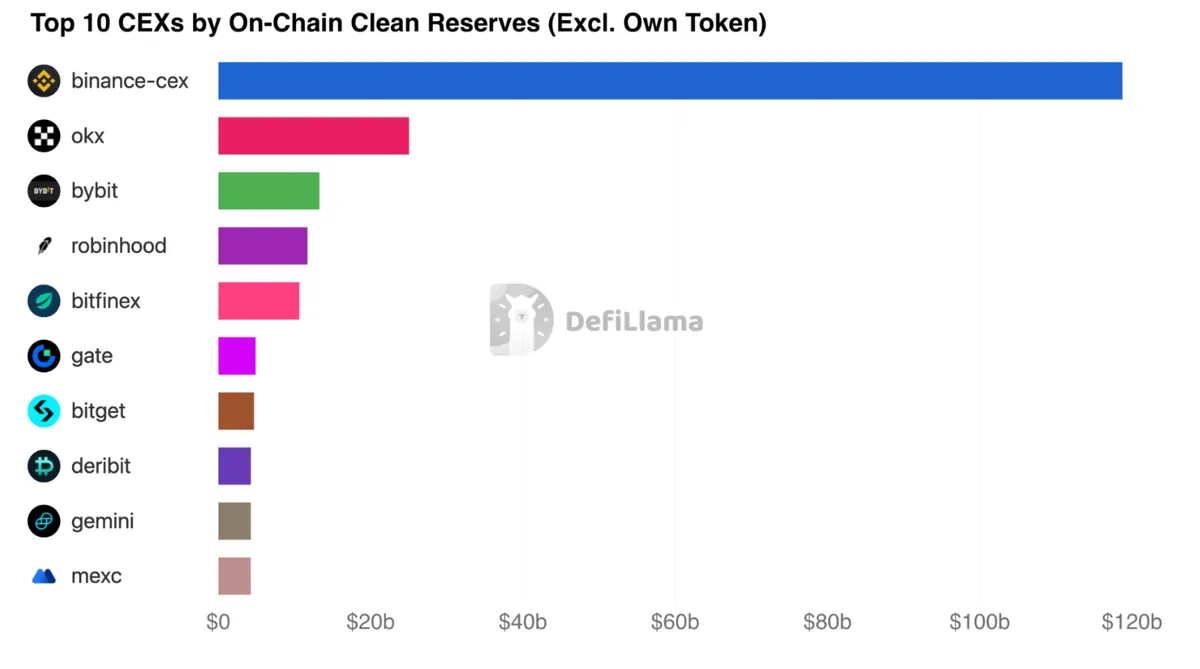
From Defillama data, Gate currently holds $4.61 billion in onchain tracked reserves (this excludes their GT token), placing them seventh of the 87 exchanges DefiLlama tracks. This is substantial and puts them just behind Bitfinex.


Asset | Amount | USD Value |
|---|---|---|
BTC | 19,942.19 | $1.28B |
GT (own token) | 108.8M | $727.9M |
WETH | 357,212.65 | $709.0M |
USD1 | 370.7M | $370.5M |
(stablecoin, unlabeled) | 312.8M | $312.2M |
DOGE | 2.30B | $161.3M |
stETH | 61,599.82 | $115.7M |
USDT (spUSDT) | 105.6M | $108.4M |
From the table above, we can see that Gate’s on-chain reserves are well diversified and aren’t concentrated in 1 or 2 assets. In fact, they are comfortably collateralized and have their holdings in many different assets, which is good to see for an exchange.
We would also like to highlight that Gate has reserves beyond what we can observe onchain. On July 27, 2026, Gate published a report that announced an overall reserve coverage ratio of 117%, spanning ~500 user asset types, including reserves of 26,775 BTC (24.2% over-collateralized) and 456,798 Ether (22.02% over-collateralized).
This follows reports in June and January that detailed the following figures:
On June 22, 2026, Gate claimed a coverage ratio of 115%, with 25,292 Bitcoin and $782 million in USD1
Asset | User Holdings | Platform Reserves | Coverage Ratio |
|---|---|---|---|
Overall (all ~500 assets) | — | — | 117% |
BTC | 21,557 BTC | 26,775 BTC | 124.2% |
ETH | 374,348 ETH | 456,798 ETH | 122.02% |
GT (native token) | — | — | 131.13% |
XRP | — | — | 116.5% |
Stablecoins (USDT+USDC+USD1+GUSD) | 1.336B tokens | 1.59B tokens | 118.97% |
And so — although there seems to be a discrepancy between DefiLlama's centralized exchange data and Gate's own reserve reports, that's to be expected —there are subtle but important differences in how the organizations track reserves. Here's how to read them together:
The DefiLlama table measures only onchain wallet balances for addresses Gate has disclosed to us. Those balances are independently verifiable — we can see the Bitcoin, WETH, USD1, and other assets sitting in Gate's tracked wallets in real time. But it's necessarily a floor, not a ceiling: it only counts what's onchain and disclosed, so it structurally cannot capture off-chain custody, undisclosed wallets, or the full ~500-asset scope Gate reports internally.
Gate's Proof of Reserve reports measure a self-attested comparison of platform reserves against user liabilities, across roughly 500 asset types, something no blockchain explorer or onchain tracker (including DefiLlama) can independently verify, because liabilities (what Gate owes users) simply aren't an onchain-observable fact. Only the exchange itself knows that number.
This is why Gate's self-reported total reserve figures run meaningfully ahead of DefiLlama's onchain read. The January report claims $9.4 billion in total reserves, while DefiLlama reports just $4.6 billion in clean reserves. The two numbers are measuring different parameters — DefiLlama for the verifiable, onchain floor, and Gate’s reports for a broader total that includes offchain assets and custody arrangements.
Taken together, the two data sets are complementary rather than competing. DefiLlama independently confirms that Gate's disclosed onchain reserves are real, substantial, and well-diversified. No single asset dominates the tracked balance sheet, and Bitcoin (the largest holding) makes up just 23.1% of onchain tracked value.
Gate then supplements that with its own report, which includes its full, undisclosed reserve base and its liabilities. This fuller picture shows that coverage runs comfortably above 100% across every major asset category, according to Gate. The company’s latest report also shows a particularly comfortable reserve base for the two largest cryptocurrencies, Bitcoin (124.2%) and Ether (122.02%).
Conclusion
Gate's position in the CEX landscape is best understood as two distinct but complementary pictures. On the trading side, Gate is a genuine top-tier player. That's a derivatives-heavy franchise punching above its overall size, and one of the strongest, most defensible data points in Gate's favor.
On the reserves side, the picture is solid. Gate’s reserves are genuinely diversified, spread across many distinct tracked assets with no single holding dominating the balance sheet. Bitcoin, the largest position, is only 23.1% of the total. On top of that, with a self-reported reserve coverage ratio that has stayed persistently above the 100% safety benchmark across its last three published reports, and with every major asset category—BTC, ETH, GT, stablecoins—individually over-collateralized, they have sound reserves.
Thus, Gate is a top exchange backed by a substantial, diversified reserve base that extends into comfortable over-collateralization across its full ~500-asset reserve program. They are substantial and well-run, fully covered with room to spare.