The Infrastructure Behind Stellar’s RWA Boom
Real-world assets (RWAs) have proven to be one of crypto industry’s most bustling segments over the recent years, growing from $10.5 billion to $36 billion in total value across all chains year on year.
Redstone
Real-world assets (RWAs) have proven to be one of crypto industry’s most bustling segments over the recent years, growing from $10.5 billion to $36 billion in total value across all chains year on year. While issuance has been growing across all chains in 2026, its uptick on Stellar is especially significant, rising from $525M to $2.6B+, an increase of more than x5 within just 8 months, making its RWA segment one of the fastest-growing ones across the industry. Behind this expansion is a multi-layered infrastructure streamlining RWA issuance across several key verticals, including compliance and DeFi utilization.
The backbone: Stellar’s infrastructure
Stellar offers institutions several key architectural features enabling compliant RWA launches. These include a set of native KYC standards, such as SEP-9, which standardizes the KYC information across protocols on Stellar and is integrated with the deposits and withdrawals API (SEP-24) as well as the SEP-12 KYC API.
Besides the native KYC framework, Stellar also features a dedicated standard for issuing regulated assets (SEP-8), which enables the issuer to sign off any transfers for the asset, an important feature for institutional-grade assets from the AML perspective. Assets leveraging this standard include WisdomTree’s WTGXX (Treasury Money Market Digital Fund), CRDT (Private Credit and Alternative Income Digital Fund), and its physical-gold-backed Gold Token, all distributed through WisdomTree Prime. Issuers are also free to explore bringing their RWAs onchain via the general fungible token standard SEP-41.
The execution: Stellar’s validator network
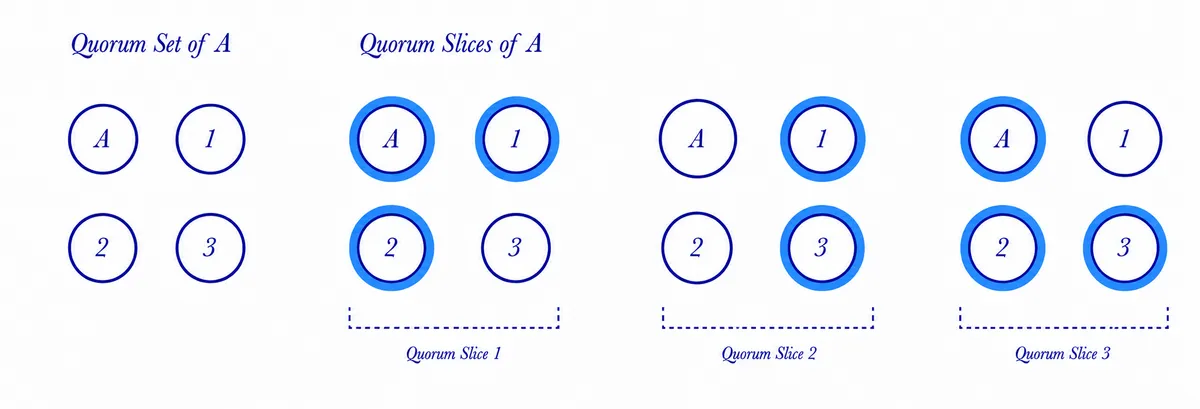
Stellar’s native standards enable the assets to be issued and managed with compliance, but execution makes them usable. The Stellar Consensus Protocol is a federated Byzantine agreement model where validators pick their quorum slices, or validator subsets tasked with confirming a transaction; in other words, finality, does not require a signoff from the entire validator set, which enables transactions to settle within 5 seconds. Running the validators is a select group of Tier-1 validator organizations (Franklin Templeton, Blockdaemon, MoneyGram, Figure, Range, etc), all running multiple nodes that are spread between different physical locations.
Stellar’s RPC infrastructure works as the gateway for bringing data onchain to the network, and it also has a few peculiarities. It features two main components: a REST API for routine operations such as payments and setting onchain permissions, and Soroban RPC, a JSON-RPC interface specifically for smart contract interactions. Multiple RPC operators, including Alchemy, Validation Cloud, QuickNode, or Ankr, enable builders on Stellar to leverage their RPCs instead of running their own nodes.
The DeFi unlock: The pricing infrastructure on Stellar
Issuance brings an RWA onchain, but in itself, that doesn't grant it the same composability as a crypto-native asset. To trade on DEXes, work as collateral, or otherwise function in DeFi, an RWA token requires a price feed delivered in a standard onchain shape. On Stellar, pricing is handled under the SEP-40 standard, which sets the unified interface for consuming price data, sparing builders the need to set up custom adapters for every price feed and integration.
While a crypto token is priced based on deep-liquidity markets trading 24/7, pricing most RWAs represents a much larger challenge. Most of them, such as stocks, either trade within designated windows on business days, or, like gold and the largest indices, 23/5; additionally, a variety of RWAs, such as money market funds, aren’t priced based on trading at all, but rather based on their underlying NAV, which is reported by fund manager. That complexity is a large part of why RWAs remain broadly underutilized in DeFi, and Stellar illustrates the gap clearly: its RWA active market cap has grown to $2.64 billion, yet DeFiLlama’s RWA dashboard shows $0 in tracked DeFi Active TVL for those assets on Stellar, against overall Stellar DeFi TVL of roughly $238 million.
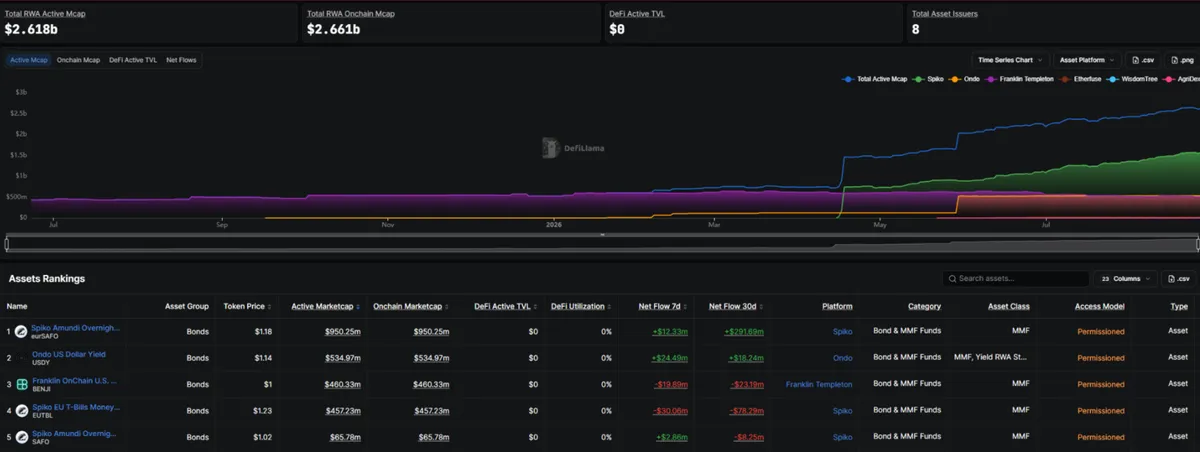
The challenge has birthed a variety of oracles specializing in RWAs. Among them, several have already adopted the standard and are providing SEP-40 price feeds for RWAs on Stellar. As an example, RedStone is pricing 10 RWAs on Stellar, varying from sovereign debt, both US and non-US, to tokenized gold and collateral loan obligations. RedStone price feeds have unlocked these assets for Templar Protocol, which is running lending markets against Centrifuge-tokenized deJTRSY and deJAAA by Janus Henderson Investors, USTRY (tokenized T-bills), and CETES (tokenized sovereign debt of Brazil),
The outlook: DTCC is the next milestone
Stellar’s next RWA milestone may already have a name. The Depository Trust and Clearing Corporation (DTCC), the financial company that automates, clears, and settles trades for global financial markets, has announced plans to tokenize the assets in custody of its subsidiary DTC on Stellar, aiming to start next year. DTCC is a clearing house powering the global stock trade and processing quadrillions of dollars in securities; DTC, or the Depository Trust Company, custodies more than $114 trillion worth of assets, per DTCC’s own figures.
The momentum behind Stellar’s RWA sector has already clearly manifested itself, and its partnership ecosystem sets it up for further growth. The main challenge ahead is not bringing more RWAs onchain, but rather unlocking what’s already out there for use in DeFi, a challenge resolved first and foremost via robust pricing infrastructure.