Hylo xSOL: No Liquidation, No Funding - But What Are the Real Costs?
Hylo markets its xSOL token on two guarantees: no liquidation and no funding rate. And so far this holds true, as nobody holding xSOL has ever been forced out of a position, and nobody pays an ongoing fee to hold leveraged SOL exposure the way they would on a perpetual exchange.
XSOL
Hylo markets its xSOL token on two guarantees: no liquidation and no funding rate. And so far this holds true, as nobody holding xSOL has ever been forced out of a position, and nobody pays an ongoing fee to hold leveraged SOL exposure the way they would on a perpetual exchange.
But no liquidation doesn't mean no loss. Between October 2025 and June 2026, under Hylo's first version, xSOL lost nearly all of its value, even though SOL itself, the asset it's meant to track with leverage, fell by a much smaller amount. Meanwhile, hyUSD, the stablecoin this whole system exists to protect, never lost its dollar peg through any of it, another outcome promised by the protocol.
That gap is the actual subject of this piece. If nobody was liquidated despite the leverage, where did the extra loss go, and who ended up paying for it? The short answer is dilution, and we will dig into why by revisiting the stress event that happened in the period mentioned above. Then we'll assess whether V2 actually changes things and limits or reduces that risk. But before any of that, let's briefly revisit how Hylo works under the hood.
Under the hood: the promise, and what it takes to keep it
No leverage, no funding rate…
Hylo's basic principle is as follows: take one pool of staked SOL, and split it into two claims on that pool, ranked. One claim, hyUSD, sits first in line and is always worth exactly $1, as long as there's enough value in the pool to cover it. The other claim, xSOL, gets whatever is left over, no ceiling, no floor, all of the pool's ups and downs land here. That's the entire mechanism.
To make things more tangible, here is a concrete example: say the pool holds $150 of staked SOL. $100 of that backs hyUSD, fixed at $1 a token, while the remaining $50 belongs to xSOL. If SOL rises 33%, the pool grows to $200. hyUSD still only needs its $100, so the remaining $100 becomes xSOL's new total value. That means on a 33% SOL move, xSOL's value doubled, a 100% price appreciation, three times the size of SOL's own move. On the opposite side, if SOL falls and the pool drops to $100, hyUSD still needs its $100, and xSOL is left with nothing. The ratio itself, three times the swing either way, is where "3x leverage" comes from.
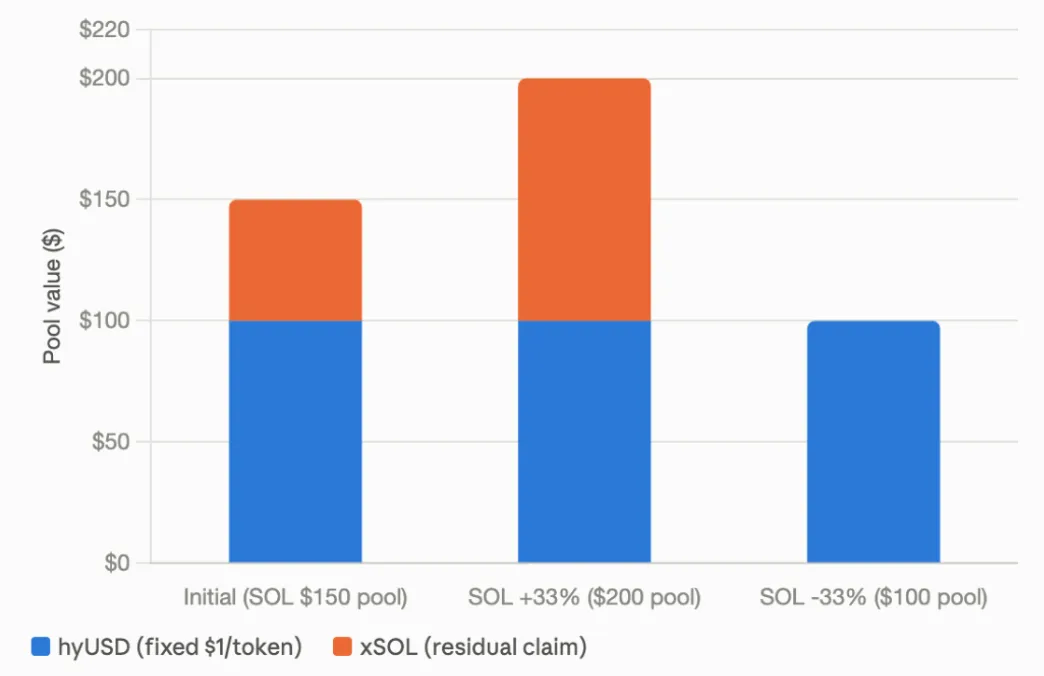
Because leverage comes from the pool's composition, not borrowed money, there's nothing to force-close. xSOL holders don't owe anyone anything, they just hold a claim that can shrink toward zero in a bad enough crash, or grow substantially if the market appreciates.
The ‘no funding rate’ part comes from the underlying collateral itself. Staked SOL earns real staking rewards just by existing, roughly 7 to 8% a year. That yield flows through the system and effectively pays for the arrangement, so nobody needs to charge xSOL holders an ongoing fee.
…but proper risk management is still required
None of this holds together on its own, as the pool needs active management to stay near that target, and Hylo handles that in two layers.
The first layer is pricing. To mint hyUSD, users deposit collateral (SOL, BTC, or USDC) into the pool of their choice and receive hyUSD in return. Redemption reverses this process: hyUSD is burned, allowing users to withdraw collateral from a selected pool. Rather than applying fixed fees, Hylo adjusts pricing dynamically according to each pool’s condition. Minting is cheaper in healthier pools, while redemption is cheaper from pools experiencing greater stress. This fee structure creates economic incentives that direct user activity toward restoring balance across the system.
If the Collateral Ratio (CR) for a pool, defined as the total value of the pool divided by what hyUSD needs to stay whole, drifts outside the healthy range, roughly 136% (or 3.8x leverage) to 167% (or 2.5x leverage), a second layer kicks in. The protocol trades directly against its USDC reserve, buying collateral back when CR runs high to re-lever the pool, selling collateral into USDC when CR runs low to de-lever it. Pricing on these trades starts in the protocol's favor and shifts toward the trader as CR nears the edges of that range, which is what pulls arbitrageurs in to help push things back to center.
This is where xSOL holders incur a real cost: selling collateral for USDC during periods of stress permanently reduces the SOL exposure backing each token and a full recovery in SOL’s price may not restore the position to its previous state.
Last but not least, in the true worst case, if a pool is still short on backing after all of that, the Earn Pool's own hyUSD gets burned to make up the difference and restore full backing. That's a direct cost to Earn Pool depositors, not to xSOL holders, and falls outside the scope of this report.
Put to the test: what happened to Hylo's first version
An important note before diving into the case study: everything below describes Hylo's first version, not the current one. V1 supported a single collateral asset, SOL, with no isolation between markets, no USDC pool, and no Earn Pool. Instead of the USDC-based rebalancing described above, the protocol relied on the Stability Pool and defended the peg through conversion of hyUSD to xSOL rather than by selling collateral. That difference matters as this mechanism created the dilution xSOL holders faced, which is the indirect cost of having no funding fee and no liquidation.
The peg held, exactly as promised…
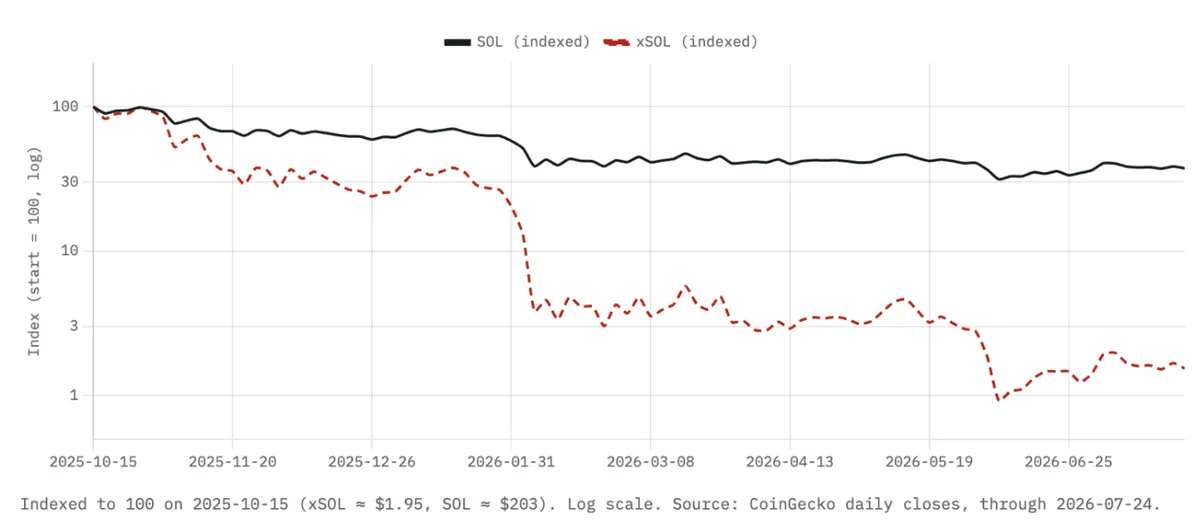
Hylo's first version ran for about eight months on a single SOL pool before it hit a real crash. Between October 2025 and June 2026, SOL fell around 69% from its highs. Through all of that, hyUSD never lost its dollar peg and the stablecoin side of this system got exactly what was promised, at every point.
However, xSOL holders got a very different outcome. Over that same window, xSOL lost close to all of its value, down about 99% from its October high. This isn't really a surprise given the example from the last section: a 33% SOL drop is exactly the point where xSOL's claim hits zero and the pool's collateral ratio falls to exactly 100%.
But with a 69% drop in SOL price, the pool alone can no longer fully back hyUSD without help. And as hyUSD held its peg the whole time, even while the pool's own collateral was worth far less than what was needed to back it fully, the natural question that comes is “who paid for it?”. And the answer is xSOL holders through a dilution mechanism that only experienced traders might have identified.
…but someone still had to pay for that
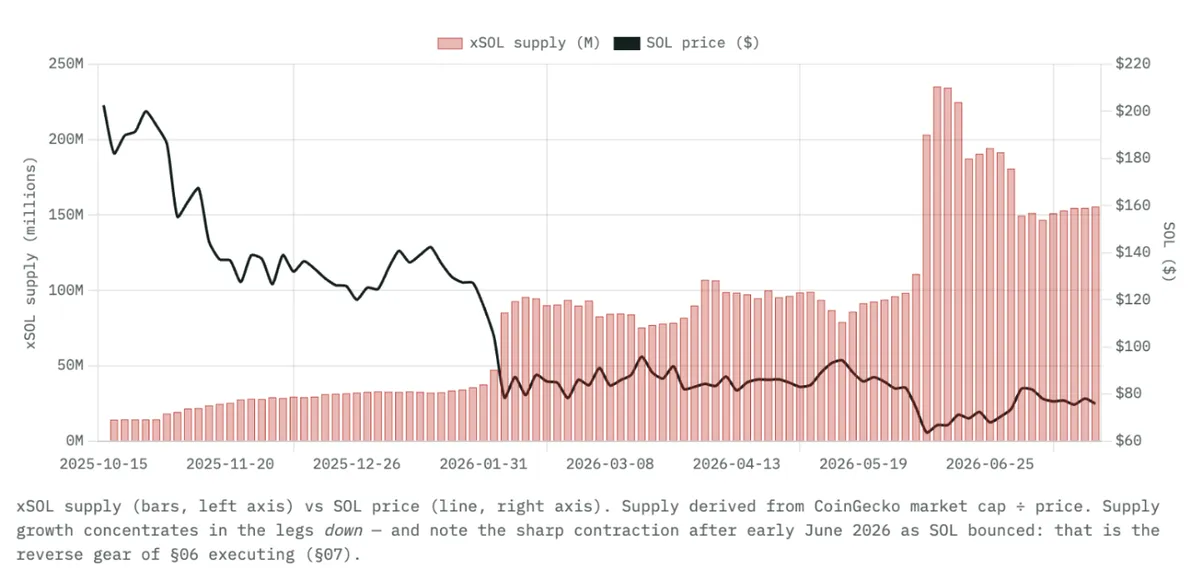
As Hylo’s collateral ratio declined, V1’s defense mechanism was activated to protect the hyUSD peg. This mechanism differed structurally from the USDC-based rebalancing system used in V2 and expanded xSOL’s supply through two distinct channels. The first was minting at net asset value (NAV): users could deposit fresh SOL and receive newly issued xSOL priced according to the pool’s actual per-token value at the time of minting. The second was the Stability Pool conversion mechanism, which automatically burned staked hyUSD and issued new xSOL in its place once the collateral ratio fell below a specified threshold. Together, these mechanisms caused xSOL’s supply to increase approximately 28x over the period, from around 8.4 million tokens to 235 million.
Roughly 126 million of the new tokens came from ordinary buying: someone deposits fresh SOL, the pool genuinely grows, and new xSOL mints against that deposit at the prevailing NAV. However, the depressed NAV meant that each dollar of new capital received significantly more xSOL than it would have before the crash. Although the issuance price was fair relative to the pool’s value at the time, it substantially expanded the token supply and for existing holders, this created dilution: any subsequent recovery in the pool’s value would be distributed across a much larger number of xSOL tokens.
The remaining 43% came from Stability Pool conversions. Unlike the standard minting described above, this process introduced no fresh capital into the system. Instead, the protocol burned hyUSD deposited in the Stability Pool and issued xSOL in exchange, reallocating collateral already held within the protocol.
In both cases, xSOL issuance served the same broader objective: absorbing pressure from hyUSD and helping preserve its peg. However, this protection came at a significant cost to existing xSOL holders. As the token supply grew, each existing xSOL represented a smaller share of the collateral pool and any recovery would therefore be spread across many more tokens.
What it would take to get back to even
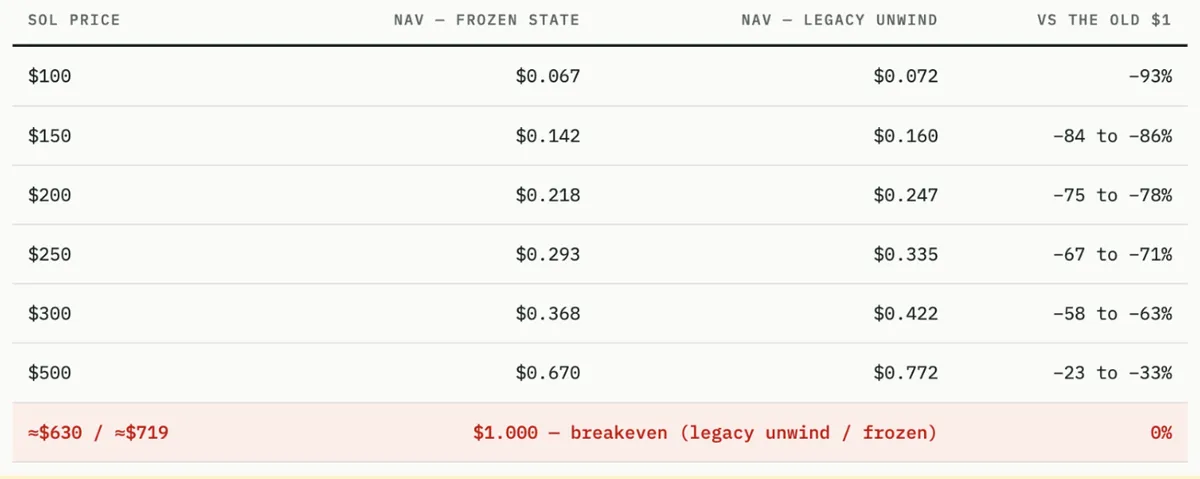
With that much new supply in circulation, one question follows naturally: what would SOL actually need to do for xSOL to see $1 again?
The answer, based on the pool's state as of the July 2026 snapshot, is a SOL price somewhere between roughly $630 and $719 assuming xSOL supply stays in a similar range. That's a move of 8.3x to 9.5x from where SOL was actually trading at the time, and still way above SOL's previous all-time high.
That range exists because of the re-conversion: above a healthy 150% collateral ratio, tokens sitting in the Stability Pool get gradually converted back into hyUSD, shrinking xSOL's supply as things improve. So far, about 79 million xSOL, roughly a third of June's supply, has already been reconverted back into hyUSD and that's what pulled the frozen-state breakeven down from initially $1,024 in June, right after the event, to $719 today.
Either way, the conclusion is the same: SOL simply recovering isn't enough anymore. xSOL needs SOL to blow past its old all-time high before an early holder sees their money back.
Is V2 a real change in the risk?
V2 touched almost every part of the system, but does that mean the risk has changed for xSOL holders?
Multi-asset collateral
Splitting the system into independent pools — SOL, BTC, and more planned — means a crash in one no longer drags the others down with it. Look closely at what that actually protects, though, and it's hyUSD's aggregate backing, not xSOL's risk. Each pool's own health is still calculated locally, so a SOL crash puts exactly the same pressure on the SOL pool, and on xSOL holders, regardless of how healthy a BTC pool sits next to it.
The USDC pool
The new USDC pool allows users to mint and redeem hyUSD directly against USDC. As a result, hyUSD growth no longer depends as heavily on demand for SOL, as it did under V1. It also gives arbitrageurs a permanent, liquid venue through which they can rebalance the system, rather than forcing them to wait for occasional trading opportunities. This should make the hyUSD peg more resilient.
For xSOL holders, however, the main risk appears when the protocol sells SOL for USDC during periods of stress to keep the collateral ratio within an acceptable range. Once conditions improve, the protocol may use that USDC to buy SOL back. But because the original sale took place after SOL had already declined, the proceeds may not be enough to repurchase the same amount of SOL if the market subsequently recovers. The protocol therefore rebuilds only part of the original SOL exposure, meaning that each xSOL may remain backed by less SOL than before the stress event.
The Earn Pool
hyUSD holders can deposit into the Earn Pool to earn yield, staking rewards, BTC borrow-rate revenue, and fee income, receiving eHYUSD as a receipt.
Under V1, this pool, then called the Stability Pool, doubled as Hylo's backstop: when collateral ran short, deposits got converted into freshly minted xSOL to defend the peg. That's where roughly 43% of V1's xSOL dilution came from.
V2's Earn Pool is now delta-neutral instead. In the true worst case, the protocol burns some of its hyUSD outright rather than converting it into xSOL, a bounded loss for depositors instead of a directional bet.
For xSOL holders, that closes off a real source of dilution: no new tokens get minted this way anymore.
hyUSD is the protocol's first-class citizen, xSOL pays the difference
No liquidation and no funding rate are both real and structurally true. However, they come with a hidden cost that not all participants might have understood. This one is dilution.
The case study showed it very well. In Hylo's first version, new xSOL were minted to maintain the collateral ratio and protect the peg for stablecoin holders. The minting was so aggressive that supply grew 28x, and with roughly 43% of that new supply coming from Stability Pool conversions, the recovery price now sits around $630 to $719.
V2 improves the situation, but it doesn’t fully eliminate the risk for xSOL holders. The Earn Pool (Stability Pool redesign) removes one major source of dilution: during periods of stress, stablecoin deposits are no longer converted into fresh xSOL. Instead, the protocol can sell collateral for USDC to support a stressed pool. This doesn’t increase the xSOL supply, but it reduces the amount of SOL backing each token with no guarantee of recovery due to price volatility. As for the second dilution channel, it remains unchanged: during stress events, users can still mint xSOL at NAV by depositing fresh capital. When NAV is depressed, the same amount of capital receives more xSOL, expanding the supply and reducing existing holders’ share of any future recovery, just as it did under V1.
In the end, the system protects stablecoin holders by transferring the cost of that stability to xSOL holders. No liquidation is the promise and dilution is how xSOL holders pay for it.