bStocks After Hours: Who is Capturing Liquidity When Markets Close?
Tokenization makes stocks more accessible, more liquid, and in principle tradable 24/7, from anywhere. Traditional exchanges still close on schedule, but the venues distributing tokenized versions of the same stocks don't have to. The question: who actually shows up when Wall Street doesn't?
Binance
Tokenization makes stocks more accessible, more liquid, and in principle tradable 24/7, from anywhere. Traditional exchanges still close on schedule, but the venues distributing tokenized versions of the same stocks don't have to. The question: who actually shows up when Wall Street doesn't?
As of August 2, roughly six weeks after launch, Binance's bStocks have already crossed $500M in AUM. On top, bStocks also recorded $2B in trading volume over a single weekend, a signal worth stress-testing against real usage data. In this article, we compare Binance's bStocks, Kraken's xStocks, and Ondo's Global Markets as they represent three distinct tokenized-stock models while offering consistent hourly volume data. Using six weeks of DeFiLlama data, from June 14 to August 2 , 2026, we examine how trading volume shifts between weekday market hours, weekday off-hours, and weekends, whether one platform takes the lead once traditional markets close, and what these patterns reveal about its users.
Weekdays - A Market That Never Fully Closes
The weekday hourly profile confirms the basic premise: trading doesn't stop when the traditional market does, and tokenized venues hold their promise of round-the-clock access. However, the profile isn't uniform. Activity clusters tightly around the moment TradFi opens, with volume across all three venues surging between 13:00 and 15:00 UTC and slowly decreasing until the market closes.
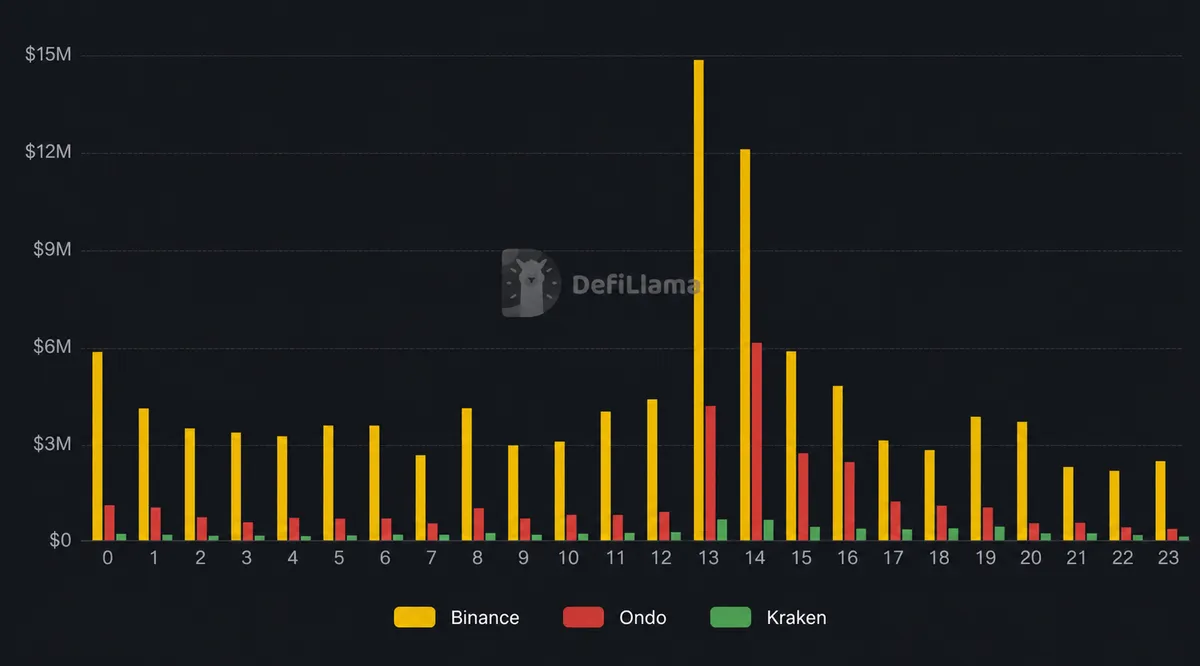
Visually, it's tempting to conclude that most of the volume concentrates during the opening hours. However, that picture needs nuance. If we count 13:00-20:00 UTC as TradFi's opening hours, 49% of weekday volume falls in those 7 hours. But the remaining 51% still happens off hours. That's significant, and it says something specific: traders are here round the clock, and TradFi's trading hours function as a constraint. In other words, traders have to adapt around the opening hours.
As 24/7 access becomes standard across more venues and more tickers, that concentration should fade. The more normal it becomes to trade a tokenized stock outside market hours, the less trading should cluster around the one moment TradFi happens to be open.
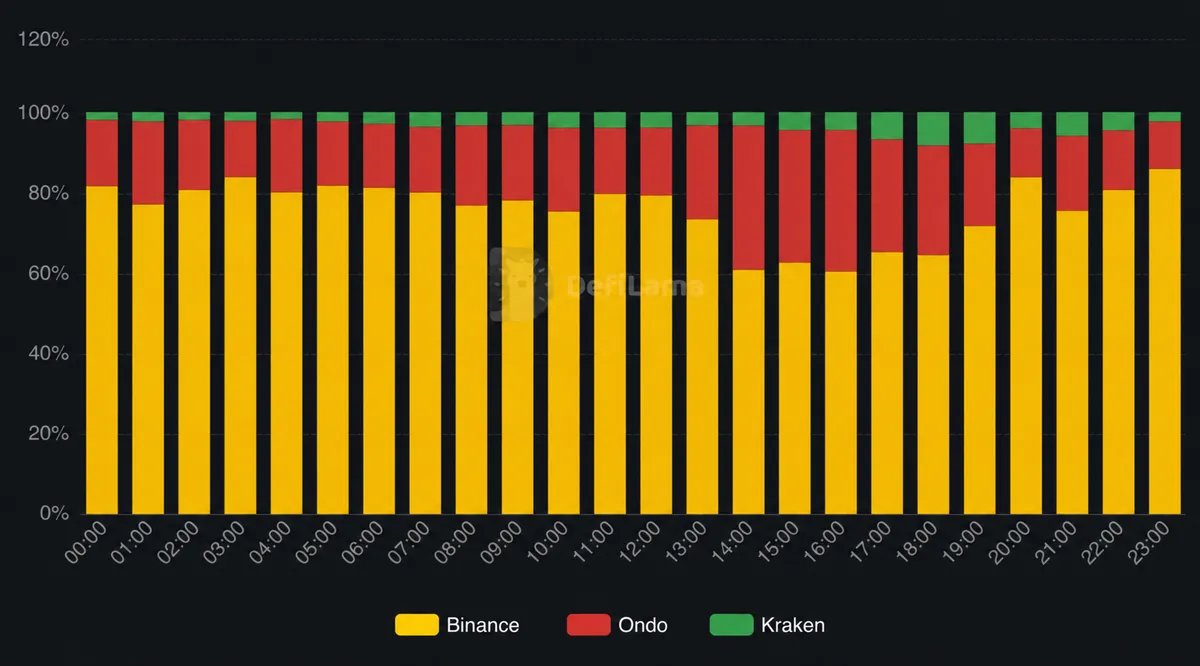
By venue, Binance's lead holds through the entire day, ranging from 64% to 86% of combined volume in any given hour. But the pattern underneath is clear: Binance's dominance actually increases during off-market hours and is strongest over the weekend.

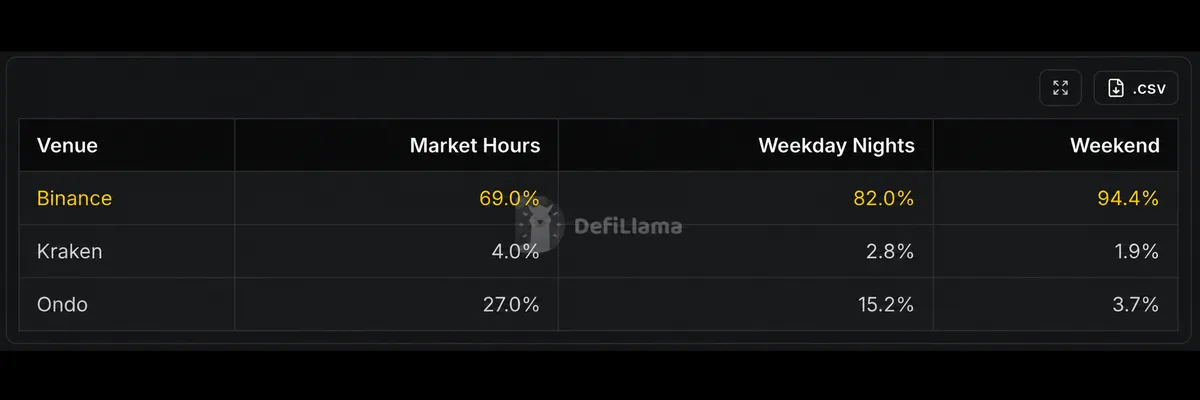
Off-market hours, Binance averages 82% of volume, against 15.2% for Ondo and 2.8% for Kraken. During market hours, Binance’s share moderates to 69%, while Ondo rises to 27% and Kraken to 4.0%.
That gap points to Ondo and Kraken being relatively more active while the underlying market is live. Two main reasons can explain this. First, user typology: Binance leans more retail while Ondo is more institutional. Second, the structural layer or how each product is actually built and what it relies on to function.
The products may look similar on paper, but their liquidity models are fundamentally different. bStocks are converted 1:1 from Binance Stocks positions and trade directly on Binance’s order book. That liquidity also extends to BNB Chain, creating a bridge between CeFi and DeFi positions, particularly interesting for market makers. xStocks, by contrast, rely on pre-funded liquidity pools. These pools can become thinner once the underlying market closes. Ondo follows another model: tokens are minted and redeemed against live trades on NASDAQ and the NYSE. As a result, its liquidity is closely tied to US market hours. These structural differences help explain why some venues perform better outside traditional trading hours and especially on weekends.
Weekends - How Token Design Sets The Dominance
Weekend trading is still a small slice of the total, about 4.3% of combined volume across the sample. That's likely a floor rather than a ceiling: as more venues and more tickers get built for continuous trading, weekend share could grow from here.
Interestingly, the pattern within the weekend is relatively flat. Volume stays mostly in the $380K-$2.04M range across the sample, with a notable dip in activity on Saturday evening and again on Sunday evening, both in UTC. It only picks back up as Sunday evening turns into the Asian start of the week, ahead of Monday.
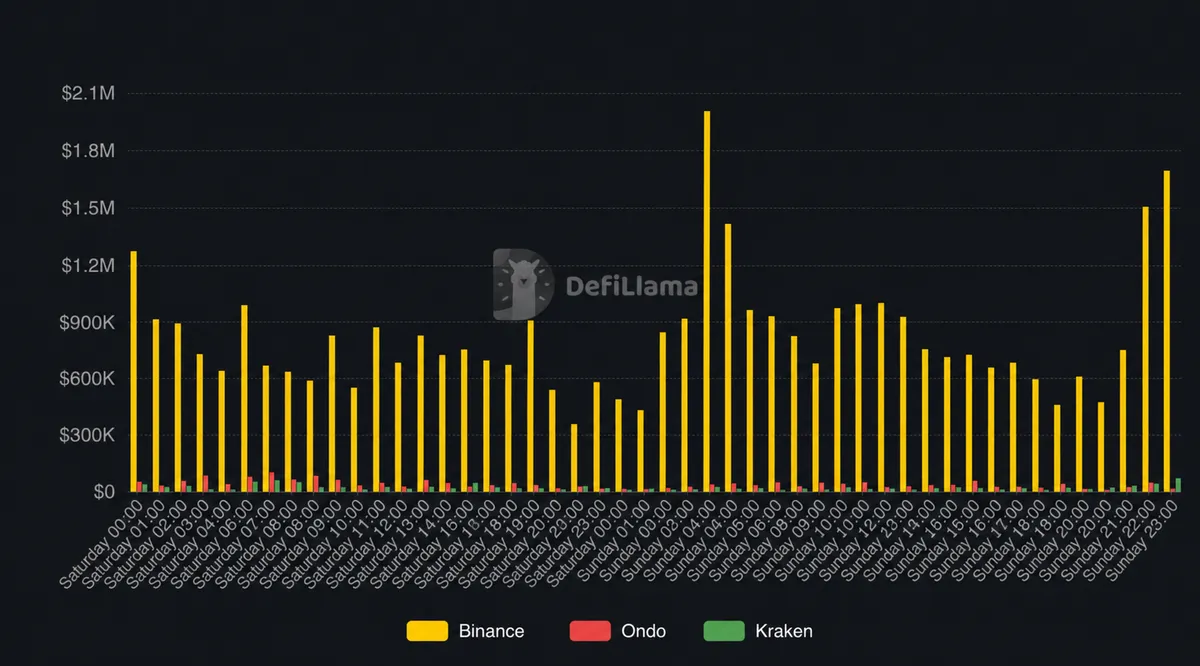
Across the roughly 350 weekend hours in the sample, Binance holds somewhere between 85% and 97% of combined volume in nearly every one of them, averaging 92.8%. Kraken averages just 3.24%, spiking as high as 50.4% in a handful of isolated hours. Ondo trails further still, averaging 3.93% and dropping to zero in some hours entirely.
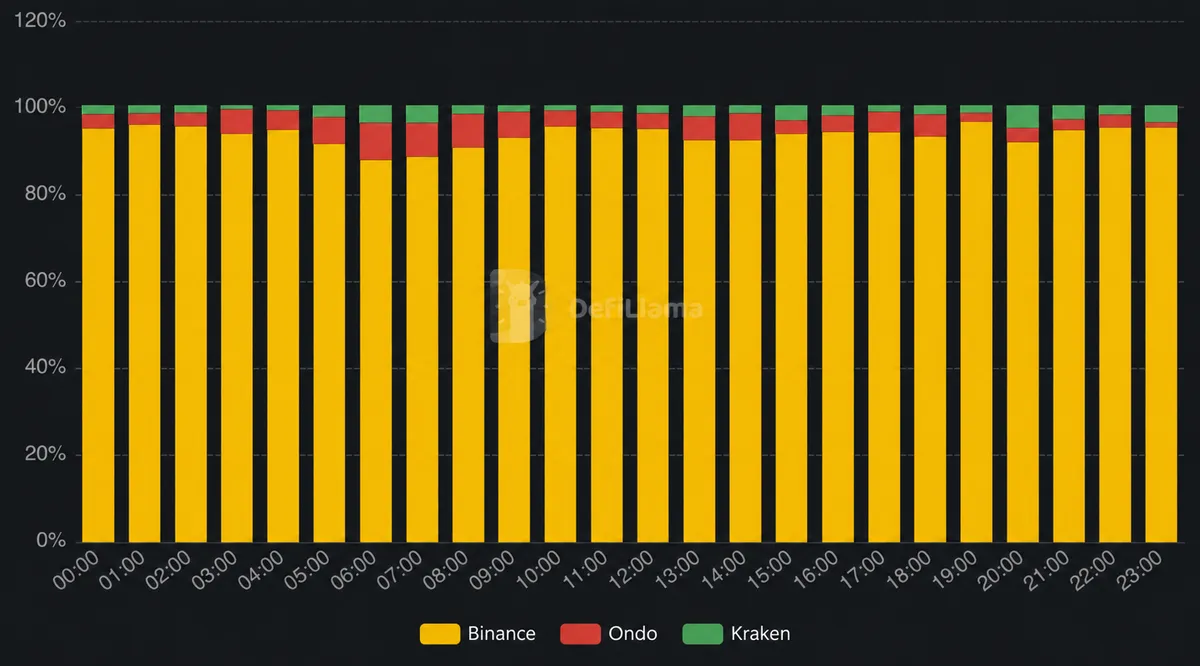
The main factor explaining this is the same structural element mentioned earlier, and in the end it comes down to where the liquidity is actually sourced from. Ondo's tokens are minted and burned against an actual Nasdaq trade happening in real time, so once Nasdaq shuts for the weekend, there's no live transaction to mint or burn against, though that's starting to change: Ondo enabled 24/7 minting and redemption for six of its assets in late June. Kraken's xStocks trade against pre-funded liquidity pools rather than a live link to the exchange, and only 10 of its 141 tickers are enabled for weekend trading. As for Binance, once a bStock is converted, it can be traded on Binance’s own centralized order book, the same infrastructure that already runs every other asset on the exchange at any hour, and on-chain. In other words, it doesn't rely on a pool that can run dry, or a mechanism that needs traditional markets to be awake to function.
On the surface, these figures could be read as just one venue accumulating more liquidity. But they point to something more important: price discovery increasingly happening on Binance rather than elsewhere. Indeed, the venue holding the deepest, most continuous order book during the hours nobody else is trading isn't just capturing volume, it's becoming the place where the market actually finds its price.
Conclusion
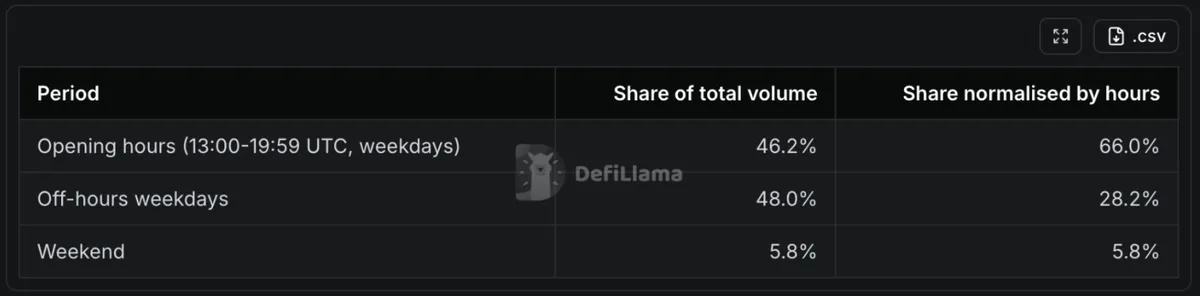
Two things stand out from the full-period view. Raw volume splits almost evenly between opening hours and weekday off-hours, 46.2% against 48.0%, with weekend trading a small 5.8% slice on top. But those weekday periods aren't the same size, opening hours are a fraction of the week's hours compared to nights, and normalized for that, they account for 66.0% of volume-per-hour against 28.2% for weekday off-hours. In other words, TradFi's operating hours still set the tempo today, though that grip should loosen as adoption spreads across time zones and 24/7 access becomes the norm rather than the exception.
By venue, Binance leads across every segment, and its lead grows in off-hours: 69.0% during market hours, 82.0% overnight, 94.4% on weekends. Ondo moves in the opposite direction, from 27.0% down to 15.2% and then to just 3.7%, a trajectory that tracks almost exactly with how much live Nasdaq activity its mechanism has to work with. Kraken barely moves at all, hovering between 1.9% and 4.0% regardless of the segment, which suggests its volume is small enough in absolute terms that session timing isn't really the constraint, distribution and catalog coverage are.
As of now, Binance bStocks end up looking like the product that best matches two things at once: how crypto-native users already trade, i.e., continuously, and what tokenization was supposed to deliver in the first place, i.e., deep liquidity and access anytime, anywhere.
Methodology: hourly and daily USD trading volume for Binance bStocks, Kraken xStocks, and Ondo Global Markets, June 14 to August 2, 2026 (UTC). bStocks volume is measured on Binance (56 assets), Kraken’s xStocks volume on Kraken (141 assets), and Ondo volume on the Ondo Global Markets platform (400+ assets). Market hours are defined as NYSE regular sessions, 13:30-20:00 UTC (considered 13:00-20:00 UTC in the analysis), weekdays. Data extracted by the DeFiLlama team.
Raw data: https://gist.github.com/FelixBruguera/7d10c40fc0cd8a885e7c0d82dd2a09a2