The Casper Manifest: Why the next wave of crypto adoption needs a construction plan
We believe the next phase of adoption will be driven by two forces: institutional RWA tokenization and agentic commerce.
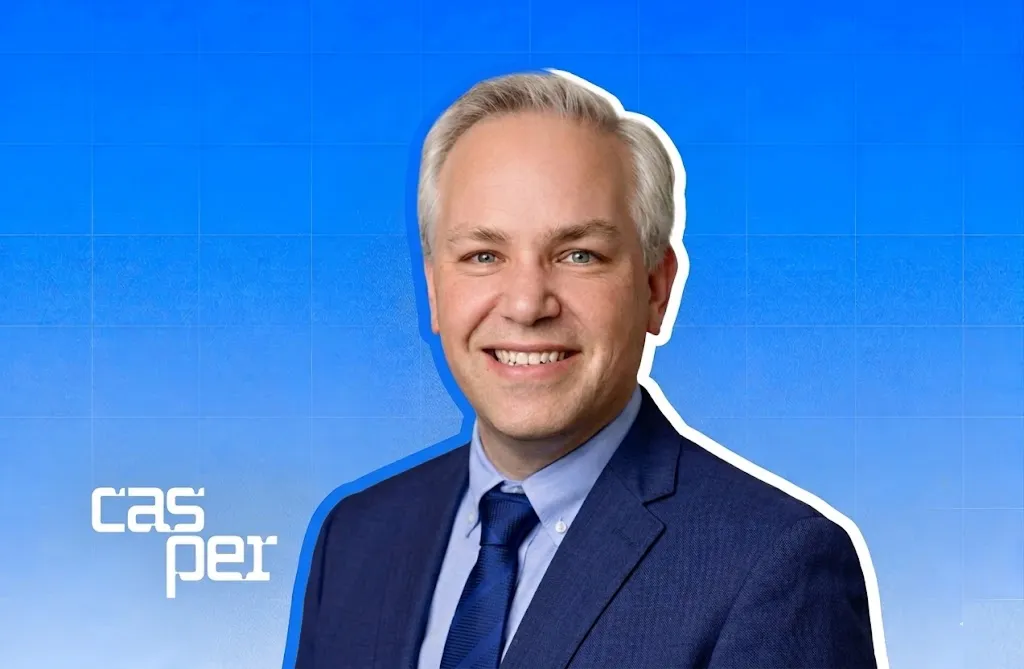
Sixteen years into crypto, total adoption has stalled at a few hundred million users out of 8 billion, and total asset value has largely moved sideways for years, mostly tracking the price of Bitcoin. The industry has not lacked for vision, but for construction. That is the framing behind the Casper Network’s Manifest, announced last month at the Digital Finance Forum in Bermuda: a concrete build plan targeting the two forces Casper believes will drive the next wave of real-world adoption, institutional RWA tokenization and agentic commerce.
In this interview, we chat with Michael Steuer to find out what it takes today to build for institutions, and how Casper is uniquely positioned to do it.
- The Casper Manifest covers a lot of ground: EVM compatibility, post-quantum cryptography, AI micropayments, and more. What are the problems in blockchain and DeFi that Casper is built to solve?
When we founded Casper in 2018, we identified two core problems. First, the industry was too slow to move away from proof-of-work. Casper's consensus mechanism originated in the Ethereum Foundation's research back in 2015, but we estimated it would take another five years before Ethereum completed the merge. That felt too long, both from a cost and environmental standpoint. Today, Casper Network ranks among the top three most environmentally friendly proof-of-stake blockchains in the world and one of the cheapest for operators to participate in.
Second, in 2018 and beyond, most of blockchain was "crypto for crypto's sake." ICOs, memecoins, NFTs -- very little of it solved real-world problems or was designed for non-crypto-native users and enterprises. We set out to build a blockchain that would change that, offering enterprises and institutions what they actually needed to adopt blockchain as part of their technology stack: a familiar developer experience, upgradable contracts, access rights management, and predictable costs.
The Casper Manifest, which we announced during the Digital Finance Forum in Bermuda last month, is a continuation of that philosophy. We believe the next phase of adoption will be driven by two forces: institutional RWA tokenization and agentic commerce. Both come with specific requirements around account configurability, privacy, enterprise-grade security, and regulatory compliance. That is what the Casper Manifest is built to provide.
- Three protocol versions in under a year is a fast cadence for a Layer 1. What were some of the tough technical decisions you had to make to get there?
Casper 2.0 was the real big release. Many of the protocol's core subsystems were rewritten from the ground up: a new consensus protocol in "Zug" for instant finality at scale, protocol-native liquid staking, and the groundwork for multi-VM execution. To avoid overwhelming the ecosystem, we rolled out the remaining functionality in phases. Casper 2.1 halved block time and introduced deflationary tokenomics. Now, as part of the Casper Manifest, we are leveraging those multi-VM capabilities to add EVM execution to the layer one, alongside protocol-native account abstraction to power AI-friendly smart accounts and gasless transactions.
- You recently took the stage in Bermuda to present Casper's new Manifest. Can you walk us through the headlines and what it means?
The room in Bermuda was filled with TradFi investors and asset allocators all looking at the same two verticals: RWA tokenization and AI. But no L1 protocol today can claim a holistic framework to power both for the next decade. The solutions we have seen are partial at best.
Take finality. About half of the world's RWAs live on Ethereum, but Ethereum will not have single-block finality until the end of the decade. When a hedge fund moves a billion-dollar asset, they don't want to wait for 64 confirmations. Casper has had instant finality since day one. Take quantum safety. A CISO committing to a decade-long blockchain deployment wants to know the quantum threat has been answered today, not earmarked for future research. Take privacy. Funds don't want competitors seeing their trades, but existing privacy protocols are all-or-nothing and largely shunned by institutional participants for it. Casper's Manifest provides compliant privacy with selective disclosure and Proof-of-Innocence.
The same logic applies to AI agents. Giving agents the ability to transact is only half the equation. They also need accounts with owner-defined limits: how much they can spend, how long they have access, and what assets they can touch. Casper's smart accounts provide that infrastructure for the machine economy.
- Casper is adding EVM as a second execution environment on top of its existing multi-VM architecture. What does running multiple execution environments on the same chain open up for users and developers day to day?
Casper's addition of EVM brings clear benefits to both users and developers. For users, especially crypto-native ones, it brings familiarity. You can use your MetaMask wallet and do all the things you're used to from other EVM chains. For developers, it's particularly interesting. The same familiarity benefit applies: you can bring your EVM developer tooling, port over existing contracts from other networks, and use audited libraries from OpenZeppelin. But you also get an EVM running on a blockchain with instant finality and an existing ecosystem of primitives more advanced than many EVMs out there. We are tremendously excited to see what developers will cook up with this.
- X402 micropayments are first to ship. For those who have not come across it before, what is X402, and why does it matter for Casper and the machine economy?
X402 targets AI agents. We all want our agents to have a level of autonomy, which means transacting without a human intermediary. But AI agents do not fill out credit card forms, sign up for premium API plans, or use Apple Pay.
That is where X402 comes in. It is a 30-year-old HTTP standard that has finally found its product-market fit. Most people are familiar with 404 errors, which tell a browser that a page was not found. The 402 response code works similarly, telling the visitor that payment is required to access a resource. For decades, nobody did anything with it. Now it is being used to charge AI agents a small micropayment for access to online resources on a pay-per-use basis, settled in crypto. Casper launched X402 in early June and became the first WASM-native blockchain to do so.
- Post-quantum cryptography is on the 2027 timeline. How do you explain that risk to an institution evaluating a blockchain platform today, before quantum hardware is anywhere near mainstream?
Interestingly, institutions don't need this explained. Their CISOs read the same reports your readers do. Just last month, both Google and Nvidia confirmed they expect quantum safety to become a real concern before the end of the decade. No CISO will commit to a decade-long blockchain deployment if that question hasn't been properly answered.
For many chains, it remains a theoretical research question. Casper designed for this eventuality from day one in 2018, and leads the industry in bringing quantum-safe cryptography to mainnet. The protocol already supports two cryptographic key algorithms side by side. Adding a third or fourth is a maintenance task, not open-heart surgery as it will be for many other chains.
- Privacy infrastructure has become a major focus across the industry lately. What is Casper's angle on it and how does it fit with the compliance requirements your target clients have?
Privacy is critical for institutional adoption. A fund doesn't want competitors seeing its trades. An enterprise doesn't want vendors' pricing exposed. Onchain privacy has been partially solved, but not compliantly. Most solutions today are all-or-nothing: transactions are either fully private or fully visible, which means authorities can't see them either. That invites illicit usage and makes existing privacy protocols difficult to bring to regulated markets.
At Casper, we believe that privacy can be done in a compliant way. Transactions that are fully confidential to the public, but selectively disclosed to authorities, regulators, and auditors. Counterparties that are completely anonymous to the public, but with Proof-of-Innocence to attest they are not blacklisted. Combined with our native implementation of ERC-3642, the compliant security token standard powering the vast majority of RWA tokens today, and native compliance hooks built directly into the protocol, we provide a compliance infrastructure that is unique in the industry.
- You described the Manifest as a construction plan and not a vision document. What does success look like for Casper in three years by following this plan?
Take an honest look at our industry: the adoption after 16 years has stalled at a few hundred million users worldwide, out of 8 billion. And for the last several years, the total asset value for all of crypto fluctuates between $1.5T and $3T, mostly tied to the price of Bitcoin. This means no new investment flows into this space, and that we’re basically just moving value around from project to project, from chain to chain, based on where the current crypto-native hype resides. We believe that the solution to break out of this crypto silo, to truly achieve adoption in the real world, is no longer about dreaming up what needs to be built - it is about actually building it. And that construction plan is the Casper Manifest.
Success for Casper in three years means success for the blockchain industry as a whole. We don’t believe in zero-sum games. We believe in growing the proverbial pie. After we announced the Casper Manifest, we’ve seen several projects announce specific elements of our roadmap as well. For us, this means not just peer validation, but also that as an industry we are getting serious about meeting the real world where it is. Casper is already going there. Success would be seeing the rest of the industry joining us on this journey.