MotoSwap’s playbook for building liquidity and trading activity
With the launch of MotoSwap on Ethereum one important question is whether the platform can build meaningful and lasting market share in an already competitive DeFi environment. We examine MotoSwap’s approach and how its design compares with the lessons from these previous launches.

With the launch of MotoSwap on Ethereum, one important question is whether the platform can build meaningful and lasting market share in an already competitive DeFi environment.
We take a closer look at some of the most notable attempts by DeFi protocols to attract liquidity and users from established competitors, often called ‘vampire attacks’ in DeFi, and assess which strategies succeeded and resulted in sustained adoption. We then examine MotoSwap’s approach and how its design compares with the lessons from these previous launches.
How MotoSwap plans to bootstrap liquidity

After 18 months on Bitcoin L1, MotoSwap launched on Ethereum Monday, generating over $6 million in volume and adding $5.7 million TVL in the first 24 hours. MotoSwap will use incentives to encourage Uniswap V2 LPs, which currently hold $790 million in TVL, to participate in this new EVM-based DEX.
Liquidity mining and LP migration
The core of MotoSwap’s liquidity bootstrapping campaign is a two-step acquisition strategy. First, it targets Uniswap V2 LPs with 30 million MOTO (3% of supply) and will distribute these tokens over a 2-week blitz campaign. During this period, LPs can stake their existing Uniswap V2 LP tokens into the MotoSwap contract to earn MOTO rewards alongside their Uniswap V2 fees.
This lowers the friction to participate because LPs do not need to remove liquidity from Uniswap immediately, and can instead keep their existing position intact while testing the incentive program. After the 14-day campaign, MotoSwap will convert these LPs into MotoSwap-native liquidity through a one-click migration process that moves their positions into the same pair on MotoSwap.
The second phase aims to retain that liquidity. After migration, MotoSwap will distribute an additional 70 million MOTO over 90 days through liquidity mining on MotoSwap-native pools. In total, MotoSwap allocates 10% of the supply to liquidity acquisition and retention: 3% to attract Uniswap V2 LPs, and 7% to retain them post-migration.
This strategy first attracts liquidity on Uniswap V2, simplifies migration, and then offers LPs a larger incentive to remain on MotoSwap.
MotoSwap’s fee structure adds another retention layer. Where Uniswap V2 charges a 0.3% swap fee, with 0.25% going to LPs, MotoSwap plans to charge 1%, with 0.3% to LPs. The remaining fee is split between MOTO stakers, trader rakeback, buyback and burn, the treasury, and creator fees.
The trader rakeback is one of the more novel parts of the model. MotoSwap returns 0.2% of every swap to the trader who generated the volume, distributing rewards through weekly epochs. That turns traders from pure fee payers into fee loop participants. For example, TRUMP launched in January 2025 and cleared roughly $120 billion in volume that month alone. Run that through MotoSwap's model and about $240 million would have gone back to the wallets that traded it.
This can also support retention: traders must return to MotoSwap to claim their rakeback, creating another touchpoint with the DEX after the initial swap.
Modernizing the token flywheel
The same fee structure also feeds into a broader MOTO flywheel. Beyond trader rakeback, MotoSwap combines buybacks and burns with direct revenue distribution to MOTO stakers.
This differs from pure buyback models, where protocol revenue can end up absorbing tokens from unlocks or sold by early investors or insiders. Indeed, MotoSwap’s design creates market demand for MOTO and directs part of the value directly to users who remain staked.
Moto.fun adds another layer to that design. Upon bonding, the curve triggers MOTO buying to create MOTO/ETH liquidity, generating additional trading and arbitrage opportunities. The same bonding event also triggers MOTO buy-and-burn, and under the current parameters, a token reaching roughly $1 million in market cap results in around $50,000 worth of MOTO being bought and burned.
This creates a broader flywheel: more launches drive MOTO demand and burns, new pairs generate more trading activity, and that activity produces fees that flow back to stakers and further buybacks.
What historical vampire attacks show
MotoSwap is not the first DEX to use token incentives to attract liquidity and users from an established platform. Comparable strategies have appeared throughout DeFi, most notably through vampire attacks that directly targeted the liquidity or users of incumbent protocols.
These earlier examples provide a useful benchmark for MotoSwap’s liquidity bootstrapping strategy. We compare eight notable vampire attacks to assess which approaches translated initial incentives into lasting market share and which failed once those incentives began to fade.
We compare each attacker’s position at the time of the attack with its position three months later, with one exception that uses a different evaluation window. Protocols that captured more than 50% of the incumbent’s market were classified as successful, while those that failed to do so were classified as failures.
Of the eight vampire attacks analyzed across DEXs and NFT marketplaces, four succeeded and four failed. This shows that launching a vampire attack does not guarantee success, but it can provide a meaningful opportunity to grow relative to the incumbent in terms of TVL or trading volume.


Attacker | Incumbent | Launched | Evaluation Window | Position at Attack | Position at Window End | Outcome |
|---|---|---|---|---|---|---|
SushiSwap | Uniswap | Sep 2020 | 3 months | 68.4% of incumbent TVL | 60.9% of incumbent TVL | Succeeded |
Swerve Finance | Curve | Sep 2020 | 3 months | 30% of incumbent TVL | 0.5% of incumbent TVL | Failed |
Trader Joe (LFJ) | Pangolin | Aug 2021 | 3 months | 14.7% of incumbent TVL | 531.9% of incumbent TVL | Succeeded |
0xDAO | veDAO | Jan 2022 | 2-day governance snapshot | 37.7% of incumbent TVL | 550% of incumbent TVL | Succeeded |
LooksRare | OpenSea | Jan 2022 | 3 months | 10% of total NFT volume | 6.9% of total NFT volume | Failed |
X2Y2 | OpenSea | Feb 2022 | 3 months | 4% of Total NFT volume | 9% of total NFT volume | Failed |
KLEX Finance | KlaySwap | Aug 2022 | 3 months | 8.9% of incumbent TVL | 6.0% of incumbent TVL | Failed |
Blur | OpenSea | Oct 2022 | 3 months | 11.5% of incumbent volume | 101.6% of incumbent volume | Succeeded |
DEXs
The most well-known DEX vampire attack was SushiSwap’s attack on Uniswap. SushiSwap launched in August 2020 with SUSHI incentives for users who deposited Uniswap LP tokens, then migrated that liquidity to SushiSwap on 9 September 2020. The attack was initially successful, pulling roughly $1.08 billion of liquidity from Uniswap and briefly allowing SushiSwap’s TVL to surpass Uniswap’s.
However, Uniswap responded by announcing its UNI airdrop. Every Ethereum address that had interacted with Uniswap V1 or V2 contracts received 400 UNI. The launch of UNI also allowed Uniswap to introduce token incentives of its own, helping it win back market share.
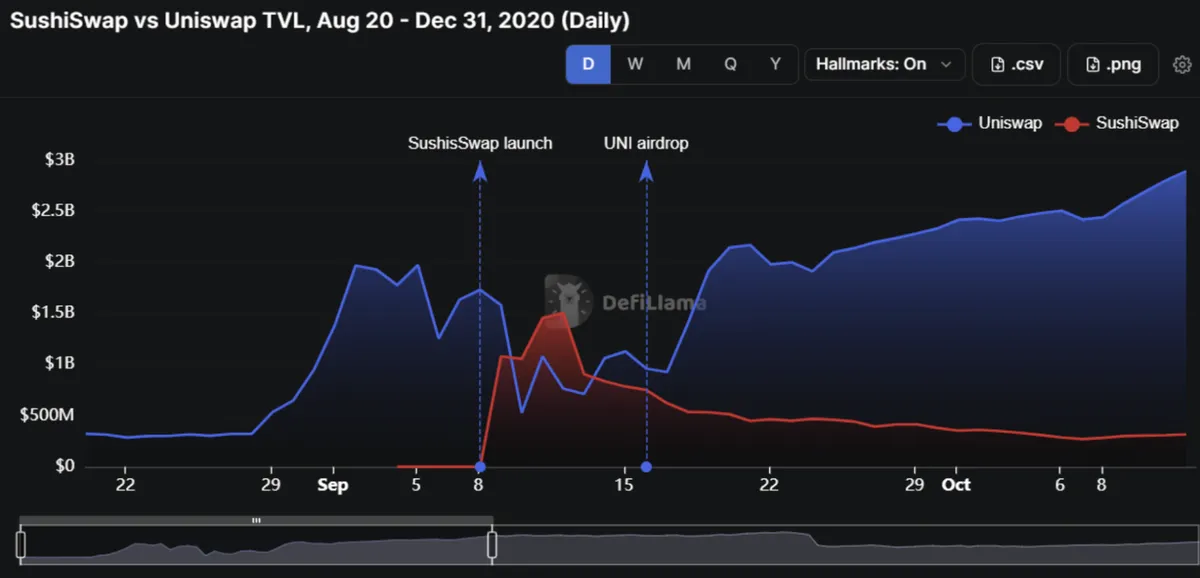
After 3 months, SushiSwap was still able to hold 60.9% of Uniswap’s TVL. This made the vampire attack clearly a success for SushiSwap, as it briefly overtook Uniswap and then settled into a comfortable position.
Shortly after SushiSwap’s launch, Swerve Finance attempted a vampire attack on Curve by launching a fork of the protocol and distributing its SWRV tokens through liquidity mining. Initially, this appeared successful. At launch, Swerve captured TVL equal to 30% of Curve’s TVL and at one point reached $800 million in TVL.
Swerve ultimately failed because its incentives dried up, and the protocol did not offer a differentiated product. After three months, its TVL had fallen to just 0.5% of Curve’s TVL, ultimately an unsuccessful vampire attack.
Last, 0xDAO represents a vampire attack centered around a specific event. Solidly was Andre Cronje’s ve(3,3) DEX on Fantom, and a snapshot allocated its initial governance power to the protocols with the highest TVL.
veDAO launched first, offering aggressive APYs to users who deposited liquidity into its farms. It quickly grew to become the protocol with the highest TVL. 0xDAO was then launched by a coalition of Fantom-native protocols, including SpookySwap, Scream, Liquid Driver and Tarot, which sought to pull liquidity back because they did not want veDAO to win the snapshot.
Conclusion
The main lesson from previous vampire attacks is that incentives alone are not enough to produce lasting market share. The strongest examples paired rewards with mechanisms that encouraged users to remain active after the initial incentive period.
MotoSwap has incorporated several of these lessons into its liquidity bootstrapping strategy. Its LP incentives and one-click migration process resemble SushiSwap’s approach to attracting Uniswap liquidity, while its airdrop and points program more closely mirror Blur’s strategy of rewarding the users and activity that matter most to the platform. By targeting both LPs and traders, MotoSwap is attempting to build liquidity and trading activity at the same time instead of relying on liquidity mining alone.
This also means MotoSwap does not need to capture the majority of Uniswap V2’s liquidity for the campaign to be meaningful. With Uniswap V2 currently holding around $790 million in TVL, attracting just 10% would already provide MotoSwap with roughly $79 million in liquidity and establish a substantial base from which to build trading activity.
For MotoSwap to be considered successful, we would want to see a high share of staked Uniswap V2 LP tokens actually migrate to MotoSwap after the 14-day campaign, and for that liquidity to remain after the 90-day liquidity mining program starts to mature. More importantly, that liquidity needs to become productive, with sustained trading volume and meaningful fee generation without relying entirely on emissions.
The main risk is that MotoSwap attracts mercenary LPs and incentive farmers who leave once rewards decline. Its 1% swap fee might seem high to cost-conscious traders, but it is comparable to fees charged by traditional in-wallet swaps and certain aggregators. Pons, for example, applies a 1% standard trading fee to tokens launched on Robinhood Chain.
The difference is where those fees go. MotoSwap redistributes part of them to traders through rakeback, while also supporting MOTO stakers and buybacks. The real test will therefore be whether MotoSwap can turn its initial attack into persistent liquidity, real trading volume, and recurring user activity.