LlamaSwap: the ‘aggregators of aggregators’ puts safety first
Traders have taken notice. In 2025, LlamaSwap processed $50 billion in trades. In another sense, however, it has flown under the radar. Uniswap, the world’s largest decentralized exchange, has processed more than $36 billion in trades in the past 30 days alone.
There are hundreds of decentralized exchanges. Traders looking to swap tokens face an overwhelming number of choices.
DEX aggregators make traders’ lives a little easier, taking orders and scanning select exchanges for the best quotes. But they have their own fees, and their own methods of identifying the best trades.
Enter LlamaSwap, the self-described “aggregator of aggregators.”
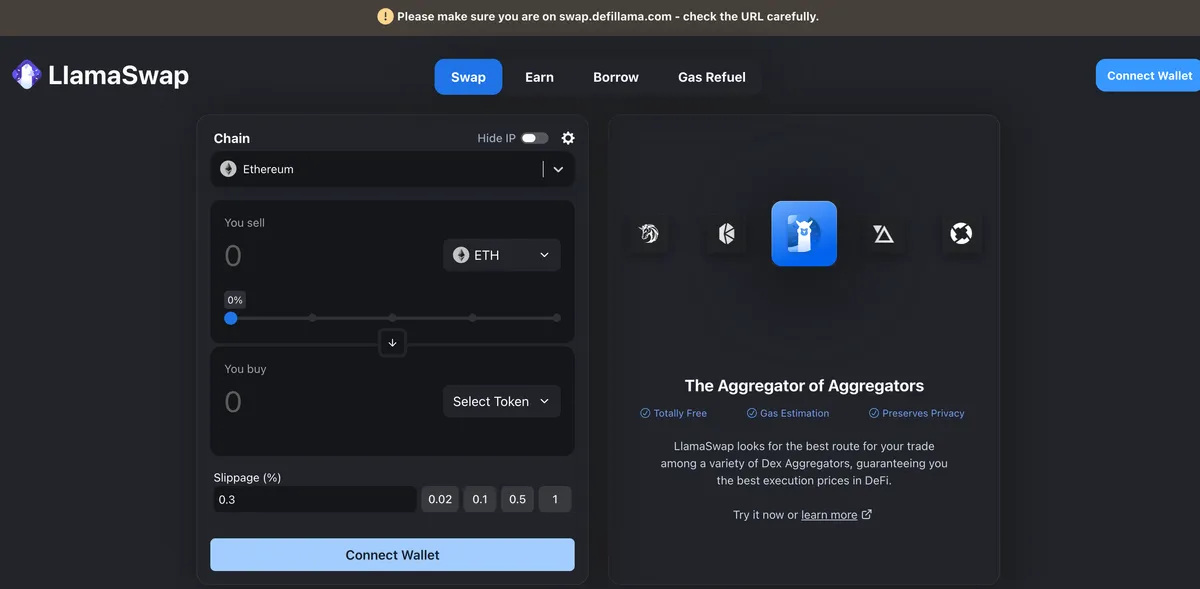
Launched by DefiLlama in 2023, LlamaSwap queries the price of trades on 1inch, CoW Swap, and several other aggregators. If those aggregators offer the cream of the crop, LlamaSwap is an attempt at offering la crème de la crème.
Traders have taken notice. In 2025, LlamaSwap processed $50 billion in trades. In another sense, however, it has flown under the radar. Uniswap, the world’s largest decentralized exchange, has processed more than $36 billion in trades in the past 30 days alone.
So let’s shine a spotlight on LlamaSwap, one of the premier venues for trading crypto.
Free!

First and foremost, LlamaSwap is free to use.
It doesn’t charge its own fee, so the price offered is the same price a trader would pay if she went directly to the chosen aggregator.
But LlamaSwap does generate revenue. Some aggregators profit off “positive slippage” — if a trade executes at a superior price to the one quoted, the aggregator pockets the difference. And some of those aggregators share a portion of that revenue with LlamaSwap.
Lest anyone worry that LlamaSwap only routes trades to aggregators with a revenue share agreement, rest easy — in its attempt to find traders the best price, LlamaSwap also scans aggregators that don’t share their revenue.
LlamaSwap has grown since its 2023 debut, and it’s no longer just an exchange aggregator. Its “earn” function displays yield opportunities for thousands of assets. And its “borrow” function aggregates lending paths, offering two varieties based on a user’s risk tolerance: “safe” and “degen.” That lets users easily see which lending protocols support a particular token. It also makes it easy to compare lending terms to get the best deal when borrowing crypto.
Finally, LlamaSwap introduced a feature called “gas refuel” last year. It ensures traders never get stuck without the crypto needed to execute trades.
Staying safe
Hacks continue to plague the DeFi ecosystem, and DefiLlama founder 0xngmi has called his approach to building LlamaSwap “extremely paranoid.”
Some users have executed nine-figure swaps, 0xngmi said on X earlier this year. It demonstrates an incredible level of trust in the product, and for that reason he personally audits updates to the LlamaSwap frontend and the contracts that users approve.
“To this date our users have NEVER had an approval hack, despite doing almost $100 billion in volume over the years and being the most-used meta aggregator,” he wrote.
“DefiLlama is extremely cautious with which aggregators are listed,” Patrick Scott, DefiLlama’s chief revenue officer, said.
That also means LlamaSwap users are protected from hackers that exploit aggregators’ websites, as happened early this year when the CoW Swap website was compromised.
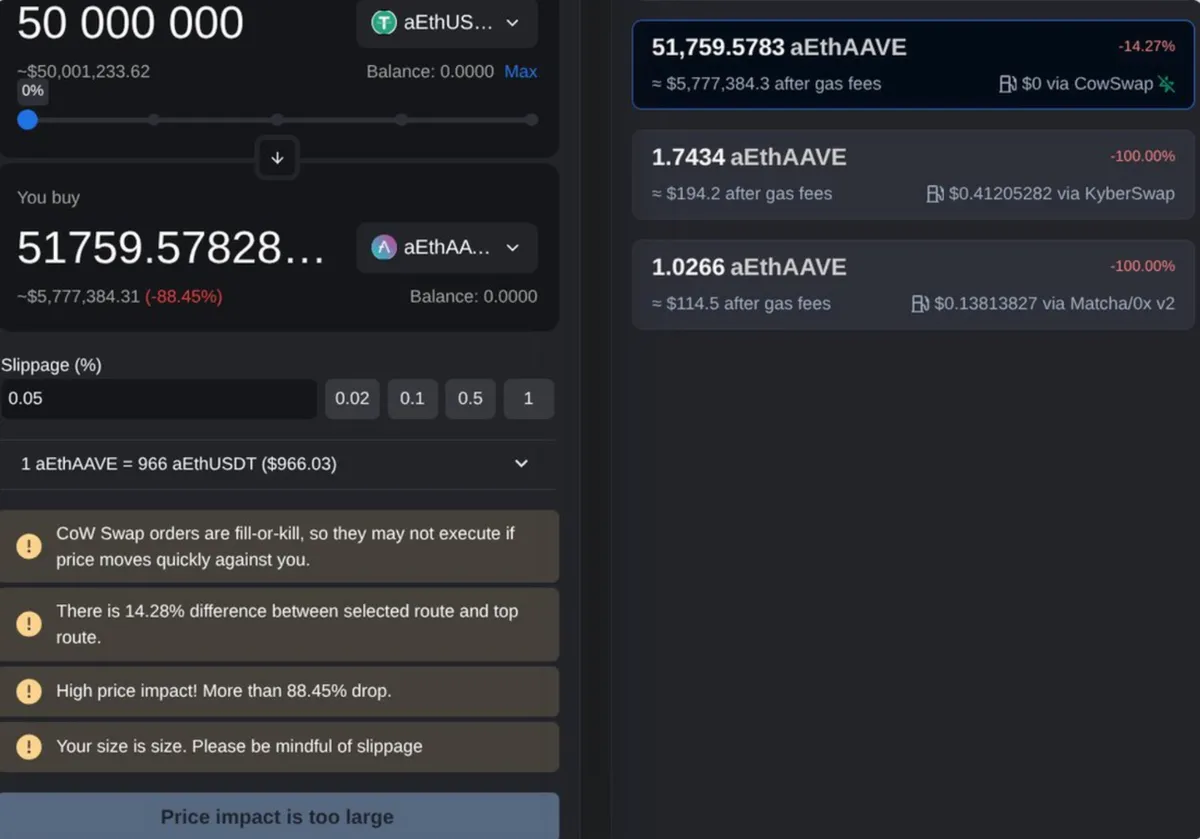
That isn’t the only way LlamaSwap protects users. It also prevents them from executing terribly disadvantageous trades. Sadly, there was a prime example of this back in March, when someone used Aave’s website to swap $50 million in USDT for AAVE tokens.
The trader likely expected to receive about $50 million in AAVE tokens. Instead, extreme slippage on the multi-step trade meant the trader received just $36,000 worth of AAVE.
Aave founder Stani Kulechov said the trader had been warned they would suffer “extraordinary slippage” and moved ahead with the trade anyway. Kulechov also said Aave would attempt to return the $600,000 in fees the transaction generated.
LlamaSwap takes a different approach.
“We directly forbid swaps like this in the UI and you wouldn't be able to make them,” 0xngmi wrote in March.
There was a less extreme example just this month, when a trader swapped $2 million in Ether for $14,000 in LIT using 0x, a popular aggregator.
But sometimes, users do have to protect themselves.
Scammers have tried to swindle LlamaSwap users by creating bogus websites that look and feel like LlamaSwap but serve only to drain users’ wallets. Google has been slow to remove suspect websites, so anyone using LlamaSwap needs to be vigilant — always make sure you’re using swap.defillama.com. It can also be accessed by clicking on the “DEX aggregator” button on DefiLlama’s main page.