Hyperliquid and the RWA onboarding question: what the data shows
Does opening Hyperliquid to RWA Markets attract net new users, or does it mostly give existing traders something else to trade?
When Hyperliquid activated HIP-3 in October 2025, it made a structural bet. By allowing any qualified builder to deploy a permissionless perpetual market on HyperCore (staking 500,000 HYPE worth $3.5M at the time of writing) the protocol effectively handed listing decisions to the market itself. The context matters: centralized exchanges have spent the past two years racing to absorb RWA flow, listing tokenized equities, indices, and commodities as fast as regulation allows. Hyperliquid's answer was different, make the listing layer permissionless and let builders do it onchain, 24/7, without approval cycles.
The question that follows isn't whether new asset classes would appear but whether they'd pull in genuinely new users and, if so, whether those users would matter to the platform's revenue.
To shed light on this topic, we used in-house data to answer two questions directly. First, does opening Hyperliquid to RWA Markets attract net new users, or does it mostly give existing traders something else to trade? Second, do those RWA-First users generate significant volume and fees, or does the revenue continue to come from the crypto-native base regardless?
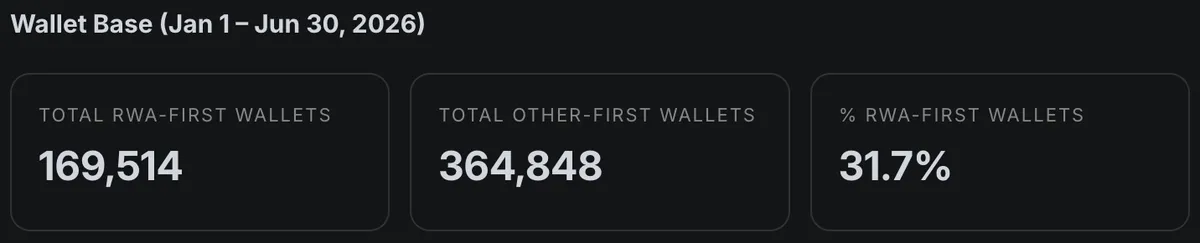
RWA Markets attracted 169K new wallets
To assess whether RWA Markets are attracting new users to Hyperliquid, we identified every wallet whose first-ever trade on the platform occurred on a HIP-3 RWA Market on or after January 1, 2026, referred to as RWA-First wallets. The remaining new wallets, those who entered through Other Markets (defined as crypto perpetuals or any non-RWA Market) are referred to as Other-First wallets. Wallets with any prior trading activity on Hyperliquid, or any USDC deposit into the Arbitrum bridge before that date, were excluded.
This leaves a cohort of 534,362 new wallets active between January and June 2026. Among them, 169,514 wallets, representing 31.7% of all new wallets, executed their first trade on an RWA Market.
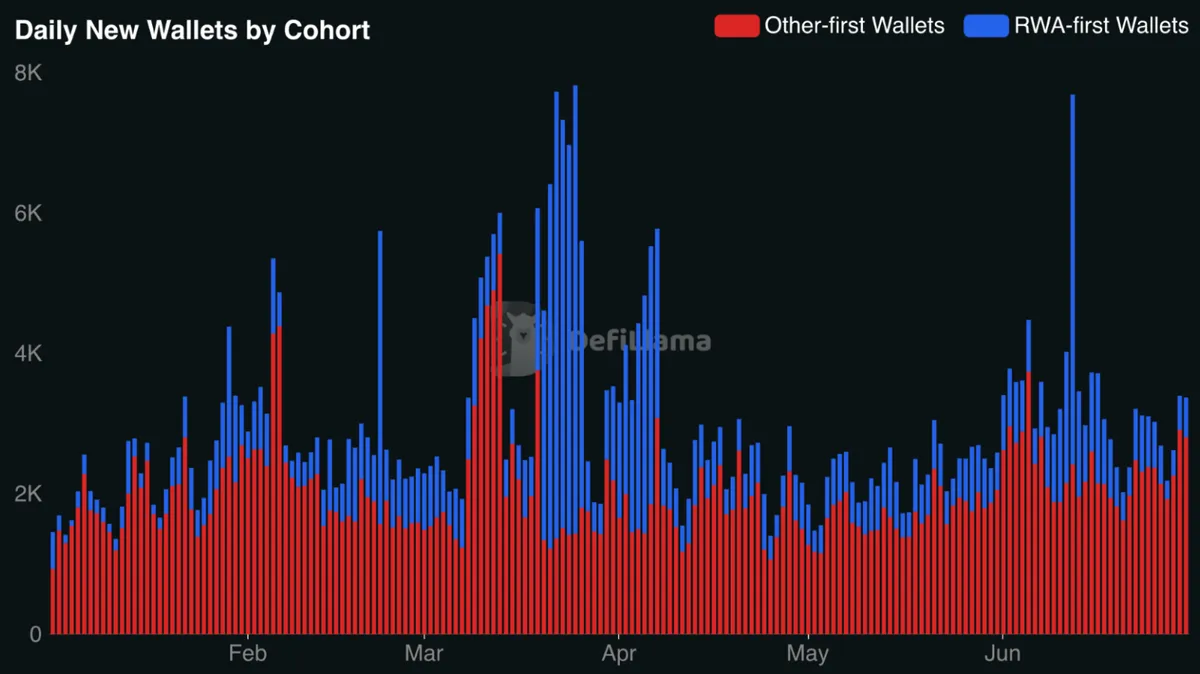
RWA-First onboarding remained relatively modest at the beginning of the year before accelerating from February onwards. Daily inflows generally ranged between 300 and 700 new wallets, punctuated by several distinct onboarding waves linked to major product launches and macro-driven trading opportunities.
The largest event occurred in mid-March following TradeXYZ's launch of the S&P 500 perpetual under an official S&P Dow Jones Indices license, bringing more than 38,000 new wallets to Hyperliquid in just eight days. Earlier spikes in late February and early April reflected a different catalyst. Heightened geopolitical tensions surrounding the Iran conflict increased demand for oil and silver exposure, with Hyperliquid emerging as one of the few venues offering continuous 24/7 trading on these markets. The final major wave, in mid-June, coincided with the listing of the SpaceX pre-IPO market.

The onboarding profile of Other-First wallets follows a different pattern. Daily inflows remained consistently higher, typically between 1,500 and 2,500 new wallets, with peaks largely tracking broader crypto market activity rather than individual RWA listings. This contrast suggests that the two cohorts are responding to different demand drivers throughout the period.
All of this leads us to the first conclusion: RWA Markets are bringing new users onto the platform.
...but they don't move the revenue needle
If RWA Markets account for 31.7% of all new wallets joining Hyperliquid, a broadly similar contribution to trading activity would be expected.
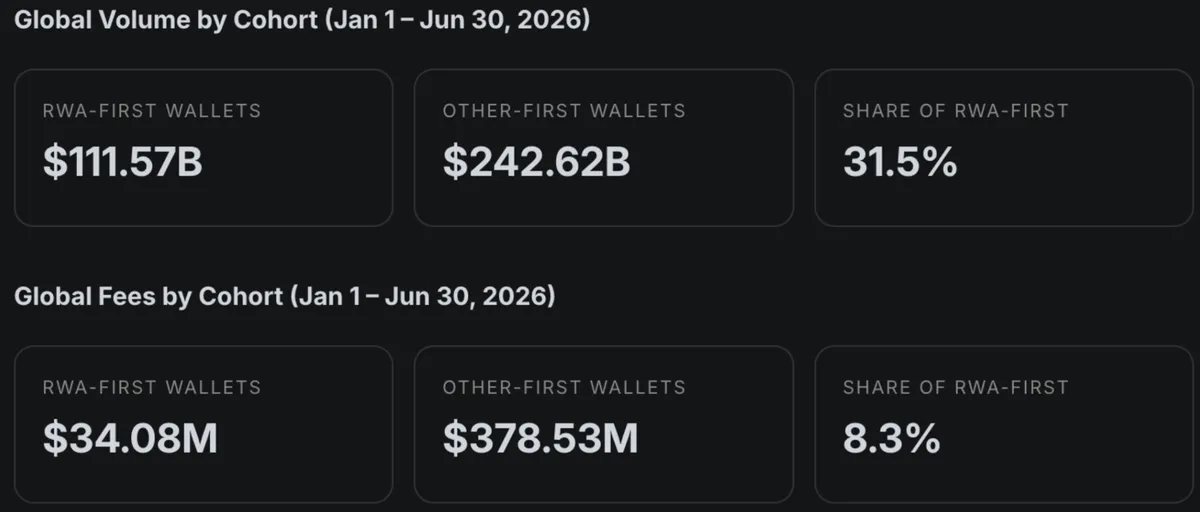
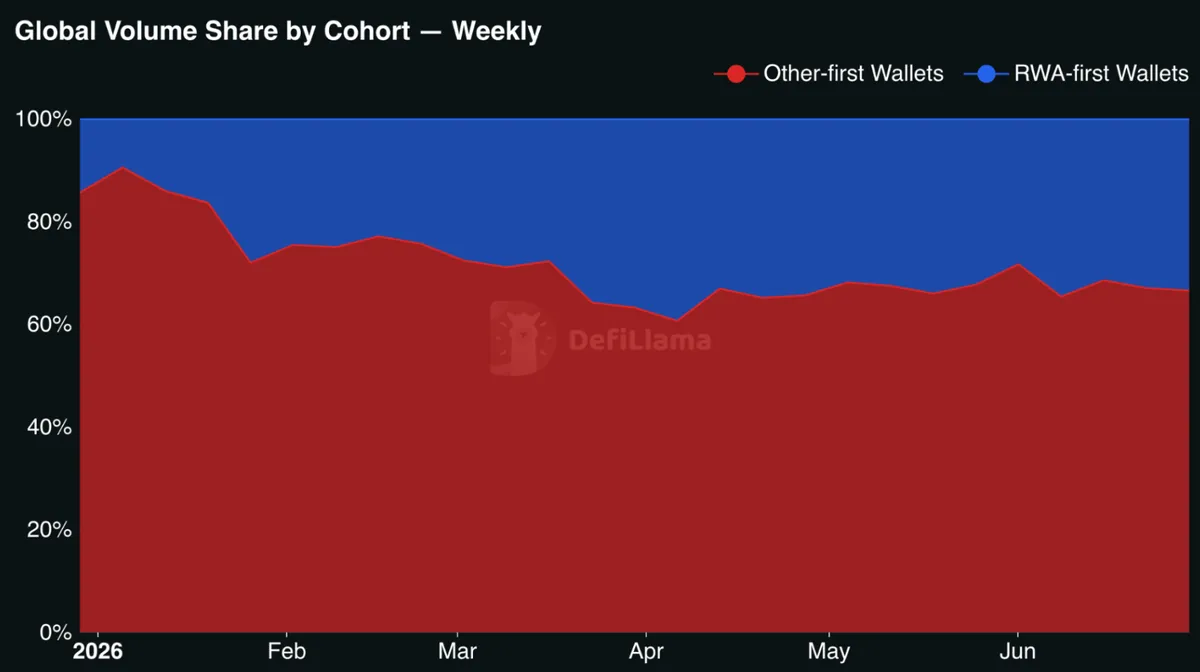
On trading volume, this expectation largely holds. Between January and June 2026, the 169,514 RWA-First wallets generated $111.6 billion in trading volume, representing 31.5% of the $354.2 billion traded by all new users during the period. Their share of trading activity is therefore closely aligned with their share of new user acquisition.
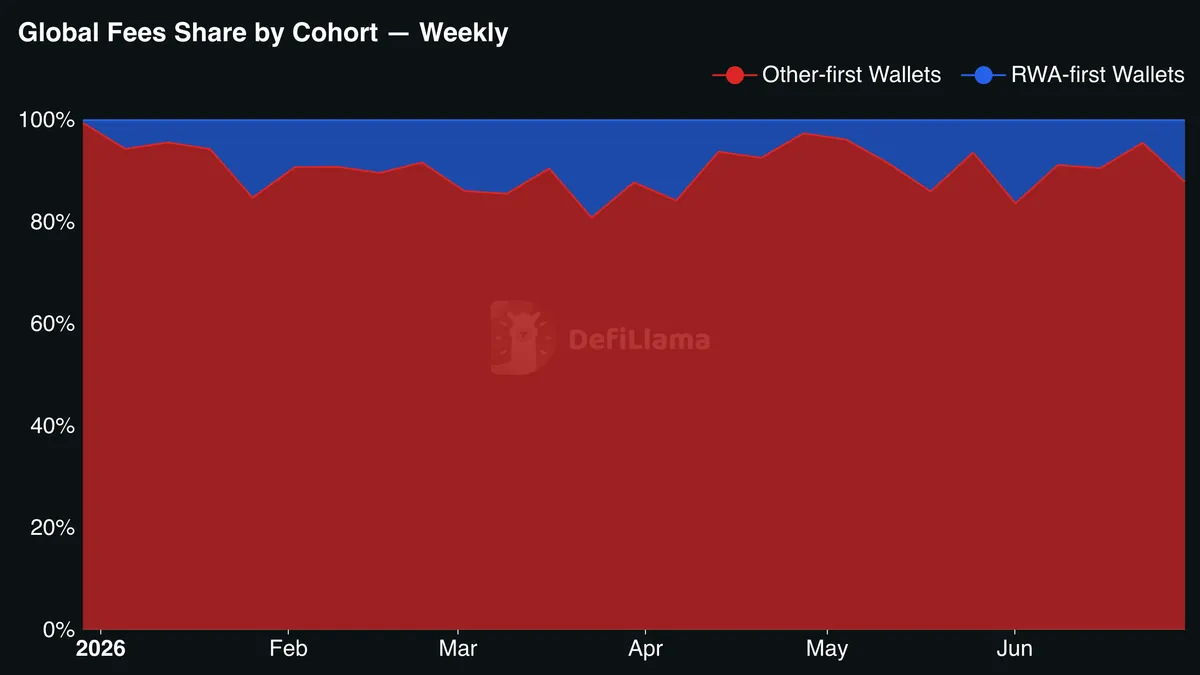
However, the picture changes when looking at fee generation. Over the same period, the RWA-First cohort generated $34.1 million in fees out of the $412.6 million paid by all new users, accounting for just 8.3% of the total.
The explanation, as discussed in the following sections, lies in two factors: the trading behavior of the cohorts and the fee structure of the assets they trade.
RWA-First wallets trade RWA products…
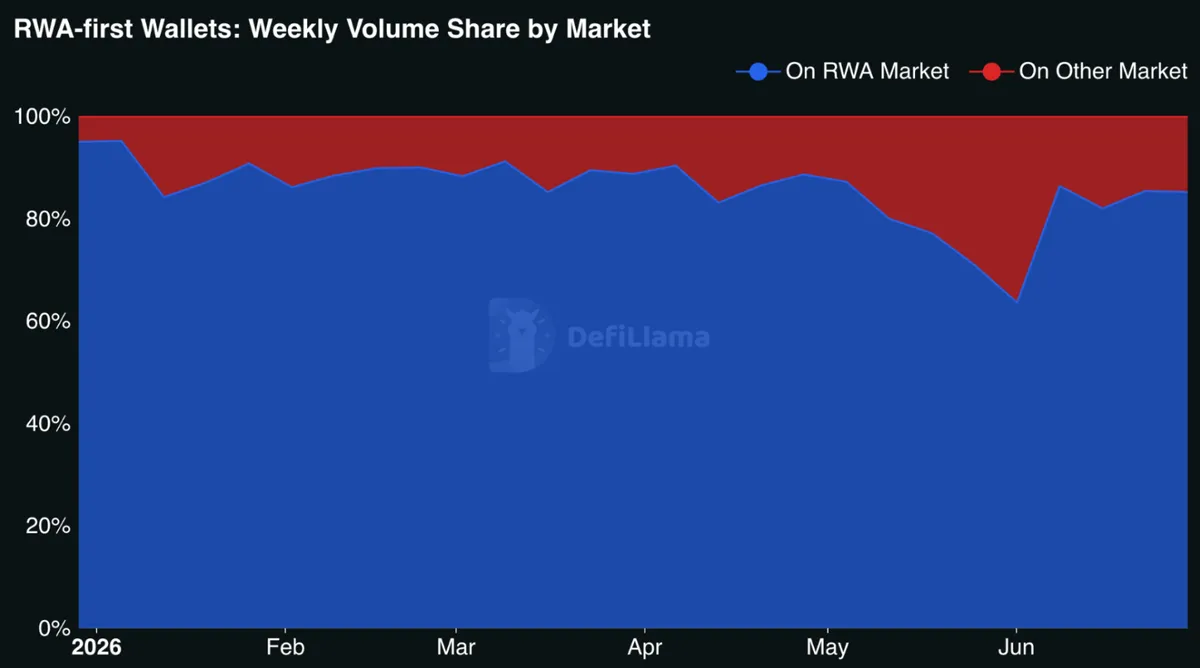
The trading activity of the RWA-First cohort is highly concentrated in the products through which they entered the platform. Of the $111.6 billion in trading volume generated between January and June 2026, $93.2 billion (83.6%) was executed on RWA Markets, while just $18.3 billion was traded across crypto perpetuals and Other Markets.
The evidence suggests that RWA-First users remain largely focused on RWA products rather than expanding into the broader Hyperliquid ecosystem. RWA Markets therefore appear to attract users who might not otherwise have joined the platform, although cross-market participation remains limited.
…while the crypto base is trading it all
The behavior of the Other-First cohort differs significantly. Of the $242.6 billion in trading volume they generated over the period, $187.3 billion (77.2%) was traded on Other Markets, their primary entry point. The remaining $55.3 billion (22.8%) was executed on RWA Markets, with this share increasing steadily as the RWA offering expands. As of today, RWA Markets account for approximately 30-35% of the cohort's trading volume.
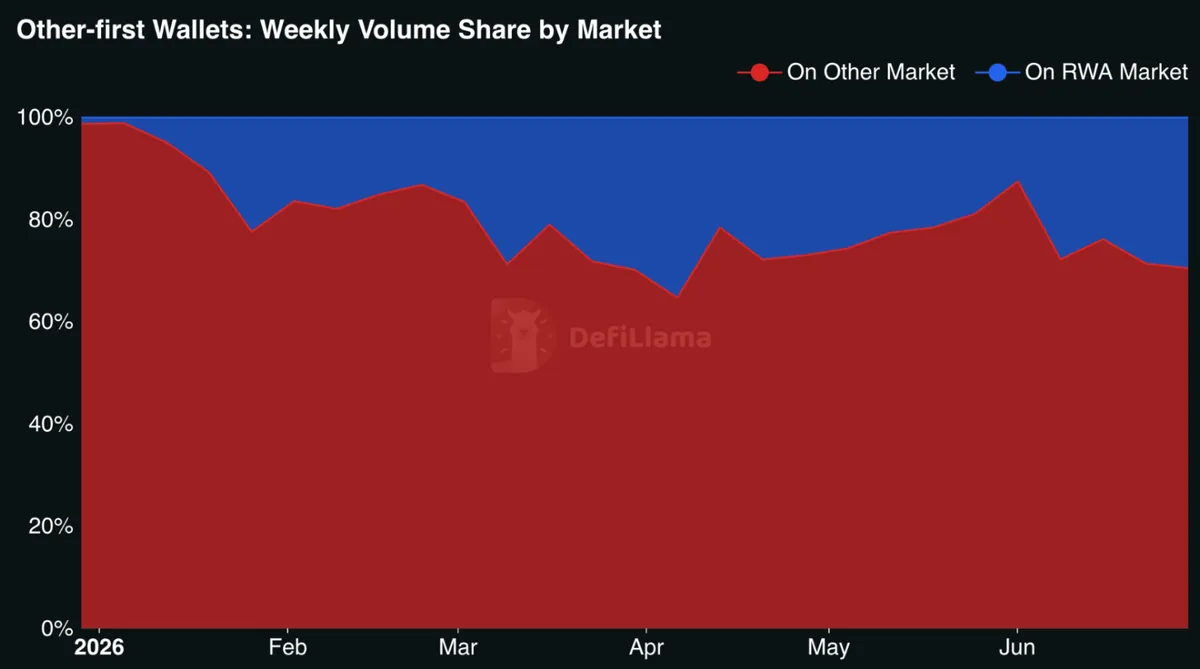
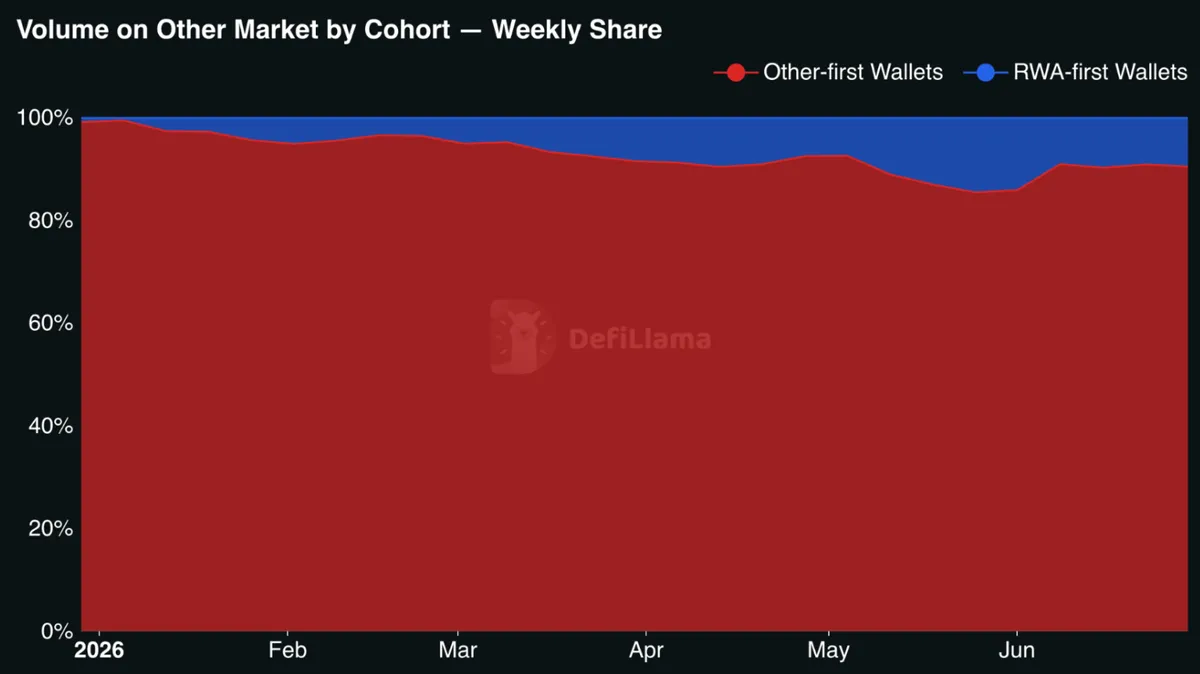
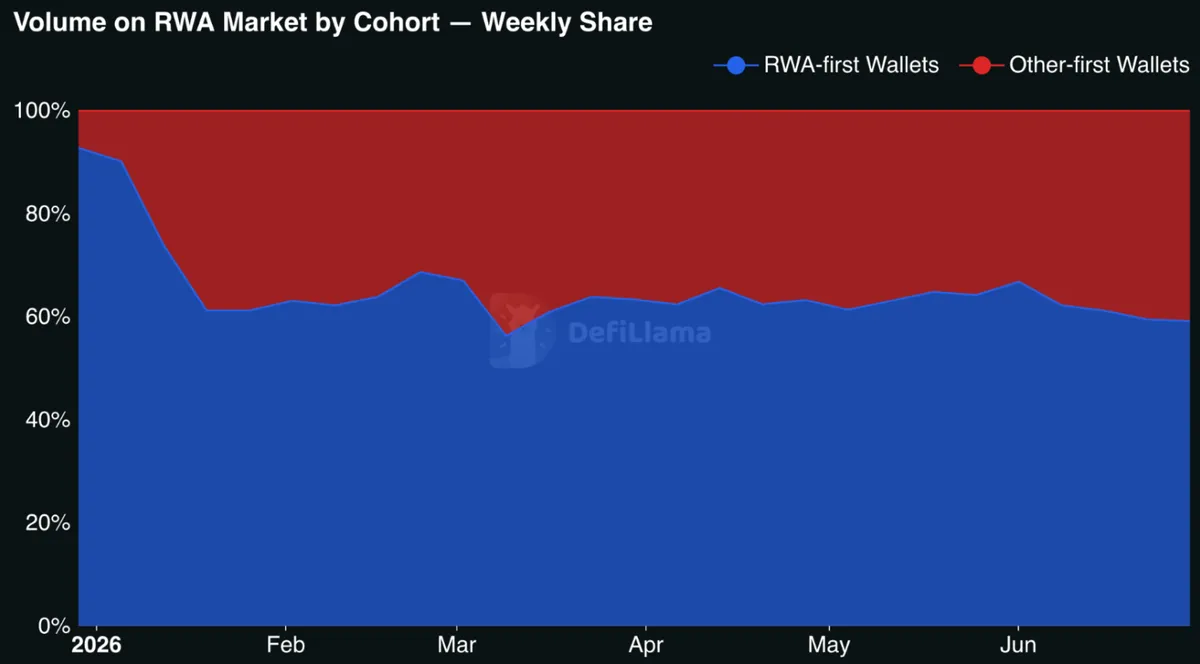
This pattern translates into a dominant position for the Other-First cohort across both market segments. On Other Markets, primarily crypto perpetuals, Other-First wallets generate around 90% of total trading volume. At the same time, they also account for roughly 40% of trading volume on RWA Markets, making them a major source of trading activity in that segment as well.
The contrast between the two cohorts is clear: RWA-First users remain largely specialized in RWA products, whereas Other-First users are considerably more asset agnostic, readily expanding into newly listed markets. For Hyperliquid, this means RWA listings serve two distinct purposes: they attract a dedicated group of new users while simultaneously creating additional trading opportunities for the platform's crypto user base, increasing both trading volume and fee generation.
And Fees are pretty clear on this
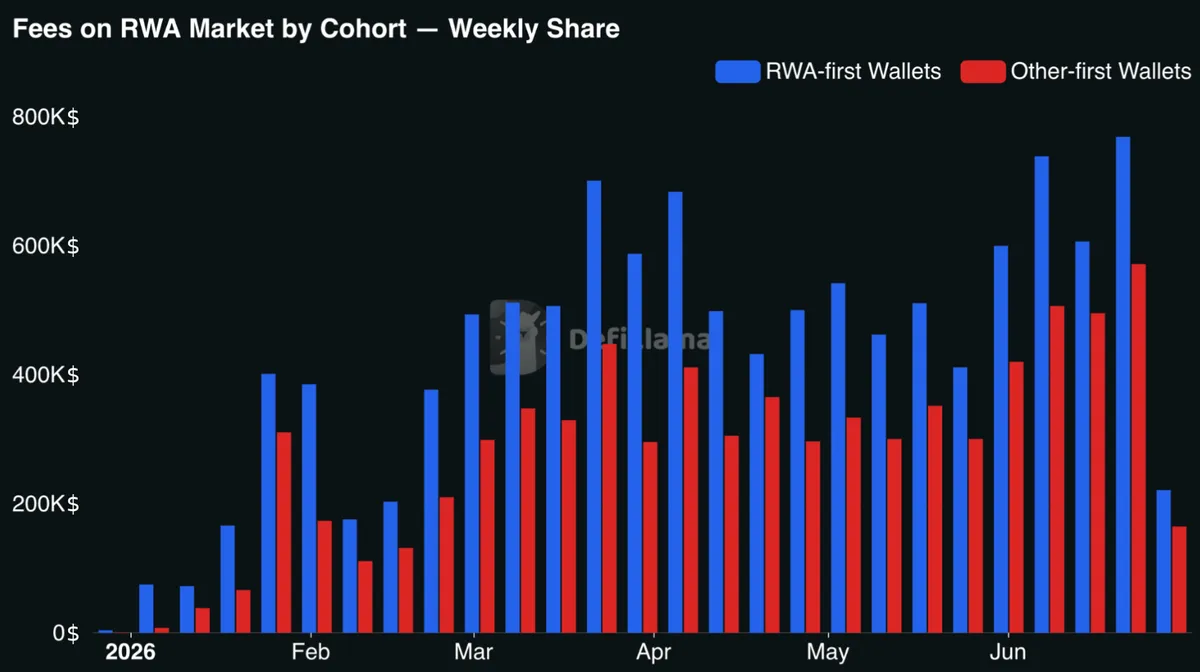
The fee breakdown removes any ambiguity about where Hyperliquid's revenue comes from between the two cohorts.
On RWA Markets, fee generation closely mirrors trading volume. Throughout the period, RWA-First wallets generated $11.7 million in fees (60.6%), while Other-First wallets generated $7.6 million (39.4%), broadly reflecting their respective shares of RWA trading activity.
The picture changes on Other Markets. Other-First wallets generated $370.9 million (94.3%) in fees on crypto perpetual markets, compared with just $22.4 million (5.7%) for the RWA-First cohort. This gap is substantially larger than the corresponding volume split, with RWA-First wallets still accounting for 8.3% of trading volume on Other Markets.
Looking at the effective fee rate adds another data point, though it should be interpreted with caution. By dividing total fees paid by each cohort on Other Markets by their total trading volume on those same markets, we obtain 12.2 bps for RWA-First wallets versus 19.8 bps for Other-First wallets, a roughly 1.6x difference despite both cohorts trading on the same infrastructure at the same nominal fee rates. This points to a potential behavioral difference between the two cohorts on Other Markets. Without per-trade granularity, the exact cause cannot be confirmed, but several explanations are plausible. For example, RWA-First wallets may trade more passively as makers (0.015%) rather than takers (0.045%), or the two cohorts may fall into different fee tiers due to staking or differences in their 14-day rolling trading volumes. However, investigating this further falls outside the scope of this report.
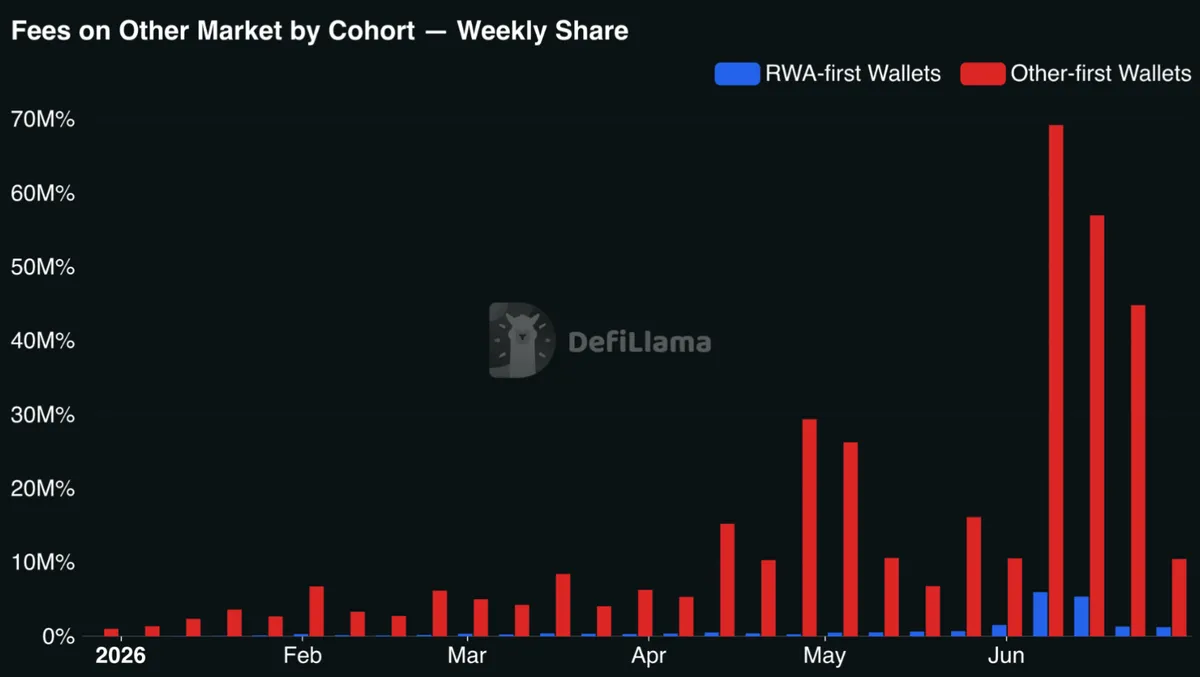
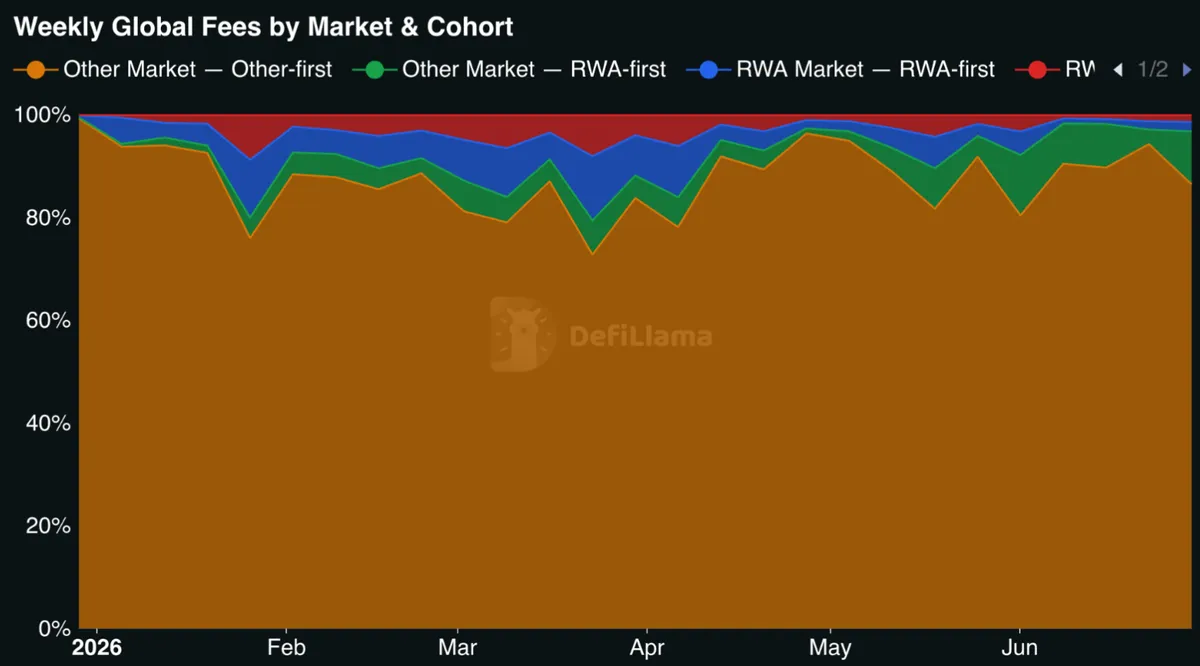
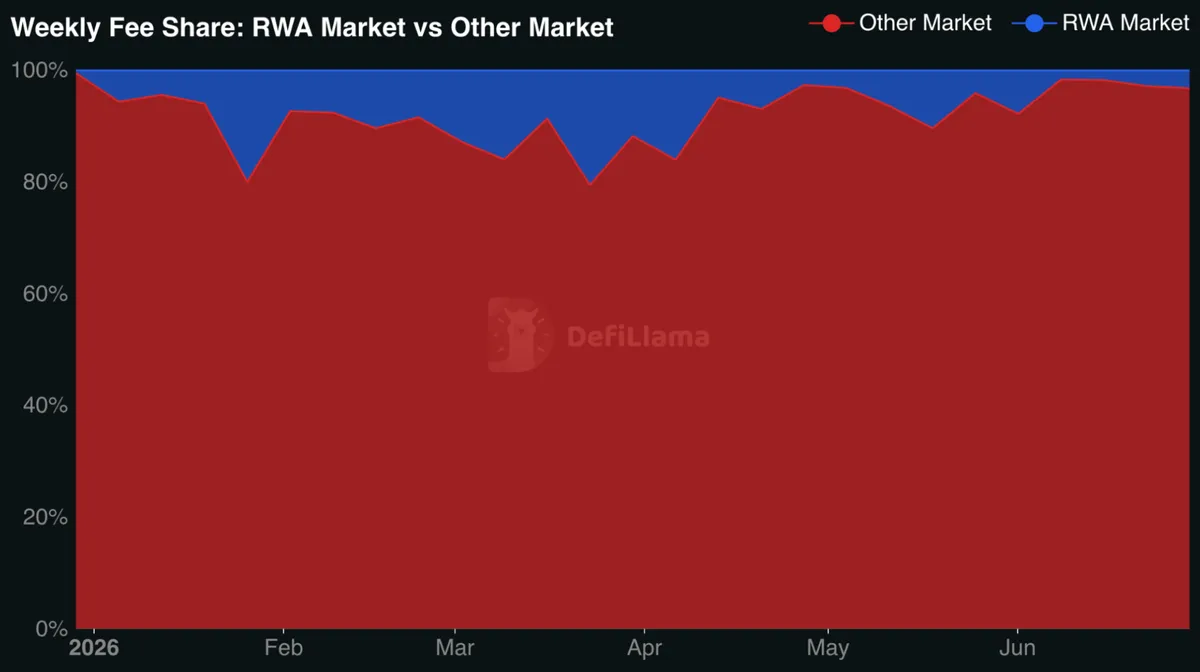
Overall, the answer to the second question is clear: RWA markets are not yet a meaningful driver of fee generation for Hyperliquid, regardless of the cohort considered. More than 80% of all fees generated by new users originate from Other-First wallets trading on Other Markets. What is equally striking is that despite a rapidly expanding RWA product offering, new equity listings, the S&P 500 license, pre-IPO markets, fee generation from RWA markets hasn't grown proportionally. Both cohorts trade more on RWA Markets over time, but the fees those markets produce remain a marginal share of the total.
Conclusion: new users, different economics
Between January and June 2026, 169,514 verified wallets entered Hyperliquid through an RWA Market, representing 31.7% of all new users. Their trading volume followed proportionally, accounting for 31.5% of all new-user activity. The evidence is therefore clear: RWA Markets are attracting genuinely new users at meaningful scale.
Those new users, however, behave differently from Hyperliquid's crypto-native user base. RWA-First users remain concentrated in the markets through which they entered, with 83.6% of their trading volume staying within the RWA Markets. By contrast, crypto-native users are considerably more asset agnostic, already directing around 30-35% of their trading volume toward RWA Markets as the product offering expands.
As for fees, several key takeaways emerge. First, RWA Markets account for less than 10% of the platform's fee revenue among new users despite generating meaningful trading volume. Second, RWA-First users generate relatively few fees because they largely remain within RWA Markets. Third, when they do venture into crypto perpetuals, they tend to adopt a more conservative trading profile, resulting in lower fee generation. Most importantly, more than 80% of all fees generated by new users come from wallets that entered Hyperliquid through Other Markets and keep trading on these markets.
The next question is therefore no longer whether RWA Markets can attract new users but whether those users become more economically valuable over time by expanding into crypto perpetuals, increasing their activity on RWA Markets or as the RWA Markets keep evolving.
Methodology
This analysis covers the period January 1 to June 30, 2026. A wallet is classified as an RWA-First user when its first ever trade on Hyperliquid occurs on a HIP-3 RWA Market, specifically one of the following builder-deployed DEXs: vntl, xyz, flx, km, cash, para, abcd. To ensure the cohort contains only genuinely new participants, each candidate wallet was cross-checked against on-chain Arbitrum bridge deposit history. Any wallet that had deposited USDC into the Hyperliquid Arbitrum bridge before January 1, 2026 was removed. The two groups, 169,514 RWA-First wallets and 364,848 Other-First wallets, together account for 534,362 wallets active in the window.
Volume and fees are tracked across all days each wallet traded, not just their first. Both are split across a 2x2 matrix of wallet group (RWA-First vs Other-First) and market type (RWA Markets vs Other Markets). Volume is reported as single-side USD notional. Fees reflect only the main Hyperliquid trading fee, builder fees and HIP-3 deployer fees are excluded. The analysis processed 1.44 billion fill events across 582 GB of decompressed data from the public Hyperliquid raw fill archive.
Full methodology and raw data :
https://gist.github.com/noateden/6ee849a5348c99636681164878c40694