What the last two generations of reserve proofs missed
On the weekend of June 20, 2026, a stablecoin called msUSD (Main Street USD) lost most of its value after the dashboard proving its reserves went dark. Its issuer, Main Street, said the token “remains fully backed” and called the outage a “reporting issue, not a solvency issue.”
MSUSD
On the weekend of June 20, 2026, a stablecoin called msUSD (Main Street USD) lost most of its value after the dashboard proving its reserves went dark.
Its issuer, Main Street, said the token “remains fully backed” and called the outage a “reporting issue, not a solvency issue.” Accountable, the firm behind the dashboard, ended its work with the issuer and said it “did not retain an ongoing, source-level view” of the reserves.

That left holders with an issuer vouching for the reserves and a verifier saying it could not see them. Neither statement settled whether the money was there, and the market declined to wait for an answer.
Altura, a vault that peaked at $39 million, said it “never had any exposure to Mainstreet,” although it did share a verifier. Within a day, it paid out more than $8.5 million in redemptions and announced a wind-down.
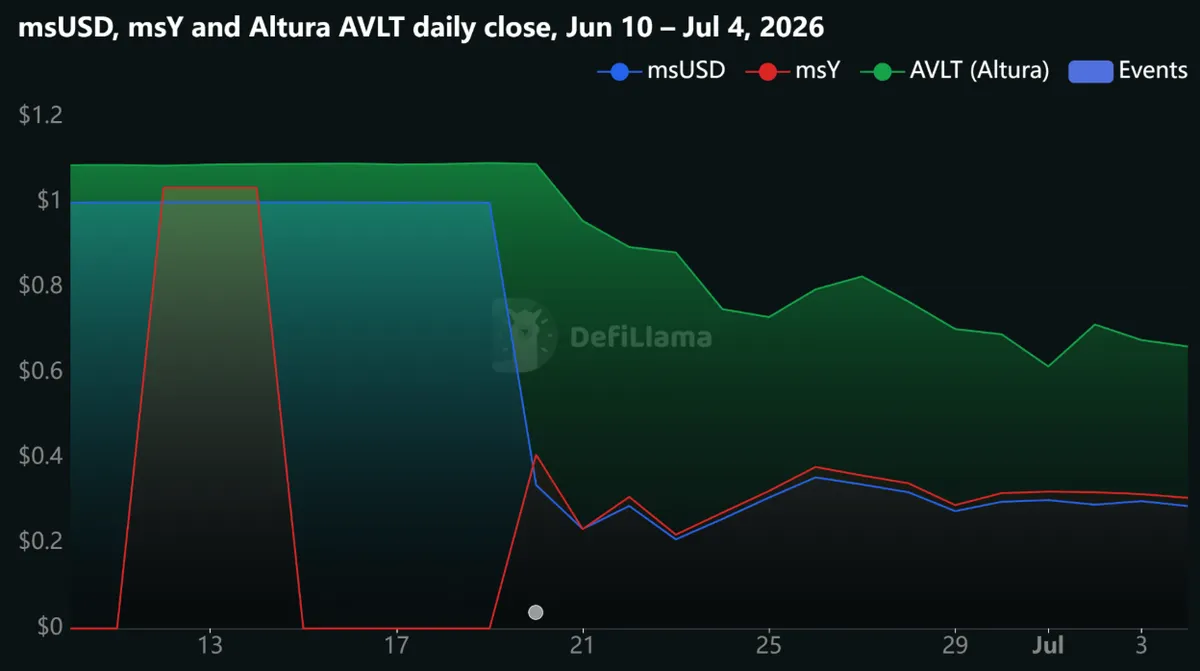
That event was just another example of crypto’s reserve proofs breaking in public. An early, prominent case followed the collapse of FTX in November 2022, when other exchanges rushed to publish proof-of-reserves reports from accounting firms. Mazars, which produced them for Binance, KuCoin and Crypto.com, paused the work a month later, citing “concerns regarding the way these reports are understood by the public.
A month later, it paused the work, citing “concerns regarding the way these reports are understood by the public.”
Even the PCAOB, the US audit regulator, told customers to “exercise extreme caution,” that these engagements “are not audits,” that they described assets “at one point in time,” and that they “likely do not address the crypto entity’s liabilities.” The reports might also miss assets an exchange had borrowed to look well funded on the day of the check.
TL;DR: an exchange could pass on a Tuesday, but that wouldn’t tell its customers anything about its status on Wednesday.
With those complaints in hand, the next generation tried to fix onchain reserve reporting. Accountable bolstered its services to be the antithesis of “self-reported claims, delayed audits, and static PDFs,” instead offering a continuous, privacy-preserving view of assets and liabilities across wallets, custodians, exchanges, and banks.
That answered the snapshot problem and most of the liabilities problem. But private accounts stayed private, so holders still relied on the attestor’s word as to which accounts counted in its analysis.
Neutrl USD supplied the harder lesson in proof of reserves’ shortcomings.
In May, Accountable said its dashboard provided “continuous cryptographic proof that NUSD reserves matched the protocol’s liabilities.” Less than three months later, Neutrl stopped holders from minting or cashing out NUSD, with about $53.6 million of the token outstanding. A DeFi researcher then found that Accountable’s page for Neutrl was no longer working, leaving holders to rely on Neutrl’s own disclosures. Two weeks into the freeze, Neutrl reported about $27 million in assets it could readily sell, roughly half of what was outstanding, plus other positions it could not. When it finally let holders cash out in September, the price was 51 cents per token. Neutrl has not said how much of the rest holders might recover.
Nothing public shows the May proof was false, and holders were stuck anyway. Nearly four years of better proofs had brought the industry back to the question it started with: could people get their money out?
Across both generations, the proofs tended to be accurate about something narrow and were read as saying something broad. A balance existed, so the product must be safe. A badge said verified, and nobody scrutinized the verifier or its methods.
Verified by llamas
DefiLlama launched Verified by DefiLlama on Nov. 2, with Frax Finance’s frxUSD as its first record. The latest snapshot shows $99.34 million of reserves against $96.05 million of frxUSD, or about $1.03 behind every token.
You can check most of that yourself, too. Six Ethereum addresses hold about 98% of the reserves, and the register lists each one with its units, price, and token contract. Another 10.48 million frxUSD sit locked in the Fraxtal bridge, with matching supply on Fraxtal, so the numbers are counted only once.
For offchain assets, DefiLlama takes read-only access to banks, custodians, and fund administrators, then checks balances at the source against token supply. Ultimately, it can see the money, and cannot move it. For example, our dashboard shows that Frax holds $2.01 million at Erebor; readers rely on DefiLlama’s access there. If a source misses an update, the program’s label is “Stale.” If a figure cannot be independently checked, the label is “Unverified.”
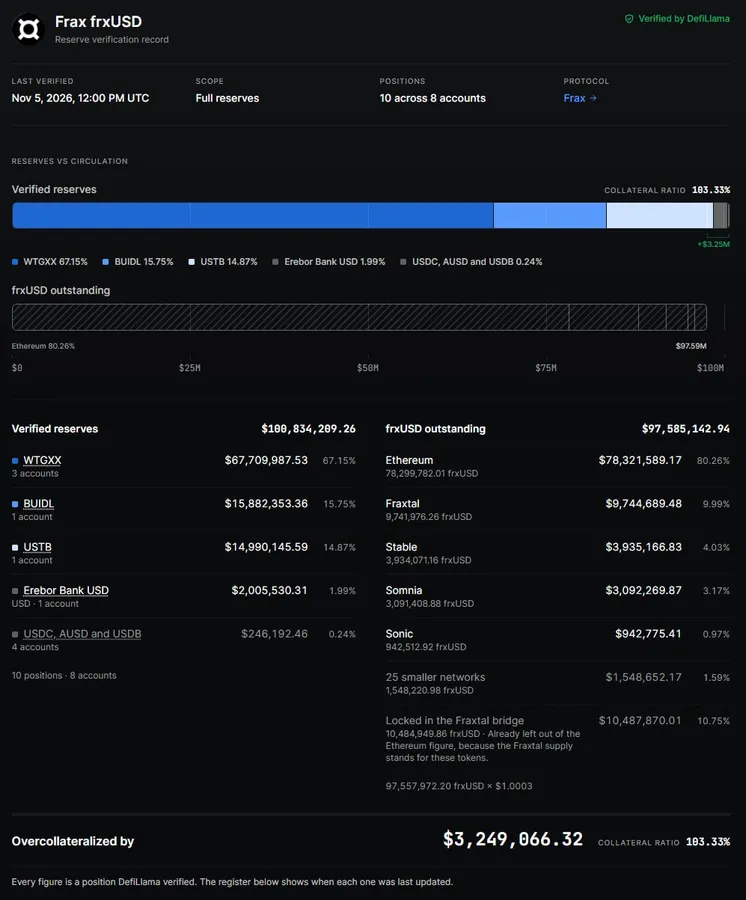
This service has been in the works for some time, and developers have taken extra care to set customer expectations about what proof DefiLlama accepts to verify reserves.
The timing of this launch lines up with some important regulation. The GENIUS Act, due to take effect by Jan. 18, 2027, will require monthly reserve reports examined by a PCAOB-registered accounting firm. Frax says it is applying for this license. Those reports carry legal weight a dashboard cannot, and they arrive twelve times a year. Verified covers the days in between, on a site where the market already checks TVL and stablecoin supply.
The old limits still apply, since the record covers only the accounts that issuers provide. The record cannot say how fast fund shares turn into dollars. DefiLlama’s own page makes clear it is “not a statutory audit or a guarantee of future solvency.”
More records are coming in the near future, and those will show whether other issuers publish as much as Frax did.
The frxUSD register is public: https://defillama.com/verified/frxusd
Issuers can apply at https://defillama.com/verified