Tokenized Stocks Have Volume. Do They Have Liquidity?
Now that the market has real size, how good is the liquidity behind it? To find out, we took a live snapshot of four names (AAPL, TSLA, GOOGL and SPY) across perps on Bitget, Binance, OKX and Bybit, and spot on Bitget, Binance, OKX, Bybit and Hyperliquid.
Bitget
The Tokenized Stock Market
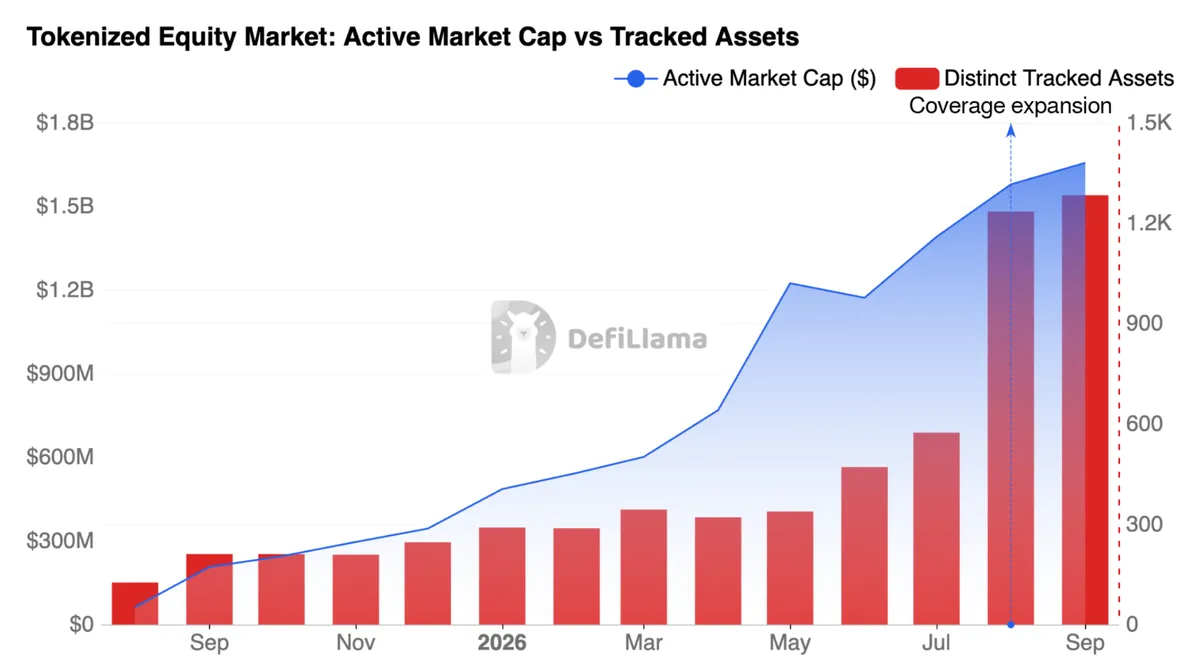
In just over a year, tokenized stocks have gone from a niche experiment to a real market. DefiLlama's tracked tokenized-stock market cap grew from about $63M in August 2025 to $1.66B as of 14 October, a 26x increase over 14 months. As of that date, DefiLlama tracks 1,284 instruments across 18 chains. Instrument counts need care. In August 2026 the tracked count rose from 574 to 1,235 (+115%), but much of that reflects DefiLlama widening its coverage, not 661 new products launching. Market cap is the cleaner growth signal, though it is also affected by which instruments were tracked at each date.
Our first Spotlight showed that Bitget has become one of the main venues for trading tokenized stocks, with strong retail demand and growing volume. But volume only tells you how much people are trading. It doesn't tell you how well the market handles that activity: how tight prices remain, how easily large orders can be filled, or how much liquidity is available outside regular e US trading hours.
This piece asks the next question: now that the market has real size, how good is the liquidity behind it? To find out, we took a live snapshot of four names (AAPL, TSLA, GOOGL and SPY) across perps on Bitget, Binance, OKX and Bybit, and spot on Bitget, Binance, OKX, Bybit and Hyperliquid. The snapshot was taken on September 29, 2026 at 04:47 UTC, outside US market hours.
Here's what we found. All findings come from this single snapshot, so they describe that moment rather than a standing ranking:
Bitget recorded the deepest perpetual order books on all four instruments tested (AAPL, TSLA, GOOGL and SPY), despite never leading on 24-hour volume. By displayed order-book depth within 1% of the price, Bitget ranked first among the four perp venues on every name. By 24-hour volume it ranked second or third.
Onchain books aren't comparable yet. Hyperliquid's spot books had almost no orders near the price, with spreads in the thousands of basis points. We report on-chain and centralized books separately.
Large-order execution revealed significant differences between venues. Bitget and Binance were the only spot venues with sufficient displayed liquidity to fill a simulated $100,000 buy order across all four instruments, although execution costs varied by assets.
Every ranking and figure below is a single reading from September 29, 2026 at 04:47 UTC and should not be read as an average or a standing ranking.

Where Tokenized Stocks Trade
Before comparing execution quality, it's worth being clear about what's actually being traded, because "tokenized AAPL" isn't one product. Perps on Bitget, Binance, OKX and Bybit are cash-settled derivatives that track the stock price. They're created by each exchange, so there's no underlying share or issuer behind them. Spot tokenized equity products provide exposure to underlying equities through different issuance and custody structures. Depending on the product, tokens may represent claims on underlying shares or other forms of economic exposure, with investor rights varying by issuer.
Venue | Product | Symbol convention | Issuer / brand |
|---|---|---|---|
Bitget | Spot | r-prefix (rAAPL, rGOOGL, rSPY) | Reality, a Bitget subsidiary — branded "Reality Tokenized" |
Binance | Spot | B-suffix (AAPLB, TSLAB, | B-Tech Holdings Limited (confirmed for TSLA, GOOGL, SPY; not found for AAPL) |
OKX | Spot | X-prefix (XAAPL, XTSLA, | Not identified |
Bybit | Spot | X-suffix (AAPLX, TSLAX, | Not identified (tickers match other venues' products, so not confirmed as Bybit's own) |
Hyperliquid | Spot (on-chain) | Ticker as-is (AAPL, TSLA, GOOGL) | Not identified |
For spot products, the issuer is shown where it could be identified. "Not identified" means we could not confirm one.
We chose AAPL, TSLA, GOOGL and SPY because they're the most widely listed tokenized stocks across the venues we tested. Every venue offers at least one of them, and three of the four are available on spot at all five venues. SPY is the only index product in the set, which lets us check whether liquidity looks different for a broad-market ETF than for single stocks.
The venues match those covered in our first Spotlight: Bitget, Binance, OKX and Bybit for perps, with Hyperliquid added on spot as the on-chain comparison. Using the same list across both markets keeps the comparison like-for-like.
How we measured
All figures in this piece come from one live order-book snapshot, taken on September 29, 2026 at 04:47 UTC, outside US market hours. We covered four instruments (AAPL, TSLA, GOOGL and SPY) across the venues listed above. Spreads are the gap between the best bid and best ask at that moment, in basis points. They are a single-moment reading, not an average over a trading day, so they can look wider or tighter than the typical spread at other times, especially on individual names. Depth is the dollar value of resting orders within a set distance of the price. Slippage is simulated: we walked each order through the book as displayed, so it shows the cost the book implied at that moment, not an actual executed trade.
The Busiest Venue Isn’t The Deepest
Most trackers rank venues by trading volume. But volume only shows how much is being traded, not how much liquidity is sitting in the book. To test whether the two line up, we ranked each venue by 24-hour perp volume and then, separately, by order-book depth within 1% of the price.


Ticker | Venue | Volume rank (of 4 venues; OKX not shown) | Depth rank (of 4 venues; OKX not shown) | Pattem |
|---|---|---|---|---|
AAPL | Binance | 1 | 2 | Aligned |
AAPL | Bybit | 2 | 3 | High volume, thin book |
AAPL | Bitget | 3 | 1 | Low volume, deep book |
TSLA | Binance | 1 | 2 | Aligned |
TSLA | Bitget | 2 | 1 | Aligned |
TSLA | Bybit | 3 | 4 | Aligned |
GOOGL | Binance | 1 | 2 | Aligned |
GOOGL | Bybit | 2 | 3 | High volume, thin book |
GOOGL | Bitget | 3 | 1 | Low volume, deep book |
SPY | Binance | 1 | 2 | Aligned |
SPY | Bitget | 2 | 1 | Aligned |
SPY | Bybit | 3 | 4 | Aligned |
The clearest pattern is Bitget. It never ranks first by volume, yet it has the deepest order book on all four names. On AAPL and GOOGL the gap is widest: Bitget ranks third of four venues by volume but carries the most resting liquidity.
This matters because volume and depth measure different things. Volume shows how much has already traded over the past 24 hours. Depth shows how much the book can absorb right now without moving the price. A trader placing a large order cares far more about the second number, and on that measure Bitget had the deepest book on every name, despite trailing on volume each time.
That's easy to miss on a volume leaderboard, which is how most tokenized-stock trackers rank venues today. This snapshot shows the difference in displayed depth, but it doesn't establish what drives it.
Bybit shows the opposite. On AAPL and GOOGL, it ranks second by volume but third by depth, so heavy trading sits on a thinner book. These are the same two names where Bitget looks quiet but deep, while Bybit looks busy but shallow. On TSLA and SPY, Bybit ranks low on both, so the mismatch doesn't apply there.
Binance sits between the two. It leads on volume for every name and ranks second on depth each time, just behind Bitget. It shows a venue can be strong on both measures, but even the most active venue here didn't have the deepest book.
What It Actually Costs To Trade
Rankings help compare venues at a glance, but they don't say what a trade actually costs. This section puts numbers on it in three ways: spreads, depth at different distances from the price, and slippage at different order sizes.
Hyperliquid is included in the spot data but shown separately. Its spreads run in the thousands of basis points, compared with single digits on centralized venues, so averaging it in would produce a "typical" figure that no real venue matches.
Spreads
These are single-moment readings from the September 29 snapshot, taken outside US hours.
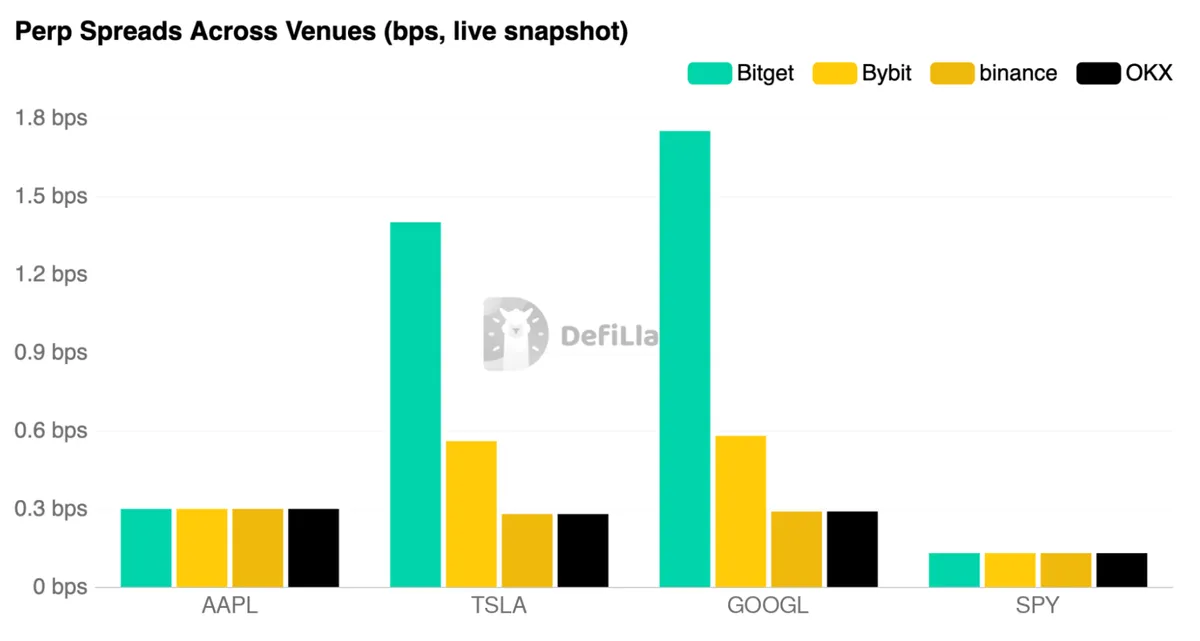
The 0.83 bps reported in our earlier research was calculated across a different dataset and sampling period. The figures below reflect a single order-book snapshot taken on September 29, 2026, outside US market hours, and are therefore not directly comparable. . A median across many readings smooths out moments when a book is thin or wide. A single reading does not, so the two numbers measure different things and shouldn't be compared directly. Perp spreads in this snapshot ranged from about 0.13 to 1.75 bps.
On perps, Bitget isn't the tightest venue. Its spreads are wider than Binance and OKX on TSLA (1.4 bps vs 0.28 bps) and GOOGL (1.75 bps vs 0.29 bps), and roughly in line with the field on AAPL and SPY.
On spot, Bitget's spreads are wider than Binance's on every name. On GOOGL, for example, Bitget quoted 9.06 bps against Binance's 0.88 bps. But the spread only shows the price of the very first order. For larger trades, what matters is how much size sits behind it.
Depth
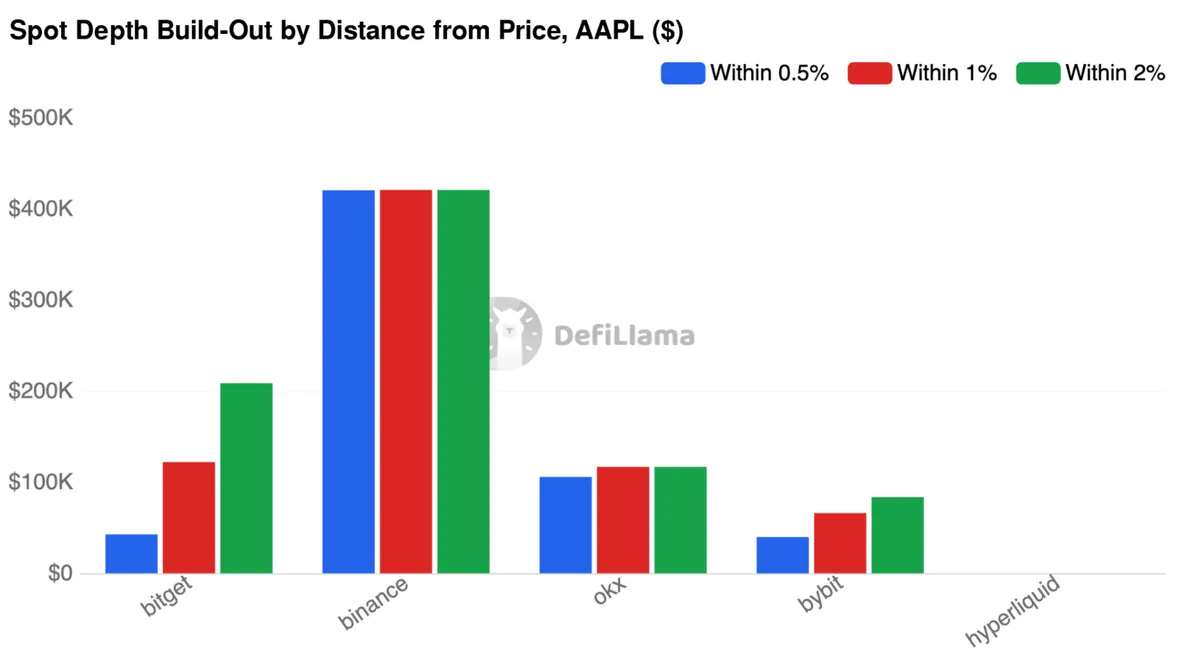
Spot books are shaped differently from venue to venue. Bitget's book keeps adding size the further you go from the price. On AAPL, its depth grew from $42.7k within 0.5% of the price to $122.1k within 1% and $208.6k within 2%, with a similar build-up on GOOGL and SPY. Binance and OKX, by contrast, concentrate more of their size close to the price, with less added further out. On AAPL spot, Binance's book was deeper than Bitget's at every distance shown; Bitget's depth lead in this snapshot was on perps.
This matters for larger orders. A small trade only touches the orders closest to the price, while a large one works through them and relies on size further out. In this snapshot, Bitget's spot liquidity was spread more evenly across price levels, while Binance's was concentrated close to the price. The snapshot doesn't tell us why the books are shaped this way.
Slippage
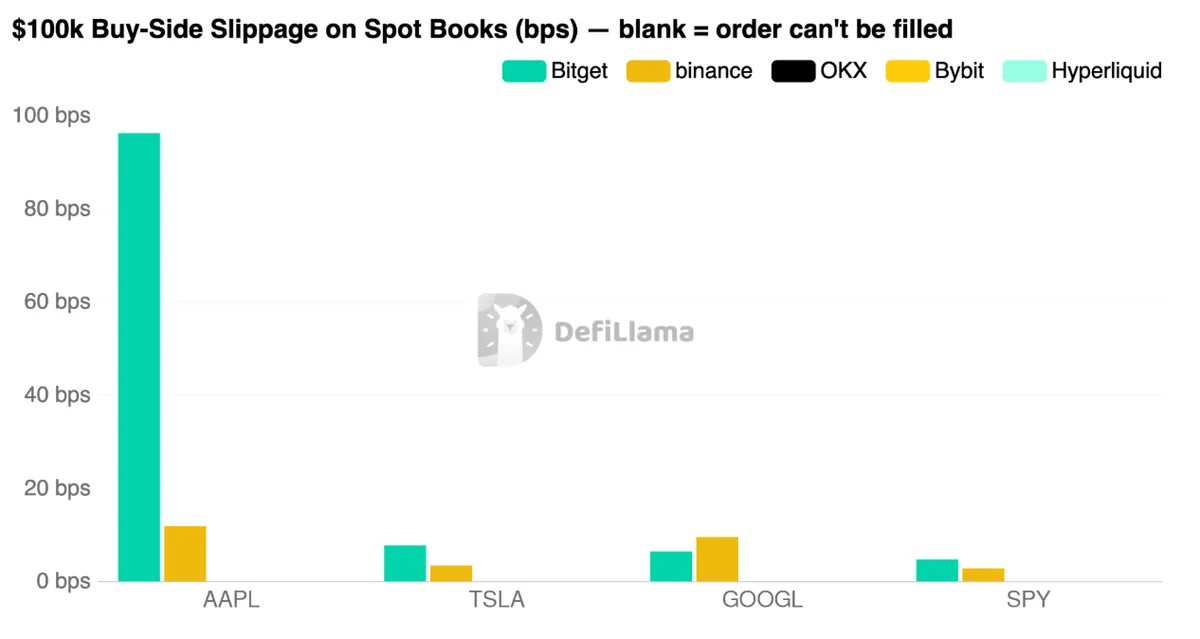
Slippage figures here are simulated execution costs. We walked each buy order through the order book as displayed at the time of the snapshot, so they are not actual executed trades. Real fills would also depend on how the book moves while the order executes.
At $1000, simulated slippage was below 5 bps across almost all , centralized venues tested, with differences becoming more pronounced at larger order sized.
Slippage is the extra cost of a buy order relative to mid price / best ask, found by walking the order through the displayed book. At $100k, only Bitget and Binance could fill a simulated order on every ticker. Binance was cheaper on AAPL (11.8 bps vs Bitget's 96.2 bps), TSLA (3.4 vs 7.7) and SPY (2.8 vs 4.7). Bitget was cheaper on GOOGL (6.4 vs 9.5). The AAPL gap is an outlier, and because it reflects one snapshot of the displayed book, we would not read it as a standing difference. Neither venue wins across the board.
Perps vs spot
We did not compare perp and spot execution costs like-for-like, so this piece makes no claim about which is cheaper. The two are different products. Perps are cash-settled derivatives with no underlying share, and their costs include trading fees, funding, margin and liquidation risk, none of which are covered here. Spot slippage above is simulated from the displayed book for Bitget and Binance only, because the other venues could not fill a $100K order.
Conclusion: Volume Alone Doesn’t Show Where Liquidity Sits
Tokenized stocks now have real scale, and this piece set out to test whether the liquidity behind them matches the headline numbers. In this snapshot, volume was a poor guide to where displayed liquidity sat. Bitget never led on 24-hour perp volume, yet it had the deepest perp book on all four names we tested. It was also one of only two spot venues, alongside Binance, that could fill a simulated $100k order on every ticker.
Perp depth was Bitget's clearest strength in this snapshot. On spreads, it quoted wider than Binance on several names, and it cost more on most simulated $100k spot fills. The gaps are small on most names, though AAPL was a clear outlier on $100k spot fills.
There's a lot this snapshot can't tell us. It can't show what drives the differences in displayed depth. We didn't compare fees, which affect where liquidity providers post size. And because this was a single snapshot taken outside US trading hours, we don't know whether these rankings hold when the US market is open or across other market conditions. A US-hours comparison is a natural next step.
As tokenized equities expand across trading venues, liquidity and execution quality are becoming important measures of market competitiveness. This analysis shows why trading volume along cannot capture those differences. In the September 29 snapshot, Bitget recorded the deepest perpetual order books across all four instruments tested, while spot execution costs varied across venues and order sizes.