Fees or execution? What a cross-chain BTC to ETH swap really costs
To measure what a cross-chain swap really costs, we analyzed 2,741 BTC to ETH swaps of $1,000 or more between September 15 and October 25, 2026, a period in which all three protocols were fully functional and stable, with no news event that could have distorted their usage. Read more.
THORChain
BTC
ETH
Every few months, a centralized platform reminds its users of the risk they carry, from leaked customer data to drained wallets. Using DEXs is the natural answer: on a single chain they've become routine, but across chains, the story is a bit different. Users either trust a bridge and the risks its wrapped assets carry, or turn to the few protocols that swap native assets directly, the three main ones being THORChain, Chainflip and NEAR Intents.
Beyond selecting a venue, what matters more to a user is how much they receive against what they sent. Between the protocol fee, the frontend fee and other factors such as slippage, the gap between the value going into the protocol and the value coming out can be wide.

To measure what a cross-chain swap really costs, we analyzed 2,741 BTC to ETH swaps of $1,000 or more between September 15 and October 25, 2026, a period in which all three protocols were fully functional and stable, with no news event that could have distorted their usage.
Three findings stand out: THORChain and
NEAR Intents compete head to head, at 47.2 and 46.3 bps for a median swap, while
Chainflip sits 6 to 7 bps higher. NEAR's output is more predictable than THORChain's, but it's still in a subsidy phase, so its fees could rise over time. THORChain, the most established of the three, competes very well with NEAR and should become even cheaper with an upcoming upgrade.
THORChain leads at both ends of the size range
To compare protocols on equal terms, we repriced every swap in the dataset through the cheapest route a user without a coding background can take. We considered three components: the protocol fee (what the protocol or blockchain charges), the frontend fee (what the app or broker charges on top) and the remaining price gap (everything else the user loses between the BTC sent and the ETH received, such as price impact, outbound costs and price moves during the swap).
For THORChain, the cheapest route is swap.thorchain.org, with no frontend fee and a 20 bps protocol fee. For Chainflip, it's swap.chainflip.io, with a 30 bps broker fee, which acts as its frontend fee, and a 10 bps protocol fee, plus a boost fee when used. For NEAR Intents, we use a 40 bps frontend fee and a 0.01 bps protocol fee. That reflects near.com, which no longer displays its fees (NEAR's business page mentions 35 bps, while a few in-house tests put them at 40 bps), and the cheapest frontends, which also charge about 40 bps once the discounted prices some apps use to bootstrap volume are set aside.

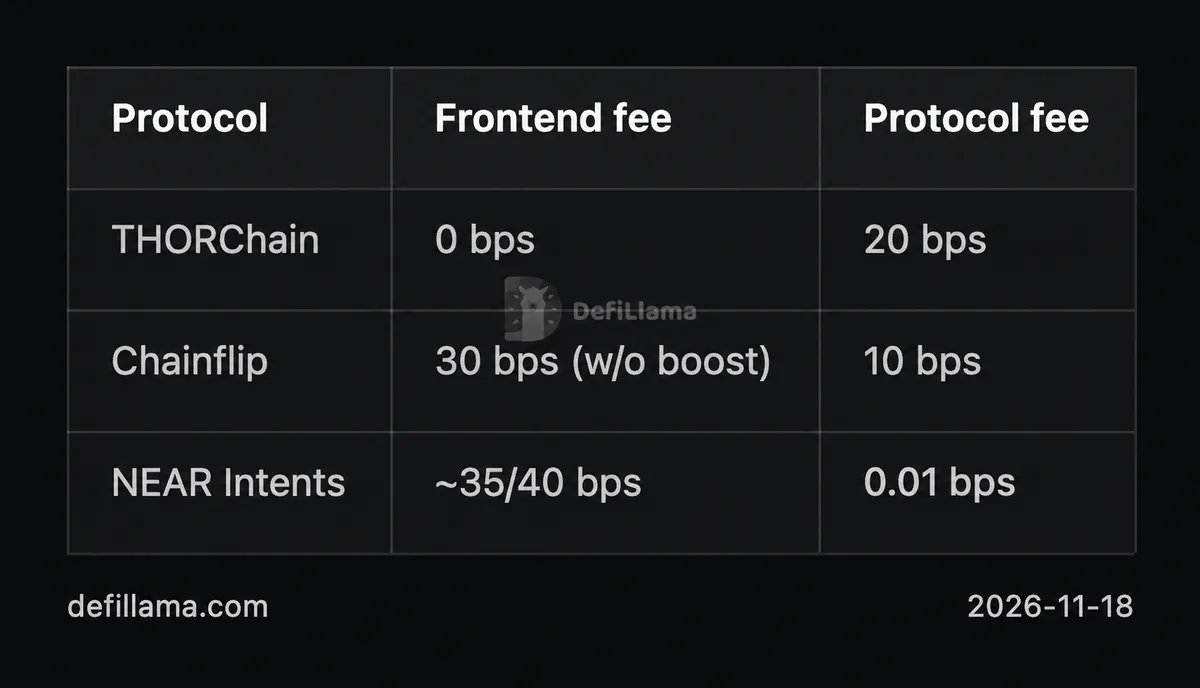
Across all sizes, the median swap costs 46.3 bps on NEAR Intents, less than a basis point below THORChain's 47.2, and 53.4 on Chainflip. The first takeaway: through the cheapest routes, Chainflip is more expensive by a substantial amount, while THORChain and NEAR Intents sit at the same level.
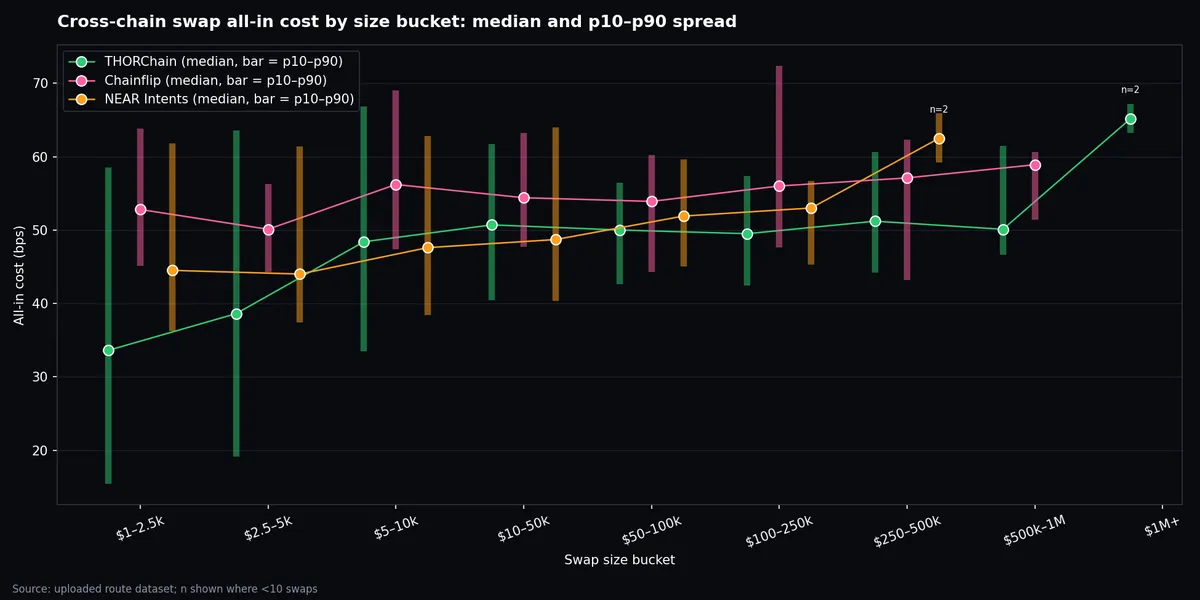
Breaking the sample down by size shows more precisely who performs well where.
Under $5k, THORChain leads at 33.6 bps between $1k and $2.5k and 38.6 bps up to $5k, against about 44 bps on NEAR Intents and 50 to 53 bps on Chainflip. In this bracket, fees make the difference: a small swap barely moves a THORChain pool, so the price gap stays at about 13 to 17 bps on top of the 20 bps liquidity fee, while the other two charge 40 bps in fees alone.
Between $5k and $50k, NEAR Intents takes the lead at around 48 bps, against around 50 bps for THORChain. This is where THORChain's price impact catches up with the fees: the price gap rises to 23.5 bps and then 29.4 bps as swaps take a bigger bite of the pools, while NEAR's solvers keep it under 9 bps.
From $50k up, THORChain leads again, and its cost barely moves: between 49.5 and 51.2 bps all the way from $10k to $1M, while NEAR climbs to 53.0 bps by $250k and Chainflip stays between 54 and 59. Streaming swaps (TWAP) explain the flat line, something THORChain has been good at: they split a large swap into sub-swaps over several blocks so arbitrageurs can rebalance the pool in between. NEAR's price gap, by contrast, rises from 4 to 13 bps as tickets grow, likely because solvers price in more hedging.
Note: Above $500k, the sample is too thin to draw conclusions.
THORChain wins on fees, the others on execution
The median is one way to read the data, but it doesn't show the whole picture. As the bars on the chart above show, the spread around the median can be significant. In other words, two swaps of the same size on the same protocol can land several basis points apart, and for a user that means uncertainty about the amount that actually reaches the destination wallet.
For example, on a $1,000 swap, the cost ranges from about $1.50 to $5.90 on THORChain, $3.60 to $6.20 on NEAR Intents and $4.50 to $6.40 on Chainflip.
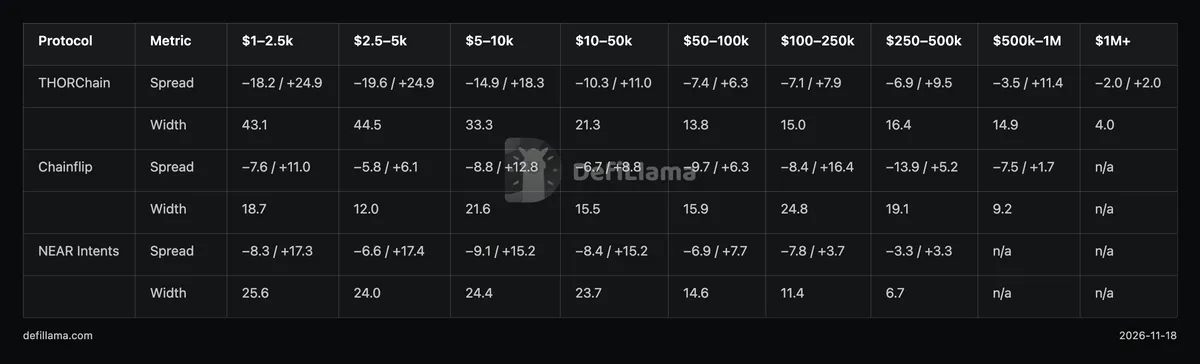
Combining fees, price gap and spread gives a better sense of how many bps a swap costs and how likely one venue is to be cheaper than another. It also shows what each venue has to work on to be more competitive.
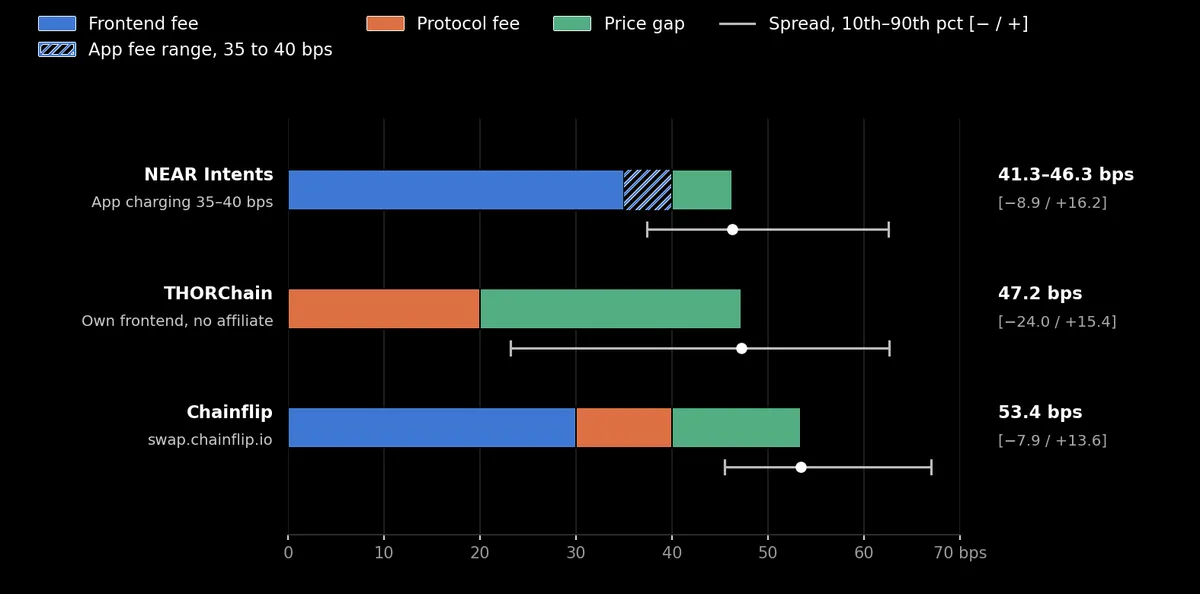
THORChain's typical swap costs 47.2 bps but can range from about 23 to 63 bps, the widest spread of the three. Several factors can explain why. First, the pool design ties price impact to swap size, and the order in which swaps are processed within a block can work against small swaps, which don't get priority. Second, streaming swaps (TWAP) cut large swaps into chunks that fill at slightly different prices: this reduces the impact on the pool, but the market can move in the meantime. Hence, THORChain's main work should focus on execution quality and stability to reduce the price gap, something the team is working on, as covered below.
Chainflip's typical swap costs 53.4 bps but can range from about 45 to 67 bps. Most of the cost comes from fees: a 30 bps frontend fee and a 10 bps protocol fee. Its narrow spread makes it remarkably stable and predictable for users. To improve, Chainflip's lever is mainly pricing: with fees setting a floor of about 40 bps (without boost), competing for flow will take a cheaper frontend.
NEAR Intents' typical swap costs 46.3 bps and can range from about 32 bps (at near.com's 35 bps fee) to 63 bps. NEAR Intents does best of the three on execution, with a price gap of about 6 bps, the smallest of the three. This comes from a design that is less decentralized than Chainflip's and THORChain's, in which solvers compete to quote against the market rather than trade against a pool, which keeps price impact low and most swaps close to the median. NEAR's main focus should be on sustainability first and fee optimization second. For now, NEAR bears the infrastructure cost by emitting NEAR tokens while charging almost nothing (0.01 bps) on transactions. That subsidy will stop at some point, and NEAR Intents will have to find a sustainable model.
Cross-chain swaps are set to get cheaper
Through the cheapest realistic routes, a native BTC to ETH swap costs roughly 20 to 65 bps in normal conditions, depending on the quality of execution and the market. Both the range and the cost should come down over time, bringing cross-chain swaps closer to the fees users pay on centralized exchanges.
For Chainflip, staying in the race will mean lowering costs while optimizing pools that already work relatively well, which could come with deeper liquidity and a new economic model.
For NEAR Intents, execution is already built to be cost efficient. The real challenge is sustainability: making sure all the actors involved, from NEAR validators to the solvers and frontends, become profitable without NEAR emissions. Doing so while lowering the cost for the end user will be a challenging mission.
For THORChain, it's all about improving the code, and that could come relatively soon. Base-layer limit orders will introduce a true order book to THORChain, enabling liquidity to sit at fixed prices in tandem with the variable liquidity pools, improving arbitrage and reducing slippage for the end user. Currently being tested, they could go live in the coming weeks or months and are expected to cut 10 to 20 bps from the all-in cost.
The race on execution has just started, and traders should keep an eye on which platform keeps offering the best prices.
Methodology
Native BTC to ETH swaps of $1,000 or more from September 15 to October 25, 2026: 8,323 swaps in total, of which 2,741 form the cleaned sample used for the cheapest-route and price gap views.
All-in cost = (USD in - USD out) / USD in, with both legs priced from the DefiLlama API when the protocol registers the BTC deposit. The BTC network fee the user pays to send the deposit is not included.
Remaining price gap (price gap for short) = all-in cost - frontend fee - protocol fee, or what the user loses beyond fees. It covers price impact, the margins built into pool, market maker or solver pricing, outbound costs and price moves between deposit and fill.
Coverage: NEAR Intents data covers public 1Click swaps only, across several frontends, since near.com swaps run on a confidential shard. The frontend fee was therefore set to 40 bps to reflect the real cost of using the protocol. THORChain swaps come from swap.thorchain.org and Chainflip swaps from swap.chainflip.io.
Statistics: unless stated otherwise, medians are per swap, so each swap counts once whatever its size. Ranges run from the 10th to the 90th percentile to set aside incidents and outliers that would skew the data. Spread = the distance from the median to the 10th and 90th percentiles, shown as − / +, with eight swaps in ten falling inside it.
To reflect real users, the cleaned sample sets aside one repeated Chainflip trader (an automated bot behind 5,319 October swaps of 0.045-0.065 BTC), one NEAR data error and 262 repetitive THORChain swaps that misuse streaming swaps, with settings entered manually instead of following the protocol's rules, and so don't represent genuine users.