Optimum and the economics of faster block propagation
Optimum introduces a complementary block propagation network for Ethereum . Its mump2p system uses random linear network coding to distribute information more efficiently, without requiring modifications to Ethereum's consensus protocol.

ETH
Optimum introduces a complementary block propagation network for
Ethereum. Its mump2p system uses random linear network coding to distribute information more efficiently, without requiring modifications to Ethereum's consensus protocol.
Early adoption has expanded substantially since mainnet. Connected stake increased from 1.42 million ETH on October 20 to approximately 3.44 million ETH by November 10, representing roughly 7.9% of Ethereum's staked ETH using the available reference total. Ether.fi has mandated deployment across its 12 node operators.
Optimum's performance studies indicate improvements in propagation and validator outcomes. Recent network measurements report that mump2p accelerated block delivery in 91.6% of measured slots, while earlier operator studies found reductions in wrong head votes.
Faster propagation has economic implications beyond networking performance. Earlier block receipt can improve attestation accuracy and potentially give proposers additional bid selection time. The same infrastructure may eventually support other latency-sensitive blockchain applications.
Ethereum has spent years improving its ability to process transactions and support more activity onchain. Much of this work has focused on execution and consensus, but the speed at which information travels across the network also matters. Delays in block propagation can affect validator rewards, limit the time available for block construction, and create advantages for operators with better network connectivity.

Optimum is focused on improving this part of Ethereum's infrastructure. Its approach is built around a simple idea: getting blocks across the network faster and more consistently can benefit both validators and block proposers. Rather than changing Ethereum's underlying protocol, Optimum seeks to improve the infrastructure that connects its participants.
Following months of testing with staking operators, Optimum launched on Ethereum mainnet on October 20, 2026. Since then, it has attracted significant participation from institutional staking providers, with millions of ETH now connected to its network. Its early performance results and growing adoption offer a closer look at the economic importance of Ethereum's networking layer.
Architecture and economics
The core innovation behind Optimum's approach is mump2p, a networking protocol designed to move block data across Ethereum faster and more consistently. Rather than replacing Ethereum's existing infrastructure, mump2p works alongside it, offering another way for information to reach validators. Understanding how it works also helps explain why improvements in block propagation can translate into better validator performance and potentially higher proposer revenue.

How Optimum’s mump2p works
Ethereum relies on a gossip-based network to distribute newly proposed blocks. When a node receives a block, it forwards the information to its peers, which then relay it to others until the block has spread across the network. While effective, delivery times can vary depending on connectivity, geographic location, and the number of network hops involved. Ethereum's gossip network already uses multiple paths to distribute information, but differences in network conditions can still affect when individual validators receive a block.
Optimum takes a different approach through Random Linear Network Coding (RLNC). Rather than simply forwarding copies of the original message, nodes can combine data into encoded packets that travel through different paths. Within Optimum's network, relay nodes known as Flexnodes forward these packets and can create new combinations from them. A receiving node can reconstruct the original data once it collects enough independent packets, reducing its reliance on any particular packet arriving. This means that losing one packet does not necessarily prevent the receiver from reconstructing the block, provided enough independent information arrives through other paths.
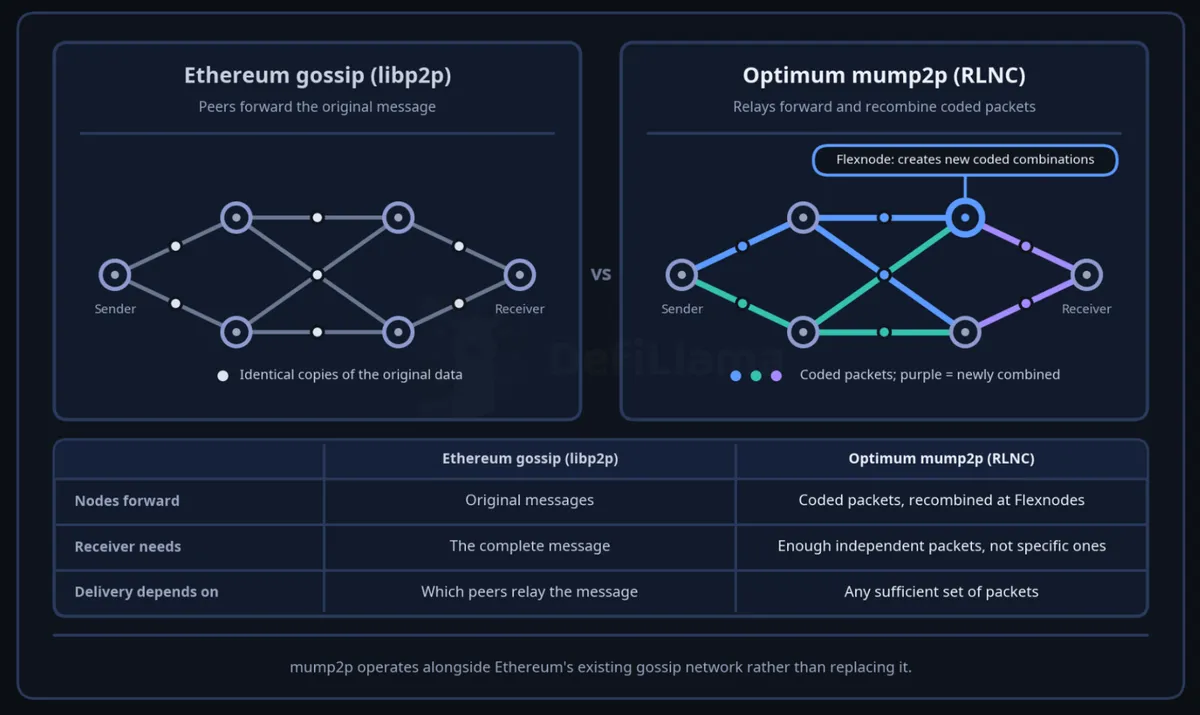
Optimum offers two functions built around this networking approach: Signal and Accelerate. Signal focuses on getting blocks to validators earlier, giving them more time to perform their attestation duties. Accelerate addresses the sending side, helping proposers distribute blocks more quickly. It also includes a service that optimizes when proposers stop accepting builder bids, potentially allowing them to wait longer for more competitive bids before publishing.
For operators, mump2p runs through an additional gateway alongside their existing consensus clients. It does not require changes to Ethereum's consensus rules, and the gateway can be disabled without interrupting normal validator duties. This allows staking providers to adopt the additional networking layer without replacing the infrastructure they already use.
There are also differences in how the two functions are offered. Signal is currently free for validator operators, while self-service access to Accelerate requires at least 200 validator keys. Optimum's gateway has undergone an independent security audit by ProbeLab. Together, the ability to integrate mump2p alongside existing infrastructure, its accessibility, and the independent audit help explain its appeal to staking operators.
The economics of faster block propagation
Block propagation affects more than how quickly information moves across Ethereum. For validators, receiving a block even slightly earlier can influence whether they earn the full rewards available for performing their duties. This matters for both attesters and proposers, although the economic benefits differ.
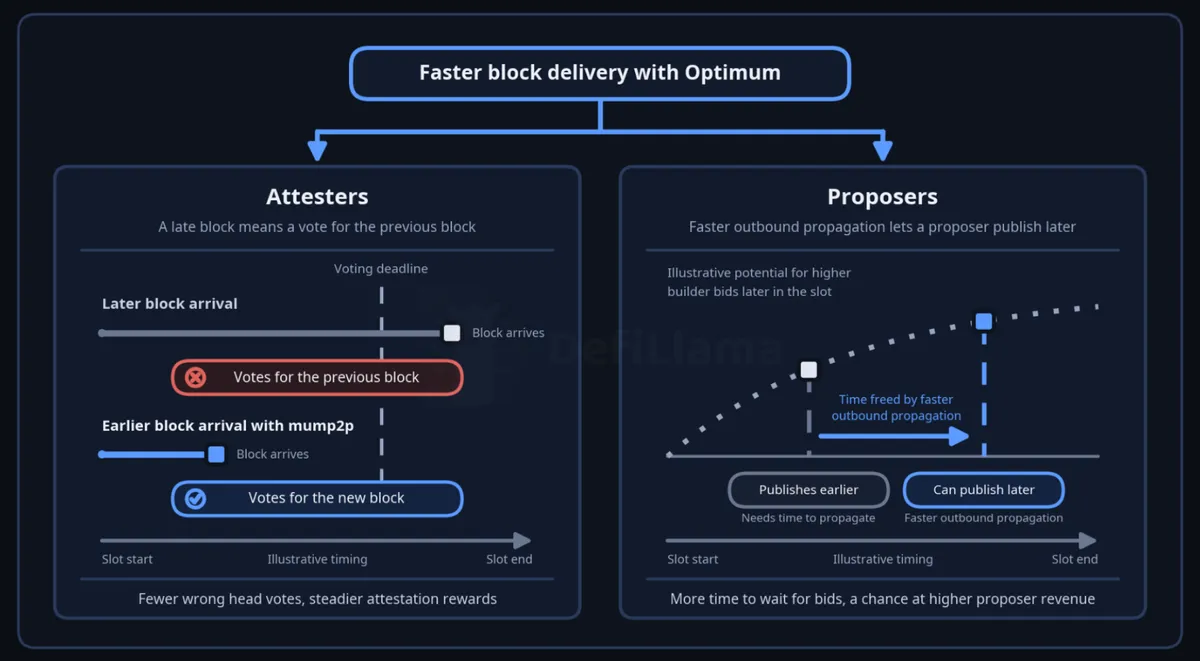
For attesters, a block arriving late can mean voting for the previous block as the chain head because the newly proposed block has not yet arrived. These incorrect head votes reduce the rewards validators would otherwise earn for accurately participating in consensus. By delivering blocks earlier and more consistently, mump2p aims to reduce these errors and improve attestation performance. Individually, the differences may be small, but across thousands of validators performing duties continuously, even modest improvements can accumulate.
The economics are somewhat different for block proposers. Under Ethereum's existing proposer-builder arrangement, supported by infrastructure such as MEV-Boost, builders compete to have their blocks selected by proposers, with bids changing as the slot progresses. Proposers face a trade-off: publish early to give the block enough time to propagate, or wait longer in the hope of receiving a better bid. Publishing too late increases the risk that other validators will not receive the block in time. Faster propagation can give proposers more room to wait before making that decision, potentially increasing the value they capture from builder competition. This is also the decision that Accelerate's bid-cutoff service is designed to help optimize.
There is also a broader implication for how rewards are distributed across Ethereum. Operators with better network connections can receive information earlier than their peers, giving them an advantage in performing time-sensitive duties. Optimum, led by CEO and co-founder Muriel Médard, argues that validators farther from major hosting hubs are particularly affected by late block arrivals. More consistent delivery could narrow some of these differences, making validator performance less dependent on location and connectivity. Signal is available free to validator operators, while Accelerate focuses on outbound propagation and currently targets larger operators.
These potential economic benefits have been a central part of Optimum's development. With mump2p now live on Ethereum, its growing adoption among staking operators and the performance improvements recorded during earlier deployments provide a clearer picture of how faster block propagation translates into practice.
Mainnet adoption and measured performance
Since launching on Ethereum mainnet on October 20, 2026, Optimum has seen considerable growth in connected stake. The network expanded from approximately 1.42 million ETH at launch to 3.44 million ETH by November 10, an increase of 142.3%. This represents approximately 7.9% of Ethereum's total staked ETH, based on an estimated 43.7 million ETH staked.
Optimum tracks adoption through Total Value Boosted (TVB), which its Hub defines as the effective stake run by operators connected to mump2p. Unlike conventional DeFi metrics such as Total Value Locked (TVL), TVB does not represent assets deposited into a protocol. Optimum reports the metric in both ETH and USD, with the ETH-denominated series providing a clearer picture of adoption without fluctuations in ETH's market price.
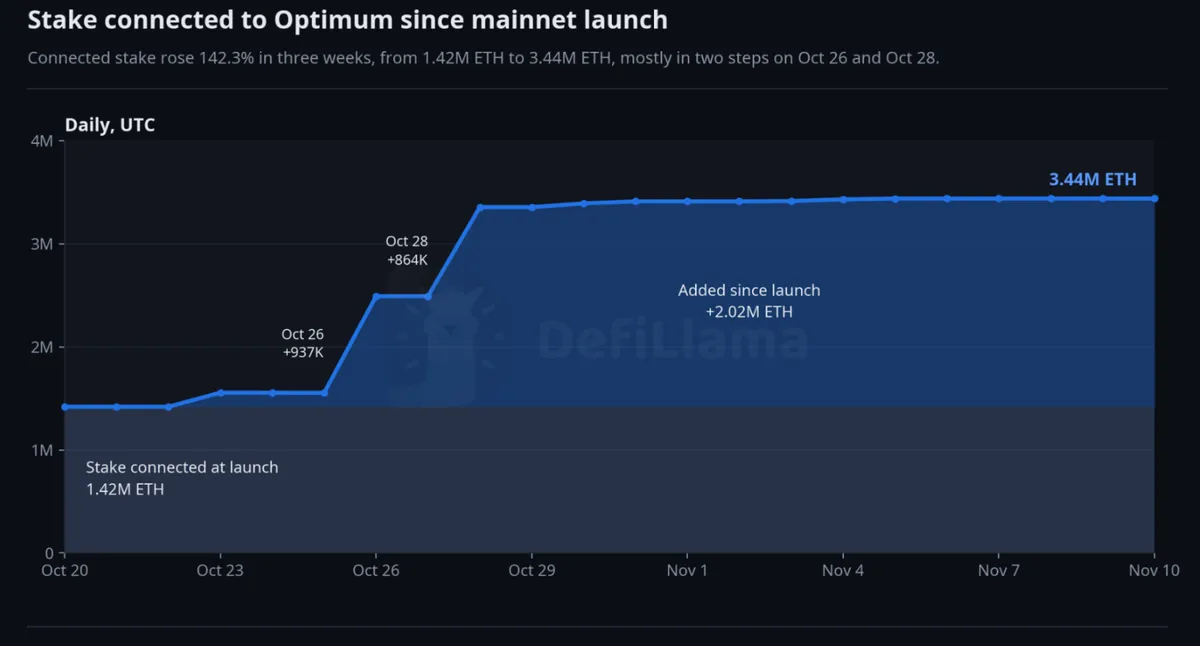
As shown above, growth has come in large increments rather than gradually. Two increases on October 26 and 28 accounted for approximately 89% of the additional ETH connected since launch.
Institutional participation was already established at launch, with 16 operators representing approximately 22,000 validator keys. At the time, Optimum announced that ether.fi required all 12 of its node operators to run mump2p, moving from an optional integration to a fleet-wide mandate. According to Optimum, ether.fi validators account for approximately 1.4 million ETH, representing roughly 41% of the network's reported connected stake. Other participating providers include Blockdaemon, Everstake, and P2P.org.
Network and validator performance
Beyond the growth in connected stake, Optimum has published several studies examining how mump2p performs against Ethereum's existing networking infrastructure. Its public network data, which uses a rolling seven-day window, covered 50,273 slots between November 4 and 11, with observations from 372 Optimum gateways and 194 public Xatu sentries monitoring Ethereum's existing gossip network. During this period, Optimum reported accelerating block delivery in 91.6% of observed slots.
Consistency matters alongside speed, since differences in when nodes receive the same block can leave some validators operating with older information. Optimum reported a propagation spread of 181.8 milliseconds for mump2p, compared with 388.8 milliseconds for libp2p. The latter was approximately 2.14 times as wide, indicating more consistent block delivery across the measured network.
Earlier operator studies provide a closer look at how these improvements affect validator performance. According to Optimum's Impact Report, which compared validator performance during June 16–23 and September 2–9, 2026, wrong head votes declined from 0.127% to 0.0841% across a cohort representing approximately 1.11 million ETH. A wrong head vote can occur when a validator attests to an earlier block because the latest proposed block has not arrived in time. The report found an average reduction of 34.3% across participating operators, with individual reductions ranging from 20.3% to 46%. The average reflects per-operator improvements rather than the reduction calculated from pooled rates.
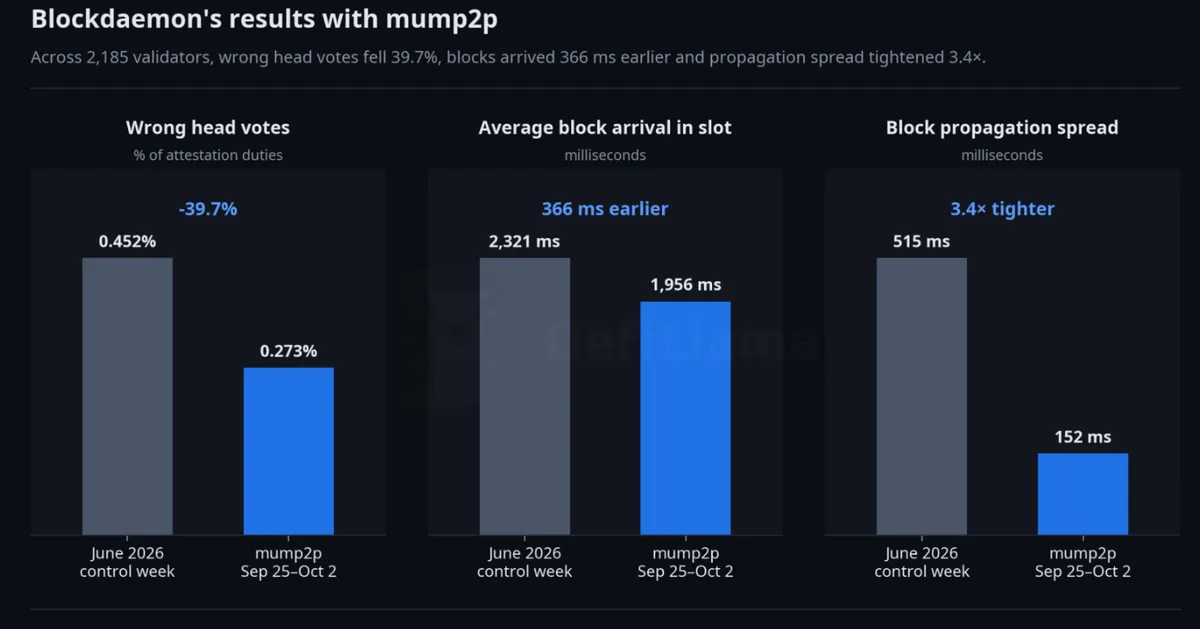
A separate Blockdaemon case study examined 2,185 validators representing approximately 69,900 ETH. Wrong head votes fell from 0.452% during a June control week to 0.273% during September 25–October 2, a reported 39.7% reduction. In separate propagation measurements comparing Blockdaemon's gateways with public Xatu sentries, blocks arrived 366 milliseconds earlier on average, while propagation spread narrowed from 515 milliseconds to 152 milliseconds.
Optimum also conducted six mainnet experiments examining whether faster propagation could allow proposers to extend their bidding windows. By moving the MEV-Boost bid cutoff 20–160 milliseconds later, the study found that blocks could be published approximately 160 milliseconds later without an increase in orphaned or locally built blocks. Winning bids arrived around 120 milliseconds later, giving proposers more time to capture competitive offers. Based on these results, Optimum modeled an 8.4% uplift in builder bids relative to the initial bid, providing an early estimate of the potential revenue benefits.
Beyond Ethereum staking
As Ethereum continues to scale, faster block propagation could become increasingly important. Shorter slot times would give validators less time to receive and process blocks, while larger blobs and a growing validator set would place additional demands on the network. Improvements in propagation could help Ethereum accommodate these changes while reducing some of the advantages enjoyed by better-connected operators.
Optimum is also looking beyond Ethereum staking. The company is working with design partners to bring Accelerate to professional trading organizations, including market makers and high-frequency trading firms, where faster access to block information and more timely transaction delivery could offer competitive advantages. Plans to expand to other blockchains could further extend the technology's reach. With millions of ETH already connected and established staking providers adopting mump2p, Optimum has begun building a foundation for broader use of its networking infrastructure.