Katana brings its revenue home
Katana now owns the venues that generate its fees and routes a share of them into KAT buybacks for stakers. The program is small at today's activity, and it differs from buybacks popularized across DeFi in where the money comes from and where the purchased tokens end up.
Katana
KAT
AVKAT
Katana now owns the venues that generate its fees and routes a share of them into KAT buybacks for stakers. The program is small at today's activity, and it differs from buybacks popularized across DeFi in where the money comes from and where the purchased tokens end up.

For most of Katana’s first year, the chain’s revenue and its token ran on separate tracks. Incubated by Polygon Labs and GSR on Polygon’s Agglayer, Katana was designed so that bridged capital earned yield from the moment it arrived, and that yield went to the Foundation. KAT holders locked their tokens into vKAT, a vote-escrowed position that let them direct emissions and earn fees from the pools they backed, with no claim on the chain’s own income.
On Nov 11, 2026, the Katana Foundation brought its Sushi deployment and Vault Bridge in-house, adding them to the IDEX perps business it bought in March, and retired vKAT voting. Staking now runs through a single token, avKAT, which receives open-market KAT purchases funded by a share of the chain's four revenue streams. DeFi has spent the past two years moving toward tokens paid from activity, and Katana is applying the idea to a whole chain rather than a single app.
Against other buybacks, the design stands out in where the purchased tokens go, which is into the staking pool rather than a burn, and in its funding, which draws on several owned products with a split weighted toward swap and sequencer fees over perps, the largest stream. At last week's activity, the program would buy roughly $700K of KAT a year, about 7% of market cap, and the interactive model below lets readers test other levels. What the overhaul changes more durably is the route by which any future growth on the chain reaches KAT holders.
KAT's first design: voting on emissions

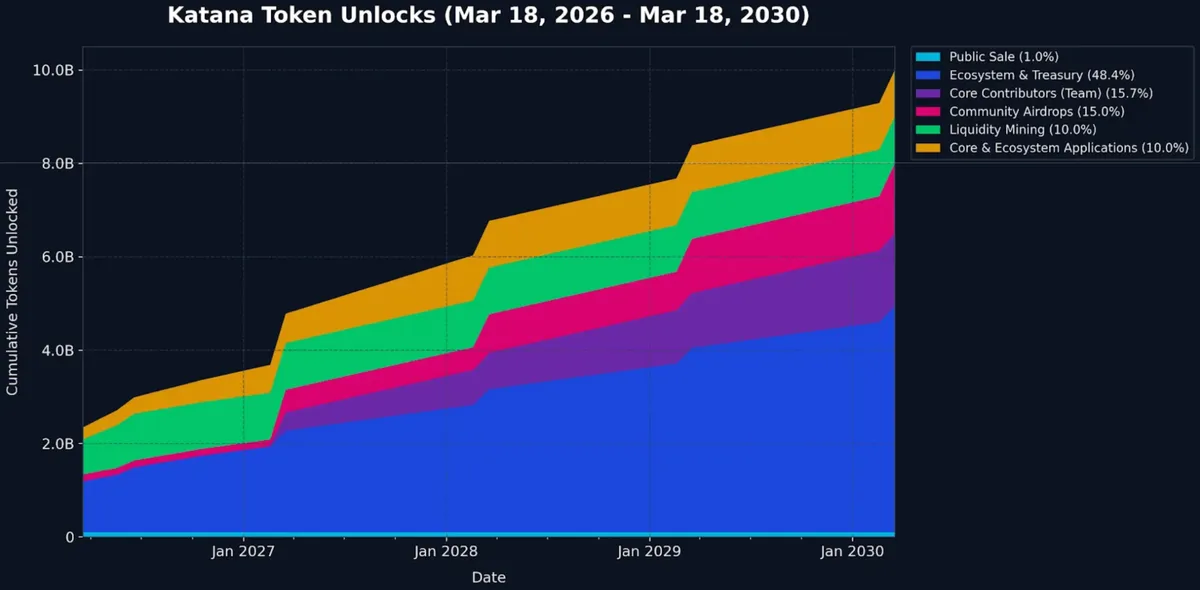
KAT has a fixed supply of 10 billion tokens, all minted in 2025. According to Katana documentation, no tokens went to venture investors, and the user allocations unlocked first. Roughly 48% sits in an ecosystem and community treasury, about 16% with core contributors, 15% in an airdrop to POL stakers (delivered as vKAT), and 10% each to app liquidity mining and to early depositors, with 1% sold publicly.
Our vKAT: Taking veTokenomics Chain-Wide (October 2025) covered how that design extended the ve model from one app to a whole network:
Holders locked KAT into vKAT at 1:1,
received full voting power immediately,
and directed emissions to pools across the chain, starting with Sushi.
avKAT was a liquid wrapper that voted automatically and compounded, and exits took 45 days with a fee that declined from 25% to 2.5%.
The revenue that now funds buybacks sat outside that system, because Vault Bridge yield, sequencer fees, and treasury yield from the AUSD stablecoin all stayed with the Foundation. Vault Bridge is how Katana put bridged capital to work: assets bridged to the chain are deposited in Morpho vaults on Ethereum, and the yield returns to Katana. The Foundation used these streams to build chain-owned liquidity and fund incentives, and as our Katana's VaultBridge: A Self-Funding Rewards Engine (December 2025) noted, vKAT holders had no direct claim on them. The stated plan was for buybacks from chain revenue to fund emissions over time.
The November overhaul keeps the buyback idea but changes its job: instead of funding pool emissions, purchases now compound into avKAT, giving stakers a direct claim on chain revenue.
What changed on November 11
The Foundation's announcement and tokenomics post describe two moves that work together, and the first is vertical integration. Katana acquired its Sushi deployment, which relaunched on Nov 11 as Katana Swap with the same contracts but with swap fees kept inside the ecosystem. The protocol also took ownership of Vault Bridge. Those join Katana Perps, which runs on the engine and team Katana acquired with IDEX in March 2026.
The chain now owns four revenue streams directly:
Swap fees
Perps fees
VaultBridge yield
Sequencer fees
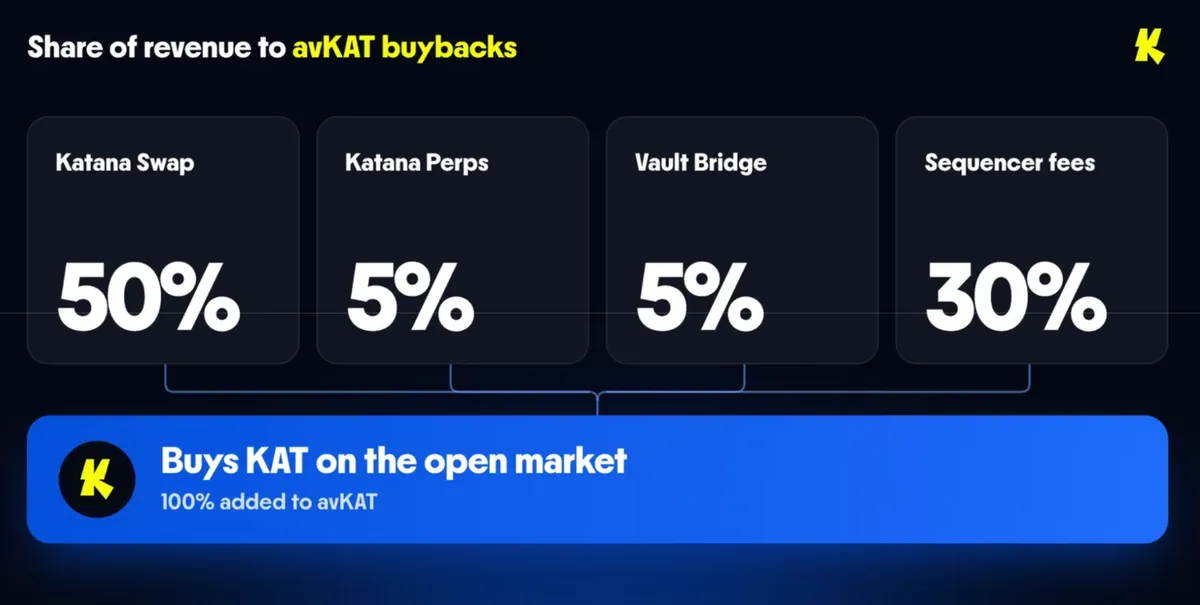
The second move concerns the token, where vKAT and voting are being retired and avKAT becomes the sole staking route. A share of the four streams funds open-market KAT purchases, and 100% of the purchased KAT goes to avKAT, where it compounds every epoch. The Foundation puts the shares at 50% of swap fees, 5% of perps fees, 5% of Vault Bridge revenue, and 30% of sequencer fees.
Starting today, fees begin flowing to avKAT, and unstaking falls from 45 days to seven with an early-exit fee that starts at 25% and declines to zero. Programmatic buybacks are planned at a later date, after further security and engineering work. KAT itself is unchanged, and holders can convert vKAT at any time (note: vKAT stops earning once it is sunset).
Three tokens and a vote every round collapse into KAT and a single staking claim, a real simplification for holders. Without a voting layer, revenue can be routed from any product, and the Foundation says new sources, Katana-native or third-party, can be added as builders arrive.
Sizing the buyback
DefiLlama tracks the fee streams that feed the program, which allows for rough sizing. Over the last seven days, the four streams generated about $123K in fees:
$80.5K from perps;
$27.3K from sequencer fees;
$13.9K from VaultBridge;
And $1.4K from Sushi-based swap pools.
Applying the Foundation's shares gives a weekly buyback of roughly $13.6K, or about $700K a year if that week held. That is 7.3% of KAT's $9.7M market cap, and 2.4% of its fully diluted value of about $29.0M.
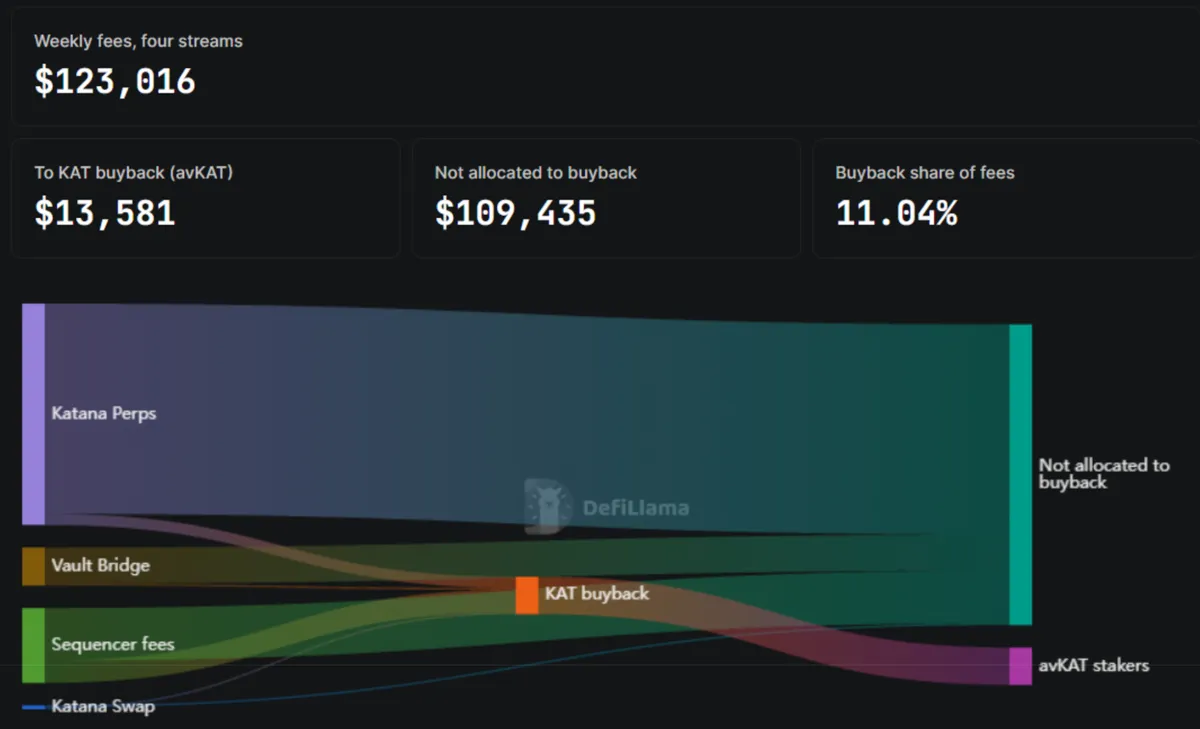
The split changes which business pays for the buyback. Perps produced 65% of tracked fees but would fund about 30% of the buyback, while sequencer fees (22% of fees) would fund about 60%. Recently, sequencer fees jumped from a few hundred dollars a day at most to several thousand starting Oct 30.
INTERACTIVE CHART — Model your own $KAT buyback scenario
How could KAT buybacks play out? Run the numbers yourself.
For the first time in a DefiLlama Research article, we’ve embedded a live model, built with LlamaAI’s generative UI. It starts from last week’s fees (Nov 9 to 15) and the Foundation’s 50/5/5/30 split, and lets you move each stream, the share of fees the program counts, and the perps share.
The line replays every week since April 2025 under your settings, showing how often Katana has reached that buyback level. Sliders stop at each stream’s highest week so far, and a flag appears when a combination has never occurred. Buybacks have only just begun, so every figure is implied by the stated shares.
How Katana's buyback compares
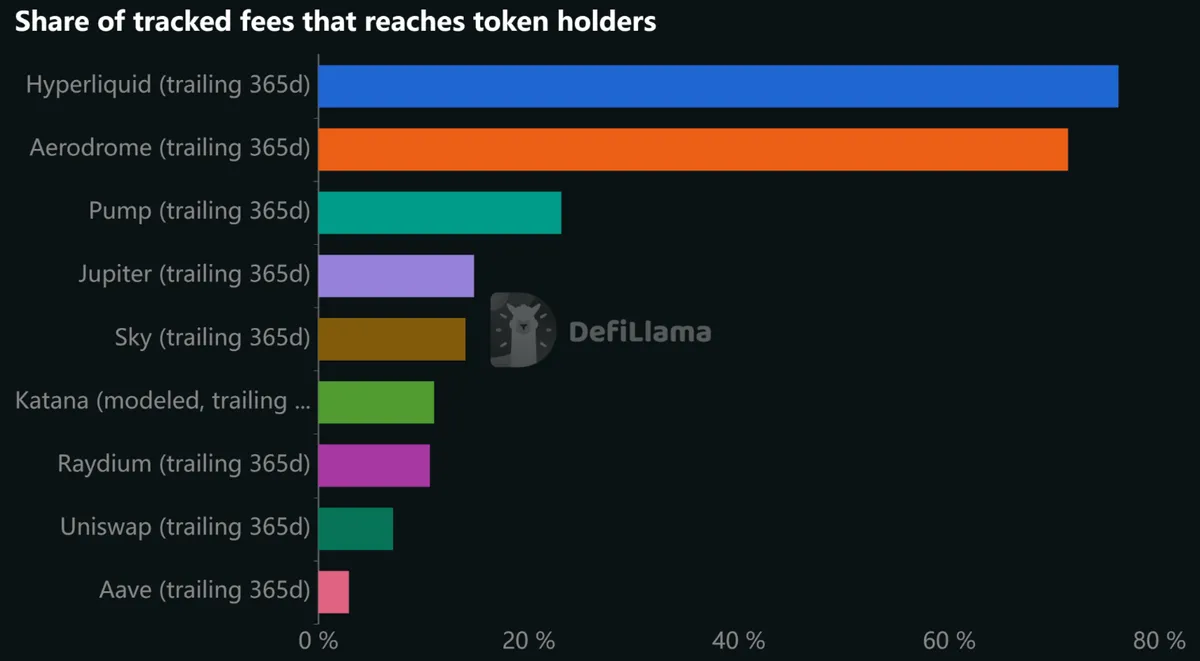
Buybacks have become one of DeFi's main ways of tying a token to a business. The comparison below uses DefiLlama's token-rights records and holder-revenue data, where holder revenue means the portion of revenue that reaches token holders through buybacks, burns, or direct distribution:
On a trailing-year basis, Aerodrome returned about 28% of market cap to holders and Pump about 22.5%. A group of established protocols sits between 4% and 5%: Raydium (4.7%), Jupiter (4.6%), Sky (4.6%), and Hyperliquid (4.4%). Uniswap returned about 2.1% and Aave about 1.1%.
Katana's bar is a modeled run-rate rather than a year of results, and with that caveat it ranks third, behind Aerodrome and Pump. The bar uses last week's fee level. At the median of the past 13 weeks it would be about 2.5% of market cap, just above Uniswap, so the ranking depends on where fees sit within their recent range. The ratio owes as much to KAT's $9.7M market cap, the smallest in the comparison by a wide margin, as to the size of the buyback.
The clearest design difference lies in where the purchased tokens end up:
Burned:
Hyperliquid (HYPE in its Assistance Fund is treated as burned), Sky, Pump (about 36% of circulating supply as of April 2026), and
Uniswap, where anyone can burn 4,000 UNI at the FirePit contract to claim accumulated fees.
Locked:
Jupiter holds the JUP it buys in a trust for three years.
Staked: Katana adds purchased KAT to avKAT, leaving supply unchanged.
Katana's route works like revenue sharing, rewarding stakers directly while leaving the supply schedule intact, though that is an inference and not a Foundation claim. Aerodrome is the closest relative: 100% of its exchange revenue goes to sAERO stakers, which is why DefiLlama attributes about 71% of its fees to holders. Its Foundation-managed Momentum Fund also buys AERO, mostly to burn, so the two designs overlap on paying stakers and diverge on burning.
Control over the program varies too:
Set by contract: Uniswap's permissionless burn and Hyperliquid's protocol-defined routing.
Raydium buys automatically once fees reach $10, though a multisig controls its fee addresses.
Set by governance or a team:
Aave paused its $50M-a-year buyback in April 2026, five months after approving it as permanent. Sky voted in March 2026 to temporarily cut buybacks by 87% to build reserves. The Aero Foundation times Aerodrome's Momentum Fund buybacks.
Katana sits in the second group for now, since the Foundation can modify or end the program at its discretion. Automated onchain execution would move it toward the first.
Katana's funding base is broad, though Pump (bonding curve, PumpSwap, and Terminal) and Uniswap (which also receives Unichain sequencer fees) draw on more than one product too. At current fee levels the breadth is mostly prospective, with sequencer fees funding about 60% of the buyback.
What to watch
Automation. The move from scheduled to automated buybacks will make the mechanism verifiable onchain, and it is the step that would narrow the Foundation's discretion over timing.
Sequencer fees. They fund about 60% of the buyback at current levels, so whether the early-November jump persists matters more to the program's size than any other line.
Swap volume. Swap fees carry the highest share at 50%, so each dollar of Katana Swap fees adds more to the buyback than a dollar from any other stream. At about $1.4K a week, swap fees would need to grow about twelvefold to match what sequencer fees contribute today.
Perps. Perps is the largest stream and the one the Foundation is building out, with new markets and biweekly trading competitions, but it carries only a 5% share. Each additional point of share would add about $800 a week to the buyback at current volume, which makes the split itself the largest lever on the program's size.
Unlocks. Contributor and treasury allocations unlock in four annual parts from the March 2026 transfer date, with the first in March 2027. At today's price, the first contributor tranche alone, about 400M KAT, is worth roughly $1.2M, against about $700K a year of buybacks.
The overhaul is the clearest expression yet of the thesis we have followed since October 2025, that a chain can earn its own revenue and tie its token to it instead of leaning on emissions. The buyback starts small and leans on a fee stream that is only weeks old, and its structure, with several owned products feeding one buyer and the bought tokens staying with stakers, has few close parallels among its peers. How large it becomes now depends on activity in the products Katana owns.