Kalshi’s “Fake Volume” hides a real fee engine
When a contract settles, Kalshi counts $1 of notional volume per contract, regardless of the price actually paid by the taker. This means that whether a contract changes hands at $0.25 or $0.75, it still contributes $1 to reported notional volume.
With monthly notional volume jumping from $6.57B in December 2025 to $40.0B in August 2026, more than 6x in nine months, Kalshi’s growth looks spectacular. But this figure hides another reality.
A reality very similar to TVL, which was once DeFi’s default activity metric before the market realized it didn’t always reflect actual usage or revenue. For Kalshi, it all comes down to the word notional.
When a contract settles, Kalshi counts $1 of notional volume per contract, regardless of the price actually paid by the taker. This means that whether a contract changes hands at $0.25 or $0.75, it still contributes $1 to reported notional volume.
Actually, notional reported volume combines two things: the trader’s cash and the collateral posted by the counterparty, which most of the time comes from a market maker rather than another trader. Said differently, notional includes the liquidity supporting the trade, not just the capital actually deployed by traders.
And by looking at trader activity, the picture is clear: in November 2025, every $100 of Kalshi notional carried $47 of trader cash (a standard figure we would expect). By September 2026, it carried just $23.
The ratio has declined throughout the year, and nothing in the data or recent developments suggests it has reached a floor. Is that a problem? Not necessarily. However, relying on notional alone can overstate underlying activity and give investors and users the wrong picture on who is actually leading prediction markets.
Same dollar, six times less cash behind it
The explanation for that decline comes down to product mix. Combos, the multi-leg contracts Kalshi launched in late 2025, grew from just 1.7% of monthly notional in November to 46.5% in August 2026. The trend has only accelerated since, with combos reaching 60% of notional by mid-September, meaning they now account for more volume than single-leg contracts.
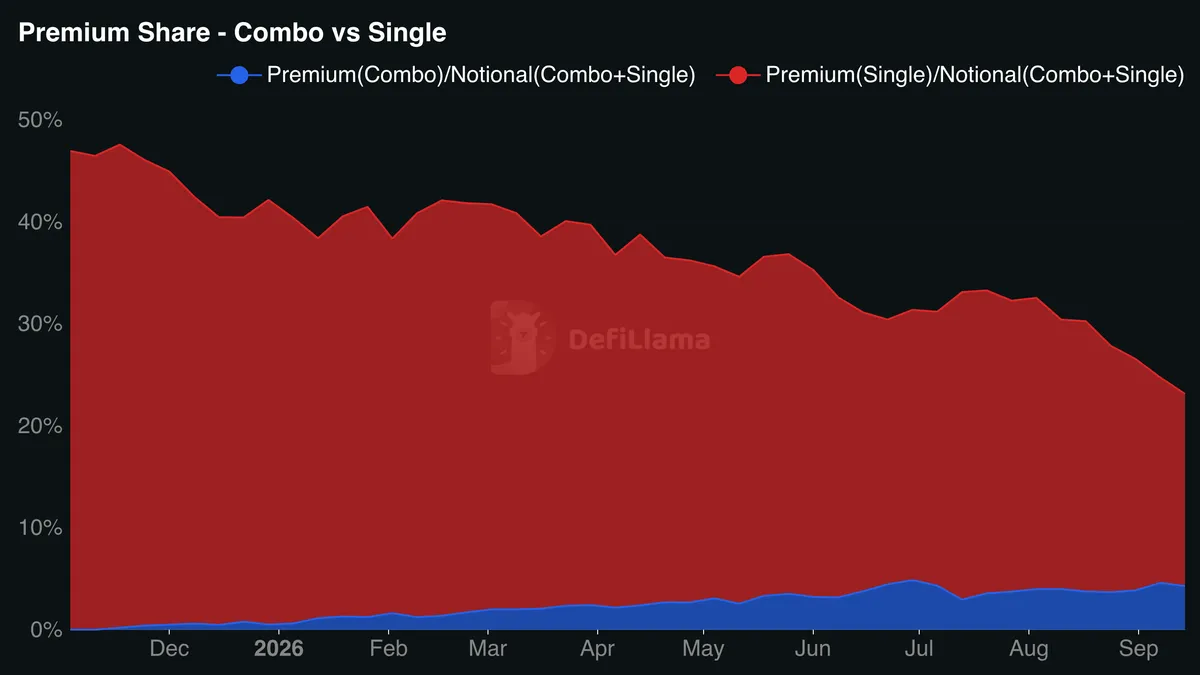
However, the two products don't turn cash into notional at the same rate. Indeed, on a single-event contract, trades happen somewhere in the middle of the price range, so the taker pays close to 50 cents for every $1 that gets reported. On the other hand, a combo multiplies several probabilities together, which pushes its price toward zero, since the odds of all the events landing together get smaller with every leg added. Hence, instead of being close to 50 cents for $1, the taker's part drops significantly, reaching 8.3 cents in August. This part, the actual cash brought in by the trader, is called the premium.
TABLE - PREMIUM/NOTIONAL for single and combo
Taking the premium of each product against total notional shows clearly what is happening. The notional represents less and less the money actually traded. The rise of combos into Kalshi's dominant product pushed the ratio down to the point where for every $100 of notional declared, only $23 comes from a trader as of today, against $47 right before combos launched.
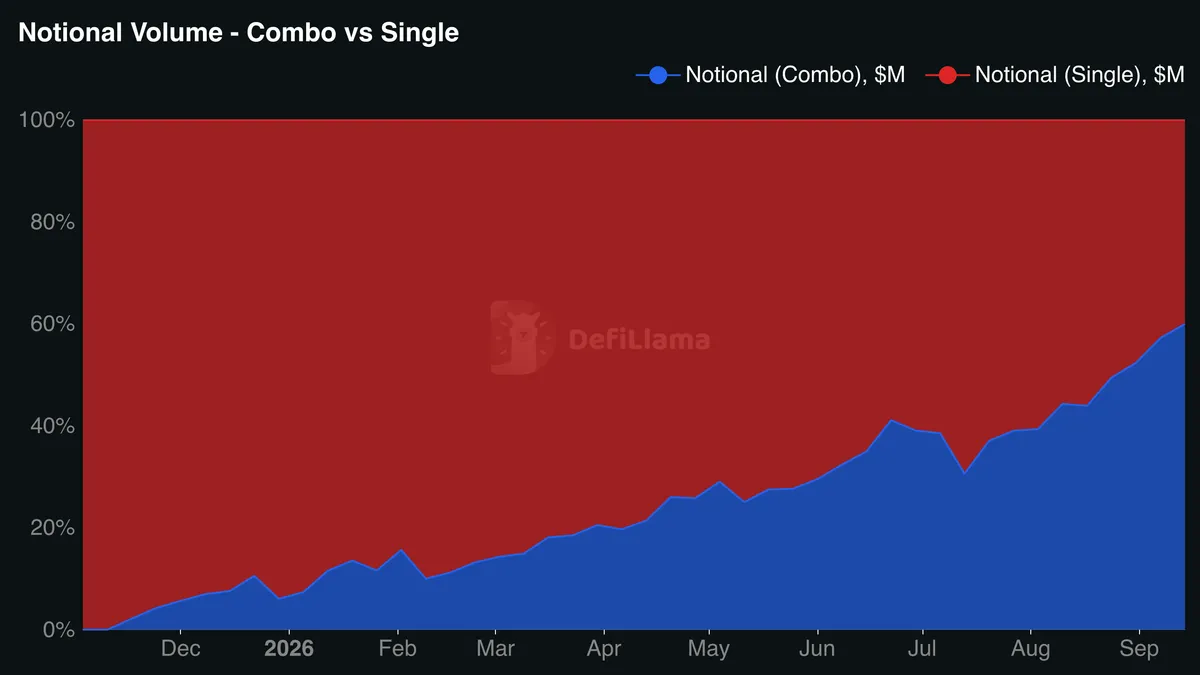
Hence Kalshi's notional volume no longer reflects real trading activity the way it did in 2025, and combos inflate the figure enough to make cross-venue comparisons on notional misleading.
Combos don't pay… yet
Using the fee rate, anyone can estimate the fees generated by the taker’s activity. The conclusion everyone reaches is that while the mix is close to 50/50 on notional, the imbalance on fees generated is clear: in August, around 83% came from single markets against only 17% from combos.
(note: fee rates vary with some exceptions here and there, and for simplicity we applied the standard taker rate across the board)
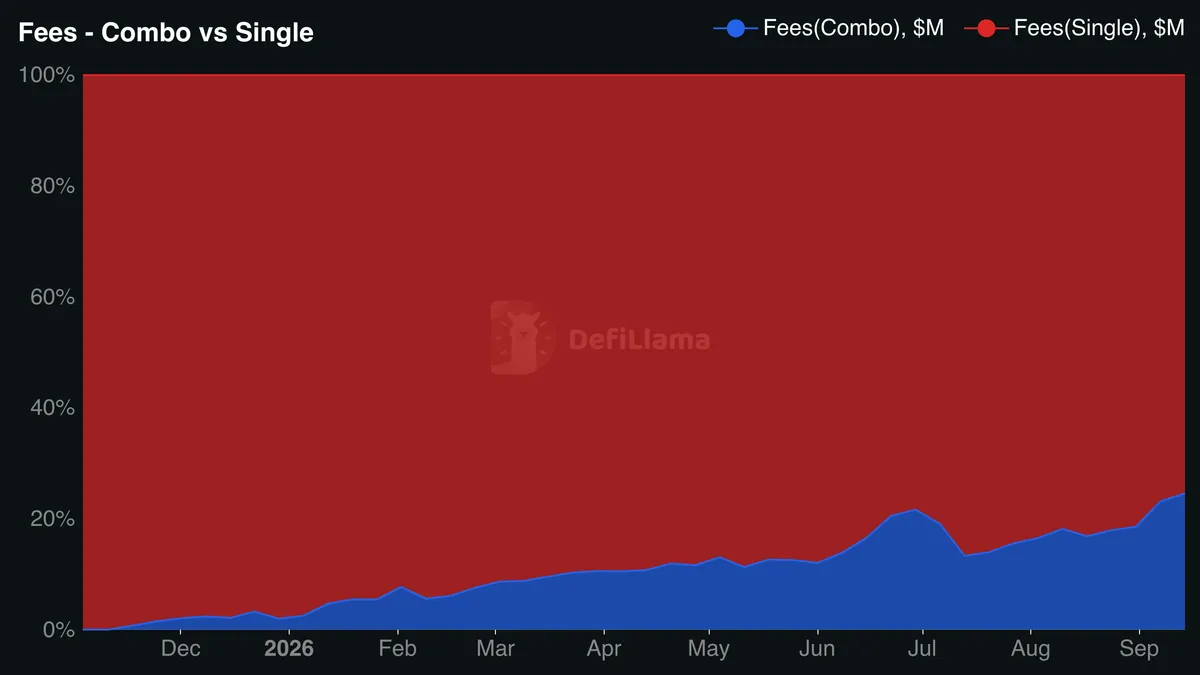
Any analyst would quickly get to the usual conclusion that combos print volume and don't pay for themselves. But that overlooks three things a closer reading would catch.
First, the capital behind combos is more productive. Measured against premium rather than notional, combos have carried the higher take rate in every month since launch, though the gap has narrowed from 1.9 times in February to 1.4 times in August.
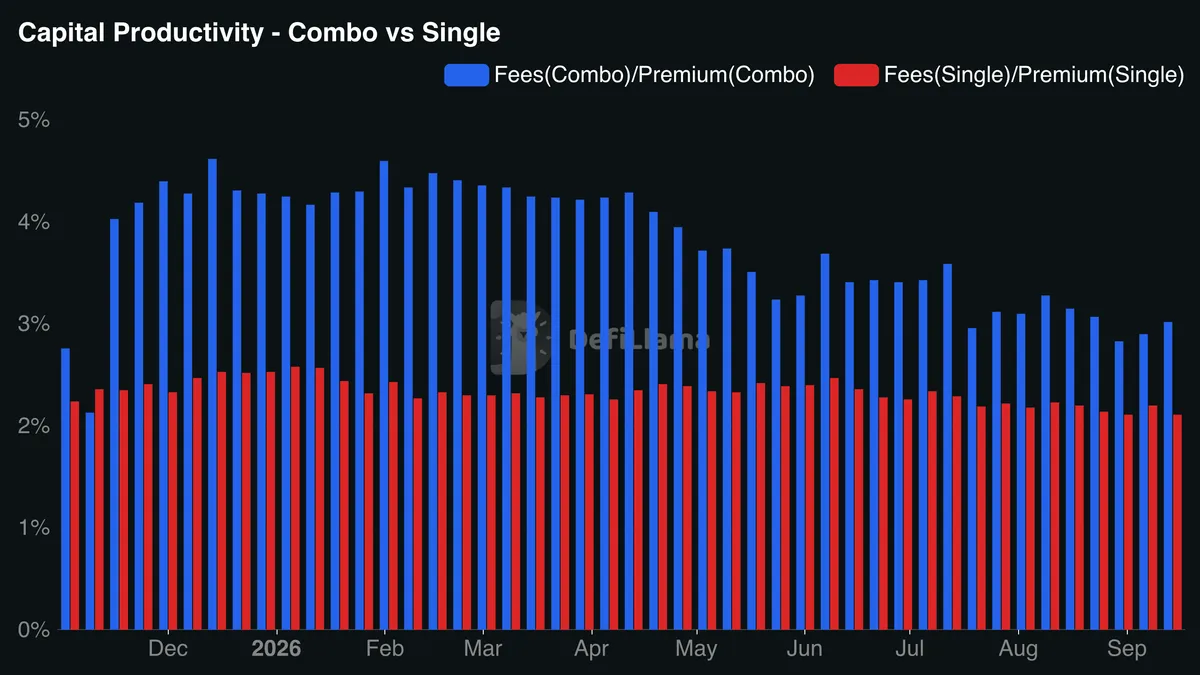
Second, Kalshi opened a new monetization stream on August 20 by introducing maker fees on combos at half the taker rate, while makers remain fee-free across most of the exchange. Including those maker fees (not captured in the chart above) raises combos’ share of total fees from around 17% to 24.3% in late August and nearly 32% in September.
Third, combos likely generate flow elsewhere. A market maker holding combo exposure would hedge by trading the individual legs, which are single markets, deepening the liquidity available there and indirectly supporting volume on the other products. This can't be measured from public data, since the hedge may be executed on Kalshi, on another venue, or netted internally against the rest of the book.
Notional is the new TVL, and Kalshi is fine with that
Notional counts contracts and collateral, which makes it the right metric for settlement exposure and the wrong one for measuring actual economic activity. DeFi went through the same phase when TVL was treated as the default measure of activity.
Combos dilute the headline dollar and generate only a fraction of the fees their volume implies. Most analysis stops there, but that misses what Kalshi is actually building.
The strategy is straightforward: build the product that acquires users fastest, accept thin taker fees while it scales, and let the hedging activity it creates deepen liquidity. Then reinforce the economics, which we are starting to see with maker fees on combos (August 20), followed by sub-cent ticks on combos (September 3).
Those two changes push the metrics in opposite directions: volume becomes cheaper to print while combos become more expensive to trade.
Press and analysts may criticise the headline notional volume as “fake,” but Kalshi has little reason to care. What matters more to the business is how effectively it can monetise combos through fees, and Kalshi is currently executing a strategy in that direction.