Proof of Reserves isn’t enough: Gate’s new standard for exchange security
Proof of reserves shows an exchange holds enough to cover its users. Gate's new Proof of Security standard shows how much of that sits within an attacker's reach, and whether the exchange's own money could absorb the loss.
Gate
Proof of reserves shows an exchange holds enough to cover its users. Gate's new Proof of Security standard shows how much of that sits within an attacker's reach, and whether the exchange's own money could absorb the loss.
The two largest exchange hacks of 2026 drained hot wallets at exchanges that had already published proof they held enough to cover customer balances. Both exchanges had the reserves. It’s just that some of them were sitting in wallets connected to the systems the attackers reached.

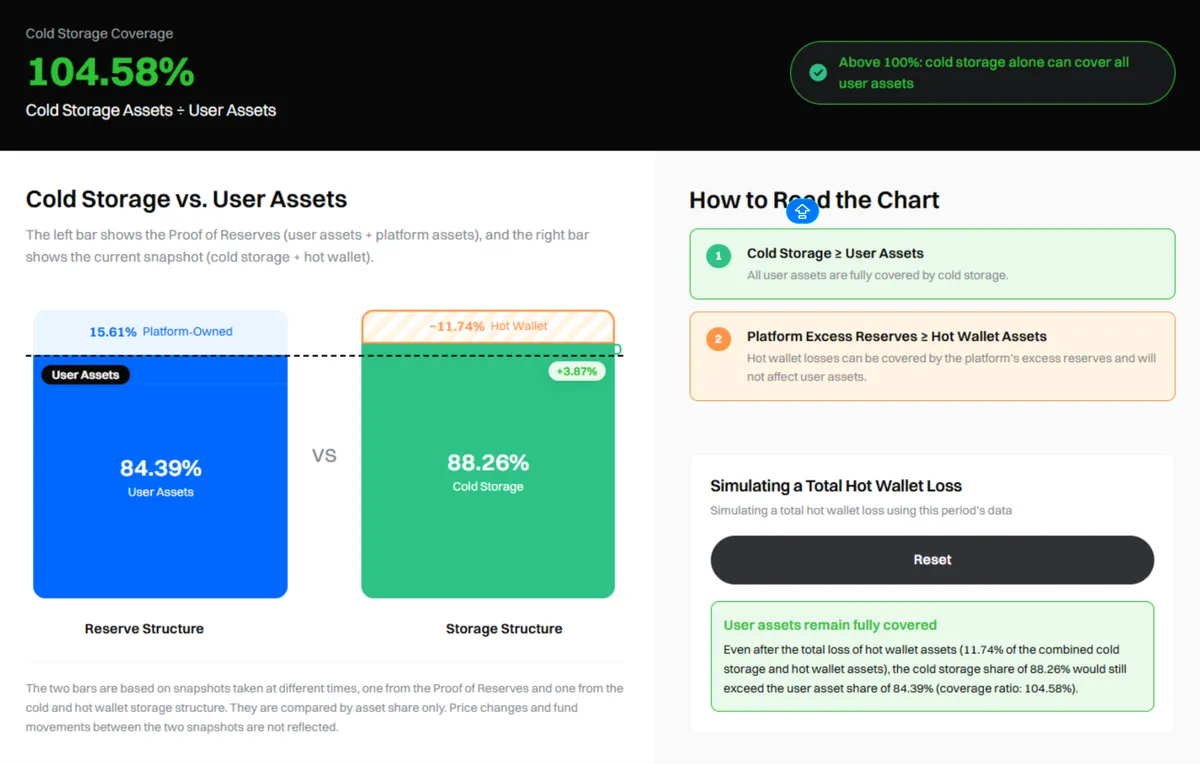
On November 5, Gate became the first exchange to launch a Proof of Security (PoSEC) framework. Its core metric is cold storage coverage: the assets Gate holds offline or with independent custodians, divided by what users own on the platform. As of the November 4 snapshot, Gate's coverage stands at 104.58%, meaning cold storage alone would cover every user balance if every hot wallet were emptied.
As one of the first crypto exchanges to pioneer 100% on-chain proof of reserves in 2020, Gate now argues that proof of reserves alone is no longer enough, and it is publishing the PoSEC methodology so the rest of the industry can track the same figure.
Key takeaways
Cold storage covers 104.58% of user assets: Gate holds 88.26% of its assets in cold storage and 11.74% in hot wallets.
Gate's own funds provide an additional buffer against hot wallet losses: Platform-owned assets make up 15.61% of total assets, adding another layer of protection beyond user reserves.
PoSEC builds on top of Proof of Reserves (PoR): Gate shows $8.69 billion in reserves and a 118.49% reserve ratio. An independent third-party audit of the PoSEC data and code is under way, with the report to be published on the PoSEC page.
Gate holds licenses and registrations across Europe, the Middle East, Asia-Pacific, the Caribbean, and the US, including a MiCA license in Malta passported across the EEA and a VASP license from VARA in Dubai.
Alongside PoSEC, Gate provides additional security products, which include Gate Vault offering an optional MPC wallet with a 48-hour transfer freeze window, and Gate Security Guard compensating eligible unauthorized-access losses of up to $200,000.
What proof of reserves measures

Gate was one of the first pioneers of 100% onchain proof of reserves in 2020, when Armanino published a Merkle tree report on Gate’s BTC holdings, and it has published 100% proof of reserves since. The method now pairs two tools: a Merkle tree lets any user confirm their balance is included in the total, and a zk-SNARK proves that no user’s net balance is negative and that every account is counted, without revealing individual accounts. Gate also attests ownership of its cold and hot wallets, and the verification code is open source on GitHub, with tools for Mac, Linux, and Windows. Hacken has carried out a security review of the system.
Each report measures one thing: whether the exchange holds at least as much as it owes its users. The latest October 18 snapshot shows $8.69 billion in reserves against $7.33 billion in customer balances, an overall reserve ratio of 118.49% across about 500 assets, with BTC covered at 121.60% and ETH at 123.78%.
Where the assets are kept isn’t part of that answer, because Gate’s method proves ownership of a coin in a hot wallet the same way it proves ownership of one in an offline vault. An exchange with every coin in one hot wallet and an exchange with every coin in offline multisig vaults can publish the same reserve ratio, and this year’s hacks showed which of those details decides how much an attacker can take.
How Proof of Security works
PoSEC divides cold storage assets by user assets. A ratio of 100% or more means cold storage alone can cover every user balance, even if everything in hot wallets were lost. Gate founder and CEO Dr. Han described it as "simple arithmetic anyone can check."
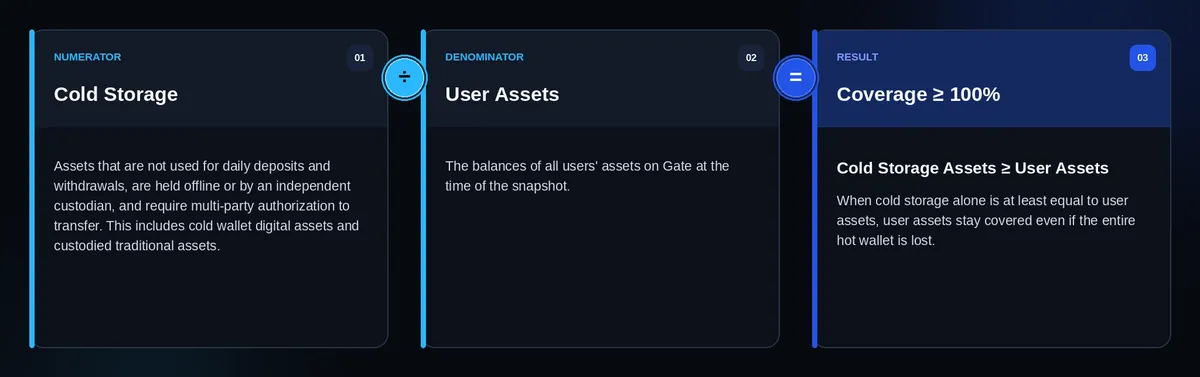
Since every asset sits in either cold or hot storage, an exchange clears 100% only if it owns at least as much as it keeps in hot wallets. One that holds exactly what its users are owed fails the moment it moves a single coin online to process withdrawals. On this basis, Gate’s 104.58% coverage puts it 4.58 percentage points above the 100% threshold, meaning its cold storage alone exceeds total user assets.
An asset counts as cold storage only if it meets four conditions:
Not used for day-to-day deposits and withdrawals.
Held offline or with an independent custodian: Onchain assets have their private keys kept offline. Offchain traditional assets, such as equities and US Treasuries, are held by independent custodians, so the cold balance can exceed what is visible onchain.
Transfers require multi-party authorization and cannot be completed by any single person, with every onchain transfer independently checked before multisig signing.
Ownership, balance, and valuation can all be verified.
Regulators have moved in this same direction. Japan, for instance, requires licensed exchanges to hold their own assets against any customer crypto kept in hot wallets, the same test PoSEC applies at Gate. Several jurisdictions, including Hong Kong, Singapore, and Dubai, also ask exchanges to report their cold storage share.
The protections around it
PoSEC sits on top of Gate's existing wallet design. The vast majority of assets are held in multisig cold wallets, managed offline and physically isolated. Hot wallets use multisig and MPC with distributed key management, hold only what daily operations require, and automatically sweep any balance above set thresholds into cold storage.
Two user-facing products extend that protection to individual accounts:
Gate Vault uses MPC with a 2-of-3 signing scheme. The user's device, Gate, and an independent third party each hold a key share, and any two must sign. Every outgoing transfer waits 48 hours, during which the user can freeze it.
Gate Security Guard compensates eligible direct losses, up to $200,000 when assets leave a user's account without authorization, for example through phishing, malware, or a fraudulently reissued SIM card. Users qualify once their security score, determined by security measures taken by the user, reaches 80 and stays there for 30 days.
Gate describes PoSEC and proof of reserves as complementary. As of publishing, an independent third-party audit is reviewing the PoSEC data and code, covering asset authenticity and control, valuation methods, and the coverage calculation. Gate says it will publish the report on its PoSEC page once the audit is complete.
Gate's regulatory licenses
FTX's collapse in 2022 changed what it took for a crypto exchange to be trusted with other people's money. Before it, a large exchange could serve users worldwide from an offshore base and let its size speak for it. Afterward, regulators began following users home, writing rules for the markets where those users lived and expecting exchanges to set up local entities to meet them.
Europe built the most ambitious version, MiCA, a single rulebook for the whole EU that by this summer had made a license the condition for serving European customers at all. The US took another path, applying the money transmission laws it already had one state at a time and backing them with real penalties: two of the largest offshore exchanges pleaded guilty in early 2025 to operating without those licenses, paying about $800 million between them.
Across these markets, an exchange's credibility has come to rest on a map of local entities, each answering to its own regulator, and the last-minute rush for MiCA licenses showed how quickly that map became the price of market access.
Gate built its map ahead of those deadlines, with its Malta entity holding a MiCA license well before the EU's cutoff and passporting it across the EEA, alongside a payment license that supports Gate Money. Dubai's VARA licenses its exchange services there; Gate US now holds money transmitter licenses in 37 states and serves customers across 47 U.S. states and territories; and registrations in Australia, Japan, and the Bahamas extend the footprint further.
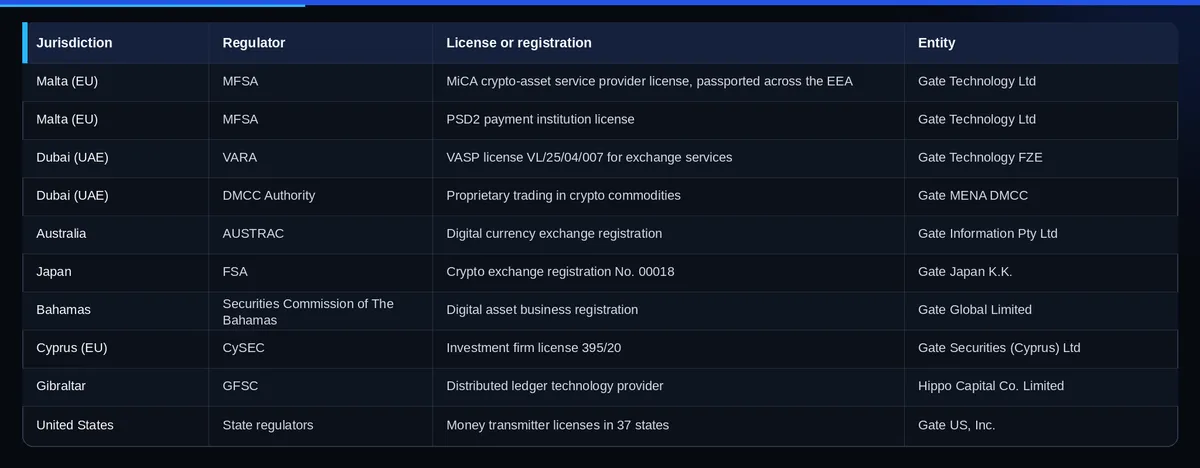
Each license carries its own custody and safeguarding rules, from MiCA's requirements to segregate client assets in the EU to VARA's rulebooks in Dubai. PoSEC adds a single measure across Gate's platform on top of those obligations, one that users can read without knowing which regulator oversees which entity.
A call for PoSEC standards
Crypto’s disclosure standards tend to spread the same way: after FTX, large exchanges published proof of reserves within weeks of one another, because staying silent had started to look like a forfeit answer. PoSEC could follow the same path. Once one major exchange shows how much of its users’ money sits offline, every exchange that doesn’t will face the question.
To pass the test, an exchange needs more money of its own than it keeps in hot wallets. That pushes exchanges toward bigger reserves and smaller hot wallets, the same cushion that let this year’s hacked exchanges repay users from their own funds. It is why a published ratio could become a must-have: it answers the question before users have to ask it.
Licenses have multiplied since FTX, but each covers a single entity under its own custody rules, and the regulators that set cold storage rules measure them differently. A single ratio, based on shared definitions, would let users and regulators compare exchanges across borders.
Gate has committed to developing the standard with other exchanges, and recent calls elsewhere in the industry for consistent reporting and independent security checks alongside proof of reserves suggest the appetite is there.
Proof of reserves answered whether the money was there, and this year’s hacks raised the next question: whether an exchange can lose some of it without its users feeling it. Gate is the first to publish an answer, and the industry’s next step depends on how many exchanges publish theirs.