Gate Money: From Crypto Exchange to All-in-One Financial Account
Gate Money is the centerpiece of Gate's "all-in-one platform" brand upgrade, under the theme "One Gate, Everything Money." This report covers what Gate Money offers, the scale of the exchange behind it, how the market reacted, and how it compares with similar moves by OKX and others.
Gate's biggest repositioning since its 2013 founding: what Gate Money offers, the exchange behind it, and how it compares with peers.
For most of crypto's history, an exchange had one job: match buyers and sellers. Gate is now betting that a trading venue is no longer enough. On October 7, founder and CEO Dr. Han took the main stage at TOKEN2049 Singapore to launch Gate Money, a single account for holding, moving and spending money across crypto, fiat and stocks.
Gate Money is the centerpiece of Gate's "all-in-one platform" brand upgrade, under the theme "One Gate, Everything Money." Traditional finance splits everyday money tasks across separate accounts, apps and systems. Gate Money brings them into one, built on a principle Dr. Han set out on stage: "Accounts should not be the boundary of funds."
This report covers what Gate Money offers, the scale of the exchange behind it, how the market reacted, and how it compares with similar moves by OKX and others.
Key takeaways
One account for everything. Gate Money combines crypto, fiat, stocks, a bank account in the user's own name and a payment card. It is live now for eligible users.
Built on a top-tier derivatives venue. Gate now ranks 3rd by derivatives volume, behind only Binance and OKX, at $12.77B a day. Its share of derivatives volume across five major exchanges rose from 9.3% to 11.2% month-on-month.
GT rallied before the launch. GT rose about 70% from its August low to around $11, and has held near that level since the keynote.
Gate leading the race. Others like OKX are building similar products. Gate leads with a live bank account.
Latest Proof of Reserves. Gate's latest Proof of Reserves report shows total reserves of $8.68B and an overall reserve ratio of 118%.

What Gate Money is
Gate Money is a single account that connects:
Digital assets and fiat currencies: Users hold multiple fiat currencies and digital assets in one account system, with a consolidated view of balances and fund movements. Fiat accounts can be managed separately by currency. Fiat and on-chain deposits, withdrawals and transfers are supported.
Stocks: Access to stocks and other traditional financial assets, now organized in a clearer account structure.
A bank account in the user's own name: Eligible users can upgrade to one, to receive funds and make withdrawals with their personal account details.
Payments: Gate Card works online and in stores with fiat currencies or digital assets and can be linked to Apple Pay and Google Pay. In certain countries and regions, users can also access ATM withdrawals and local QR-code payments.
Convert and Earn: Convert swaps between assets. Earn offers earning products, with eligible balances such as USDT earning up to 3.6% and no lock-up.
Why now: money has stopped fitting in boxes
Stablecoins, tokenized real-world assets and blockchain payment rails now give more kinds of assets digital liquidity and instant settlement. If a stock, a gold position and a stablecoin can all settle quickly, there is less reason to keep them in different apps.
Holding, growing and spending an asset used to be three separate steps. Gate Money is designed to make them one.
Gate Money is backed by licenses across several jurisdictions:
a MiCA crypto-asset service provider license and a PSD2 payment institution license in Malta
a full virtual asset service provider license from VARA in Dubai
a registration with AUSTRAC in Australia as a digital currency exchange
a money services business registration with FinCEN and 37 state-level money transmitter licenses in the US, held through Gate US and covering 47 US jurisdictions
local entities in markets such as Japan, covering 81 regulated jurisdictions in total
These are supported by partnerships with payment institutions, banks, custody providers and clearing institutions.
Gate serves more than 61 million users and offers 5,300+ digital assets and 12,800+ stock assets, plus metals, forex, indices and commodities.
The foundation: a derivatives-heavy exchange
Gate Money is built on an exchange that is already large. Of the 88 centralized exchanges tracked by DefiLlama, Gate sits in the top tier on derivatives and reserves.
Metric | Gate | Rank |
|---|---|---|
Derivatives volume, 24h | $12.77B | 3rd |
Spot volume, 24h | $1.60B | 2nd |
Reserves excluding its own token | $6.19B | 6th |
Total tracked reserves (including its own token) | $7.49B | n/a |
24h volume figures as of October 20, 2026. The spot rank excludes Bitrue, whose spot volume carries a data-quality warning.
By derivatives volume, Gate is now third, behind Binance and OKX. Binance leads by a wide margin, at $50.24B a day against OKX's $18.85B.
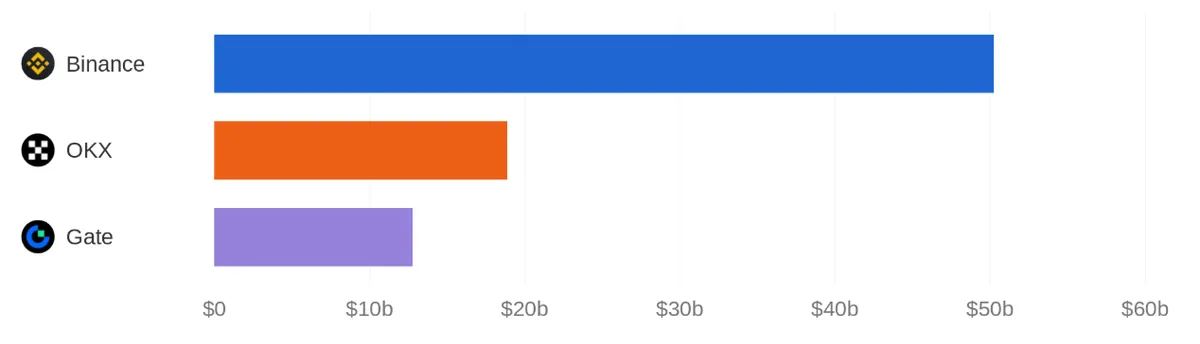
Gate's derivatives volume is about 8 times its spot volume ($12.77B against $1.60B). That is the same shape as most large exchanges, where perpetuals dominate. It also shows why Gate Money matters strategically. Trading volume is cyclical and cheap to switch away from. An account that holds incoming funds, stocks and a card is stickier.
How Gate's derivatives volume has moved
The chart shows the average daily derivatives volume by week for Gate against OKX, Bybit and Bitget since mid-June. Binance is left off because its volume is several times larger and would flatten the other lines.
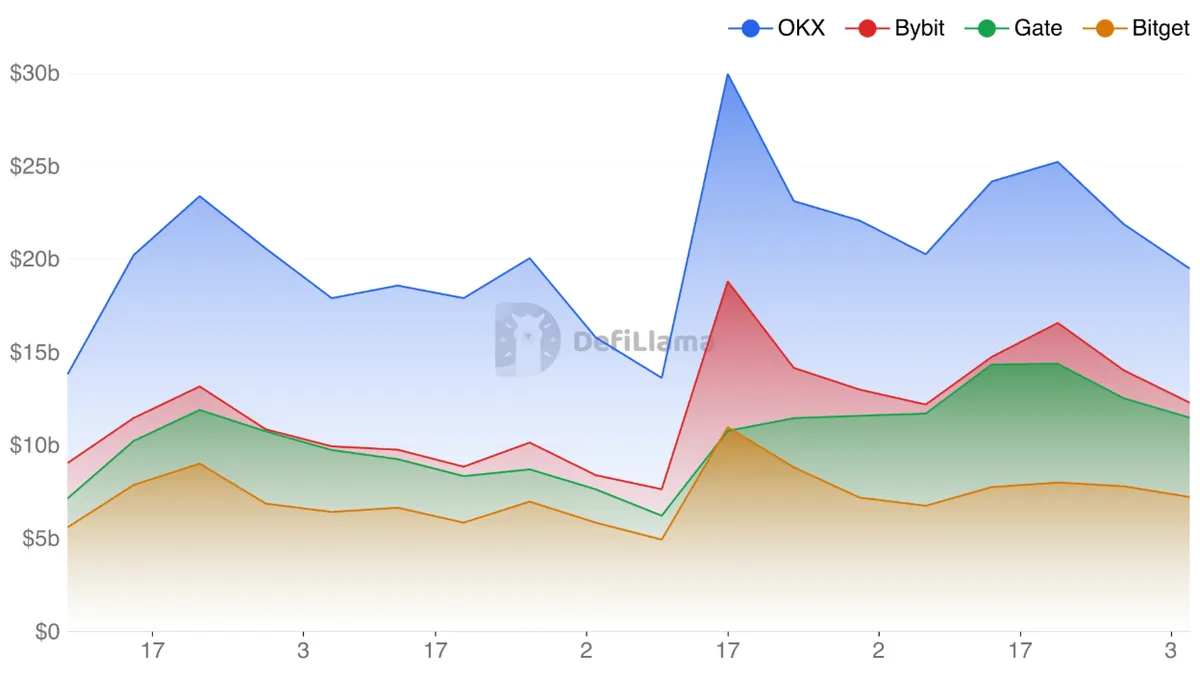
Monthly averages of daily derivatives volume, from the same data:
Month | Gate | OKX | Bybit | Bitget | Binance |
|---|---|---|---|---|---|
June (from the 14th) | $10.99B | $21.49B | $12.20B | $8.28B | $46.25B |
July | $9.51B | $19.34B | $10.01B | $6.66B | $45.38B |
August | $8.87B | $20.05B | $11.88B | $7.36B | $50.67B |
September | $13.15B | $23.27B | $14.42B | $7.62B | $59.69B |
October (1st to 11th) | $11.23B | $19.19B | $12.24B | $7.08B | $51.63B |
Gate's September average was its strongest of the period. August 19 is excluded, as Gate's volume is recorded as zero that day, a likely data gap.
Among these five exchanges, Gate's share of derivatives volume rose from 9.3% in the 30 days to September 11 to 11.2% in the 30 days to October 11. This is share of the five-exchange set, not of the whole market. Gate's average daily volume over the same two windows rose from $10.97B to $12.7B.
The launch has not lifted volume so far. In the five days from October 7 to 11, Gate averaged $11.1B a day, against $11.9B in the week from September 30 to October 6. That is a short window, but the September rise came before the announcement, so it should not be credited to Gate Money.
What Gate holds
Gate's latest Proof of Reserves report, released on 21 October, shows total reserves of $8.68B and an overall reserve ratio of 118%.
The two sources in this section measure different things. Gate's Proof of Reserves is its own report, comparing the assets it holds with what it owes users. DefiLlama's figures, used for the rest of this section, only count on-chain assets in wallets DefiLlama tracks for Gate, priced at market, and can leave out assets held elsewhere. They do not include what Gate owes users, so they show what Gate holds on-chain, not how fully user balances are covered.
On Gate’s latest PoR data, its tracked reserves are diversified, led by Bitcoin.
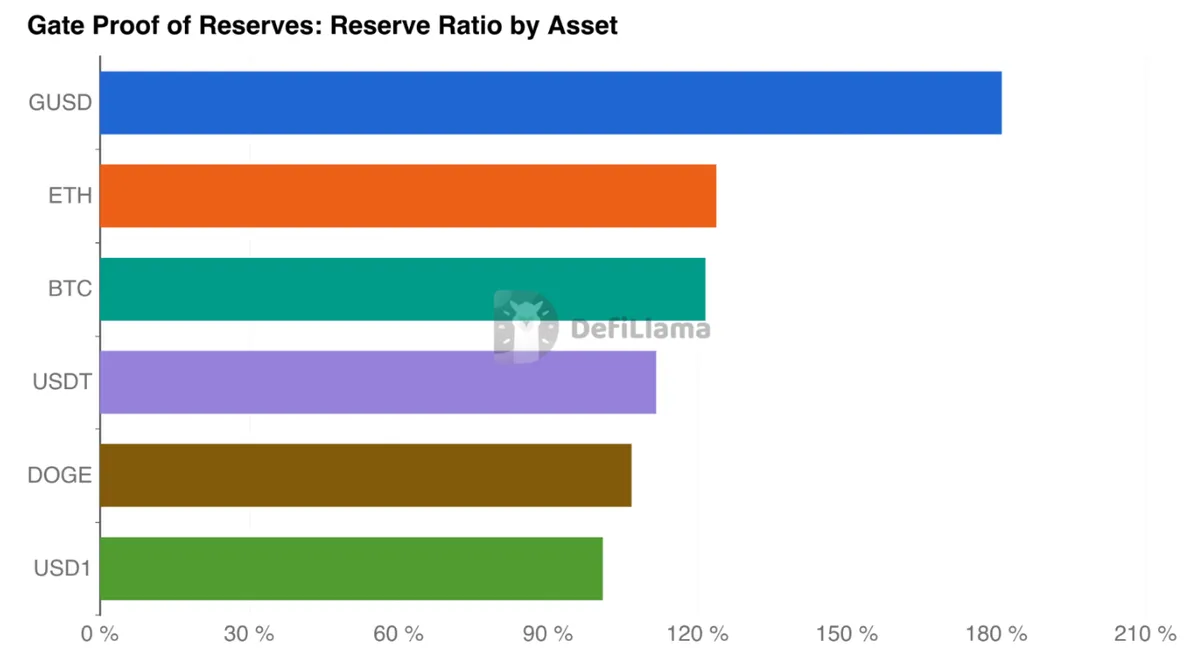
BTC is the largest tracked holding at $2.12B.
GT, Gate's own token, comes second at $1.17B. This is the main reason Gate's total tracked reserves ($7.49B) are higher than its reserves excluding its own token ($6.19B).
ETH and ETH-linked assets follow, with ETH at $1.08B.
Stablecoins and yield-bearing dollars appear healthy, including USD1, USDT, USDC, GUSD and more, at an aggregated value of $1.9B.
Gate's tracked clean assets in reserves come to $6.2B, fifth among exchanges.
Gate's on-chain footprint is small
Gate Money is a centralized-finance product, and that is where Gate's weight lies. Its Gate Layer network holds $3.36M of TVL, up 8.8% over 30 days, and generated about $120K of app fees over 30 days. That is tiny next to the exchange's $6.19B of reserves, so the on-chain side is not what this launch rests on.
Strategy: three business lines
At a press Q&A on October 8, Dr. Han said "the core of growth is still user demand." As users' needs extend from trading to investing, payments, transfers and fund management, Gate plans to widen its services to match.
He set out three business lines for the next three years:
Digital asset trading. Still the core business, with continued investment across spot, derivatives and on-chain markets.
Gate Money. Fund management, payments, transfers and multi-currency accounts.
Stocks and other asset services. More ways to access and manage different asset types on one platform.
Beyond these, Gate will keep watching opportunities in AI and the on-chain ecosystem.
Gate Money against its peers
Gate is not the only exchange trying to turn itself into an everyday finance app. In recent months, the biggest exchanges have all announced versions of the same idea. The differences are in which pieces they lead with: bank accounts, payments, real stocks or tokenized stocks.
The peer set, product by product
Gate | OKX | Coinbase | |
Branding | "One Gate, Everything Money" | OKX Money app (select markets) | "Everything Exchange" |
Bank-style account | Bank account in the user's name for eligible users, live now (Oct 7) | Fund with local currencies and hold USDG, USDC or USDT (Oct 6) | None identified |
Card and payments | Gate Card; Apple Pay and Google Pay; ATM and QR in some regions | Card in the OKX Money app | Coinbase One Card |
Stocks | Access to stocks in the account | Tokenized US stocks via partners such as Ondo and xStocks | Tokenized stocks and options announced as coming |
Standout feature | One account for banking, payments and stocks | Digital-dollar balances with a card | Borrowing against staked Solana |
Source: company announcements, press releases and media coverage, as of October 12, 2026.
How Gate's approach differs
Gate's account is live; Bybit's is still being built. Gate's bank account is available now for eligible users. As of September, Bybit held an electronic money institution license in Austria, expected a MiFID license, and planned a banking-style app with its own accounts and IBANs.
The "use assets without selling" idea is not unique to Gate.
Bitget lets 100 stock tokens serve as margin or collateral inside its unified account.
Coinbase has announced borrowing against staked Solana.
At the keynote, Dr. Han said stocks held in Gate Money can be used for daily spending without selling them first.
Gate has not yet published the details. Limits, haircuts and collateral rules will decide how useful it is.
Timing is crowded. OKX launched its OKX Money app on October 6, the day before Gate's keynote. Bybit began offering US stocks and ETFs on October 12. Gate's launch sits in a cluster of similar announcements, but it is the only one of these with a bank account already live.
The scale comparison
Product breadth only matters if there is trading and balance-sheet scale behind it. Here is where the closest peers stand in DefiLlama's data.
All figures from DefiLlama, October 12, 2026, 08:01 UTC.
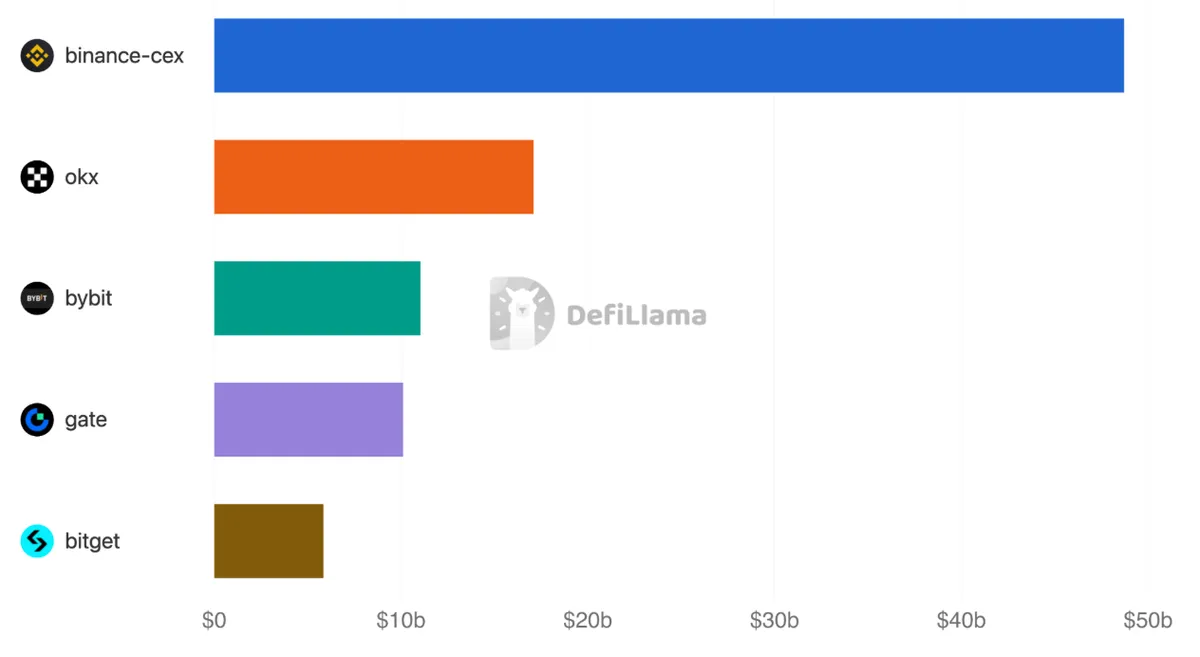
On October 12, Gate ranked fourth of these five on combined volume. Its spot plus derivatives volume was $10.1B, against $11.0B for Bybit, $17.1B for OKX and $48.7B for Binance. Gate was well ahead of Bitget at $5.8B.
Gate maintains a substantial reserve base of $6.19B excluding its own token, placing it above Bitget and supporting the platform as it expands beyond trading into account-based financial services. As users keep more balances on-platform, reserve transparency becomes increasingly important.
Derivatives dominate everywhere. Derivatives volume is between 5 and 10 times spot volume across all five exchanges, and 6.8 times at Gate. The all-in-one pitch is partly an attempt to broaden revenue away from that dependence.
Coinbase and Kraken are excluded, as comparable current data is not available for either.
The wider picture
Large exchanges are pushing past trading into payments, stocks and wealth products. What stands out about Gate Money is that it is built as one account with a bank-style front end, not as a set of separate products inside an exchange app.
That framing has real strengths. Gate already operates in derivatives, spot, a card and stocks, so Gate Money is mostly about connecting existing pieces. It also targets a real gap, because most crypto users still move between exchange, bank and broker accounts to do everyday things.
For Gate, Gate Money is the bid to turn a place users trade into a place they live financially. The launch is early, and the numbers that will say whether it worked, such as activations, card spend and balances held, are not yet public.