Flare's tokenomics revamp: the transition to activity-linked economics
FIP.16 passed on April 24 with 98.06% in favor, one of the strongest mandates in Flare's governance history. It restructured FLR issuance, burn fees, transaction fees, staking weight and protocol revenue in a single proposal.
Flare
FIP.16 passed on April 24 with 98.06% in favor, one of the strongest mandates in Flare's governance history. It restructured FLR issuance, burn fees, transaction fees, staking weight and protocol revenue in a single proposal.
Four months on, most of the roadmap is live, and the effects are now visible onchain. Inflation dropped in May, the same month FIRE began collecting FAssets minting fees and FXRP tag fees. The hard fork followed in July, while FDC attestation fees started accruing and were first collected into FIRE in August. FAssets redemption fees began routing in September.
Other components, notably MEV capture and Confidential Compute fees, are still staged for later by design. With the core pieces now in place, this is a good time to assess what has shipped and what the early data shows.
Flare - brief refresher
Flare is a layer-1 EVM chain, live since July 2022, built around one design choice: its oracles are part of the protocol rather than a service bought from outside. Two enshrined protocols do that work, the FTSO (Flare Time Series Oracle) for price feeds and the FDC (Flare Data Connector) for attesting to events on other blockchains and Web2 APIs, both secured by the same set of data providers weighted by staked FLR. That infrastructure is what makes FAssets possible, bringing assets from chains without smart contracts onto Flare, currently XRP minted as FXRP, and giving their holders somewhere to put them to work in DeFi.
What FIP.16 changed
Inflation came down, and so did the base it applies to
Annual issuance fell from 5% to 3% on May 14, with the yearly hard cap dropping from 5 billion to 3 billion FLR. Applied to an inflatable supply of roughly 87 billion, that puts gross annual issuance at about 2.6 billion tokens.
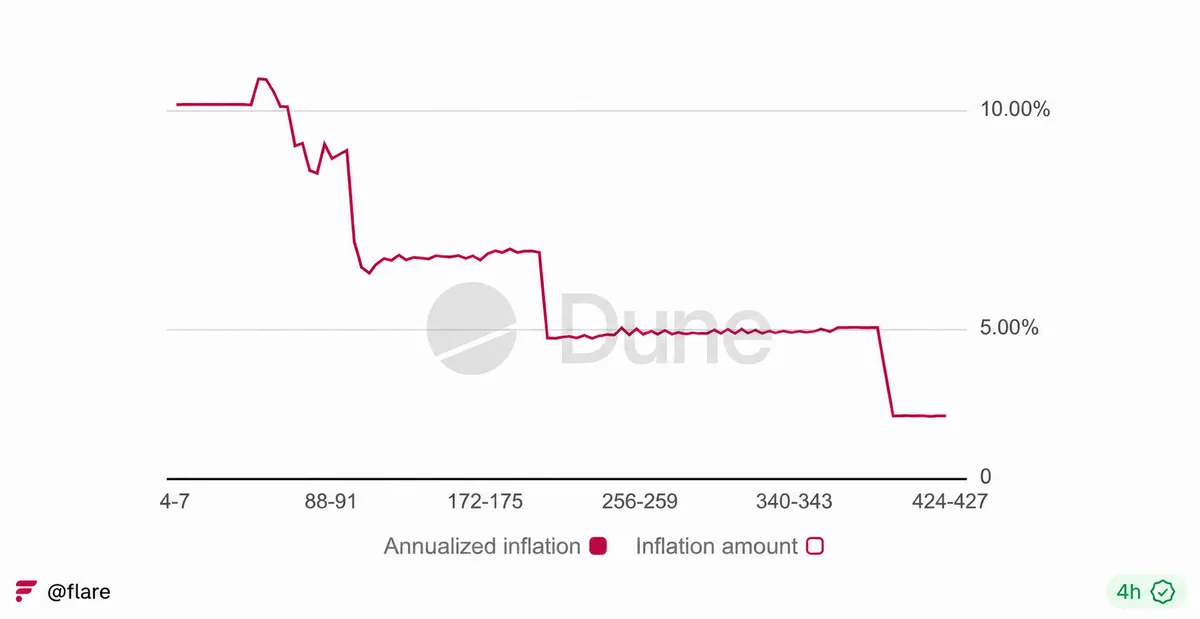
The rate cut is the visible half. The less visible half is that FIP.16 also shrank the base the rate applies to. Permanently burned tokens, unearned rewards sitting in penalty pools, and FLR held by FIRE are all excluded from the inflation calculation. That creates a compounding effect: as the burn address grows and FIRE accumulates, the pool that 3% is calculated against keeps getting smaller, producing fewer tokens each period.
Every transaction burns more
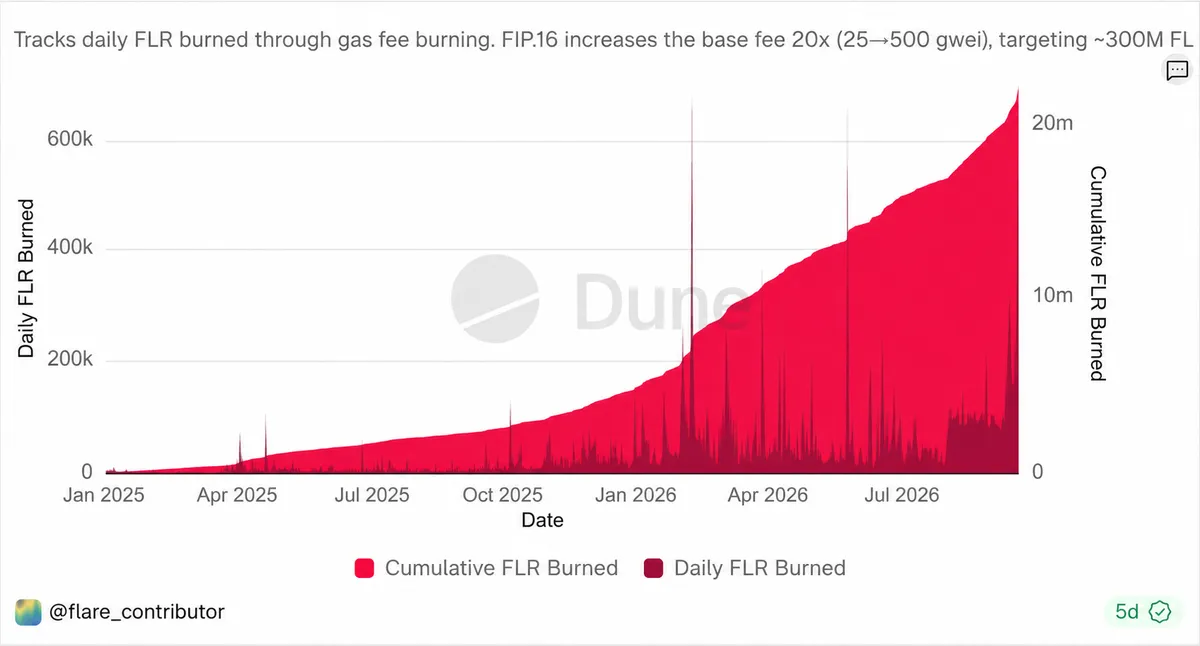
The July 14 hard fork raised the base transaction fee from 25 gwei to 500 gwei, a 20x increase that significantly lifted the burn rate (see chart in the data section). For users the cost stays negligible, at roughly 0.064 FLR for a simple transfer, which is invisible at any realistic transaction volume.
The mechanism is encoded and runs by itself with no governance decision, no treasury discretion and no allocation vote, making it efficient. Every transaction on Flare destroys FLR automatically, the tokens are removed permanently, and the effect scales linearly with usage.
Staking carries more weight
Influence on Flare is measured in signing weight. Nothing the network produces is final until operators holding more than half the total weight sign off on it, and those same operators do three jobs at once: producing blocks, running the FTSO price oracle, and running the Flare Data Connector. Weight comes from FLR, either staked and locked to a validator on the P-chain (Flare's platform chain) or as wrapped FLR delegated on the C-chain (the EVM chain), which stays liquid.
FIP.16 now counts P-chain stake at 5x the weight of C-chain delegation. It also raised the maximum validator size from 200 million to 300 million FLR and set a 20% minimum delegation fee network-wide, giving operators room to grow and a floor under their economics. The core effect is to move influence toward committed staked capital, since delegated FLR can exit at any moment and locked stake can't.
Additionally, FIP.16 unified how that weight is counted. Before the change, FTSO anchor feeds counted C-chain delegation only, while FDC and block-latency feeds used a combined weight that treated staked and delegated FLR as equal. Now all three share one calculation, and it's the one weighting locked stake at 5x. In other words no part of the network is cheaper to attack than another.
FIRE gives protocol revenue somewhere to go
The Flare Income Reinvestment Entity (FIRE) is the structurally new piece. It's a governed pool with a primary mandate to reduce FLR supply through burns and open-market buybacks, and secondary mandates covering asset issuer rewards, dApp yield and liquidity, and Foundation sustainability. Its first operational use is replacing inflation-funded validator and staker rewards with revenue the network generates itself, which serves the same mandate from the other side: FLR that never gets minted is supply that never gets created.
The proposal names several revenue sources, and four fee streams are routing today. FAssets minting fees go to FIRE in full. 90% of FDC request fees are redirected into it, with the remaining 10% continuing through existing reward channels. 10% of FAssets redemption fees route in, with the majority staying with the agent and the collateral pool. And FXRP destination-tag registrations, a permanent piece of XRPL namespace that lets a minter route straight to their own Flare address, are paid to FIRE in FLR. Flare Smart Account fees, Flare Confidential Compute fees, and captured MEV will arrive in the upcoming phases.
FIRE is administered by the Flare Foundation initially. After the first year, the community can vote to move it into joint governance, a decision that requires 50% of total inflatable FLR supply to vote in favor. If it passes, four representatives are elected from providers running infrastructure on both Flare and Songbird.
The data so far
Staking responded fastest
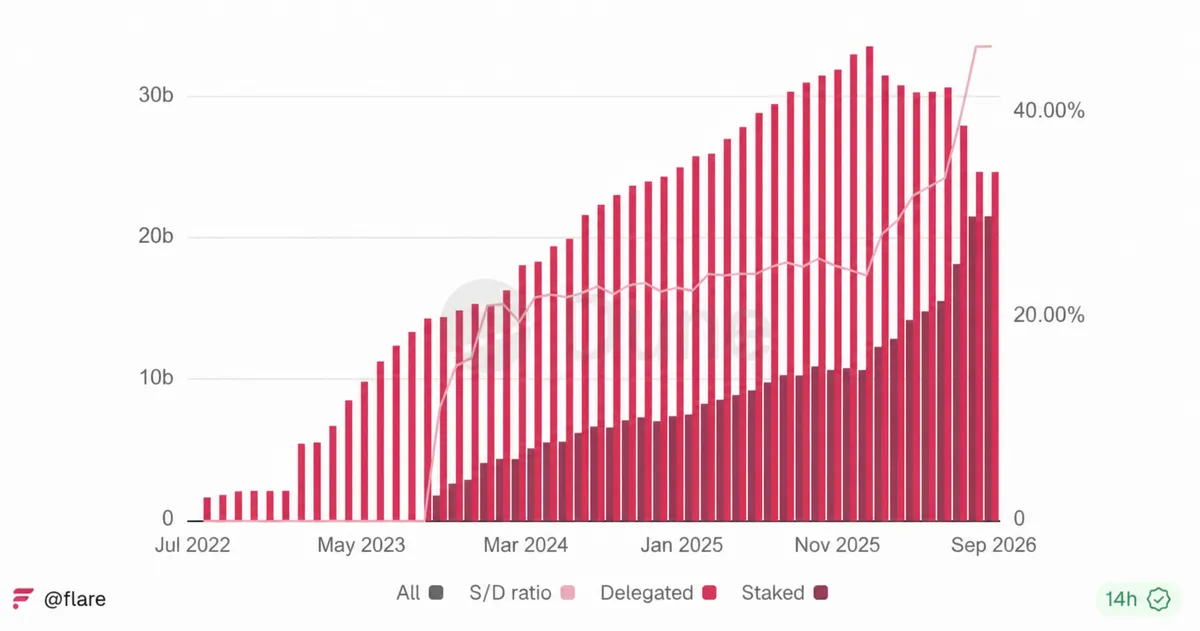
Flare now has 21.5 billion FLR staked, up from roughly 16 billion in July. Staking's share of all staked-or-delegated FLR climbed from about 32% in April to roughly 46% by late August. Most of that move landed within weeks of the hard fork.
The burn scaled by an order of magnitude
Flare has burned 15.6 million FLR year to date through transaction fees, with more than 40% of that total burned since the July 14 fork and the subsequent increase in gas fees. That puts the current burn rate at more than ten times its pre-fork baseline.
Protocol revenue is live and early
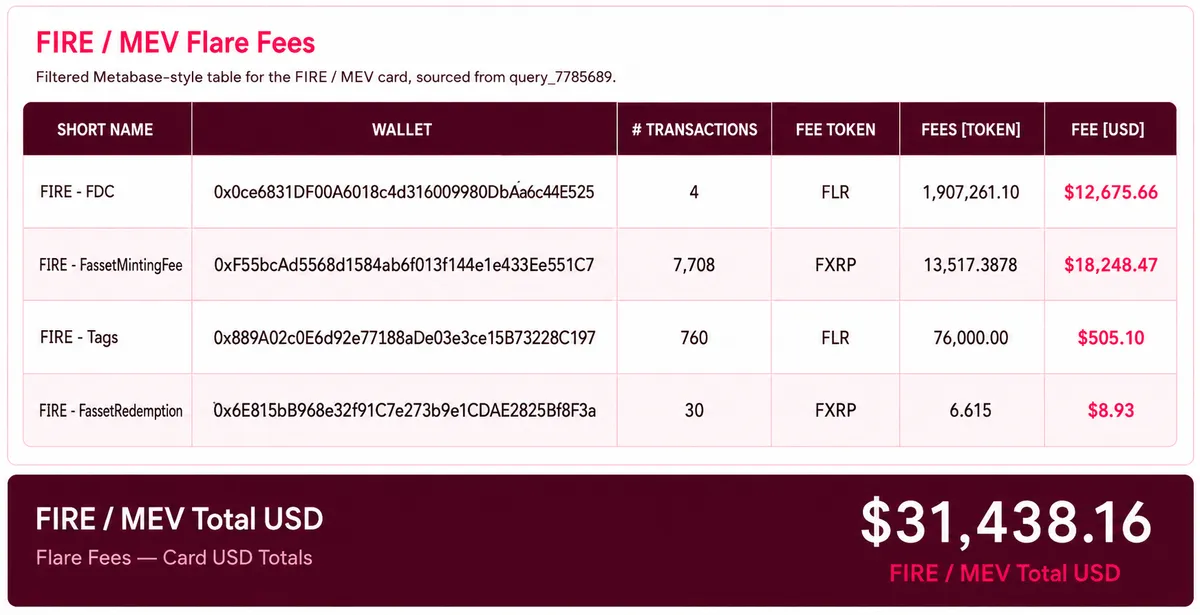
FIRE has been collecting since May and has taken in $31,438 to date. FAssets minting fees are the largest contributor at $18,248 across 7,708 mints, followed by $12,676 in FDC request fees, which began claiming into the pool on August 18. Tag registrations add $505 and redemption fees $9. Two of the four streams pay in FLR and two in FXRP, so the dollar figure moves with prices as well as with volume. The trend is worth watching as FAssets and FDC volumes scale.
Conclusion
Four months in, the structural work is done. Inflation is lower and applies to a shrinking base, the burn runs an order of magnitude above where it started, staking has shifted toward capital committed to securing the network, and protocol revenue has a governed destination for the first time.
What's live today is the bootstrap phase, and the proposal sequenced it that way. The largest parts of FIRE's mandate, Smart Account fees, Confidential Compute, and protocol-level MEV capture, arrive as the underlying infrastructure ships. That means today's figures reflect a system still being switched on, with mechanisms designed to compound as usage grows. The machinery is built and running, governance approved it near-unanimously, and the first onchain evidence points where the proposal said it would. What comes next is volume.