Stablecoin yield above the T-bill: every point has a price
DeFi stablecoin yield can be interesting, but only selectively. Half of the pools beat the bill, yet lending, which holds most of the money, usually sits around the T-bill and never pays more than about 2.3pp over it.
All investors love yield, and the 3-month US Treasury bill currently sits at 4.17%. For anyone holding stablecoins, that's the benchmark to beat, since it comes without smart-contract, credit or depeg risk. But is DeFi able to compete and offer enough extra points on top to be worth the risk?

To answer that question, we took every stablecoin pool on DefiLlama with at least $50M supplied and no token incentives. That gives us 98 pools, and we compared their 30-day base APY with the bill to measure the gap in percentage points (pp).
The short answer is that DeFi stablecoin yield can be interesting, but only selectively. Half of the pools beat the bill, yet lending, which holds most of the money, usually sits around the T-bill and never pays more than about 2.3pp over it. The pools that go further earn the yield of another asset: in RWA, tokenized credit, reinsurance or preferred shares, and elsewhere in unsecured loans, basis trades or small trading books. The higher the premium, the more of that asset's risk you're buying, on top of the smart-contract risk.
Half the large pools beat the bill, and the category decides by how much
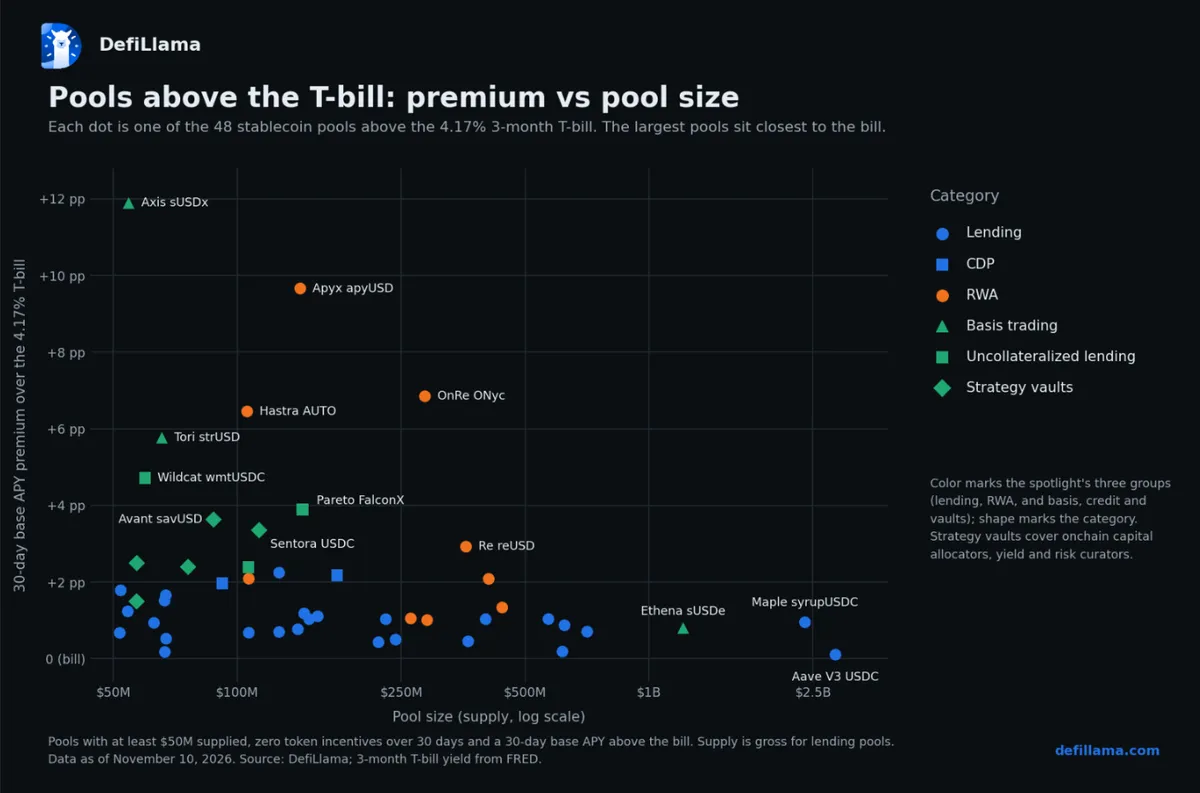
Across all 98 pools, the median 30-day base APY is 4.07%, which puts the typical large stablecoin pool 0.10pp under the bill. Keeping only the ones that beat it leaves us with 48 pools. Their median premium is 1.21pp, for a yield of 5.38%, and the highest, Axis sUSDx, pays 16.06%, or 11.89pp above the bill.
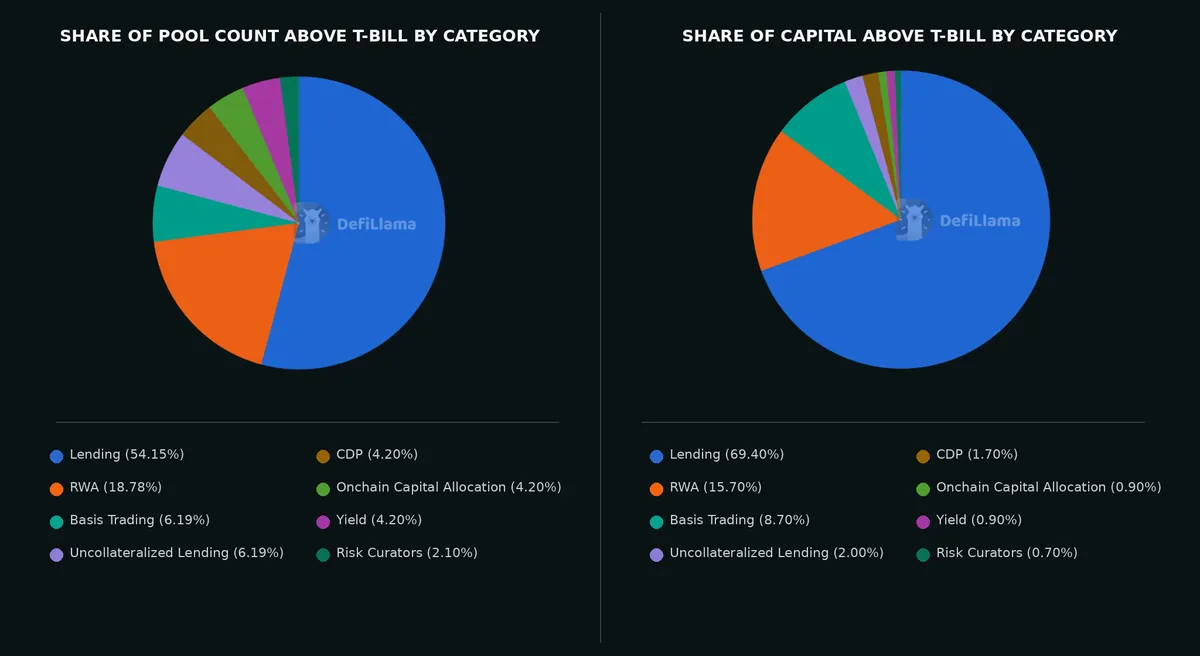
The distribution shows where activity lies and, as we'll see, shapes the premium. The 48 pools hold $15.3B of supply, and lending dominates on both counts, with 54% of the pools and 69% of the capital ($10.6B) across 10 protocols. The lending pools are also large, at $409M on average against $267M for RWA.
RWA comes second, with 19% of the pools and 16% of the capital, and basis trading third, with 9% of the capital and 6% of the pools, nearly all of it in a single pool, Ethena's sUSDe ($1.21B). The other categories are small: uncollateralized lending (6% of pools, 2% of capital), CDP (4%, 1.7%) and the three strategy-vault categories, onchain capital allocators, yield and risk curators (10%, 2.5% combined).
In other words, the money above the bill is mostly lending and RWA: together they hold 85% of the capital and 73% of the pools, so what drives their premiums drives most of the market.
Lending never pays more than 2.3pp over the bill
The 26 lending pools above the bill pay between 0.11pp and 2.25pp over it. Weighted by size, the average premium is 0.65pp. The largest pool in the sample, Aave V3's USDC market on Ethereum with $2.8B, earns 4.28%, only 0.11pp above the bill, while the top earner, Fluid's USDC market on Ethereum, pays 6.42%, or 2.25pp over it, on $126M.
The reason lending can't offer a high premium comes down to its design and to how competitive and efficient the market is. Most lending markets use a curve that steepens sharply once utilization passes a target, often around 80% to 90%, so borrowers repay when rates spike and the rate falls back. In an efficient market, where funds flow seamlessly from one venue to another, any market paying well above the others quickly attracts deposits, which lowers its utilization and its rate.
Higher lending premiums tend to reflect differences in borrowing demand, liquidity, or the borrowers themselves. For example, on Aave, USDC yields 0.11pp above the bill on Ethereum versus 1.66pp on Avalanche, where a smaller $67M market makes rates more sensitive to changes in utilization. A similar dynamic plays out on HyperLend (+1.79pp, $52M), where demand for leveraged trading drives borrowing on HyperEVM. Cap's stcUSD (+1.52pp, $67M) shows the third factor: it lends to whitelisted institutional operators such as market makers and proprietary trading firms.
At the higher end, the two CDP pools, Sky's stUSDS (+2.18pp) and Reservoir's wsrUSD (+1.97pp), rely on two distinct mechanisms: stUSDS earns yield from SKY-backed borrowing, with returns linked to pool utilization, while wsrUSD pays a protocol-set savings rate funded by returns on Reservoir's underlying asset portfolio.
For an allocator, the takeaway is simple. At size, DeFi lending pays the bill plus less than 1pp. To earn more while staying in lending, an allocator has to accept thinner liquidity, isolated pools or more exotic approaches.
RWA pays what the asset underneath pays, from AAA credit to preferred shares
RWA is the second-largest category above the bill, with $2.4B across nine pools from six protocols. Premiums range from 1.01pp to 9.66pp, a spread four times wider than lending's.
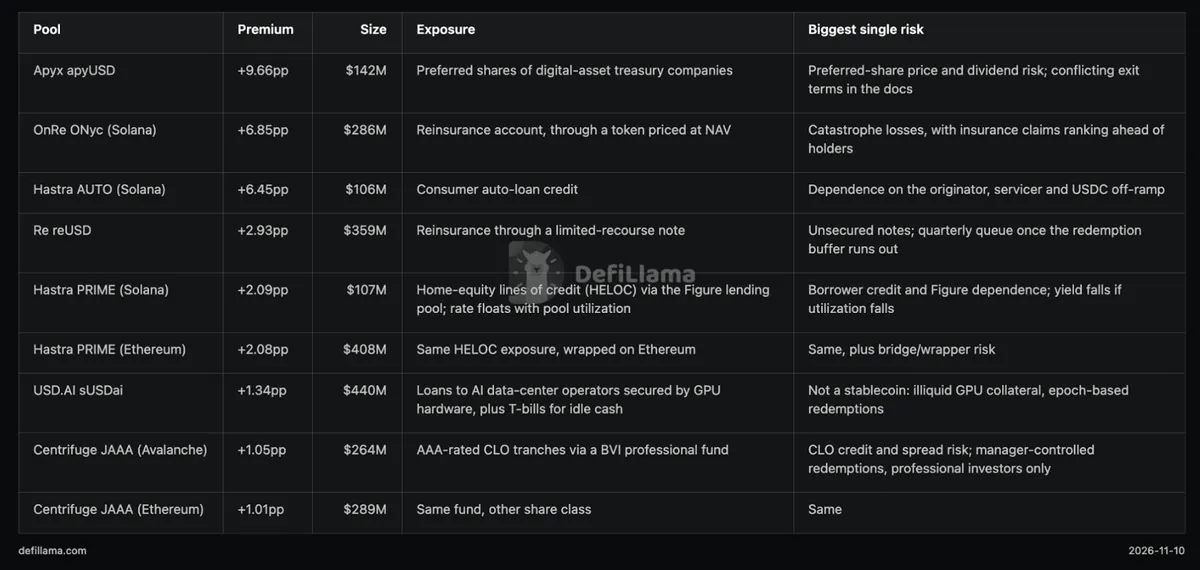
Unlike standard lending markets, the yields largely originate from the underlying assets, and the offering is wide. The nine pools cover six distinct asset classes, each with its own originator, legal wrapper and redemption terms: AAA-rated CLO tranches (Centrifuge's JAAA), GPU-backed loans to AI infrastructure operators (USD.AI's sUSDai), home-equity lines of credit through Figure (Hastra's PRIME), consumer auto loans (Hastra's AUTO), reinsurance (Re's reUSD and OnRe's ONyc) and preferred shares of digital-asset treasury companies (Apyx's apyUSD). Each pool is a tokenized slice of a specific off-chain market, which is why the premium varies with the asset more than with the venue.
This range of products explains why RWA premiums don't converge as readily as lending rates: each asset carries its own risk, priced by its own market. Credit pools depend on borrowers repaying and on the firms that originate and service the loans, as with Hastra's auto loans. Reinsurance pools depend on underwriting results, and in OnRe's case insurance claims rank ahead of token holders if catastrophe losses hit the book. Preferred shares carry dividend and market-price risk, which Apyx passes straight to apyUSD holders. On top of the asset sit structural risks that lending doesn't have. Re's reUSD is held through an unsecured, limited-recourse note and can move to a quarterly redemption queue when its liquidity buffer runs low, and ONyc and reUSD accrue value through a NAV the issuer reports rather than holding a fixed $1 peg.
For allocators, the premium here signals a change in the underlying exposure rather than just more yield. Before sizing a position, four questions matter. What is the asset, and who originates or services it? Where do token holders rank if it takes losses? Does the token track $1 or a NAV the issuer reports? And how fast can capital come out under stress, through queues, buffers or whitelists?
Elsewhere, the highest premiums come with risks to match
The remaining 11 pools come from basis trading, uncollateralized lending and strategy vaults, with $2.0B of capital, 60% of it in Ethena's sUSDe. They include six of the ten highest premiums, and the thread running through them is where the premium comes from: off-chain trading, credit extended without full collateral, or leverage inside a vault. Each is a different risk, and each is paid accordingly.
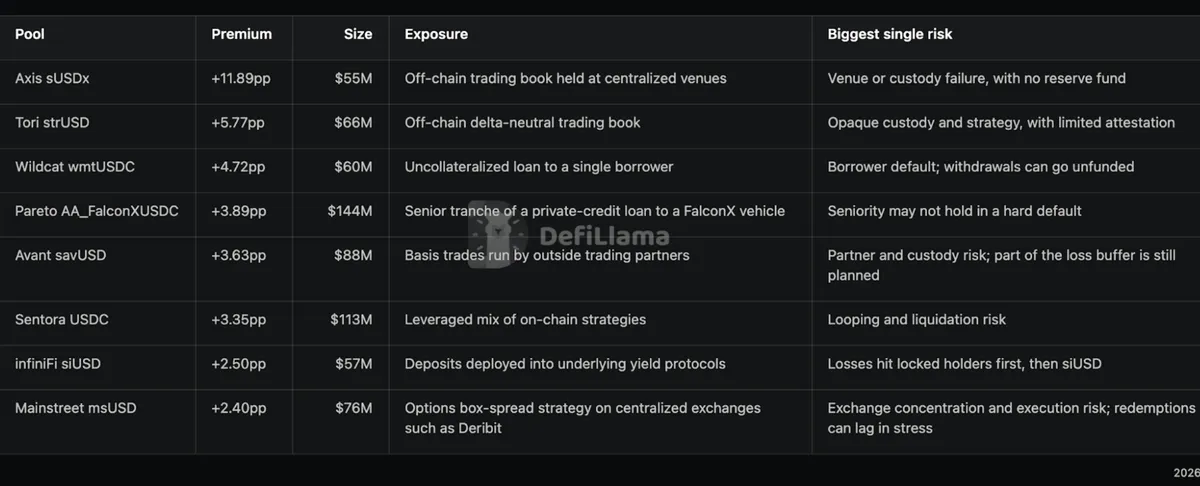
In basis trading, the premium shrinks with size. Ethena's sUSDe ($1.21B) pays 0.80pp over the bill, against 5.77pp for Tori's strUSD ($66M) and 11.89pp for Axis's sUSDx ($55M). Part of the gap is likely capacity, since funding-rate and arbitrage opportunities are limited and a larger book has to take lower-yielding positions. But the smaller books also run different trades. Tori's strategies go beyond conventional basis trading, with institutional custody and continuous reserve verification, while Axis runs cross-venue arbitrage and OTC trading from backing held directly at centralized venues, has no reserve fund, and pays sUSDx holders discretionary rewards rather than passing the book's returns straight through. Their premium pays for a different and more off-chain strategy.
Uncollateralized lending prices one main risk, default, with different levels of protection. Wildcat's wmtUSDC (+4.72pp) is a loan to a single borrower, in a market named after Wintermute Trading, with no collateral and a 0% reserve ratio. Pareto's senior FalconX tranche (+3.89pp) is better protected than its category suggests: it sits above a junior first-loss tranche, and the loans are collateralized and held through an SPV. 3Jane (+2.39pp) extends unsecured credit lines, including to crypto-native borrowers, split into senior and junior tranches. In each case, the allocator is paid for trusting the borrower.
The last group stacks strategies inside a vault. Avant's savUSD (+3.63pp) runs basis trades and other market-neutral strategies through outside trading partners, and Sentora's USDC vault (+3.35pp) combines leveraged looping, lending and liquidity provision, so the premium comes from leverage and the strategies inside.
So is the risk justified? On this evidence, the premiums track what each structure asks holders to accept, which gives a clear scale. Ethena's sUSDe pays 0.80pp for a hedged book run at scale, the tranched credit of 3Jane and Pareto pays 2.39pp to 3.89pp, Wildcat pays 4.72pp for a single borrower with no collateral, and Axis pays 11.89pp for an off-chain trading book with no reserve fund. Whether each one pays enough for that risk is an issuer-by-issuer judgment, and only five of the ten highest premiums report a verified APY.
Worth it only where you can price the risk underneath
So can DeFi stablecoin yield compete with a 4.17% bill? For most of the money, the answer is a modest yes. Lending holds 69% of the supply above the bill and pays 0.65pp over it on average, weighted by size. That's a thin payment for smart-contract, oracle and depeg risk, and it makes most sense for allocators who value keeping their dollars on-chain and usable elsewhere in DeFi.
Between 1pp and 3pp, 23 pools holding $4.4B mix newer lending venues, CDP savings rates, the safer end of RWA credit and strategy vaults. The premium is larger there, and so is the range of what it pays for, from thinner markets to tokenized loan books.
Above 3pp, the yield is the price of credit, reinsurance, equity or trading risk brought on-chain, and it has to be judged the way that risk would be judged off-chain, issuer by issuer and document by document.
In practice, the premium tells an allocator how much checking to do. Below 1pp over the bill, the questions are the protocol's track record and the depth of its market. Between 1pp and 3pp, add the venue's liquidity and how the rate is set. Above 3pp, each pool is a credit decision on a single issuer, to be sized like a private-credit position once the documents have been read. In short, the higher the premium, the longer the checklist.
Methodology
This analysis covers stablecoin pools in DefiLlama's yield dataset as of November 9, 2026. Starting from 2,927 stablecoin-only pools (exploit-affected and inactive pools excluded), we kept the 139 with at least $50M supplied, removed the 40 that paid any token incentive over the past 30 days, and kept the 98 with a 30-day base APY on record. Base APY is DefiLlama's verified base APY over the last 30 completed days where available (79% of qualifying pools), and the 30-day average of the reported base APY otherwise. None of the 98 pools was more than 2% off its peg at the time of the snapshot.
The benchmark is the 3-month US Treasury yield from FRED, 4.17% as of November 5, 2026, and premiums are expressed in percentage points. Categories are DefiLlama's labels. Supply is gross for lending pools, so it overstates net capital, and counts are pool rows: several Morpho vaults appear separately, and Hastra PRIME and Centrifuge JAAA appear once per chain. Risk descriptions come from issuer documentation, audit reports and attestations, and weren't checked on-chain.