Decentralization, Permissionlessness, Neutrality and Censorship Resistance: DeFi’s Founding Principles Put to the Test
On September 24, attackers drained $387.5M from Bitget’s hot wallets. Within a day, part of the funds were already being bridged and swapped across numerous assets, including XRP, ETH, BTC, USDT and USDC, through venues such as THORChain, Uniswap, Chainflip, NEAR Intents, 1inch and LayerZero.
XRP
ETH
BTC
USDT
USDC
On September 24, attackers drained $387.5M from Bitget’s hot wallets. Within a day, part of the funds were already being bridged and swapped across numerous assets, including XRP, ETH, BTC, USDT and USDC, through venues such as THORChain,
Uniswap,
Chainflip,
NEAR Intents,
1inch and
LayerZero.
Following the hack, Bitget CEO Gracy Chen published the attacker addresses and formally asked THORChain to refuse them service. THORChain declined. Its position is that the protocol is open to anyone by design and doesn’t filter who uses it, and the emergency halts that protect the protocol can’t be used to freeze particular funds. It added that the attackers behind its own May exploit, which took $10.7M from its pools, were never blacklisted either and kept swapping freely.
The refusal reignited the debate around DeFi, neutrality, decentralization, and what protocols should or shouldn’t do in these situations. What stands out is that no side is clearly right or wrong, it’s more of a stance.
That makes this a good moment to revisit the values behind decentralized finance, starting with Satoshi’s whitepaper, and show why they now operate more as a spectrum. Protocols sit at different points along it, and each point carries a cost. We then look at how the venues involved in the Bitget hack acted relative to their stated ethos and promises. MistTrack’s tracking of the funds lets us draw a clear picture of the situation as it stands two weeks later.
For protocols built on a decentralized ethos, neutrality is credible only if no single party holds the power to change the rules. For those that retain discretionary control, having the power to act doesn’t guarantee effective enforcement: responses remain slow, coverage incomplete, and alternative routes accessible.
The four principles behind DeFi must be seen as a spectrum
In 2008, Satoshi Nakamoto published Bitcoin: A Peer-to-Peer Electronic Cash System. Its ambition was to let people send value directly to one another without relying on a financial institution to process the payment, replacing trust in an intermediary with a network that validates transactions according to shared rules. That proposition laid the foundation for four concepts that have since become central to crypto: decentralization, permissionlessness, censorship resistance, and neutrality.
The four are often used interchangeably, but three describe what users can expect from a system and one describes how it’s built.
Permissionlessness concerns access, meaning anyone can use the system without approval. The whitepaper’s abstract describes exactly that: online payments that move straight between two parties, with no financial institution in the middle.
Censorship resistance concerns execution, the ability of a valid transaction to go through despite attempts to block it. In the whitepaper, every new transaction is shared with all the nodes on the network, so no single participant decides whether it gets through.
Neutrality concerns rules, and whether they apply consistently regardless of who the user is or what interests are at stake. The whitepaper identifies participants only by public keys that don’t need to reveal who is behind them, so the rules can’t depend on identity.
Decentralization is architecture: it concerns how control is distributed across the parties that run the system. The whitepaper describes nodes that need no identification, coordinate only loosely, and can join or drop out whenever they like. The more decentralized a system is, the more censorship-resistant it tends to be, and the better positioned it is to stay permissionless and neutral. The degree of decentralization varies from one protocol to another
These properties reinforce one another, but they don’t necessarily coexist. A system can deliver one without the others, which is why the distinction matters when judging how a protocol behaves under pressure.
Decentralization, for example, can make a system resistant to unilateral change while keeping it fully permissioned. Canton Network is one case: it’s operated by multiple independent institutions but restricts who can take part. Conversely, a centralized entity can offer permissionless access to its products while keeping the power to censor, as Circle does with USDC: anyone can hold and send it, but Circle can freeze an address. At the far end, a system can be decentralized, neutral, censorship-resistant, and permissionless all at once, like THORChain.
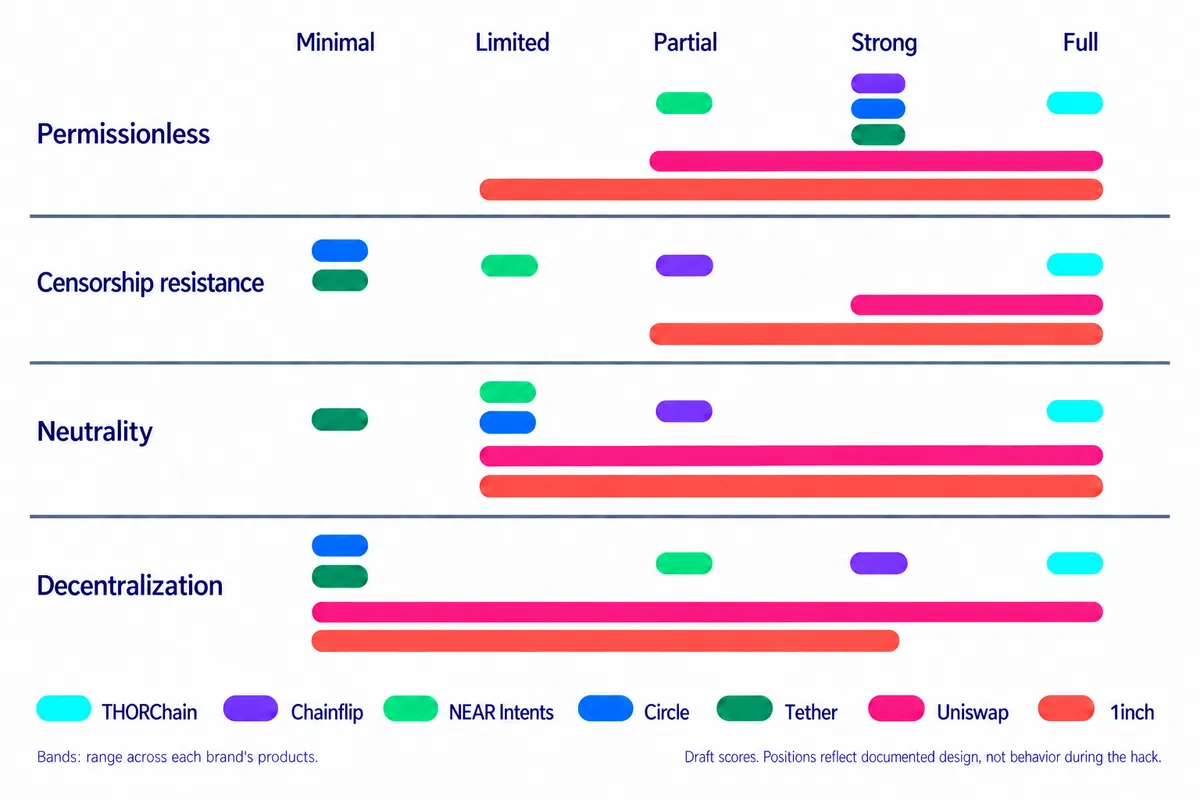
What does that mean in practice? That these properties don’t fit a binary description. Protocols and entities position themselves freely on a spectrum with four dimensions, one per principle, with plenty of nuance in between.
Brand | Permissionless | Censorship resistance | Neutrality | Decentralization |
|---|---|---|---|---|
THORChain | Full | Full | Full | Full |
Chainflip | Strong | Partial | Partial | Strong |
NEAR Intents | Partial | Limited | Limited | Partial |
Circle | High | Minimal | Limited | Minimal |
Tether | Strong | Minimal | Minimal | Minimal |
Uniswap | Full - Partial | Full - Strong | Full - Limited | Full - Minimal |
1inch | Full - Limited | Full - Partial | Full - Limited | Strong - Minimal |
In practice, the Bitget funds crossed every point on the spectrum
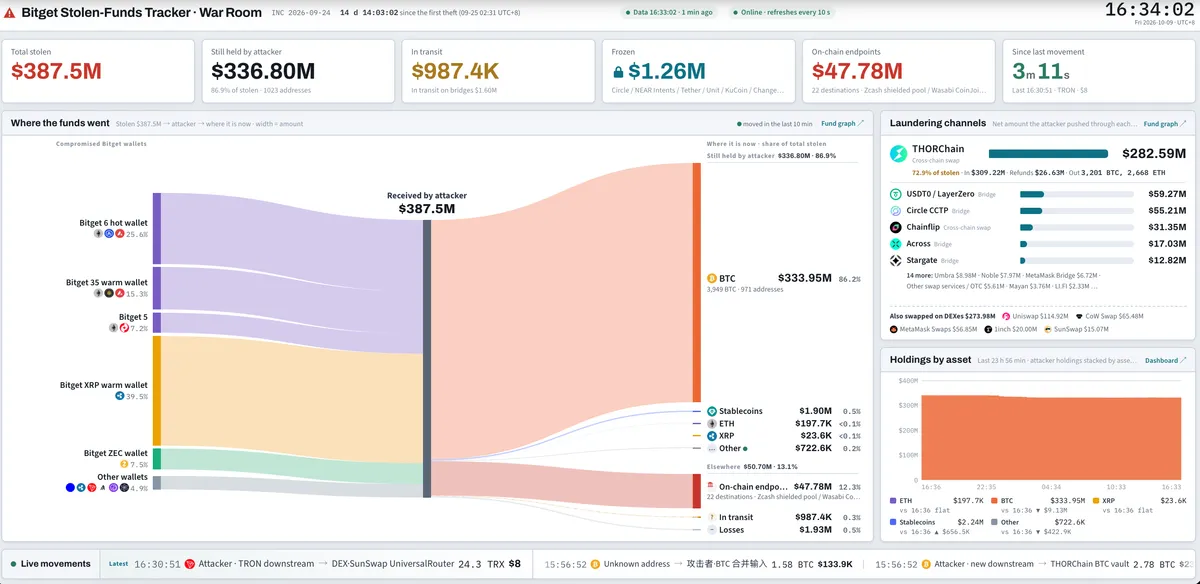
The Bitget hack put that spectrum to the test. According to MistTrack, the attacker moved the $387.5M through cross-chain swap protocols, bridges, and DEXs, and two weeks later 86.2% of the stolen value sits in BTC. Along the way, the funds met venues at every point described above, from those that can’t refuse a transaction to those that can freeze it at the token level.
THORChain followed its ethos
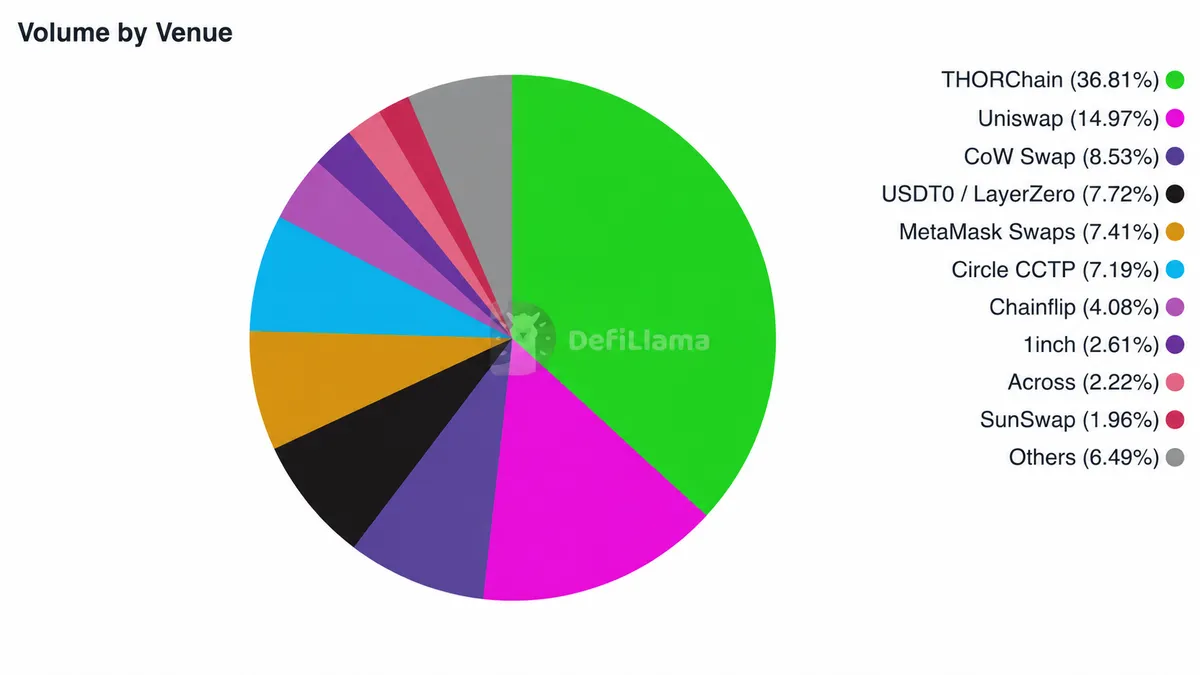
THORChain was the attacker’s main route, processing approximately $280M in swaps. This represented roughly 36% of the $780M in cumulative volume recorded across all venues used by the attacker.
That lead follows directly from its design. THORChain has no mechanism to refuse an address: swaps are executed by its node operators according to the protocol’s rules, and none can single out a user. Its only emergency tool is a halt, which stops an entire chain for every user. A halt can be triggered automatically, as it was during THORChain’s own exploit in May 2026, or manually by node operators (a single operator can pause the chain, but any other operator can lift that pause, so a halt only holds if the operators collectively let it stand).
Critics, including OKX founder Star Xu, argue that a network able to stop when its own funds are at risk can’t claim to be like Bitcoin when it refuses to stop for anyone else’s. But halts of this kind have precedents on major chains. In 2010, Bitcoin’s developers and miners coordinated to discard the blocks created by a bug that minted 184 billion BTC. In 2022, BNB Chain’s validators halted the chain after an exploit minted roughly $570M of BNB, though its validator set is far from the most decentralized. In each case, the goal was to protect the chain's integrity, not blacklist a user.
That’s also why THORChain halted in May: had the exploit continued, the protocol could have been drained to the point of having nothing left to serve its users. The halt only prevented more funds from being stolen and did nothing to recover the funds that had already been taken. THORChain also applied the same permissionless principle to itself, since the attackers behind that exploit were never blacklisted and remained free to swap on the protocol.
THORChain’s response, both to Bitget and to its own exploit, therefore matched its architecture and its stated principles, whether one likes it or not. The cost of that consistency shows in the numbers: sitting at the far end of the spectrum meant carrying most of the stolen funds.
Freezing powers stopped 0.3% of the stolen funds
Across every venue, $1.26M has been frozen so far, 0.3% of the stolen funds. The power to freeze exists at several points along the funds' path, from stablecoin issuers to protocols and exchanges, yet each caught only a fraction.
Stablecoin issuers have the most direct lever with the ability to freeze at the address level. About a fifth of what was stolen, $75.47M, was in USDT, USDC and USDT0, and the attacker kept using them. $55.21M moved through Circle’s CCTP and $59.27M through USDT0 on LayerZero. Circle froze $568K and Tether $239K, about 1% of the stablecoins stolen.
Most of the remaining funds, $298M in XRP, ETH, ZEC, BNB, AVAX, and TRX, were in assets no issuer can freeze. NEAR Intents, which screens swap requests against AML databases and can hold funds during execution, froze $266K. Unit, which issues the BTC traded on Hyperliquid, froze $170K. Exchanges such as KuCoin and Bybit stopped small amounts sent to their deposit addresses, about $14K in total.
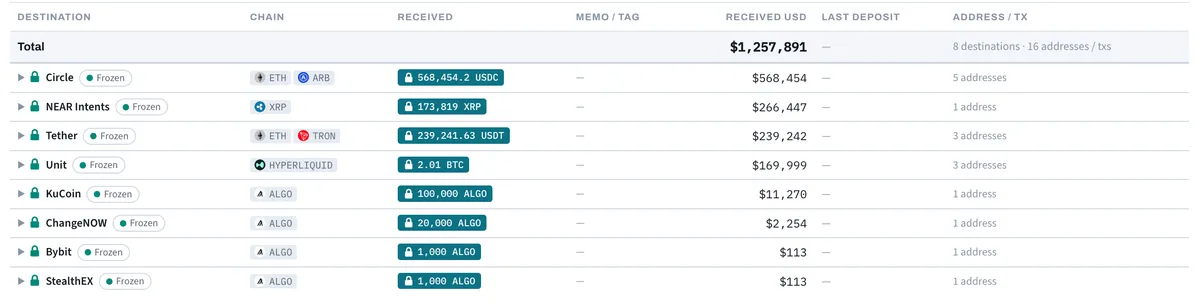
This gap can further be explained by three constraints. The first is speed: an asset can only be frozen while someone still holds it, and the attacker swapped out faster than the freezes arrived. The second is selectivity: the funds were split across more than 1,000 addresses, each of which had to be identified. The third is coordination: Circle’s policy on freezing is tied mainly to legal obligations, threats to the stablecoin’s security, and urgent requests from authorities. All of which take time to set in motion. None of this means the issuers or protocols failed, but highlights the limitations of today’s means.
Chainflip rejected the funds, then processed them through CoW Protocol
Chainflip sits closer to THORChain on the spectrum, with one difference that matters here: the brokers who open deposit channels can reject a deposit before it’s swapped. MistTrack reported that Chainflip did exactly that with one deposit tied to the hack, which was refunded to the sender rather than frozen.
Attacker-linked funds still went through Chainflip by another door. SlowMist found an automated script creating CoW Protocol orders whose receiving address was a pre-prepared Chainflip deposit address, so once CoW settled an order, Chainflip swapped the assets into BTC. MistTrack counts around $31M transiting through Chainflip in total.
Why the CoW-routed deposits got through isn’t documented. One hypothesis is that Chainflip saw CoW’s settlement contract as the depositor rather than a flagged wallet. Another is that the channels were opened through a broker that doesn’t screen, since any account can become one. SlowMist’s founder described the broader pattern: by splitting the funds and retrying across different bridges, the scripts could switch routes whenever a transfer was rejected, and in his view, AML checks are falling behind this kind of automation.
The problem therefore runs deeper than one broker’s filter. The real question is whether protocols that choose to intervene can build tools that follow funds across several hops or whether entry-point screening will always be one door behind.
Screening rules change with the product, and the funds went through anyway
After THORChain, DEXs carried the largest share of activity, with $273.98M in attacker-linked swaps. Uniswap accounts for $114.92M, CoW Swap for $65.48M, MetaMask Swaps for $56.85M, 1inch for $20M and SunSwap for $15.07M.
Several of these brands advertise screening, but the rules can change significantly depending on the product a user uses. Uniswap Labs blocks flagged wallets on its app, wallet and extension, while the contracts underneath stay open to any other interface. 1inch screens wallets through TRM Labs on its dApp and requires KYC for its Business API and Aqua product, but there’s no restriction on the classic router. In other words, the same brand can turn a wallet away on one product and still serve it on another.
That raises two questions: if a brand presents itself as protective but leaves gaps across its product suite, where does it actually sit on the spectrum, and what is it accountable for? And if screening covers only part of the product suite, does it really protect its users?
Every position on the spectrum comes at a price
Most of the debate around Bitget has been framed as a binary choice. Still, the more useful lens is the spectrum: DeFi offers a range of products and positions, and every type of user can find the one that fits how they want to transact.
However, each position on that spectrum carries its own price. For the most open protocols, those closest to the ethos of Bitcoin’s whitepaper, it means illicit funds can pass through. It also means legitimate users can’t be subjectively judged on their identity, country of residence or wealth. For the protocols that keep control, the trade-offs run the other way. Legitimate funds can be frozen by mistake, causing stress or financial loss, and users can be cut off because of where they live or because of shifting political and regulatory pressure. More importantly, their controls are also limited by what’s technically feasible, as the Bitget case showed.
In the end, with or without the power to block, freeze or screen, almost all of the stolen funds went through. The questions worth debating are therefore far more numerous than the one put to THORChain.
Issuers. How can those able to freeze funds react as fast as attackers? That means better tools and more efficient cooperation with law enforcement, but probably also stricter freezing policies, which can degrade the experience of legitimate users.
Screening protocols. How can a protocol screen effectively when it’s reached through aggregators, solvers and multiple hops? One option could be to screen the origin of funds rather than the last sender. Another could be to make screening a condition of integration.
Brands. Many teams screen the apps and APIs they operate while the contracts underneath stay permissionless. When funds move through those open products under a brand’s name, how much responsibility should sit with the team behind it?
Neutral protocols. What level of decentralization is enough for a protocol to defend its neutrality and keep the legitimacy to withstand pressure? The number of independent operators, how evenly stake is spread among them and how many of them are needed to change the rules all play a part, and the bar is likely to rise as the pressure grows.
In the end, on a spectrum where every position comes at a price, the real choice for each protocol is which price it’s willing to pay, and whether it pays it consistently.