As CEXs shut down, DeFi deserves a revisit: the case for THORChain
THORChain is not chasing the easier EVM integrations commonly seen across bridges. Instead, it has prioritized ecosystems where native cross-chain liquidity is scarce.
THORChain
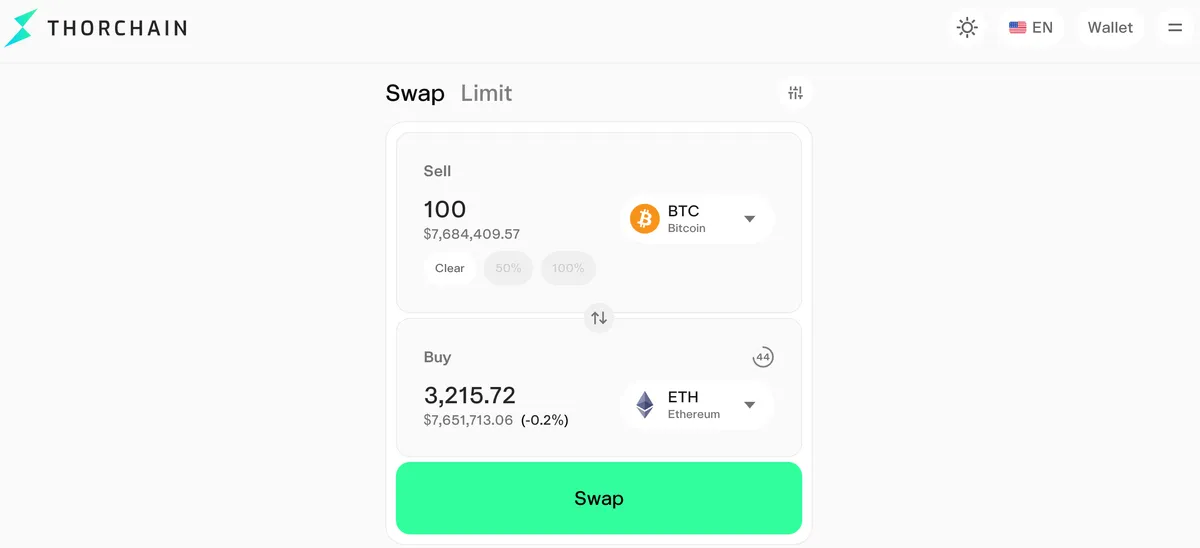
BTC
ETH
The past twelve months have been rough on centralized venues, with major exchanges such as BitMart and BitMEX announcing shutdowns of their operations. Additionally, regulation has added further pressure, with MiCA leaving many exchanges, such as Binance, unable to serve certain EU residents.
None of these events is catastrophic in isolation, and exchanges that wind down or can no longer serve their user base usually process withdrawals. But some don’t, and the ones that do often leave users spending weeks in a queue with no certainty about the outcome, and even worse, sometimes asking them to provide additional documents before accessing their funds. And that’s when “not your keys, not your coins” takes on its full meaning, the moment users realize that having a non-custodial solution shouldn’t be an option but a baseline requirement.
This context makes it a reasonable time to revisit decentralized alternatives that cover the same daily operations a CEX offers. And for those who were there in 2021 and judged the experience as poor across most DeFi protocols, a complete revisit is definitely needed. In five years, for the ones that survived, significant progress has been made, and judging them based on 2021 memories no longer tells you much.
THORChain is one of the clearest case studies. In 2021, it was barely usable in practice because only a few chains were connected, support was limited to their main tokens, and slippage was high. But the protocol has matured, and in Q1 2026 it processed $2.82 billion in swap volume, generating $3.3 million in fees. What follows is a refresher on what the protocol actually is, and a walkthrough of the changes that got it there, demonstrating that some of the “OG” DeFi projects have actually found their market.
What THORChain actually is
THORChain launched in 2021 as its own blockchain with the primary purpose of being a crosschain decentralized exchange (DEX). For the first time in crypto history, users could swap native assets across chains in a fully permissionless manner. For example, a user can swap Bitcoin directly from their Bitcoin wallet and receive Ethereum in their EVM wallet, all without relying on a centralized entity or wrapped assets.
That design choice matters for three reasons. First, there’s no account to freeze. Users keep custody in their own wallets at all times, except during the swap itself, when funds briefly transit through vaults collectively secured by the node set, whose nodes don’t censor transactions. Second, no wrapped asset can trade away from the value of its underlying collateral, as can happen with IOUs, because nothing is wrapped. Third, there is no smart contract bridge securing a pool of locked assets, a structure that is usually vulnerable to hacks.
Mechanically, THORChain can be considered an AMM. Every pool pairs an asset against RUNE, making RUNE the settlement asset for both legs of any cross-chain swap: BTC into RUNE, then RUNE into ETH, all within a single transaction. Fees are paid in RUNE too. However, this all happens in the background, and users don’t need to own RUNE to swap on THORChain or ever know RUNE exists. Beyond the liquidity pools, RUNE also plays a central role in network security, with nodes bonding RUNE to secure the network.
And because THORChain operates as its own blockchain rather than as a set of smart contracts deployed on someone else’s chain, every transaction settles transparently onchain and smart contracts/applications can also be built on top of the network (with the nodes’ permission).
THORChain Features
Chain expansion: covering what the rest of DeFi can't reach
In late 2021, THORChain natively supported six chains. Today, that number has grown to fourteen: Bitcoin, Ethereum, XRP Ledger, Tron, Solana, Monero, Zcash, Base, BNB Smart Chain, Dogecoin, Bitcoin Cash, Litecoin, Avalanche, and Cosmos Hub.
Beyond simply adding new chains, the strategy is clear and deliberate: provide decentralized interoperability to asset holders who currently have very limited options. THORChain is not chasing the easier EVM integrations commonly seen across bridges. Instead, it has prioritized ecosystems where native cross-chain liquidity is scarce.
That is why Monero and Zcash have been key priorities in recent months. As Monero continues to be delisted from centralized exchanges and remains inaccessible through DEXs, THORChain will become the first DEX to support native XMR trading.
As for the next integrations, Dash is expected to follow soon after, further cementing THORChain’s role as the main privacy DEX. Bittensor (TAO) should come next, a token with no native DEX liquidity today, making it another asset where THORChain can fill a clear market gap.
Swap execution: moving size without paying for it
Back in 2021, slippage was one of the main criticisms of THORChain, with price impact sometimes reaching 10% to 20%, especially when moving larger amounts. This is certainly one of the areas where THORChain has improved the most over time.
The main innovation, Streaming Swaps, launched in summer 2023 and did much of the work. Rather than hitting the pool once, a large order is split into a series of smaller sub-swaps executed across multiple blocks.
As the market matured and new designs such as solvers, intents, and CLOBs emerged, THORChain had to improve execution efficiency to compete. Limit Swaps and Rapid Swaps are two major innovations in that direction. The first lets users set a target price and execute the trade once the pool reaches the desired price. The second allows flows moving in opposite directions to be matched, helping users save on fees and settlement time.
On top of that, Memoless Transactions significantly improved the swap interaction model while also enhancing security. By abstracting away the memo previously required in a transaction, THORChain lets users specify their intent, receive transaction instructions, send funds to a vault, and receive the desired asset in another wallet. The key benefit is that users can swap from any wallet without connecting it directly, which is particularly convenient when using cold wallets.
The combined result is a protocol that routinely settles swaps in the millions with slippage around 0.2%, competitive with any major CEX. This has made THORChain the world's largest Bitcoin DEX by volume.
Rujira: the native DeFi Layer
In 2021, native DeFi infrastructure was still immature, and THORChain experimented with THORFi, bringing lending and yield products directly into the base protocol. Unfortunately, the model ultimately created too much balance sheet exposure, leading THORFi to be sunset in early 2025 and affected users to receive TCY, a claim on 10% of protocol revenue. The approach echoes Bitfinex’s response to its 2016 hack, when creditor tokens were later redeemed in full using subsequent cash flows. THORChain has since moved toward a more modular model.
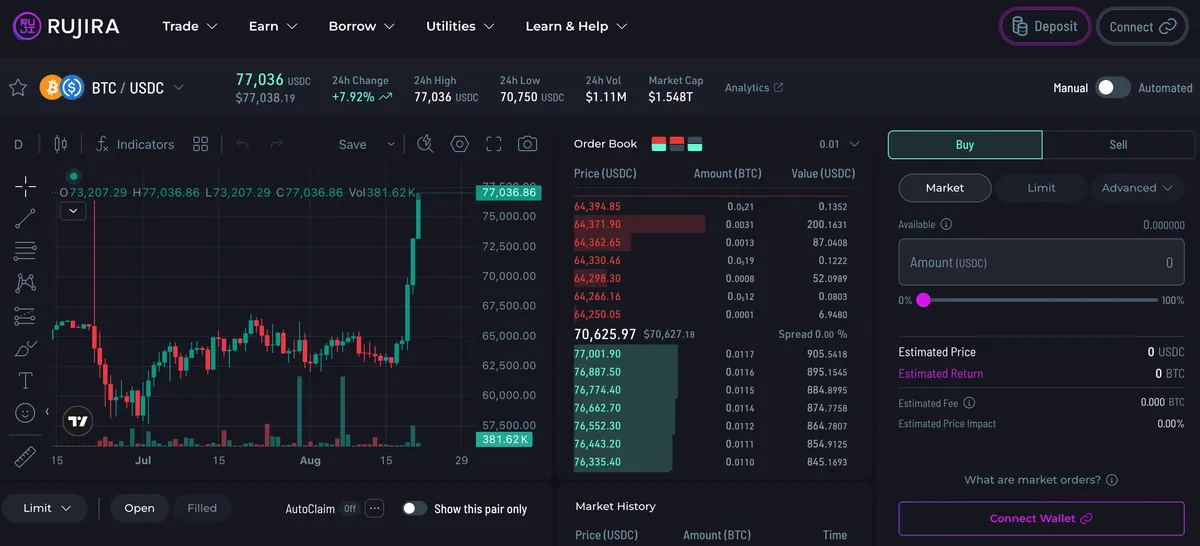
In late 2024, the Kujira team, best known for products such as FIN and ORCA, brought its DeFi expertise and product stack into the THORChain ecosystem through a merger that gave birth to Rujira. The Rujira team developed the ability to create smart contracts on THORChain, which is colloquially called the app-layer. The first products launched in May 2025, with spot and perpetuals trading. Since then, the platform has continued to evolve with lending, concentrated liquidity, and automated strategies such as DCA. Capitalizing on past lessons, the rollout has been deliberately progressive, particularly when it comes to the size and exposure of each feature, with caps being increased gradually over time.
The key difference versus THORFi is architectural. Rujira sits above THORChain’s consensus layer rather than being embedded directly into the base protocol, meaning the risks associated with individual applications are isolated from THORChain itself. Just like the risk with smart contracts on Ethereum is isolated from the Ethereum blockchain.
Distribution: the protocol you've probably already used
One of THORChain’s key drivers of success is how easily it can be integrated. Any wallet or exchange can integrate it with minimal code and almost no ongoing maintenance, either through THORChain’s own API or directly. Integrating directly doesn’t require permission, a partnership, or a counterparty relationship.
That is how, in just a few years, Trust Wallet, Ledger, Tangem, Bitget Wallet, SafePal, and OKX Wallet have all gained the ability to route swaps through THORChain. If you have swapped BTC for ETH inside a wallet interface over the past few years, there is a good chance you may have used THORChain without even knowing it. The added benefit for integrators is that they can monetize these swaps by charging affiliate fees. The numbers have been substantial: Trust Wallet generated around $17 million in just under three years, while Ledger generated roughly $7 million in under two.
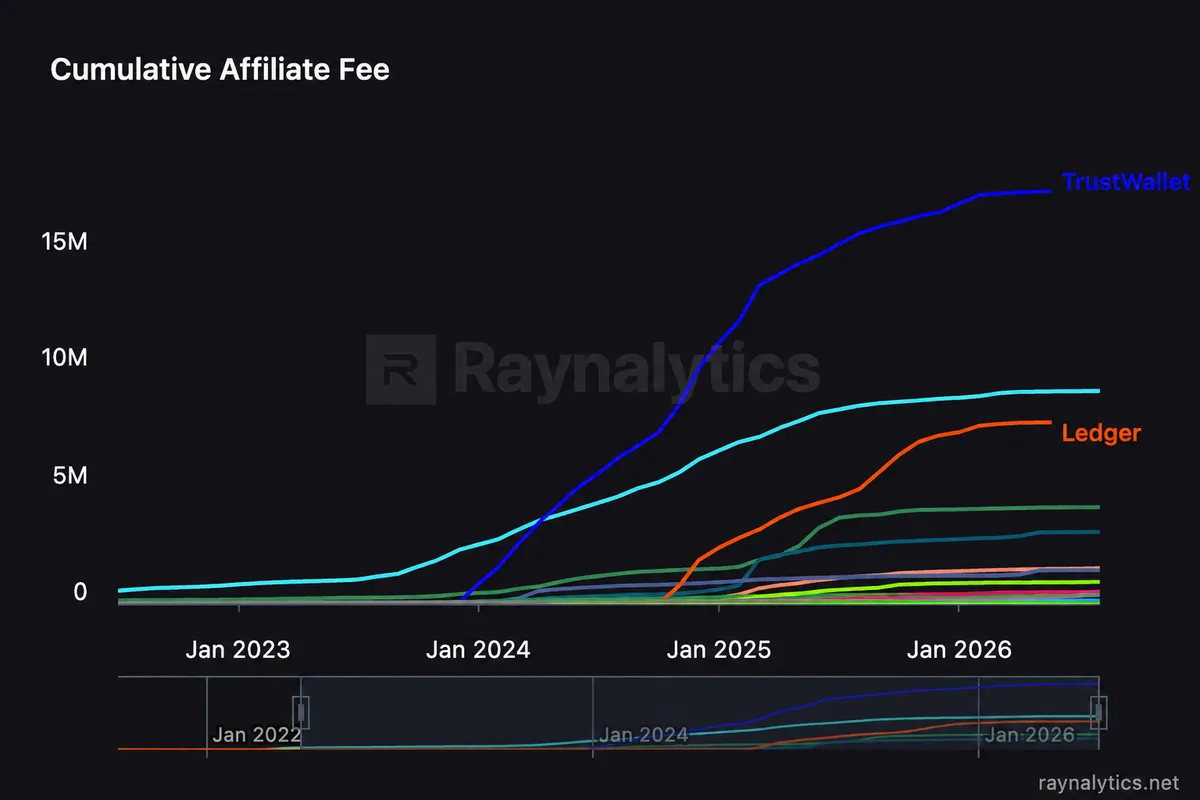
Of course, with wallets charging an additional fee, users may also end up paying a markup on top of the underlying swap cost. To address more cost-sensitive and DeFi-native users, THORChain launched its own frontend swap.thorchain.org in December 2025, where swaps incur only the base protocol fee (and potential slippage) with no additional frontend fee.
Tokenomics: fully sustainable
Like most protocols at launch, THORChain initially relied on block rewards to incentivize nodes and liquidity providers and bootstrap the network. As protocol revenue grew, however, the need for these subsidies steadily declined.
In February 2025, THORChain removed block rewards entirely, meaning the network now relies 100% on revenue generated by real activity: primarily the base fee charged on swaps, alongside a share of activity generated through Rujira. Of those fees, 5% is burned, 5% goes to the dev team, 5% to the marketing fund, 10% to TCY holders, and the remainder is shared between nodes and liquidity providers.
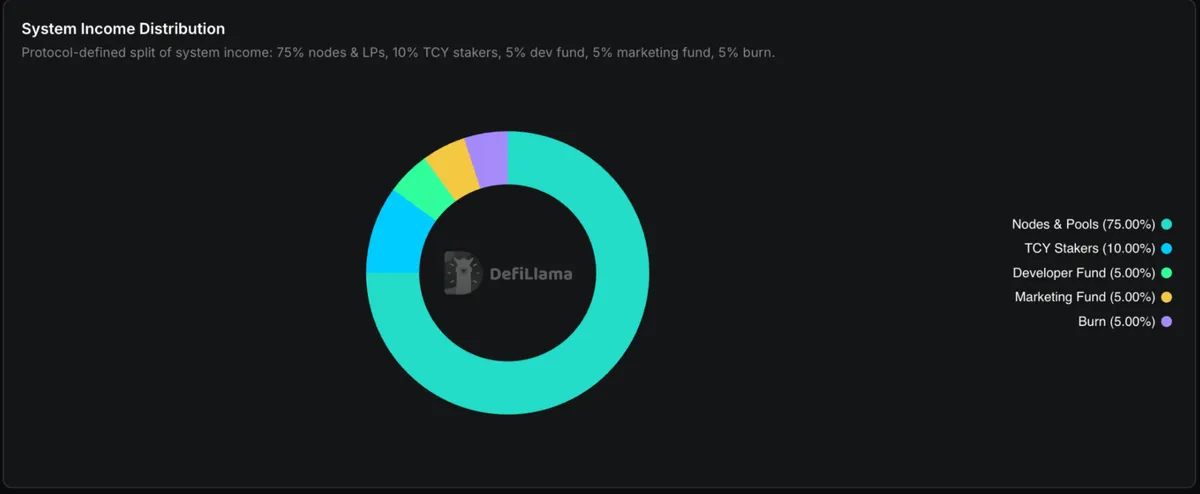
At the same time, several governance decisions reduced RUNE’s total supply to 354 million. Today, all the tokens are circulating, and only around 5% of that supply remains in the reserve, used mainly as a rainy day fund.
The end result is a tokenomics model with limited dilution risk for investors, with real protocol activity driving revenue instead of relying on subsidies.
Worth a revisit
A handful of protocols from the 2021 cycle survived, kept shipping, and quietly turned into functioning businesses while the market stopped paying attention. THORChain is a prime example, deserving the OG moniker.
Five years produced a protocol supporting fourteen chains and counting, trading billions competitively, funding itself entirely through fees with no emissions, offering DeFi features with a CEX-like experience, and reaching users through the wallets they already use, often without them even realizing it.
For those who still dismiss older protocols and blockchains based on their 2021 experience, it’s time to reassess that judgment and take another look at THORChain.