1inch Aqua: Rethinking liquidity provision in DeFi
1inch Aqua launched publicly on July 28, 2026, introducing a shared liquidity architecture that enables liquidity providers (LPs) to make the same wallet balances available across multiple trading strategies without depositing assets into separate pools.
1inch
1INCH
Key Insights
1inch Aqua launched publicly on July 28, 2026, introducing a shared liquidity architecture that enables liquidity providers (LPs) to make the same wallet balances available across multiple trading strategies without depositing assets into separate pools.
LP participation has broadened despite open positions stabilizing. Aqua reached 4,940 open positions and 720 LPs with active positions by October 29, compared with 5,516 positions and 533 participating LPs at the August 12 peak. Cumulative participation reached 2,162 unique wallets, with approximately one-third still maintaining open positions.
Liquidity availability and trading activity vary considerably across chains. Aqua recorded approximately $14.0M in shared liquidity against $6.9M in pullable liquidity. Robinhood Chain accounted for 93% of shared liquidity, while Ethereum generated $70.6M of the protocol's $73.5M in trailing 30-day trading volume, with incentive allocations also differing across chains.
Aqua's early fee generation provides an initial view of LP economics. The protocol generated approximately $161K in gross swap fees through October 29, alongside a 10M 1INCH incentive program supporting early activity. Sustained LP participation, trading demand, and fee generation following the initial reward period will provide a clearer picture of the model's longer-term economics.

Introduction
Decentralized exchanges (DEXs) have traditionally relied on liquidity providers (LPs) depositing assets into individual liquidity pools to facilitate trading. While innovations such as Uniswap V3's concentrated liquidity have improved capital efficiency by allowing LPs to allocate liquidity within specific price ranges, capital remains fragmented across pools, trading pairs, and protocols. LPs seeking exposure to multiple strategies must generally divide their assets across separate positions, limiting the ability to utilize the same capital elsewhere.
To address these limitations, 1inch publicly launched Aqua on July 28, 2026, following its initial developer release in November 2025. Aqua introduces a shared liquidity architecture that allows LPs to make the same underlying wallet balances available across multiple positions without depositing assets into separate pools. Rather than transferring custody to individual pool contracts, Aqua uses virtual accounting to track liquidity allocations, with assets remaining in the provider's wallet until a swap is executed.
By allowing LPs to use the same capital across multiple positions, Aqua offers an alternative to traditional pool-based liquidity provision. Its success, however, will depend on whether the model can attract sustained liquidity and trading activity while generating competitive returns for LPs.

Aqua overview & architecture
Shared liquidity architecture
At the core of Aqua's architecture is a virtual balance accounting system that tracks how much liquidity an LP makes available to each position. Unlike traditional AMMs, where liquidity is held in individual pool contracts, Aqua maintains an onchain registry of virtual balances associated with each LP, position, and token. These balances represent the liquidity available to a position rather than assets deposited into a contract.
For example, an LP holding $100,000 in USDC could make that balance available to three separate liquidity positions that each include USDC. In a traditional AMM, the LP would need to divide the capital among separate pools. Under Aqua, all three positions can reference the same USDC balance without requiring additional deposits.
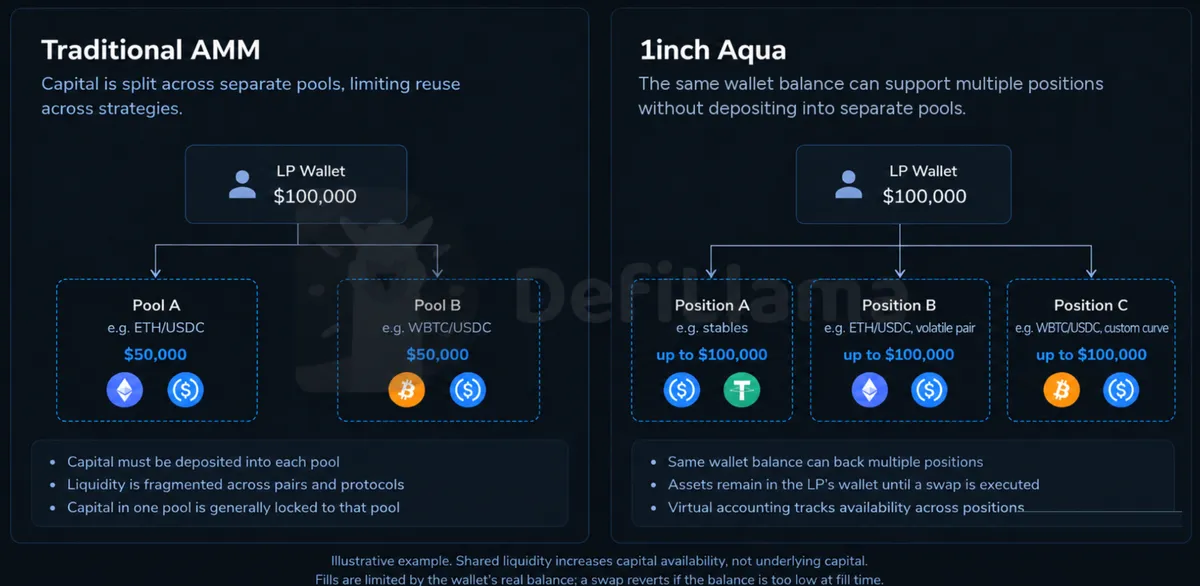
Importantly, this does not create additional capital or allow multiple positions to independently spend the same assets. Each swap draws from the LP's actual wallet balance, subject to the revocable token allowance granted by the LP. If the wallet lacks sufficient funds to settle a trade, the transaction reverts.
This lets each position quote liquidity against the same balance without increasing the capital behind it. 1inch describes this through its Shared Liquidity Ratio, which measures liquidity made available across positions relative to the wallet equity backing them, rather than financial leverage or exposure.
Liquidity provision and execution
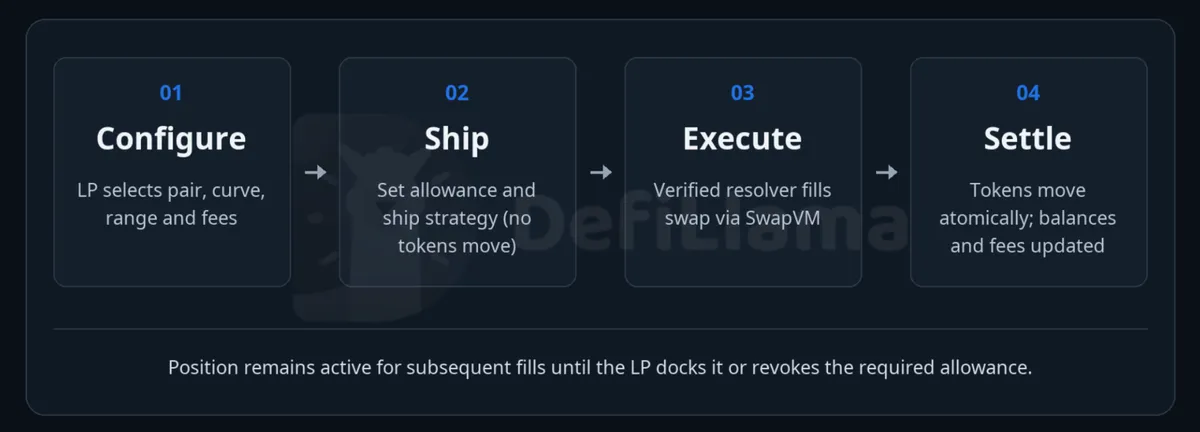
Providing liquidity through Aqua begins with an LP configuring a position, including its token pair, pricing curve, trading range, and swap fee. Once configured, the LP grants a revocable token allowance, set per token and per chain, and registers the position through Aqua's ship() function. This allocates virtual balances up to the approved amount and makes the position available for execution without transferring any tokens. Each position is identified onchain by a unique hash.
When a taker executes a swap, Aqua relies on two core functions: pull() and push(). The former transfers outgoing tokens directly from the LP's wallet to the taker and reduces the position’s virtual balance. The latter transfers incoming tokens to the LP's wallet and increases its virtual balance, allowing received assets and fees to support subsequent trades. Both operations occur atomically, meaning the swap either settles in full or reverts. If the LP's wallet balance is insufficient, the swap cannot execute until sufficient liquidity becomes available.
At launch, swaps through the 1inch dApp are filled by verified 1inch Resolvers, which are market makers that meet the network's verification requirements. Resolver eligibility is enforced through an onchain access check at execution, while liquidity provision remains permissionless.
Swap execution is handled by SwapVM, Aqua's programmable execution engine, which processes each position’s pricing instructions and determines the amounts exchanged. This separates pricing logic from liquidity accounting, allowing different strategies to operate through the same infrastructure.
Positions are immutable once registered. To modify a position, the LP must close it using dock(), which clears its virtual balances without transferring tokens, and register a new position’s with updated parameters. Until then, the position remains available for subsequent fills, provided sufficient wallet balances and allowances remain.
Market participants and order flow
Aqua's market structure differs from that of conventional DEXs, where users typically trade directly against liquidity pools. Makers (LPs) quote liquidity from their own wallets, while 1inch Pathfinder discovers that liquidity offchain and incorporates it into its routing process. Verified 1inch Resolvers, consisting of professional market makers and arbitrage traders, execute swaps when pricing conditions are favorable.
While liquidity provision is permissionless, positions created through the 1inch app are restricted to approved counterparties at launch. This is enforced through an onchain access check, allowing Aqua to function as a liquidity source within 1inch's broader routing infrastructure rather than solely as a standalone trading venue.
This structure is important when evaluating adoption. Unique taker addresses primarily reflect resolver participation rather than individual retail traders, while the underlying end-user demand behind routed swaps is not directly identifiable from Aqua's taker addresses alone. Trading volume may also be influenced by incentive-driven activity, making it difficult to assess organic demand from headline figures. LP participation, active positions, liquidity availability, and fee generation therefore provide more useful starting points for assessing Aqua's early adoption.
Early adoption & liquidity
LP Adoption and Position Growth
Aqua saw rapid adoption following its public launch, with open positions climbing from 947 on July 28 to a peak of 5,516 by August 12. Positions subsequently declined to 4,410 on September 4 before recovering, remaining between roughly 4,400 and 5,000 since August 20. By October 29, Aqua recorded 4,940 open positions, approximately 10% below its August peak. Over the same period, the number of LPs with open positions increased from 533 to 720, reducing the average number of positions per participating LP from 10.3 to 6.9. While the number of positions has largely stabilized, LP participation has broadened, though it has eased slightly from its October 11 peak of 754.
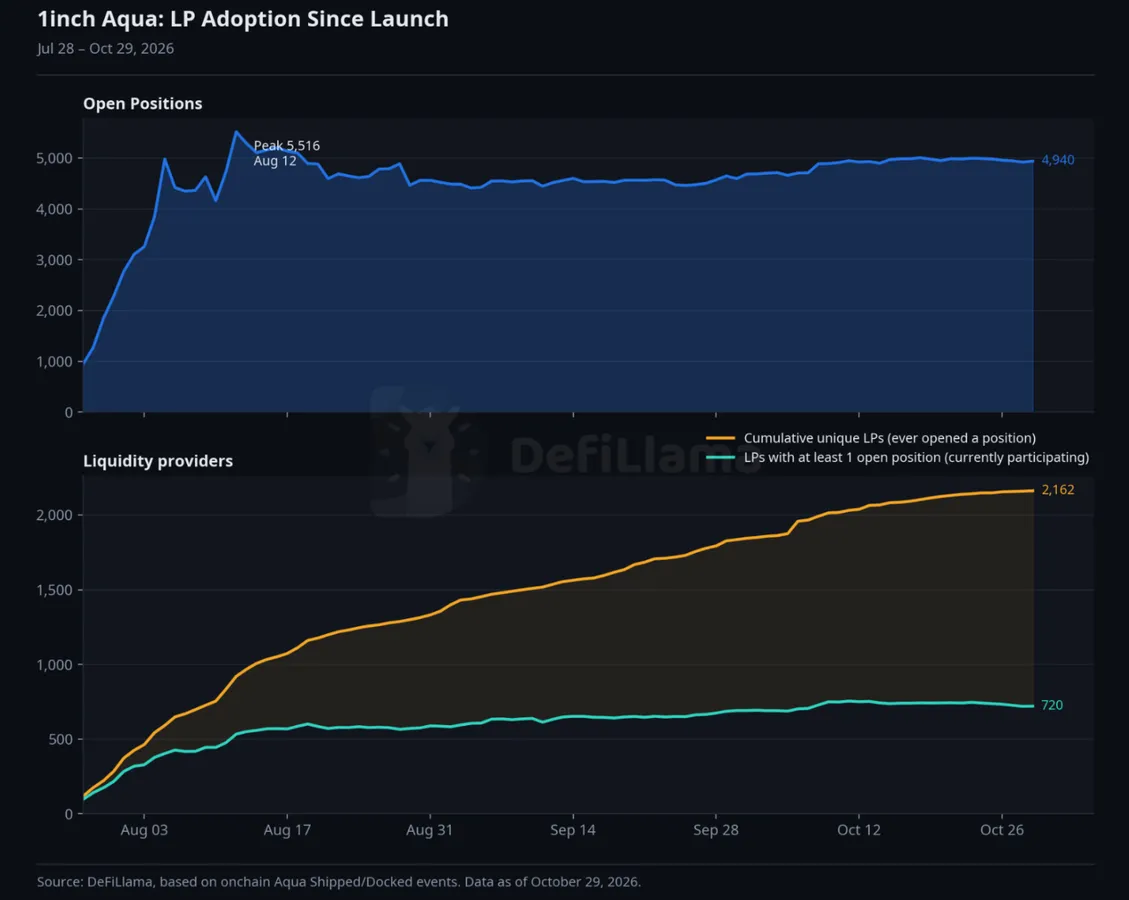
The gap between cumulative and current participation adds another dimension to Aqua's early adoption. A total of 2,162 unique wallets have opened positions since launch, with 720 still maintaining at least one. Among wallets that first participated during the initial launch period through August 4, approximately 39% continue to hold open positions. While these figures suggest considerable turnover, they measure wallet-level participation rather than unique individuals or institutions.
A small number of wallets also maintain a disproportionately large number of positions. The ten largest account for approximately 41% of open positions, with the largest holding 762 positions alone. This concentration reflects the distribution of open positions rather than the underlying capital allocated to them.
Liquidity distribution across chains
Aqua's multichain deployment has produced distinct patterns in liquidity provision and trading activity. The 1inch Aqua Dune dashboard shows Robinhood Chain holding approximately $13.1M in shared liquidity as of October 29, representing 93.2% of the total, despite having only 109 LPs with open positions. Ethereum, meanwhile, had a considerably broader LP base of 453 wallets but accounted for $839K in shared liquidity.
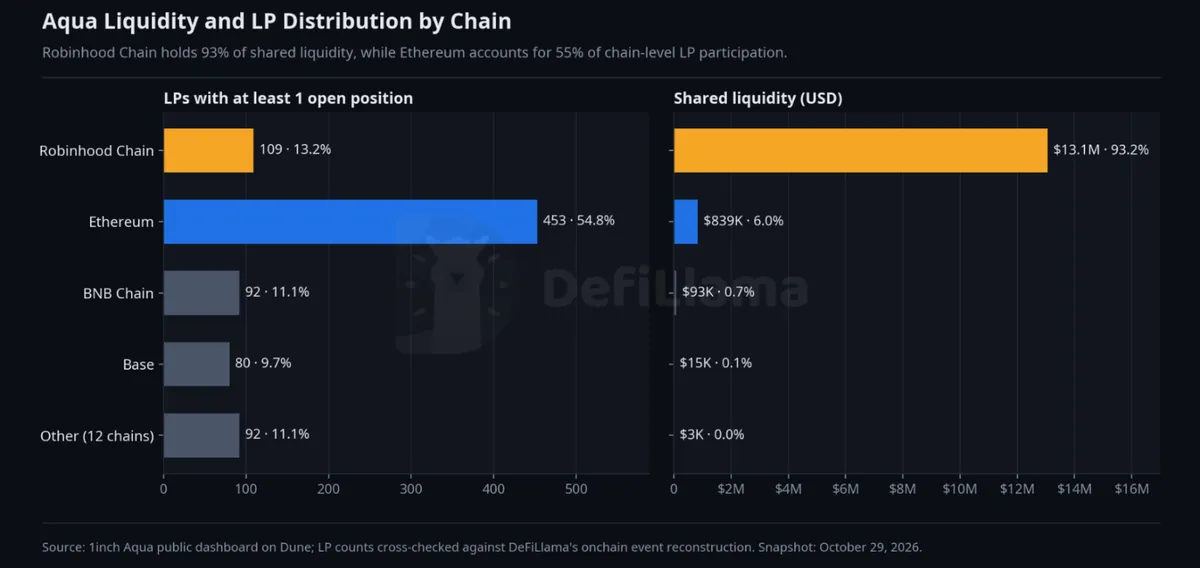
On average, Robinhood LPs maintained approximately $120K in shared liquidity per wallet, compared with $1.9K on Ethereum. While these averages may be influenced by larger individual providers, they are consistent with more substantial liquidity allocations among Robinhood's smaller LP base. The difference remains significant when considering pullable liquidity, which accounts for available wallet balances and allowances, with Robinhood holding approximately $6.1M compared with Ethereum's $689K.
Trading activity follows a different pattern. Over the trailing 30 days, Ethereum generated $70.6M in Aqua trading volume, compared with $2.7M on Robinhood Chain, based on DefiLlama's volume data. This highlights two different patterns of early adoption: Robinhood has attracted substantially more shared liquidity across a smaller group of LPs, while Ethereum has developed a broader LP base alongside greater trading activity.
Differences in available trading pairs, resolver activity, and demand across chains may help explain this divergence. As Aqua's integrations and order flow develop, the relationship between liquidity availability and trading activity will be an important indicator of how effectively the protocol's shared liquidity model is being used.
Methodology note: July 28 starting totals include pre-launch activity dating back to July 19. LP counts represent wallet addresses rather than unique individuals. DefiLlama's volume and fee figures measure net wallet-level flows per transaction, while the 1inch Aqua public Dune dashboard sums gross fills across all positions. This difference in methodology helps explain the substantial discrepancy between the two sources' reported trading volumes.
Capital efficiency and LP economics
Capital availability and utilization
As of October 29, the 1inch Aqua Dune dashboard recorded approximately $14.0M in shared liquidity against $6.9M in pullable liquidity. The roughly twofold difference shows how positions can collectively quote more liquidity than is immediately available for execution, without requiring an equivalent increase in underlying capital. This differs from Aqua's Shared Liquidity Ratio, which compares position-level liquidity with the wallet equity backing it.
The relationship between liquidity availability and trading activity varies considerably across chains. Robinhood Chain accounted for approximately 93% of shared liquidity, while Ethereum generated $70.6M of Aqua's roughly $73.5M in trailing 30-day volume. Incentive allocations also differed significantly: according to 1inch's announcement, the direct volume rewards budget allocated approximately 96% to Ethereum markets and 3% to Robinhood Chain, with the remaining 1% allocated to BNB Chain markets.
These differences illustrate an important aspect of Aqua's model. Making liquidity available across more positions expands the markets an LP can serve, but trading opportunities ultimately depend on demand, competitive pricing, and access to order flow. The shared liquidity architecture broadens where capital can be quoted; actual execution determines how economically useful that flexibility becomes.
LP economics
Between July 19, when DefiLlama began tracking Aqua, and October 29, the protocol generated approximately $160,945 in gross swap fees. Of that amount, roughly $31.7K was allocated to the 1inch DAO, leaving approximately $129.2K attributable to LPs before accounting for incentives, costs, or trading-related losses.
This distinction matters because fees are earned when swaps execute, not simply by maintaining larger quoted positions. An LP offering less liquidity but consistently attracting order flow may therefore earn more in fees than a larger provider whose positions rarely fill.
Aqua's initial 10M 1INCH incentive program included 5M in direct volume rewards, with another 5M reserved for partner co-incentives announced separately. The direct rewards provided an additional source of compensation alongside swap fees, with distributions linked to eligible trading volume rather than the amount of liquidity quoted.
For LPs, the economics ultimately depend on the combination of swap fees, incentive rewards, execution frequency, pricing competitiveness, and market exposure. Aqua provides the flexibility to pursue multiple trading opportunities using the same capital, while the returns from doing so depend on how effectively those positions attract and execute order flow.
Interactive Chart — What would your capital earn on Aqua?
Pick your fee regime and see how much of the yield comes from swap fees and how much from rewards.
Built with LlamaAI's generative UI, this model starts from Aqua's real daily fees and volume through November 16, using the last 7 days, the last 30 days, the average since launch, and the best and weakest 30-day windows observed. You set your capital, which liquidity base you share it with, how much the 1INCH price moves, and how much of the 5M 1INCH direct rewards you capture. The chart sweeps volume from −90% to +200% and shows yield with and without rewards, so you can see how much of the return depends on the incentive program.
Capital, reward share, and reward period are illustrative assumptions, and fees are modeled pro rata to your liquidity share. Liquidity bases come from the report's Dune dashboard (Oct 29), and are not to be interpreted as forecasts.
Looking ahead
Aqua's first three months have shown early interest in shared liquidity provision, with participation across multiple chains and 720 LPs holding open positions as of October 29, up from 533 at the August 12 peak. Because Aqua launched alongside a three-month reward program, the period that follows will offer a clearer picture of how participation and trading activity develop with fewer incentives. LP retention, continued fee generation, and the growth of order flow from sources beyond 1inch's own routing will be particularly important to follow.
Beyond incentives, Aqua's development will depend on how widely its liquidity is integrated and used. Expanding the range of supported positions, trading pairs, and execution counterparties could create more opportunities for LPs to attract order flow. The relationship between shared and pullable liquidity will also be worth monitoring, particularly as activity develops across chains with different liquidity profiles. Greater visibility into historical liquidity balances would help assess these trends alongside trading activity.
Aqua represents a different approach to liquidity provision, placing greater emphasis on how existing capital is allocated rather than how much capital is deposited. Its longer-term significance will depend on whether this flexibility translates into sustained participation, consistent trading demand, and competitive economics for liquidity providers.